
최근 글 목록
-
- kary mullis
- olfactory
- 2008
-
- Scent of strawberry
- olfactory
- 2008
-
- ACDLABS 11.0
- olfactory
- 2008
-
- Scent of Strawberry
- olfactory
- 2008
-
- The Good Scents Company
- olfactory
- 2008
Smelling in Color: A Rainbow of Possibilities
A sensor that detects odors better than the human nose may be able to smell dangerous air pollutants, soil contaminants, insecticides, food pathogens, biological warfare neurotoxins, and body odors associated with illness and disease. At the University of Illinois at Urbana-Champaign, chemistry professor Kenneth S. Suslick and graduate student Neal A. Rakow have spent four years developing a sensor that sniffs out odors by "seeing" them. Called "smell-seeing" by its inventors, the method relies on color changes that occur in an array of vapor-sensitive dyes in response to exposure. This newest version of an artificial nose is simple, fast, and inexpensive.
Smell-Seeing
The new technology uses materials and concepts that have been available for at least 50 years. It's basically as simple as using litmus paper to see if a solution is acidic or basic by observing whether the paper changes color. In smell-seeing, the dyes are vapor-sensitive metalloporphyrins that are closely related to hemoglobin, which transports oxygen in blood, and chlorophyll, the green pigment in plants. When the metalloporphyrins come in contact with vapors containing chemical groups common to environmental contaminants, they change color. By measuring the color change pattern, the researchers can identify a contaminant both qualitatively and quantitatively.
The structure of a metalloporphyrin consists of large rings with loosely held electrons arranged around a metal ion in the center. Anything that perturbs the loosely held electrons and moves them produces a color change. A common example is the difference in color between bright red arterial blood and darker venous blood. "That's the result of oxygen binding to hemoglobin, an iron porphyrin," explains Suslick.
The researchers pursued the idea of seeing smells after observing that many of the most toxic--and foul-smelling--compounds readily bind metals. Although little is known about the structures of the olfactory receptor proteins in the human nose, Suslick and Rakow speculated that many of the nose's sensors are likely to contain metal ions at their active sites. Their smell-seeing technology somewhat mimics the physiology of the nose because "the olfactory system is based on a combination, or array, of receptor proteins that gives you a net response," says Rakow. He adds that within the nose there are probably specialized receptors that respond to and warn about chemicals that are toxic and harmful to the human body, similar to the device he and Suslick are developing.
Proof of Concept
To create an array, the researchers paint a series of tiny dots, each containing a different metalloporphyrin, on an inert backing such as silica gel. The array is scanned with an ordinary flatbed scanner or an inexpensive digital camera before and after exposure to chemical vapors. "By subtracting the 'before' image from the 'after' image, we obtain the color change pattern of the odorant," says Suslick. By comparing that pattern to a library of color fingerprints, the researchers can quickly identify and quantify the chemical compounds present. To the best of their knowledge, this is the first time that a color-based array has been used to visually detect a wide range of vaporized chemicals.

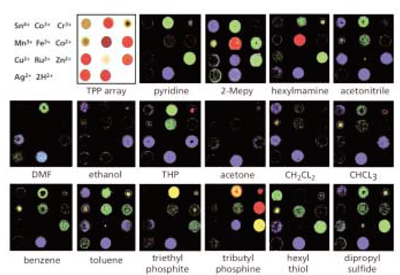
Color tells a story. Arrays consist of series of tiny dots containing different metalloporphyrins that produce unique color change patterns upon exposure to chemical vapors. Researchers are building a library of color "fingerprints" for various chemicals.
Photo credit: K. S. Suslick, N. A. Rakow
In the 17 August 2000 issue of Nature, Suslick and Rakow describe making an array of 10 metalloporphyrin dye complexes by combining 5,10,15,20-tetraphenylporphyrin with 10 metals including iron, copper, manganese, and cobalt. Then the metalloporphyrin dyes were spotted onto reverse phase silica thin-layer-chromatography plates. The metalloporphyrin array was then exposed to chemical vapors specifically chosen to represent a wide range of functional chemical groups commonly found in environmental pollutants. The functional chemical groups included amines, alcohols, arenes, ethers, phosphines, thioethers, thiols, and ketones. Within 30 seconds to 5 minutes after exposure, unique color fingerprints were obtained at exposure concentrations ranging from 2 parts per million to 100 parts per billion. In contrast, the human nose is generally sensitive to most compounds at a concentration of a few parts per million. "The sensitivity of our artificial nose is 10 to 100 times better than that [of the human nose] for many compounds," says Suslick.
Each functional chemical group is easily distinguished from the others, and family resemblances occur among chemically similar species, such as pyridine and n-hexylamine. Smell-seeing also detects more than volatile organic compounds. Permanent gases such as carbon monoxide, phosphine, hydrogen sulfide, and airborne ammonia are detected by the metalloporphyrins as well. In addition to identifying single chemical compounds, the metalloporphyrin array is proving a good way to identify mixtures of vapors. Color change patterns for mixtures containing 2-4 components are distinctly different from those for single compounds. For complex mixtures, it is often sufficient to recognize a fingerprint pattern rather than the makeup of individual components. For example, perfume manufacturers may detect counterfeit products by measuring the unique fingerprints of legitimate products. "We can generate unique color fingerprints and compare them without knowing the hundreds of components in the perfume," says Suslick.
The ability to attach chemical substituents--for instance, phenyl groups-- to porphyrins, then combine them with metals, means that an infinite number of metalloporphyrin dyes are theoretically available to cover a broad range of environmental chemicals. However, in practice Suslick believes that an array containing 25-36 different metalloporphyrins is probably sufficient to cover any foreseeable future use.
Advantages of Seeing Smells
Metalloporphyrin arrays eliminate the subjectivity associated with smell and odors. "One person may think an odor is terrible, and another may think it's not so bad," says Suslick. Smell-seeing is an excellent way to quantitatively compare aromas and measure the actual amounts of smell compounds. For instance, people living downwind of a hog farm could measure the quantity of each smell compound and monitor an acceptable level of air quality. Or smell-seeing could sniff out insecticides near farmland, bacteria causing infections in hospitals, spoilage in the food industry, or dangerous chemicals such as benzene in the workplace. The Illinois team is working on establishing sensitivities for all chemicals monitored by the Occupational Safety and Health Administration through metalloporphyrin arrays and smell-seeing.
The smell-seeing approach differs from several other commercial and experimental designs for artificial noses, which largely rely on polymers that swell when they come in contact with a vaporized chemical. When polymers swell, they trigger a measurable response such as a change in electrical conductivity, or cause a dye to fluoresce in a probe molecule. However, all systems that use polymer swelling suffer from the caveat that ambient water vapor and humidity change the sensitivity of the system, says Rakow. Because they're polar, polymers preferentially absorb water vapor more than they do the many organic chemicals they're intended to detect. Consequently, small changes in ambient humidity distort the reliability of polymer-based systems. "Unfortunately, relative humidity is one thing in the environment that changes most dramatically," says Suslick.

Drawing a picture of scent. The smell-seeing rig (above) uses nitrogen gas to create saturated chemical vapors to which metalloporphyrin arrays are exposed. Scanning and comparing "before" and "after" images yields a unique color change pattern for each chemical, which can be compared to the color fingerprint library for identification. A new "smell camera" (right) is an affordable way to quickly detect chemicals in the field.
Photo credit: K. S. Suslick, N. A. Rakow
In contrast, metalloporphyrin dyes used in the smell-seeing approach are mounted on reverse phase silica gel plates, which provide a hydrophobic surface that greatly reduces interference from water vapor. For instance, as reported in the Nature paper, a color fingerprint obtained from exposing an array to n-hexylamine vapor was identical to one from an array spiked heavily with water vapor.
The ability to easily detect chemicals in the presence of large amounts of water vapor also makes the smell-seeing method more sensitive for trace levels of odors and more specific for many different odors than polymer-based systems. The metalloporphyrins form reversible chemical bonds when they come in contact with chemical vapors. This is a much stronger interaction than the simple adsorption that occurs between polymers and vapors. "In principle and in practice, [this system has] greater sensitivity and specificity because of the discrete nature of the bonding that adsorption onto polymers does not permit," says Suslick.
A sensor based on the smell-seeing technique may be available by September 2001. A company called ChemSensing, Inc., is being set up in Champaign to develop and market a smell-seeing device. The first commercial product will be called a "smell camera" and will incorporate an inexpensive digital camera to measure colorimetric changes to detect chemicals like those described in the Nature paper. "The beauty of using dyes," says Rakow, "is that you only need a simple imaging device, so a digital camera could be interfaced with a PalmPilot." The goal is to make the product affordable--about $1,000 per unit. Still to be determined is the best way to manufacture the array of metalloporphyrin dyes. "We want to rapidly and uniformly put down the pattern of spots so when the color changes, it pops out at you and you can see it," says Suslick. One method being tested is ink-jet printing technology, used by companies that make DNA arrays.
Carol Potera
Suggested ReadingRakow NA, Suslick KS. A colorimetric sensor array for odour visualization. Nature 406(6797):710-713 (2000). Bhyrappa P, Vaijayanthimala G, Suslick KS. Shape-selective ligation to dendrimer-metalloporphyrins. J Am Chem Soc 121:262-263 (1999). Suslick KS, Rakow NA, Kosal ME, Chou JH. The materials chemistry of porphyrins and metalloporphyrins. J Porphyrins Phthalocyanines 4(4):407-413 (2000). |
|
|||||
| - Full (PDF) - Related EHP Articles - PubMed:Related Articles - PubMed:Citation - Cited in PMC - Purchase This Issue |
|||||
|


최근 댓글 목록