최근 글 목록
-
- Mi havas morgauxon
- ...-5
- 2006
-
- Gravaj Informoj pri Komuna...
- ...-5
- 2005
-
- 2005년 한,중,일 청년세미나...
- ...-5
- 2005
-
- 에스페란토 인사말!
- ...-5
- 2005
-
- 에스페란토 상징 '녹색별'
- ...-5
- 2005
8개의 게시물을 찾았습니다.
sur kajo fervoja mi ofte vidis sxin
la blua plisjupo ho ve delogis min
sxi venos tre baldaux sxi venos tre baldaux
atendis mi vane sen revid.


| 2005년 한,중,일 청년세미나(Komuna Seminario) |
|
Saluton. Kotizo:4500enoj
|

쌀루톤(의미:안녕하세요!)~ 이라고 말하면 된다.
역시나 소리는 부드럽게 굴려주세요~~
따라해봅시다~ 쌀루톤~

녹색의 별(발음:베르다 스텔로)
녹색(verda:형)은 평화를
별(stelo)은 희망을 표시한다
그래서...
에스페란티스토(esperantisto : 에스페란토를 사용하는 사람을 지칭)들은
녹색만보면 무지 조아라한다.
특히,,, 에스페란티스토들의 행사에 녹색으로 된 의상을 입어주는
센쓰를 발휘한다면 더할나위없이 주목받을꺼당! <-요건 믿거나 말거나...
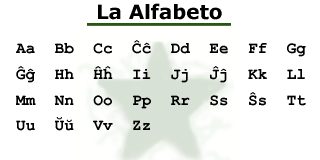
아 / 보 / 쬬 / 쵸 / 도 / 에 / 포 / 고
조 / 호 / 쿄 / 이 / 요 / 죠 / 코 / 로
모 / 노 / 오 / 포 / 로 / 쏘 / 쇼 / 토
우 / 워 / 보 / 죠
*몇개의 음은 '^'(=삿갓)을 사용해서 표현합니다.
*일반적으로는 '^'과 함께 'x' , 'h'를 사용해서 '^'을 발음을 나타내기도 합니다.
*발음은 가능한 부드럽게 내도록 합시다!
Esperanto is a language designed to facilitate communication between people of different lands and cultures. It was first published in 1887 by Dr. L. L. Zamenhof (1859-1917) under the pseudonym "Dr. Esperanto", meaning "one who hopes", and this is the name that stuck as the name of the language itself.
Esperanto is considerably easier to learn than national languages, since its design is far simpler and more regular. Also, unlike national languages, Esperanto allows communication on an equal footing between people, with neither having the usual cultural advantage favouring a native speaker.
Esperanto's purpose is not to replace any other language, but to supplement them: Esperanto would be used as a neutral language when speaking with someone who doesn't know one's own language. The use of Esperanto would also protect minority languages, which would have a better chance of survival than in a world dominated by a few powerful languages.
For a native English speaker, we may estimate that Esperanto is about five times as easy to learn as Spanish or French, ten times as easy to learn as Russian, twenty times as easy to learn as Arabic or spoken Chinese, and infinitely easier to learn than Japanese. Many people find that they speak Esperanto better after a few months' study than a language they learned at school for several years.
A knowledge of Esperanto makes it much easier to learn other foreign languages, and there is some evidence that it is actually more efficient to learn Esperanto first, before learning other languages, rather than to study foreign languages directly. For example, one may become more fluent in French by first studying Esperanto for 6 months and then studying French for a year and a half, rather than studying French for two continuous years. The reason may be that Esperanto's regular grammar and word formation and flexible syntax makes it easier to understand other languages' grammar and rules.
About 75 % of Esperanto's vocabulary comes from Latin and Romance languages (especially French), about 20 % comes from Germanic languages (German and English), and the rest comes mainly from Slavic languages (Russian and Polish) and Greek (mostly scientific terms).
The words derived from Romance languages were chosen to be as recognizable as possible throughout the world. For example, the word "radio", although technically Romance, is now used internationally. Someone knowing only Russian and looking at a text in Esperanto would immediately recognize perhaps 40 % of the words, without even having studied the language.
Esperanto is phonetic: every word is pronounced exactly as it is spelled. There are no "silent" letters or exceptions.
Even more than its vocabulary, it is Esperanto's grammar and rules which makes it exceptionally easy. Unnecessary complications have been eliminated: there is no grammatical gender, the word order is relatively free, etc. The rules have also been simplified as much as possible: there is only one verb conjugation, all plurals are formed the same way, a prefix can be added to any word to change it to its opposite (good/bad, rich/poor, right/wrong), and so on. Thus, after perhaps 30 minutes' study, one can conjugate any verb in any tense. This is a tremendous simplification compared to national languages.
Esperanto's flexible word-order allows speakers from different language families to use the structures with which they are most familiar and still speak perfectly intelligible and grammatically correct Esperanto. This also makes Esperanto an excellent translator of such different languages as Chinese, Japanese, Latin, English and French.
This is a very common question, but nobody really knows the answer. The only way to determine accurately the number of people who speak Esperanto would be to conduct a world-wide census, and of course this has never been done.
However, Professor Sidney S. Culbert of the University of Washington, Seattle, USA, has done the most comprehensive survey on language use ever attempted. He has conducted interviews in dozens of countries around the world and tested for "professional proficiency", i.e. much more than just "hello, please, goodbye".
Based on this survey, Prof. Culbert concluded that Esperanto has about two million speakers worldwide. This puts it on a par with "minority" languages such as Lithuanian or Hebrew. More information on this survey is available, partly in Esperanto. Complete results for all languages with more than one million speakers are published in the World Almanac and Book of Facts.
[There's a lot of debate over how many people speak Esperanto. Sometimes there is a tendency to exaggerate the number of Esperanto speakers, or, on the contrary, to minimize it. I've seen numbers ranging from 100 000 to 8 million. Prof. Culbert's estimate has two advantages over any other I've seen:
1. The method is sound. Doing a world-wide survey is the only valid way to estimate the number of Esperanto speakers, but it's so difficult that Prof. Culbert is the only person who has ever attempted to do so, to my knowledge.
2. The study attempted to find out how many people speak all languages, not just Esperanto. We can see whether the results obtained for other languages make sense; if they do, then the result for Esperanto is probably as valid as any other.
In short, Prof. Culbert's estimate that two million people speak Esperanto around the world is the most accurate answer we're likely to get. -- Ed.]
Some parents teach Esperanto (along with the local language) to their children; it is estimated that perhaps a thousand people speak Esperanto as a first language.
Here are some of the many different ways people use Esperanto:
For US residents, the Esperanto League for North America is the best and most reliable source for Esperanto materials. They offer a free basic correspondence course (by snail mail, but see below for an E-mail course), and may be offering a more detailed and advanced paid correspondence course. They have an extensive catalogue of books, including texts, reference, fiction, poetry, cassette tapes and audio CD-ROMs. Their address is:
Esperanto League for North America
Box 1129
El Cerrito CA 94530
USA
tel. 1-800-ESPERANTO (1-800-377-3726) toll-free (USA and Canada) for a free information package
tel. (510) 653-0998
E-mail: elna@esperanto-usa.org
WWW site: http://www.esperanto-usa.org/
Textbooks
A more immediate source of texts, especially for those with access to a university, is your local library. The quality of the books will vary widely, of course, but most of the texts, even the older ones, will provide a reasonable general introduction to the language.
One exception, mentioned here only because it was surplused to many libraries around the USA, is the US Army's Esperanto: The Aggressor Language, which is more of a curiosity than a useful textbook. This book was prepared to make military exercises more realistic by having the opposing forces speak different languages, as would be the case in a real war. The soldiers playing the role of the aggressor were taught Esperanto, hence the strange title. Unfortunately, the book is extremely poor and contains a great many mistakes; in addition, its emphasis is on military terms, not on everyday vocabulary.
The problem with most old texts is that they are... well... old! Their presentations can seem very bland and old-fashioned, and their "cultural" information about the Esperanto community will often be hopelessly out of date. One recent US textbook is Richardson's Esperanto: Learning and Using the International Language. It is available from ELNA and perhaps some libraries.
Another book, Teach Yourself Esperanto by Cresswell and Hartley, is a very useful introduction to the language. The Teach Yourself series can often be found in ordinary bookstores.
Another good, if a bit old-fashioned, textbook, Step by Step in Esperanto by Butler, has recently been reprinted and is available from ELNA. Still another book recommended by more than one participant is Saluton! by Audrey Childs-Mee. This is entirely in Esperanto, with many pictures.
Wells's two-way Esperanto Dictionary is a good choice for beginners. This dictionary is in the same series as Teach Yourself Esperanto and is also often available in ordinary bookstores. For a more thorough treatment, see Butler's one-way Esperanto-English Dictionary, and Benson's one-way Comprehensive English-Esperanto Dictionary.
(Please see the Disclosure about Amazon.com.)
Free E-mail Correspondence Courses
Free Esperanto courses by E-mail are available in several languages. Typically, these have 10 lessons and teach a vocabulary of a few hundred words. The system is the same as for traditional correspondence courses: the instructor sends a lesson; the student does the exercises and sends them back; the instructor corrects the exercises and sends the next lesson.
- In English:
- Free Esperanto Course
Marko Rauhamaa, marko.rauhamaa@iki.fi
- In French:
- Cours gratuit d'esp鲡nto
Ken Caviness, esperanto@southern.edu
- In German:
- Kostenloser Esperanto-Kurs
Steffen Pietsch, kek@esperanto.de
- In Chinese:
- Mianfei Shijieyu Kecheng
ZHONG Qiyao, zhong@accton.com.tw
- In Russian:
- Andrej Ananjin, andreo@esperanto.msk.ru
E-mail courses also exist in other languages.
Macintosh HyperCard Course
Macintosh owners with HyperCard and MacinTalk can take advantage of an introductory HyperCard course on Esperanto. This can be downloaded by FTP.
Classes and Courses
Each summer, San Francisco State University and the University of Hartford (Connecticut) offer a curriculum of Esperanto courses, in which one may participate at beginning, intermediate, or advanced levels. These courses are available for credit or on a non-credit basis. They are widely considered to be one of the best opportunities to learn to speak Esperanto "like a native", and draw students and faculty from around the world.
- San Francisco State University:
- Ellen M. Eddy
11736 Scott Creek Dr SW
Olympia WA 98512
USA
tel. (360) 754-4563
E-mail: eddyellen@aol.com
information at http://www.best.com/~donh/Esperanto/sfsu/
- University of Hartford:
- tel. (800) 234-4412 or (860) 768-4978
Other institutions offering Esperanto courses on a regular basis include:
- In France:
- Chⴥau Gr鳩llon, 49105 Baug鬠tel. 02 41 89 10 34
La Kvinpetalo, rue de Lavoir, 86410 Bouresse, tel. 05 49 42 80 74
- In Poland:
- Dr. Ilona Koutny, Linguistics Institute, Adam Mickiewicz University, ul. Miedzychodzka 3-5, 60-371 Poznan, tel. 61 861-85-72
E-mail: ikoutny@main.amu.edu.plJagiellonian University, Krakow. Contact: Maria Majerczak, ul. Armii krajovej 7 M, PL-30-150 Krakow, tel. 12 638-14-49
- In Sweden:
- Karlskoga Folkh槳kola, Box 192, 691 24 Karlskoga, tel. 0586-64600
E-mail: info@fhsk.karlskoga.se
- In Switzerland:
- Kultura Centro Esperantista, C.P. 311, 2301 La Chaux-de-Fonds, tel. (032) 9267407
National Esperanto Organizations
In the following countries, you may contact the national Esperanto organization to receive information on courses, buy books, etc.
- In Australia:
- Australia Esperanto-Asocio, 9 Ballantyne Street, Thebarton SA 5031, tel. (08) 8443-8997
Book Service: c/o T. Elliott, PO Box 230, Matraville NSW 2036, tel. (02) 9311-2246
- In Brazil:
- Brazila Esperanto-Ligo, C.P. 3625, 70084-970 Brasilia (DF), tel. (061) 226-1298
E-mail: bel@esperanto.org.br
Book Service: Same as above
- In Canada:
- Kanada Esperanto-Asocio, P.O. Box 2159, Sidney BC, V8L 3S6
Book Service: 6358-A, rue de Bordeaux, Montreal QC, H2G 2R8, tel. (514) 272-0151
E-mail: esperanto@sympatico.ca
- In China:
- Cxina Esperanto-Ligo, P.O. Kesto 825, 100037 Beijing, tel. (010) 68326682
Book Service: El Popola Cxinio, P.O. Kesto 77, 100037 Beijing
- In France:
- Unuigxo Franca por Esperanto, 4 bis, rue de la Cerisaie, 75004 Paris, tel. 01 42 78 68 86
Book Service: Same as above
- In Germany:
- Germana Esperanto-Asocio, Immentalstr. 3, 79104 Freiburg, tel. (07 61) 28 92 99
Book Services: M. F쨲er, Am Stadtpfad 11, 65760 Eschborn,
and Rolf Beau, Saxoniastr. 35, 04451 Althen, E-mail: robo.espero@t-online.de
- In Italy:
- Itala Esperanto-Federacio, Via Villoresi 38, 20143 Milano, tel. (02) 58 100 857
Book Service: Cooperative Editoriale Esperanto, same address as above
- In Japan:
- Japana Esperanto-Instituto, Waseda-mati 12-3, Sinzyuku-ku, JP-162-0042 Tokyo-to, tel. (03) 3203 4581
E-mail: jei@mre.biglobe.ne.jp
Book Service: Same as above
- In Russia:
- Rusia Esperantista Unio, P.f. 74, 367000 Mahackala, tel. (8722) 630643,
Moscow office: P.f. 57, 105318 Moskva, tel. (095) 2437456, (095) 9239127E-mail: junusov@dagestan.ru
Book Service: Same as Moscow office
- In Sweden:
- Sveda Esperanto-Federacio, Vikingagatan 24, 11342 Stockholm, tel. (08) 34 08 00
E-mail: sef@esperanto.se
Book Service: Same as above
- In Switzerland:
- Svisa Esperanto-Asocio, Jurastrasse 23, 3063 Ittigen (Bern)
Book Service: Kultura Centro Esperantista, C.P. 779, 2301 La Chaux-de-Fonds
- In the UK:
- Esperanto-Asocio de Britio, 140 Holland Park Avenue, London W11 4UF, tel. (0171) 727-7821
Book Service: Same as above
- World Esperanto Association:
- Universala Esperanto-Asocio, Nieuwe Binnenweg 176, 3015 BJ Rotterdam, The Netherlands, tel. +31 10 436 1044
E-mail: uea@inter.nl.net
Book Service: Same as above
Book catalogue available online in WAIS format. (You must use a WAIS client to access this catalogue.)These are just some of the countries with Esperanto organizations. If your country is not mentioned here, please see the complete list.
8. How come Esperanto doesn't have
? Although Esperanto is a planned language, it has developed well beyond the point at which some authoritative person or group can dictate language practice, however great the temptation may be to "tinker" with the language. For example, many people are critical of the presence of a feminine suffix and absence of a corresponding masculine suffix, and have suggested masculine suffixes (-icx, -un, -ucx, -ab), neutral pronouns (sxli, hi, ri), and/or re-interpretations of familiar words, such as redefining frato (brother) to mean "sibling". But there is no single individual or committee that will simply dictate changes such as these before they achieve general use.
Just as with any other language, the only way for such novelties to attain acceptability is for them to be used in correspondence, literature, and conversation by a growing number of people. If you see a genuine lack in the language's existing stock of roots and affixes, you may propose a new coinage and see if it catches on. Be warned that such neologisms are often controversial and will meet with criticism in proportion to the extent to which they break with the Fundamento de Esperanto (the language's canon) or to which they are redundant to the existing language. You should expect to receive the same reaction as if you were proposing a new word or feature for your own language.
9. What are some common objections to Esperanto? How do speakers of Esperanto respond to them?
(I am indebted to Ken Caviness for preparing this material. Quotations have been edited.)
Isn't English spoken world-wide already?
Don Harlow:
Interestingly, while English was spoken by about 10 % of the world's population in 1900, and by about 11 % in 1950, it is today spoken by about 8.5-9 %. The corollary is that, for better than 90 % of the world's population, it is not the de facto means of international communication.
David Wolff:
English is a very difficult language to learn unless you've been immersed in it since birth. English spelling is said to be more difficult than any other language except Gaelic. English grammar, although it may be fairly simple, is riddled with exceptions. Verbs are very often irregular. Many people just aren't going to devote several years of effort to learn it!
English has gained its present stature because of the current economic and political power of English-speaking countries. In the past, every super-power has briefly seen its native tongue used internationally: France, Spain, Portugal, the Roman empire. In fact, one of the main reasons why Esperanto was never adopted by the League of Nations was that France blocked efforts to adopt it. At the time, French was "the international language", and France expected it to stay that way forever. They were proven wrong within twenty years.
Konrad Hinsen:
Although many people all over the world study English and often think they speak it well, the number of people who can participate in a non-trivial conversation in English is very small outside English-speaking countries. Knowing English may be sufficient to survive as a tourist in many places, but not for more.
Sylvan Zaft:
One Chinese Esperanto speaker described Esperanto as a linguistic handshake. When two people shake hands they both reach out halfway. When two people speak Esperanto they have both made the effort to learn a relatively easy, neutral language instead of one person making the huge effort to learn the other person's difficult national language and the other person making no effort at all except to correct his/her interlocutor's errors.
Esperanto isn't a real language, is it?
Ken Caviness:
Yes, actually it is. You see, it's been used in all conceivable circumstances for over 100 years. Whatever you have to say, you can say it in Esperanto.
Yves Bellefeuille:
It's said that Umberto Eco, before he started supporting Esperanto, once said in class that Esperanto isn't a real language, "because you can't make love in Esperanto". A girl later wrote to him and said, with some embarrassment, "I'm sorry, Professor, but it is possible to make love in Esperanto. I've done it."
Personally, I don't believe it. I mean, I don't believe she actually said so. Oh, forget it. ;-)
Wouldn't any universal language break up into dialects?
Ken Caviness:
(1) Esperanto is intended to be your second language, so it remains relatively intact: people primarily create slang, idioms, etc., in their native language.
(2) Esperanto is intended for cross-cultural use, therefore use of too many colloquialisms, etc., jeopardizes your chances of being understood (which is presumably your intention). This acts as a stabilizing influence on the language.
Konrad Hinsen:
Regional dialects appear when people communicate mostly with their geographical neighbours and rarely with people from further away. Dialects tend to disappear when long-range communication dominates (as can be observed in many parts of the world after the introduction of radio and television). There is also the not insignificant observation that Esperanto has not formed any dialects in its more than one hundred years of existence.
Can an artificial language have its own literature?
Duncan C Thomson:
Esperanto has just as much literature (original, not just translated) as any other language of a similar number of speakers. Just because you haven't heard of it doesn't mean it doesn't exist.
Have you heard of Auld, Szathmari, Kalocsay? Galloway, Gray, Kelman? None of them, probably, but you would probably not be as quick to claim that Scotland did not have a literary culture.
[Several tens of thousands of books have been published in Esperanto; the library of the British Esperanto Association has 30 000 volumes. There are about 100 periodicals of some importance, plus countless local bulletins and newsletters. At one point there was even a daily newspaper in Esperanto! I have no idea how they managed to distribute it to the subscribers in a timely manner. -- Ed.]
Isn't Esperanto "too European"?
Joseph Voros:
The argument seems to always come down to the difference between agglutination and separate roots. Or "Eastern" and "Western" style languages, broadly speaking (I know it's an over-simplification). Some people think every concept needs its own root, others are happy to begin with some basic set and modify. Two incompatible systems of thinking.
I consider Esperanto to be a good compromise between "Western" root-based thinking and "Eastern" agglutinative thinking (again, very roughly speaking). Having a Hungarian background, I delight in the simple elegance of Esperanto word-building. [Unlike just about every other language in Europe, Hungarian is not Indo-European; it comes from a completely different language family. Thus, it is as unrelated to Esperanto as English is to Arabic, for example. -- Ed.]
I think there is something for everyone in Esperanto, no matter what your linguistic background, and that this is one major reason why it is the most successful of the auxiliary languages.
Sylvan Zaft:
The other night I was having dinner here in the Detroit area with Koralo Chen, an Esperanto speaker from China whose home is very close to Hong Kong. I presented this objection to him. Koralo Chen replied that he had often heard this objection but that it made little sense to him. In his part of the world the major languages are completely unlike each other. Knowing Chinese doesn't help with learning how to speak Korean or Japanese, for instance.
I can see why this objection makes good theoretical sense to some Westerners, but it makes no sense at all to those Chinese who, like Koralo Chen, need not a theoretically perfect but very practical language to learn for international communication.
Should we create a language with words from all around the world?
Manuel M Campagna:
The International Auxiliary Language Association (IALA) researched this point scientifically, and came up with the conclusion that while there are 6 170 languages in the world (not including dialects) at this time, there is no evidence that a language with one word from each language would be more popular. Indeed it would be an unworkable hodgepodge.
David Poulson:
This objection has been handled at length by Prof. Pierre Janton. In brief, there are two major facts to take into account. First of all, there are thousands of languages in the world and if Esperanto attempted to create its vocabulary from even 10 % of them you would simply get a language which would be very difficult to learn for everybody instead of the real Esperanto which is relatively easy for all.
Secondly, the world-wide spread of Euro-American science, commerce, technology, geopolitics, entertainment, etc., has meant that many technical terms from "Western" languages have entered the vocabulary of many other languages too. So, in fact, the European basis for Esperanto's vocabulary is a lot more international than appears at first sight.
However, the whole argument is really irrelevant because the internationalism of Esperanto -- or of any other planned language -- cannot reside in its vocabulary for the reason just mentioned.
In fact, what makes Esperanto a truly "international" language (as distinct from a "world" language like English) is its extraordinary semantic flexibility which allows speakers from different language families to translate their own thought patterns directly into Esperanto and produce something which is perfectly intelligible and grammatically correct.
Isn't Esperanto hard for speakers of non-Indo-European languages?
Manuel M Campagna:
Non-IE speakers thank you for your protective attitude, but they can and do fend for themselves, and Esperanto is very popular in Hungary, Estonia, Finland, Japan, China, Vietnam... The current [1995-1998] president of the Universal Esperanto Association is a Korean university professor of Economics. The most attended international meeting in 5000 years of Chinese history was the 1986 Universal Congress of Esperanto in Beijing, being the largest both by the number of delegates and the number of countries represented.
13. How do you say "I love you" in Esperanto?
"Mi amas vin."

최근 댓글 목록