본문
Martin Mubanga went on holiday to Zambia, but ended up spending 33 months in Guantanamo Bay, some of the time in the feared Camp Echo. Free at last and still protesting his innocence, he tells the full story to David Rose
Sunday February 6, 2005
The Observer (U.K.)
Martin Mubanga can date the low point of his 33 months at Guantanamo Bay: 15 June, 2004. That sweltering Cuban morning, he was taken from the cellblock he was sharing with speakers of the Afghan language Pashto, none of whom knew English, for what had become his almost daily interrogation. As usual, his hands were shackled in rigid, metal cuffs attached to a body belt; another set of chains ran to his ankles, severely restricting his ability to move his legs. Trussed in this fashion, he was lying on the interrogation booth floor.
The seemingly interminable questioning had already lasted for hours. 'I needed the toilet,' Mubanga said, 'and I asked the interrogator to let me go. But he just said, "you'll go when I say so". I told him he had five minutes to get me to the toilet or I was going to go on the floor. He left the room. Finally, I squirmed across the floor and did it in the corner, trying to minimise the mess. I suppose he was watching through a one-way mirror or the CCTV camera. He comes back with a mop and dips it in the pool of urine. Then he starts covering me with my own waste, like he's using a big paintbrush, working methodically, beginning with my feet and ankles and working his way up my legs. All the while he's racially abusing me, cussing me: "Oh, the poor little negro, the poor little nigger." He seemed to think it was funny.'
A few days later, Mubanga said, the same interrogator began to question him in one of the camp's 'hot rooms', where the heating was turned up to almost 100F. 'When you went for interrogation, you never knew whether they were going to take you to a booth where the air conditioning was turned up to the max, so it was really cold, or a hot room,' Mubanga said. 'This made life very difficult, because you only had two T-shirts in your cell, and if you wore just one in a cold room you'd be freezing, but wearing two in a hot room was almost unbearable. The thing was, once you were in there in your chains, it was impossible to take one off.'
After several hours of questioning, Mubanga felt severely dehydrated and begged for a bottle of water. Once again he was lying on the floor: the interrogation booth chair had been removed. As he tried to drink and cool himself by spraying a little water around his face and hair, Mubanga said, the interrogator turned violent: 'The guy started kneeling on me, and I was wriggling backwards to get away from him, trying to get in the line of sight of the CCTV camera so someone might see what was going on. Of course, he didn't want to let me do that, so he stood on my hair. It was painful, but I tried to keep moving. Then he stood on the leg chain, so my shackles dug in really deeply, cutting into my legs. But I just took the pain. I'm looking at him, the pain's getting worse but I wouldn't scream out. I just kept looking at him. From that day on, I refused to talk to any interrogator. I said nothing at all for the next seven months.'
Mubanga, 32, born in Zambia but brought up in London from the age of three, was describing his ordeal in an exclusive interview at a secret location in southern England last Friday - the first by any of the four men who returned to Britain from Guant?namo at the end of last month.
A lifelong Arsenal supporter, amateur boxer and former motorbike courier, he became Camp Delta's poet, dealing with his experiences in a series of vivid, rap-style rhymes, reminiscent of the prison blues from the American Deep South.
Mubanga is a tall man, with a build that remains athletic despite the years when the longest walk he took was the 10 yards from his cell to one of Guant?namo's tiny recreation yards. As he struggles to deal with the shock of his sudden and unexpected release, his words fall from his lips in a rapid, articulate torrent.
For many months after Mubanga was seized in Zambia with the help of British intelligence and sent to Guant?namo, the American authorities maintained that he was a dangerous 'enemy combatant', an undercover al-Qaeda operative who had travelled from Afghanistan on a false passport and appeared to be on a mission to reconnoitre Jewish organisations in New York. But documents obtained by The Observer now reveal that by the end of last October the Pentagon's own legal staff had grave doubts about his status, and had overturned a ruling that he was a terrorist by Guant?namo's Combatant Status Review Tribunal.
Like the other three men who were released last month, Moazzam Begg, Feroz Abbasi and Richard Belmar, Mubanga was held for one night at Paddington Green police station on his return to Britain and questioned. He was released unconditionally, the police having concluded within just a few hours that there was no evidence to sustain charges of terrorism.
His allegations about his treatment at Guant?namo echo similar claims by other freed detainees, and information from American official sources. In December, US civil rights groups obtained more than 4,000 pages of documents under the Freedom of Information Act about the abusive treatment of detainees. They included memos by FBI men who visited Guant?namo, the US internment camp set up on American territory on the island of Cuba in early 2002 which still houses over 500 'enemy combatants' despite attracting international criticism, and reported their concerns to their superiors.
On Friday, another memo by the US military's Southern Command was leaked to the Associated Press. It described videotapes of assaults on prisoners by Guant?namo's 'Instant Reaction Force' or 'IRF', a riot squad deployed against prisoners deemed to have broken the camp's rules. One video showed guards punching detainees and forcing a dozen to strip from the waist down. Another showed a guard kneeing a detainee in the head.
Mubanga said that in his final months at Guant?namo - just as the military lawyers were having doubts whether he really was a terrorist - the IRF was used against him three times.
Mubanga was born on 24 September, 1972, and emigrated to Britain with his mother, brother and two elder sisters three years later, when his father died. He was 15, a pupil at St George's school near his home in Kingsbury, north-west London, when his mother died from malaria. Soon afterwards he left school with just two GCSEs. After an abortive attempt at a college course in engineering, he began to get into trouble, and at 19 was convicted of trying to steal a car and sent to Feltham Young Offenders' Institution. It was there that he began to take an interest in Islam. In 1995 he spent six months in Bosnia, working with a charity with Muslim victims of the Serbs' ethnic cleansing.
Mubanga left Britain for Pakistan in October 2000, where he says he was planning to study Islam and Arabic. After a spell in Peshawar he entered Afghanistan and attended two madrasahs (Islamic schools) in Kabul and Kandahar.
Mubanga had a flight back to Britain booked for 26 September, 2001, from Karachi, and says he had planned to return to Pakistan by bus. But after the terrorist attacks of 11 September, the bus stopped running. Hiding in Kandahar while the American bombing campaign began, he says he discovered that his British passport and his will were missing. 'I don't know if they were lost or stolen. I just realised one day they were gone.'
With the war still in its early stages, before the fall of Kabul, he found a middleman willing to take him back to Pakistan. Mubanga had dual nationality and says he then phoned his family in England to ask them to post his Zambian passport to him in Pakistan. Before returning to Britain, he decided to visit relatives in Zambia. In February 2002 he flew to South Africa. After a week in Johannesburg, he took a bus to Lusaka, where he was reunited with his older sister, who was also visiting from the UK. (She has asked us not to publish her full name.)
It was then that Mubanga's sister was phoned from London by her boyfriend, and informed that the Sunday Times had published a story on 2 March claiming that a man called Martin Mubanga had been in custody for at least two months after being captured by coalition forces fighting the Taliban in Afghanistan. Here, Mubanga thought, was the answer to what had happened to his passport. He travelled north from Lusaka to visit an aunt near the town of Kitwe. There, a few days after the article was published, he was arrested by the Zambian security service.
Mubanga's solicitor, Louise Christian, suggested that by this time the authorities must have realised they did not have Martin Mubanga in Afghanistan, and would easily have discovered that the real one had recently flown from Karachi to Africa.
Yet after the first two nights, Mubanga said, he was not held at a conventional police station or prison, but in a series of guarded motel rooms in and around Lusaka. There he says he was interrogated for hours at a time each day, at first by the Zambians. He recalls they asked him whether he wished to be Zambian or British. 'I chose British. I thought that might be safer. It seems that may have been a mistake.'
Within a few days, new interrogators arrived: an American female defence official and a British man. He said he was from MI6 and called himself Martin. 'Martin tried to bond with me by saying he supported Arsenal like me. It was pretty transparent. You didn't have to talk to him long to realise he hadn't spent very much time on the North Bank.'
On the third or fourth day, 'agent Martin' produced Mubanga's British passport, his will and two further documents, which, he claimed, had been found with the passport in a cave in Afghanistan. One was a list of Jewish organisations in New York, which, he suggested, Mubanga had been ordered to reconnoitre on behalf of al-Qaeda. The second was a handwritten military instruction manual, which he accused Mubanga of writing. Mubanga protested he had not seen them before, and that he had never been to any Afghan cave, pointing out that his own untidy hand was nothing like the manual's neat script. There was no proof that he had any connection to either document, but this remained the most serious accusation the Americans made against him.
At the same time, Mubanga said, both the American woman and 'Martin' tried to recruit him as an agent, asking him to settle in South Africa or, if that was too far, in Leeds. 'They wanted me to go where no one would know me, I suppose so I could be undercover. I refused.'
After three weeks of these sessions, the American told him one morning: 'I'm sorry to have to tell you this, as I think you're a decent guy, but in 10 or 15 minutes we're going to the airport and they're taking you to Guant?namo Bay.' Mubanga knew what this meant. 'Like everyone else I'd seen the pictures of the prisoners in their goggles and jumpsuits, kneeling in chains in the dust. They took me to a military airstrip, stripped me, did an anal search and then put me in a big nappy which they seemed to think was funny. They put on the blindfold, the hood and the earmuffs and chained me to a bed in the plane. We stopped somewhere, but in all the flight took about 24 hours.'
Mubanga arrived in Guant?namo at the beginning of May. For the first two months he was held with other English-speaking prisoners, including one of the three men from Tipton in the west Midlands released last March. 'He was planning to write a letter to Tony Blair complaining about our plight, and I suggested he put in a bit saying that Blair had said he would never talk to terrorists yet had negotiated with the IRA. Of course they [the Americans] read it. It seemed to make them mad, because for the next 18 months I was kept in cell blocks where the only people around me apart from the guards spoke only Arabic. I always thought one of the main things they were trying to do was break you mentally, make you go crazy. So I thought, either I sink or I swim. I decided to swim and that meant learning Arabic.'
In the months that followed, he became proficient in this language. Early last year, his spirits lifted dramatically when rumours swept the camp that six or seven British detainees - including Mubanga - were about to go home. He was transferred to a new block with the other British detainees, but when it came to getting on the plane Mubanga was left behind. Then the Americans moved him again - to a block where all the other prisoners spoke neither English nor Arabic, but only the Afghan lan guage Pashtu. 'I ended up feeling really abandoned, left behind. They were playing games with me.' As he recalled this dark time, for a moment Mubanga's eyes brimmed with tears. 'In my interrogations for a while after that they used to taunt me saying: "Those other boys have gone home. Do you think you know why you're staying here?" They wanted to make me think I would be there forever.'
It seems that one reason Mubanga was not sent home last year but interrogated with new vigour was that the Australian detainee, David Hicks, had made false allegations - since withdrawn - about him under the stress of his own interrogation.
Mubanga began to suffer still harsher conditions. In the terse, military abbreviations of Guant?namo, he was put repeatedly on 'Cl' (comfort item) loss, so that books, his cup, board games and anything else which might help pass the time were removed. Later, he endured 'BI (basic item) loss', when his thin mattress, trousers, shirts, towel, blankets, and flipflops were also taken away, leaving him naked except for boxer shorts in an empty metal box. 'You had to be calm, bottle up any anger you might feel, show you were prepared to be docile. If you did that, slowly you'd get your items back: first your flipflops, the next day your mattress, the next day your trousers, after that your blanket and shirts.'
Last autumn he was held in isolation in the punishment 'Quebec block', where blankets would be removed between 6am and 11pm. There, communication with other prisoners was almost impossible. It was in this period that he fell victim to the IRF for small acts of defiance, such as refusing to come in from his 15 minutes of recreation. Each time the squad forced him to the floor, knelt on him, and trussed him tightly so he could not resist.
Yet even as they intensified the harshness of his conditions, the Americans were beginning to recognise officially that Martin Mubanga might not be a member of al-Qaeda at all. In October his Combatant Status Review Tribunal, a panel of military officers which examines the evidence against detainees without any legal training or advice, decided he was an unlawful combatant, and should therefore continue to be detained at Guant?namo indefinitely.
But at the end of October, James Crisfield Jnr, an American military lawyer, found this decision deeply flawed. His report, which has been obtained by The Observer, shows that Mubanga had asked for his sister, aunt and brother to testify in his defence. They could prove, he said, that he had not travelled to Zambia on false documents for a terrorist mission. The tribunal officers claimed that these defence witnesses were 'not reasonably available' and that their testimony would be irrelevant. Crisfield disagreed, stating: 'Under the circumstances, the detainee's reasons for travelling to various countries was relevant. If the detainee's motive for travelling was to do something other than join or support al-Qaeda, that evidence could have sometendency... to make it less likely that the detainee joined or supported al-Qaeda.' In Crisfield's opinion, the tribunal hearing was 'not sufficient', and he ordered that attempts be made to contact Mubanga's family.
There is no way to independently verify Mubanga's account of why he travelled to Afghanistan. But after almost three years of rigorous and sometimes brutal interrogation, no evidence has been adduced that he was guilty of any involvement in terrorism.
For the last month before his release, Mubanga was taken to the supermaximum-security part of Guant?namo known as Camp Echo. 'There, you were in an individual bungalow without even a gap in the door, so even if you shouted out you couldn't talk to anyone. There was a camera in the room and they'd write down what you did every 15 minutes. If you went to the toilet, they'd write it down.
'I think it was one last attempt to get me to go crazy. One guy went back to Camp Delta after six months in Camp Echo. He'd lost his mind completely.' Mubanga remains deeply concerned about some of the prisoners he met in Guant?namo. One is a former al-Jazeera reporter arrested in Afghanistan whom he saw being assaulted brutally by the IRF, leaving him with black eyes which took weeks to go down. 'There's also a lot of people there who think they'll be killed if they ever went back to their own coun tries. They're in limbo. As far as they're concerned, it's open season for the American government.'
Yet Mubanga, though traumatised by his ordeal, believes he stayed sane partly because of his growing religious faith, and partly because of his rapping. He has a provisional title for the album he'd like to record: Detainee . He also has a stage name - 10,007, his Guant?namo prisoner number. The content of his work is strongly political. There were times, Mubanga said, 'that I wanted to explode. And when I did, I tried to remember Allah, not to use aggression in that way. I never fought any of the guards, I never spat at them, or like some prisoners did, threw a packet of faeces. A lot of the time you go on to autopilot and you just have to tell yourself you're still here, it is happening, it is real. The golden rule a lot of us had is, if you don't feel tired, don't force yourself to sleep, stay active. That's why I made myself learn Arabic.
'For three years, I was locked in a room where I couldn't walk as far as this chair that I'm sitting in to that window, and now suddenly I'm back in London. It's hard to adjust: all my friends have got engaged, their lives have moved on. Yet though it's so different, I still know London from my time as a courier. Last week a friend gave me a lift and I was giving him directions and I pinched myself: one week earlier I had been in Guant?namo.'
As he tries to rebuild his life, Mubanga has three wishes.The first is to record his Guant?namo raps, the second to acquire an Arsenal season ticket for the 2005-06 season. The third may be more difficult. When he was 18 to 19, he had a girlfriend in Acton called Angela. They had planned to move in together, he said, but that summer his older sister took him to Zambia because he was getting into trouble, saying he would be away two weeks. When they arrived, she told Mubanga they were going to stay seven months. 'I wrote to Angie, I really loved her. And when I got back the first thing I did was go round to her house. Her dad opened the door and he says: "Are you Martin?" I thought maybe he was going to hit me because he'd read my letters or because I'd broken her heart, but instead he started weeping, saying she'd gone to Kent and he didn't know where she was.'
Mubanga said he tried to track her unsuccessfully via friends, and although he realises she may now be married, he hopes that if she's not, she might read this article and get in contact.
He insisted he doesn't feel bitter: 'I've lost three years of my life, because I was a Muslim. If I hadn't become a Muslim and carried on doing bad things, maybe I'd have spent that three years in a regular prison. The authorities wanted to break me but they strengthened me. They've made me what I am - even if I'm not quite sure yet who that person is.'
Mubanga the poet
Martin Mubanga became Camp Delta's poet and wrote a series of vivid rap-style rhymes. Here are the choruses of two of them.
Dem labelled me a
terrorist
Calling me a thug.
Dem labelled me a terrorist
Calling me a slug... But I never did join bin Laden's crew anyway And now me know to be a Muslim is a hard core ting...
And I got no love for the American government
Dey can go suck and I don't mean peppermint.
Now hear da bombs drop
As de Muslim babies, dem a die,
Now hear de bombs drop
As de Muslim mothers dem a cry
Now hear de bombs drop
As de Muslim soldiers dem a fly
Why? Because dey no want fe die.





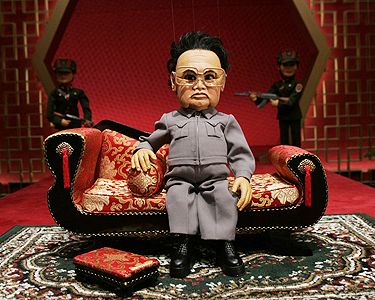 The North Korean embassy in Prague is trying to pressure Czech authorities to ban the satirical movie Team America: World Police. The movie makes fun of absolutely everybody possible: Americans, terrorists, left, righ, hawks, doves, members of the human race, generally. All come out looking completely idiotic, so it's not surprising that Kim Jong-il doesn't come off looking too great either. This situation is unacceptable to Pyongyang, says the Canadian Broadcasting Company: 'The main villain in Team America is North Korean dictator Kim Jong-il, who is shown in the movie shooting his translator in the head and feeding former United Nations weapons inspector Hans Blix to a tank of sharks.
Aided by vacuous Hollywood stars, Jong-il plans to carry out an attack with weapons of mass destruction that will result in damage that is "9/11 times 2,356."
"Such behavior is not part of our country's political culture," the North Korean diplomat added. "Therefore, we want the film to be banned."
However, the Czech Foreign Ministry said people would continue to be allowed to see the film, which had its Czech premiere on Feb. 3.
"We told them it's an unrealistic wish," ministry spokesman Vit Kolar said. "Obviously, it's absurd to demand that in a democratic country."'
Read a kind of related article here.
The North Korean embassy in Prague is trying to pressure Czech authorities to ban the satirical movie Team America: World Police. The movie makes fun of absolutely everybody possible: Americans, terrorists, left, righ, hawks, doves, members of the human race, generally. All come out looking completely idiotic, so it's not surprising that Kim Jong-il doesn't come off looking too great either. This situation is unacceptable to Pyongyang, says the Canadian Broadcasting Company: 'The main villain in Team America is North Korean dictator Kim Jong-il, who is shown in the movie shooting his translator in the head and feeding former United Nations weapons inspector Hans Blix to a tank of sharks.
Aided by vacuous Hollywood stars, Jong-il plans to carry out an attack with weapons of mass destruction that will result in damage that is "9/11 times 2,356."
"Such behavior is not part of our country's political culture," the North Korean diplomat added. "Therefore, we want the film to be banned."
However, the Czech Foreign Ministry said people would continue to be allowed to see the film, which had its Czech premiere on Feb. 3.
"We told them it's an unrealistic wish," ministry spokesman Vit Kolar said. "Obviously, it's absurd to demand that in a democratic country."'
Read a kind of related article here.

덧글 목록
관리 메뉴
본문
If we want, we - "ordinary" people - can change a lot! Just read that:http://english.chosun.com/w21data/html/news/200502/200502040024.html
(copy and paste please)
부가 정보