

사이드바 영역으로 건너뛰기

게시물에서 찾기Migrant workers' struggle

299개의 게시물을 찾았습니다.

  1. 2012/02/03
    ETU-MB ("투쟁역사")
    no chr.!
  2. 2012/01/26
    통일,北-南이동&이주노동자
    no chr.!
  3. 2012/01/25
    이주노조(MTU) 위원장...
    no chr.!
  4. 2012/01/04
    이주‘3진아웃제’대폭수정돼
    no chr.!
  5. 2011/12/19
    [12.18] 세계 이주민의 날
    no chr.!
  6. 2011/12/16
    12.18(日): 세계 이주민의 날
    no chr.!
  7. 2011/11/25
    [2011년] 불교인권상...
    no chr.!
  8. 2011/11/24
    국제노동기구vs. 남한정권
    no chr.!
  9. 2011/11/11
    11.12(土): MTU후원주점
    no chr.!
  10. 2011/11/08
    경주: 이주노동자 강제단속(1)
    no chr.!

ETU-MB ("투쟁역사")


The following text we, activists of ETU-MB, wrote (as far as I remember on demand of LabourNet UK) in spring 2004:


ETU-MB’s struggle history, a short overview


ETU-MB (Equality Trade Union – Migrant’s Branch, a part of Korean Confederation of Trade Unions/KCTU) was founded in the year 2001. Actually the group was a splitting product of JCMK. The activists had to learn that in JCMK they have no own voice and JCMK leadership was/is complete reformist. But the activists wanted a struggle organization where migrant workers can organize themselves.


With the beginning of public discussions about the planned new EPS (Employment Permit System) bill by the government ETU-MB started in spring 2002 with massive activities in the public. After in April a demonstration, around 1000 migrant workers participated, was blocked by riot cops and later the government threaten with more repression against ETU-MB’s activities Kabir and Bidduth, together with some Korean supporters started the first sit-in struggle in the back-yard of Myeong-dong Cathedral. The sit-in struggle lasted 77 days.


After the sit-in struggle the activists concentrated on organizing migrant workers in their home regions (in S. Korea) mainly in the industrial zones in Seoul and Gyeonggi-do(province).


On September 2nd, immigration officers, accompanied by dozens of riot cops, raided two migrant houses in Maseok(Gyeonggi-do) and arrested two of ETU-MB's leading activists. In the beginning of November 2002 they begun a hunger strike and on Dec 1 they were released, but only temporary.

 
Meanwhile the massive anti-USFK campaign started and also ETU-MB members participated.


In the following period ETU-MB searched for more effective ways to organize migrant workers in the union. In early summer last year we begun with a massive wave of rallies in the different industrial areas in Seoul and Gyeonggi-do. The wave reached its apex with a rally in Seoul on October 26, together with Korean irregular workers. Here after the self burning of Lee Yong-seok on the end of the rally short after the beginning of the following demonstration large units of riot cops attacked the demo and arrested Bidduth and Jamal. Later they were transferred to Hwasoeng detention center.


Almost simultaneously we started with a campaign to assist/join workplace-related struggles by migrant workers mainly in the vicinity of Seoul (Gyeonggi-do). And some of our efforts were quite successful!


Meanwhile during the whole 2003 ETU-MB activists participated also in anti-war rallies and demos.


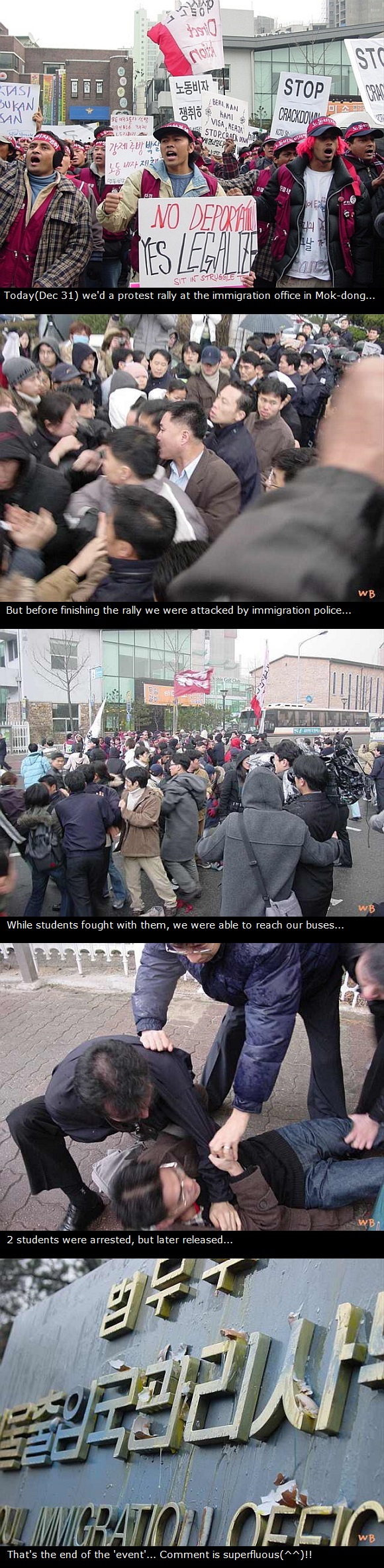
Since beginning of Nov 2003 we were planning activities against the coming crackdown period announced by the government for Nov 16. Several models were in discussions and we finally we decided to occupy Myeong-dong Cathedral’s compound on Nov 15 after a large workers rally on that day. Now since that date we’re occupying this area. During this time we held many protest rallies and demonstrations were we lost three comrades captured by immigration officers with the direct help from riot cops.


진보블로그 공감 버튼
트위터로 리트윗하기페이스북에 공유하기딜리셔스에 북마크

통일,北-南이동&이주노동자


Since my first contact with the migrant workers movement in S. Korea in spring 2002 (via ETU-MB/평등노조 이주지부, MTU's predecessor organization) I assumed that - at least - in case of a prospective North-South reunification a dark future for the migrant workers in S. Korea...


And today, as far as I know, the S. Korean media (via DailyNK) connected for the first time the "imminent" reunification process with a planned deportation of almost ALL migrant workers.


Under the headline "If Sudden Change Happens in NK" DailyNK reported the following:


On the 24th the Korea Employers Federation(KEF) in the report ‘Labor Market Changes and Policy Challenges After Reunification’ asserted that if change occurs and a radical unification happens, it could lead to a situation where many North Koreans come to South Korea, resulting in social economic chaos. The KEF claimed that South Korea is capable of only taking up to 2,220,000 North Koreans.


...the report stated that North Koreans coming to the South... South Korea needs to suggest alternative policies to reduce foreign worker dependency.


According to the KEF, the unmet reinforcement in domestic low-skill workers is 86,000 people. The target can be met by the 344,000 North Korean workers.


Based on figures from October of last year, there were 497,000 non-professional foreign workers in South Korea and 175,000 illegal aliens. If 70% of these workers were to be replaced by North Korean workers then 47,000(*) North Koreans can be recruited, according to the Korea Employers Federation.


If the low skilled workers and non-professional foreign workers were to be replaced by North Korean workers (including the dependents) around 222,000 North Korean workers can be accommodated in South Korea...


* This number in the English article is of course wrong! In the Korean text ("급진통일시 북주민 365만명 내려올 수 있다"): "47만 명...", i.e. 470,000 N. Koreans (could replace migrant workers)


진보블로그 공감 버튼
트위터로 리트윗하기페이스북에 공유하기딜리셔스에 북마크

이주노조(MTU) 위원장...


Last Saturday's Hankyoreh published the following article: 


Migrant labor organizer bids bittersweet farewell to Korea


Family duties bring MTU’s Michel Catuira home after six year struggle in Korea


On January 31, 40-year-old Seoul-Gyeonggi-Incheon Migrants' Trade Union (MTU) president Michel Catuira will leave Korea after six years in the country and return to the Philippines. Just as he came to Korea to help his family, he is returning to the Philippines because of his family.


“Anyone has to go back when the time comes, but it's a pity to be going back when I haven't achieved much in particular here,” said Michel with a smile, when meeting with a Hankyoreh reporter on Thursday at the union's office in Nokbeon neighborhood, Eunpyeong District, Seoul. He has decided to return home to look after his grandmother, who is suffering from Alzheimer's. The cousin that has looked after her until now is going to work in the United States, leaving nobody else to care for her.


Michel, who was forced by poverty to sell rice cakes on the street from the age of 13 and came to Korea after spending his 20s haunted by low wages and unemployment, acquired various titles while living in Korea as a “migrant worker.” In 2009, he became a chairman of the union, and the following year became the first ever foreign delegate in the Korean Confederation of Trade Unions (KCTU). “I didn't know about the labor movement in the Philippines, but I couldn't stand the unjustified abuse and unreasonable treatment in Korea,” he said. In 2007, Michel learned about the MTU while protesting against the unfair firing of a friend. After becoming chairman, he spent his days working in factories and his nights organizing workers. “A union where workers can discuss [issues] and make decisions themselves is absolutely necessary for the sake of migrant workers' rights,” he said.


Until now, the Korean government has not regarded the MTU's activities with pleasure. Three of its past chairpeople have been the objects of “target crackdowns” by immigration authorities and forcibly deported. Michel, whose residency status in Korea was legal, was not exiled following a crackdown, but once found himself in danger of being forcibly expelled. In February last year, Seoul Immigration Office cancelled his application for an extension of stay and ordered him to leave the country. In September, however, a judge at Seoul Administrative Court took Michel's side, saying, “I suspect that Seoul Immigration Office's handling of the case may have been because of the plaintiff's labor union activity.”


The Korean government is not a signatory to the UN's International Convention on the Protection of the Rights of All Migrant Workers and Members of Their Families, which stipulates the right of migrant workers and their families to be free from discrimination compared to citizens of the country where they work, and includes the right to form labor unions. Michel spoke sarcastically about this, saying, “As a member of the UN, Korea is only interested in benefits to itself. It doesn't fulfill its obligations.”


“Meeting people I admire, like Kim Jin-suk, Direction Committee member of the Busan branch of the KCTU, and Yu Myeong-ja of Eduwork, while working and engaging in labor activism in Korea, has been a really worthwhile experience,” said Michel. His affection for the Korean labor movement is such that he named his pet rabbit Chun Tae-il, the late South Korean labor activist . He plans to create a network of Filipino workers that have returned from Korea and international alliances between the KCTU and Filipino unions while looking after his grandmother.


Michel's last official engagement will be his farewell party on January 28(*), before leaving the Korea that he “loves and hates” on January 31.


http://english.hani.co.kr/arti/english_edition/e_national/515773.html


* Michel's "farewell party" will start next Saturday at 8pm, in the office of MTU(KCTU Seoul Regional Council) near Bulgwang Stn(subway line no. 3/6)... For more info, please check out MTU's facebook site!!


진보블로그 공감 버튼
트위터로 리트윗하기페이스북에 공유하기딜리셔스에 북마크

이주‘3진아웃제’대폭수정돼


Monday's (bourgeois) Korea Times wrote that...


The government will allow migrant workers, most likely from June this year, to change their workplaces without restrictions if they experienced discrimination at work or employers violated labor laws...


The bill will take effect five months after promulgation which is expected to take place within days...


Migrant workers have been permitted to change their workplaces only up to three times during their first-three year work permit here and twice more if they extend their visa for another two years.


This left room for employers to infringe on the rights of migrant workers, who are vulnerable to salary gouging, harassment and overtime work without due financial compensation.


Once the new legislation enters into force, they will be able to switch their jobs as much as they need if their employer breaches regulations to be set by the Ministry of Employment and Labor (MOEL).


A considerable number of foreigners have been expelled from the country as a result of circumstances where they had no choice but to walk out of their workplaces...


The revision bill states that migrant workers can switch jobs without any penalty or disadvantage if "the employer breached work conditions or if migrant workers cannot continue to work in their workplace due to reasons that they are not responsible for."

The move came amid pro-immigrant activists’ growing demand to scrap the regulation that infringes upon the freedom of job choice and the general pursuit of freedom guaranteed in the Constitution...


http://www.koreatimes.co.kr/www/news/nation/2012/01/116_102082.html


Oops~ After almost ten years of struggle by migrant organizations, solidarity groups and trade unions, incl. MTU/KCTU, against the terrible EPS(at least its worst paragraphs) the S. Korean legislative is making - possibly(??) - a first step forward...
But of course - in reality - there's is a huge gap between a bill, passing the Nat'l Assembly and a lawful process!!


Comrade Michel, MTU's chairperson comments the approved bill as follows:


Just makes it easier to cover up all of the existing exploitative conditions. Also makes it easier for the migrants to be tied down to their employers...


It was initially sold as a law to make it possible for migrants to stay longer than 4 years 10 months but the condition is for the migrant to stay with only one employer, since a lot of the employers are also in need of a stable workforce.


But there is a lot more to be done since these laws do not really protect the working conditions of the migrants.


Another thing, it remains difficult for migrant workers to prove these violations because it might take them longer to prove those violations which might mean they would be unemployed longer to be able to have their workplace change not counted.


Sadly, laws on paper might look good than not having laws at all... but practice and application is the real gauge if conditions are good or not.


진보블로그 공감 버튼
트위터로 리트윗하기페이스북에 공유하기딜리셔스에 북마크

[12.18] 세계 이주민의 날


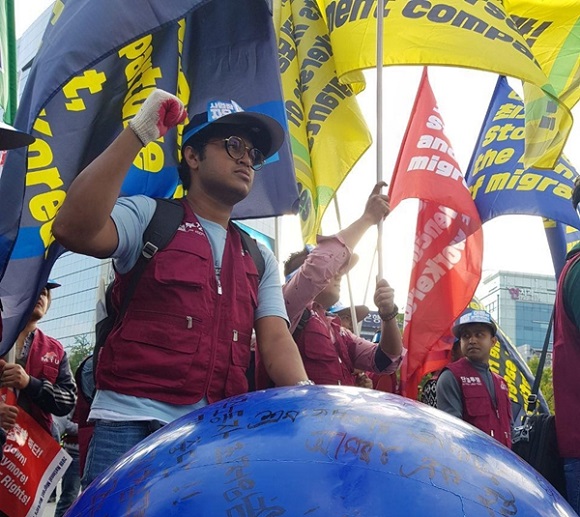
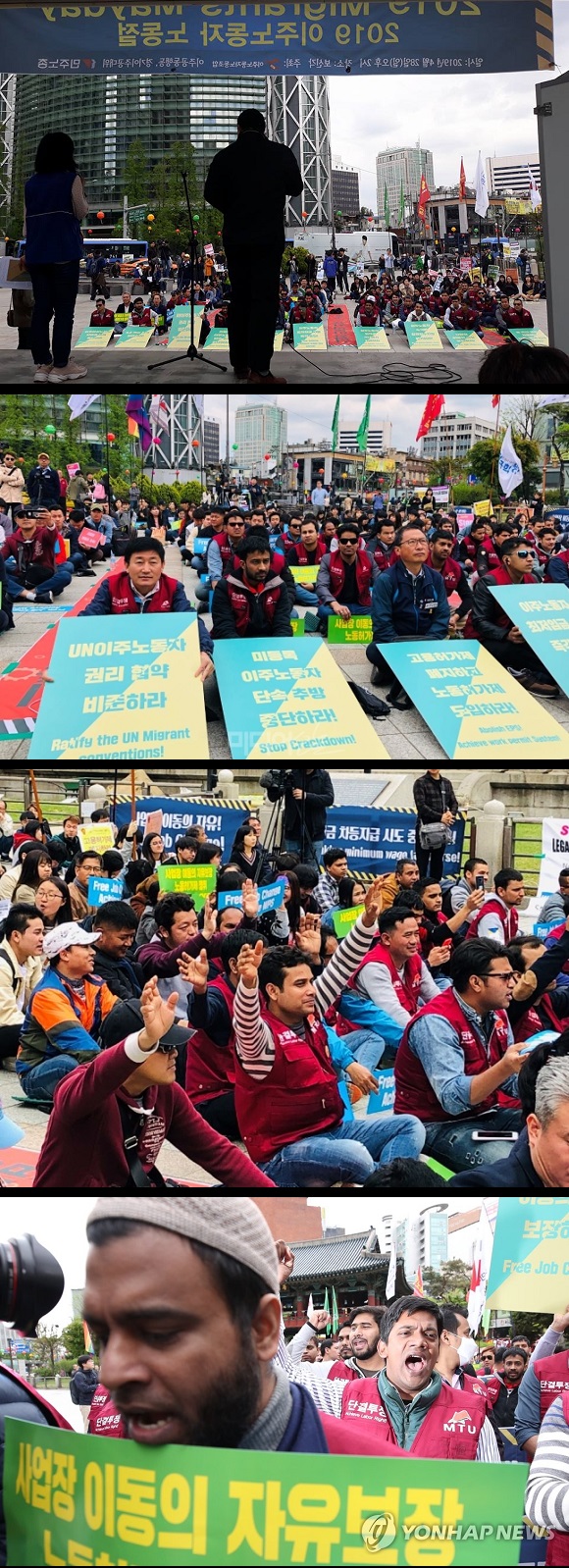
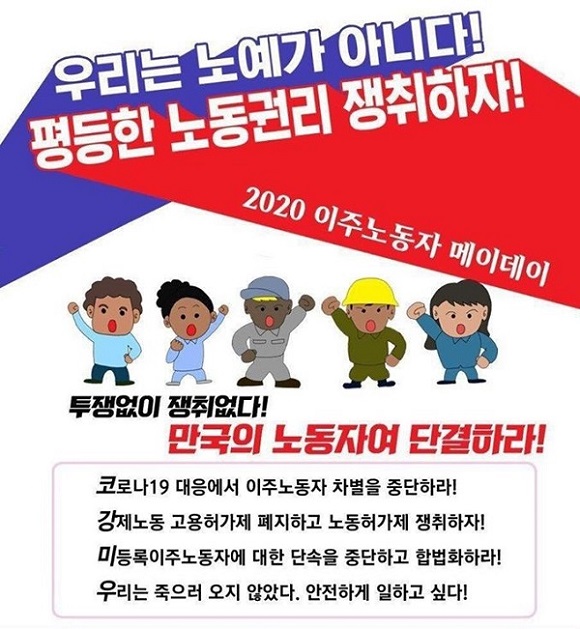
Yesterday afternoon in downtown Seoul: About 200 activists of several migrant workers organisations(incl. MTU) and their Korean supporters celebrated the Int'l Migrants Day (buy the way: during the rally the representative of KCTU appealed for a "collective struggle against capitalism"...). Here just some impressions from yesterday's event:
 

사용자 삽입 이미지


Related articles:
“이주노동자, 노예 아닌 노동자” (NewsCham, 12.18)
도심 곳곳서 `세계 이주민의 날' 행사 (Yonhap, 12.18)


Enclosure: In commemoration of International Migrants Day 2011 we, migrant workers in South Korea, make the following declaration:

 
WE ARE WORKERS, NOT SLAVES!

WE DEMAND FULL RESPECT FOR OUR HUMAN AND LABOR RIGHTS!

 
We have been forced to seek work outside of our home countries because of poverty, unemployment, political oppression and the failure of home governments to provide adequate support systems.

 
In South Korea, we work in small and medium-scale businesses, playing an important role the Korean economy. Yet we are unrecognized and neglected by Korean society. We face discrimination, physical and sexual violence and daily violations of our labor rights. These experiences have made us aware of the unjust nature of the Korean foreign labor system, which is enforced with cooperation from sending countries. They have also strengthened our determination to fight for rights.

 
The South Korean government’s foreign labor policy is aimed at reducing labor costs, increasing profitability and protecting the interests of businesses. The restrictions in the Employment Permit System and the Visit Work System enslave migrant workers to their employers, allowing greater exploitation. The result is forced overtime, unpaid wages, lack of vacation time and other abuses. Migrants’ rights as workers go ignored and unprotected.   

 
Since the 1980s undocumented migrant workers have contributed to South Korea’s economic growth, but they continue to be hunted down like criminals. They are exploited in the workplace and made into scapegoats for Korea’s social and economic problems. They continue to be arrested and deported or killed in crackdowns.

 
Women migrants continue to be trafficked, either as workers or as spouses for Korean men. They continue to be subjected to psychological, physical and sexual violence. Migrant children lack social protection. The children of undocumented migrants suffer in particular, lacking a sense of identity or nationality.

 
21 years ago today, the United Nations adopted the ‘International Convention on the Protection of the Rights of All Migrant Workers and Members of Their Families.’ The Convention sets the minimum standards for the protection of the rights of migrant workers. The South Korean government boasts of its multiculturalism and ‘advanced’ foreign labor policies. Yet it has failed to ratify the Convention or meet the standards contained in it. 

 
Migrant workers, like the Korean working class, are part of the 99%. Our labor is used to create wealth for the 1% through laws that restrict our rights and give greater freedom of businesses to exploit us. In our home countries, Korean investors take advantage of lower labor standards and shamelessly exploit workers creating despair, not decent jobs. The granting of more freedom to business and less rights to workers is part of the ‘neoliberal agenda’, which has led to rising inequality around the world.


Across the globe, people are fighting to replace a political and economic system that put profits before people with one that respects the human and labor rights of all. The demands we make on the South Korean government and our efforts to achieve them are part of this global struggle.


We make the following demands on the Korean government:


1.Uphold migrant workers' basic labor rights and recognize MTU's legal union status!
2.Stop labor exploitation and repression of migrant workers!
3.Stop the crackdown and legalize undocumented migrant workers!
4.Fully uphold the Labor Standards Act for migrant workers!
5.Change the EPS into a work permit system and allow long-term residence for migrant workers!
6.Implement stronger penalties for abusive employers!
7.Ensure free and comprehensive labor rights education and legal support for migrant workers!
8.Uphold the rights of refugees, marriage migrants and all other migrants!
9.Ratify the International Convention on the Rights of All Migrant Workers and Members of Their Families!


진보블로그 공감 버튼
트위터로 리트윗하기페이스북에 공유하기딜리셔스에 북마크

12.18(日): 세계 이주민의 날


사용자 삽입 이미지


진보블로그 공감 버튼
트위터로 리트윗하기페이스북에 공유하기딜리셔스에 북마크

[2011년] 불교인권상...


Last Sat.(11.19) Michel Caitura(MTU's chairperson), together with Park Gyeong-seok(chairman of the S. Korean Solidarity Association Against Discrimination of Disabled People) received this year's Buddhist Human Right Award...


사용자 삽입 이미지


...in Seoul's Jogye Temple(조계사):


사용자 삽입 이미지


사용자 삽입 이미지


Congrats, dear comrades!!


Related reports:
제17회 불교인권상에 박경석 · 미셸 카투이라 (정각사, 11.14)
S Korea cracks down on migrant workers  (PressTV, 11.07)


진보블로그 공감 버튼
트위터로 리트윗하기페이스북에 공유하기딜리셔스에 북마크

국제노동기구vs. 남한정권


[Nov. 2011] ILO(Int'l Labour Organisation) Governing Body recommended the following(*):

 
(a) The Committee urges the Government to refrain from any measures which might involve a risk of serious interference with trade union activities and might lead to the arrest and deportation of trade union leaders for reasons related to their election to trade union office. It requests the Government to enforce the decision of the Administrative Court cancelling all punitive measures until a final judgement has been rendered, including by granting the renewal of Mr Catuira’s residence permit. The Committee requests the Government to submit detailed information on the current status of Mr Catuira’s work permit in reply to the complainant’s communication of 28 September 2011 and any other information related to this case.


(b) The Committee expresses its firm expectation that the Government will proceed with the registration of the MTU without delay, and supply full particulars in relation to this matter.


(c) The Committee once again requests the Government to ensure that the Committee’s conclusions, particularly those concerning the freedom of association rights of migrant workers, are submitted for the Supreme Court’s consideration and to provide a copy of the Supreme Court’s decision once it is handed down.


(d) The Committee once again requests the Government to undertake an in-depth review of the situation concerning the status of migrant workers in full consultation with the social partners concerned, so as to fully ensure and safeguard the fundamental rights to freedom of association and collective bargaining of all migrant workers, whether in a regular or irregular situation and in conformity with freedom of association principles, and to prioritize dialogue with the social partners concerned as a means to find negotiated solutions to the issues faced by these workers. The Committee requests to be kept informed of the progress made in this regard.


* A PDF-link to the full text (CASE NO. 2620, "Complaint against the Gov't of the Republic of Korea presented by KCTU and ITUC") you'll find here!


진보블로그 공감 버튼
트위터로 리트윗하기페이스북에 공유하기딜리셔스에 북마크

11.12(土): MTU후원주점

사용자 삽입 이미지


진보블로그 공감 버튼
트위터로 리트윗하기페이스북에 공유하기딜리셔스에 북마크

경주: 이주노동자 강제단속


Y'day, according to several sources(*), 12 Korean human right/KCTU members were arrested in Gyeongju, east of the S. Korean city Daegu. The were arrested while defending a number of 'undocumented' migrant workers (eight of them were arrested in that process) against the current crackdown.

MTU published (unfortunalelly only on its FB site...) today the following short report: "Our Korean supporters and friends, defending and trying to prevent the arrest of the undocumented workers in Gyeongsan. 8 undocumented were detained and 8 Korean activists were arrested in the process. Another 4 Korean activist were arrested by the police in Gyeongsan earlier in the day"

* Related reports (in the independet media):
7일 경주에서 12명 단속, 항의하던 인권단체회원 12명 연행 (NewsCham, 11.8)
'미등록 이주노동자 단속 항의' 시민단체 회원 집단 연행 (OMN, 11.8)
"반인권적 '이주노동자' 불법단속, 즉각 중단을" (PeaceNews, 11.8)

Related articles (in the bourgeois media):
경찰, 불법체류자 단속 막은 노조원 연행 (대구일보, 11.8)
대구경찰, 불법체류자 단속 항의 8명 입건… (중앙일보, 11.8)


진보블로그 공감 버튼
트위터로 리트윗하기페이스북에 공유하기딜리셔스에 북마크

  • 제목
    CINA
  • 이미지
    블로그 이미지
  • 설명
    자본주의 박살내자!
  • 소유자
    no chr.!

공지사항

저자 목록

달력

«   2012/02   »
      1 2 3 4
5 6 7 8 9 10 11
12 13 14 15 16 17 18
19 20 21 22 23 24 25
26 27 28 29      

기간별 글 묶음

찾아보기

태그 구름

방문객 통계

  • 전체
    174769
  • 오늘
    463
  • 어제
    560