
공지사항
-
- '노란봉투'캠페인/국제연대..
- no chr.!
27개의 게시물을 찾았습니다.

The Central Committee of the General Federation of Trade Unions of Korea and south Korea's Federation of Trade Unions and Confederation of Trade Unions issued the following joint statement on June 15: Workers in the north and the south will discharge in the van the duty facing the nation at the historic turning point that our nation brought by its own efforts, overcoming the hill of ordeal and crisis.
It is the most primary task for co-existence and co-prosperity of the nation to put an end to the history of mistrust and confrontation and establish a durable peace-keeping regime on this land.
A total end should be put to the state of war which stopped on July 27, 1953. Moreover, a peace accord should be concluded to completely terminate the war crisis and realize lasting peace.
At the historic turning point made in 73 years of division, the workers in the north and the south will do their best to settle the historic task facing our nation.
All the workers in the north and the south will take the lead in getting the armistice agreement abrogated and realizing a peace accord.
Today the idea of By Our Nation Itself, clarified in the June 15 joint declaration, was developed into the principle of national independence in the Panmunjom declaration.
The party most responsible for peace and reunification is just our nation.
The workers in the north and the south will conduct all their activities strictly in the spirit of By Our Nation Itself and the principle of national independence and stand in the van of struggle to decisively reject domination and interference of outsiders obstructive to peace and reunification.
They will resolutely struggle against any attempt to impair the Panmunjom declaration and do their best for the unceasing implementation of the declaration.
The statement expressed the firm resolve of all the workers in the north and the south to dynamically usher in a new era of peace and independent reunification.
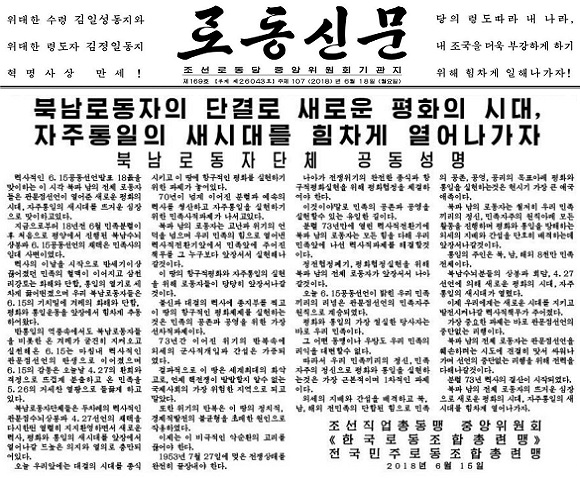
Source: KCNA/Rodong Sinmun, 6.18
The (south)Korean version, published last Friday(6.15) by KCTU you'll get here.



Yesterday's Asia Times(HK/中國) published the following: Fears of US ‘bloody nose’ attack on North Korea on the rise...
On the same day Korea Times wrote that "It seems the United States thinks a precision strike against North Korea is one of its serious options, despite concerns about catastrophic results it might trigger..."(more you can read here)
And today's main topic in Korea Herald: US seriously considering ‘bloody nose’ strategy...


Yeah, but please keep in mind...

"It's too apparent that South Korea and the U.S. will never scrap their decision concerning THAAD..." said Park Won-gon, an international relations professor at Handong University. (Korea Times, 9.06) Because "Washington ultimately wants to use the THAAD battery as a steppingstone to expand its missile defense system across the Korean Peninsula to better contain a rising China..." Kwak Jin-o, a senior researcher at the Northeast Asian History Foundation (K. Times, 9.06)
"THAAD Critics at Home", here in Seongju county(i.e. the STRUGGLE against THAAD... goes on!!!):
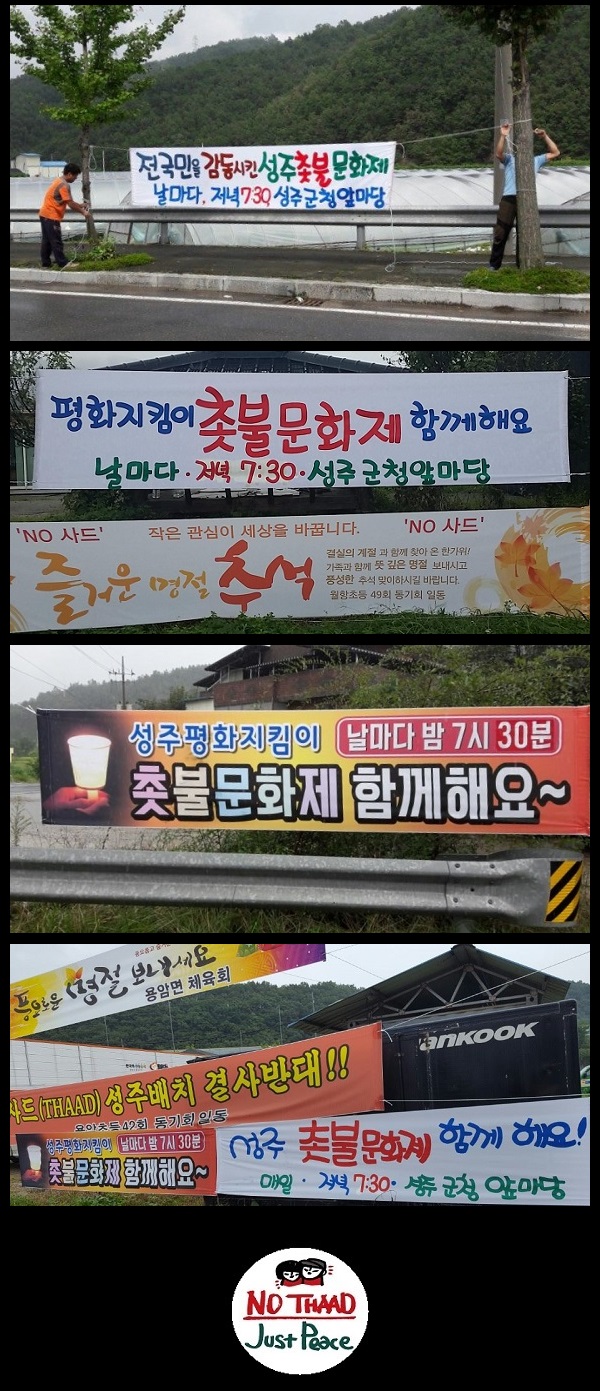

Last Sunday(8.14) about 10,000 citizens(incl. thousands of KCTU activists) gathered in central Seoul to protest against planned the THAAD deployment in S. Korea...

The Inter-Korean "policy of détente"(^^): The latest developments...
President Park Geun-hye renewed calls Thursday for North Korea to immediately stop pursuing development of nuclear weapons and long-range ballistic missiles. "As long as the North continues to refuse to abandon its nuclear weapons ambition, its isolation from the international community will deepen further and a path toward economic development will not be open," Park said during a ceremony to mark Armed Forces Day... (K. Times, 10.1)
*****
The Unification Ministry expressed deep regret over North Korea's threat to cancel the upcoming reunions of separated families, urging the North not to politicize the humanitarian issue. Late Tuesday, North Korea's Committee for the Peaceful Reunification threatened to scrap the family reunions slated for late October as President Park Geun-hye urged North Korea not to push ahead with its satellite launch... (Yonhap, 9.30)
*****
CPRK Denounces Reckless Remarks of S. Korean Chief Executive
A spokesman for the Committee for the Peaceful Reunification of Korea (CPRK) released a statement on Tuesday lashing out at the repeated reckless remarks made by the south Korean chief executive inciting confrontation with the fellow countrymen in the north at the UN.
The statement said: The south Korean chief executive in her "keynote speech" at the 70th session of the UN General Assembly let loose such invectives that the "nukes of the north constitute a top priority task for building a world without nuclear weapons", "the north's additional provocation is aimed at vitiating the atmosphere of the inter-Korean dialogue and hamstringing the efforts of the countries concerned with the six-party talks for resuming the dialogue for denuclearization and "the north would be well advised to strive to help its residents overcome difficulties through reform and opening instead of making an additional provocation."
Not content with hurting the DPRK's dignity and social system, vociferating about "requirement of the international community" and the "urging the improvement of human rights," she openly revealed her ambition to achieve "unification through absorption" with the backing of foreign forces under the pretext of "peaceful unification",.
This is an unpardonable provocation to the DPRK and a heinous confrontation act of chilling the hard-won atmosphere of improving the inter-Korean relations.
A string of silly remarks made by her clearly prove that she is utterly bereft of reason, hell-bent on sycophancy towards the U.S. and confrontation with the fellow countrymen in the north.
She is so reckless as to take issue with the DPRK's nuclear deterrent, a treasured sword of justice for defending the nation while keeping mum about nukes of her American master, the cancer-like harasser of the global peace. This is no more than a sheer jargon of the chief executive, colonial servant who is so steeped in sycophancy towards the U.S. to the marrow of her bones that she does not know what she should support and what she should oppose.
It is the height of shamelessness for her to impudently talk about someone's "human rights" and "living of residents," pretending not to know about south Korea being denounced as the world's worst tundra of human rights.
What was funny was that she made no scruple of telling cock-and bull-story that she was dreaming of the arrival of the day when "the world would hail the unification of the Korean Peninsula" just as the U.N. "greeted" the tragic day when the U.S. puppet regime was installed. This is something that provokes a side-splitting laughter.
In fact, this was an open revelation of the wild ambition to achieve "unification of social systems," a foolish act of driving this land into a war and inviting self-ruin.
We had already served a stern warning to the south Korean authorities that they would have to pay dearly for their reckless remarks.
Due to the south Korean authorities' reckless confrontation row not only the north-south relations but the reunion of separated families and relatives in the north and the south now being promoted with much effort has been put at serious peril.
If the south Korean authorities let loose a string of confrontational invectives as now, the event may prove completely abortive.
This is the unanimous view of the public at home and abroad.
We stand for improved north-south relations but have no idea of continuing to show leniency even to the partner who is persistently pursuing confrontation, turning down our offer of reconciliation and magnanimity.
The south Korean authorities should apologize to the nation for recklessly slandering the fellow countrymen and learn how to properly wag their tongues, bearing in mind that their provocative words and deeds may cause unpredictable misfortune at this crucial time. (KCNA, 9.29)
Just a short while earlier Yonhap published the full text(read it here) of Park's UN speech, mentioned in the KCNA piece above...
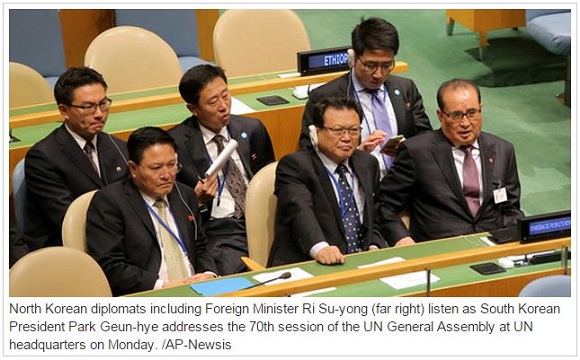
No comment...^^
THE INT'L STRUGGLE DAY OF THE WORKING CLASS
IN BERLIN/GERMANY

About y'day's events in Berlin the German (bourgeois) magazine Der Spiegel reported following (of course the report is partly just bourgeois propaganda^^):
MAY DAY DÉJÀ VU
Berlin's Ritual Riot
Like a neatly choreographed dance, "revolutionaries" and police engage in a ritual riot in Berlin every year on May Day. This year was no different, with dozens arrested and several people injured.
Every year Berlin observes its own very peculiar tradition. On May 1 -- International Workers Day -- its citizens brace themselves for a day of rioting and mayhem. And this year was no different.
Many Berliners had been hoping that this year's May Day would pass off peacefully, that the idea of a ritual riot had become just a little old hat. And for most of the day it seemed it might actually happen: there were family-friendly street parties and peaceful left-wing demonstrations.
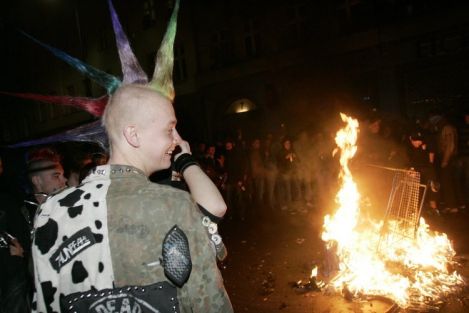
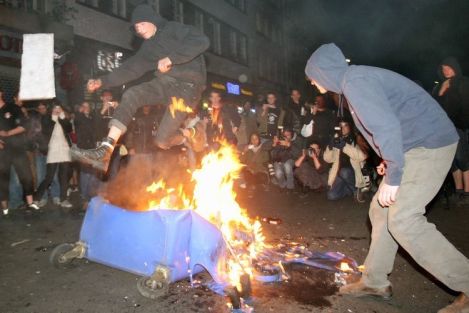
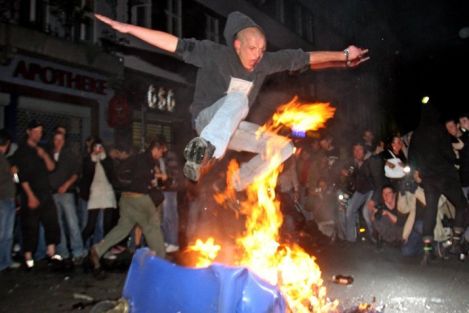
But once night fell, the revolutionary habit was back: gangs of rioters threw stones and bottles at the police and garbage bins were set alight. Several people, including police officers, were injured and there were dozens of arrests.
Nevertheless, Berlin's police chief Dieter Glietsch said that he was pleased with how the operation had gone this year, pointing out that there was a lot less violence than in previous years.
Earlier in the day, around 50,000 Berliners had gathered to enjoy the "Myfest" street party in the Kreuzberg district, which included concerts and various events for children. The festival had been organized by local government, residents and local businesses to try to create an alternative to the traditional revolutionary antics. Two left-wing demonstrations with around 6,000 participants also passed off peacefully.
But once the party was over and the stages had emptied, around 600 people decided there was nothing better to do than have a riot. And while the police initially held back in order to prevent the whole thing from escalating, they eventually began to pick off the ringleaders and arrest them. Still, by midnight the revolution was over.
A tradition is born
The rioters were "celebrating" the 20th anniversary of the first major riot in Kreuzberg in 1987. The district, which belonged to the western part of the then-divided Berlin, was a kind of sub-culture enclave with punks, squatters and assorted revolutionaries living side by side with a large Turkish community. On that first May Day over 900 rioters fought running battles with the police for 12 hours. Shops were looted and cars were set on fire -- and a ritual was born that would be reenacted to a greater or lesser extent over the next 20 years.
In recent years, the authorities have revised the way they deal with the disturbances: Instead of heavy-handed tactics, they now employ a more softly-softly approach, using "anti-conflict" teams to keep the peace and imposing bans on glass bottles and cans at the street parties.
Still, this year the police had been prepared for trouble, and there were 5,000 officers deployed to keep the peace. There were concerns that some left-wing groups might use May Day as a dress rehearsal for protests against the upcoming G8 summit at Heiligendamm in June. And already on Monday night, on the so-called Witches Night, there had been some disturbances in the eastern district of Friedrichshain. A riot broke out after a punk concert, during there were 119 arrests and 15 police officers were injured...
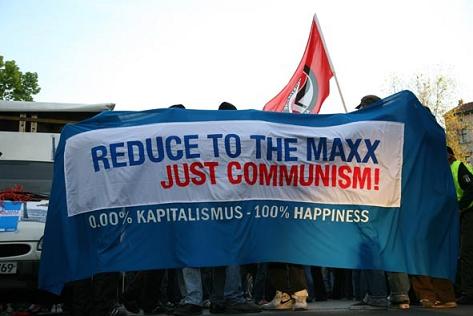

4.30, the pre-Mayday demo..
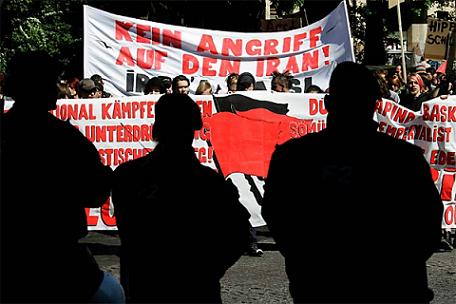
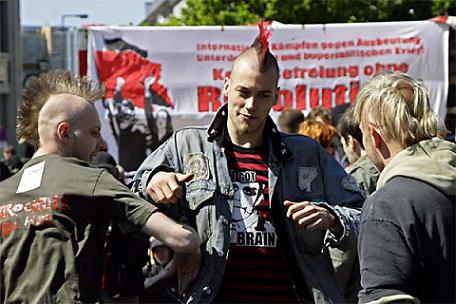
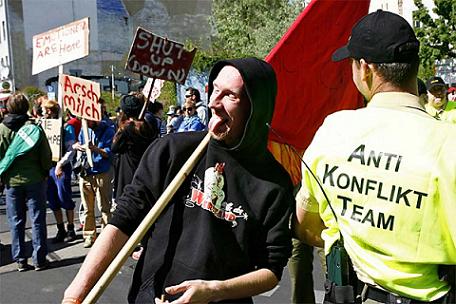
Mayday, the first "revolutionary" demo under the motto of:
"No Liberation Without Revolution"
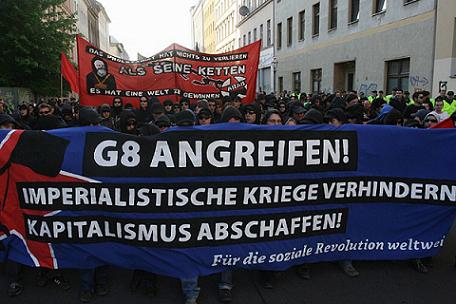
After two more different "revolutionary" demos, the last one under the motto:
"Attacking G8 - Prevent Imperialist Wars - Abolish Capitalism. For the
Social Revolution Worldwide"
And the final event - street "riots":

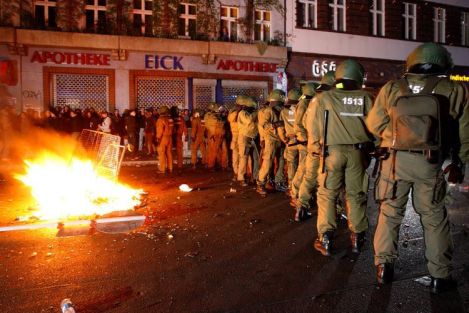
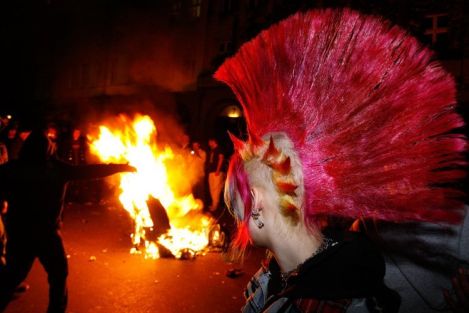
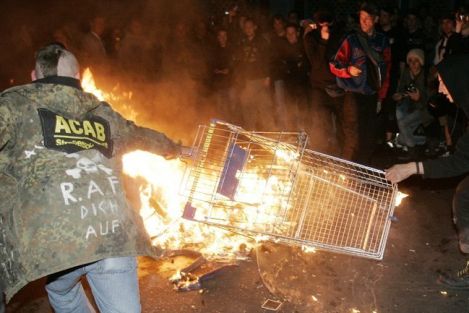
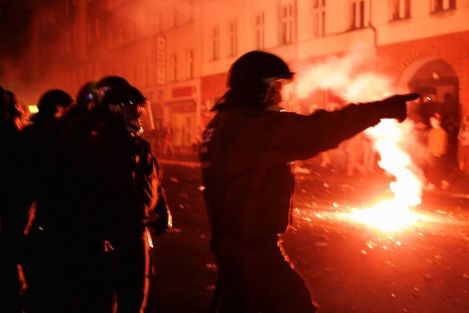
RADICAL WELFARE IN THE GAZA STRIP
Uncle Hamas Cares for Palestinians
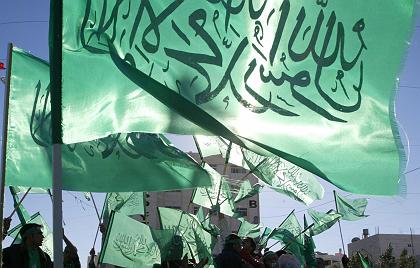
The West classifies Hamas as a terrorist organization, but in the Gaza Strip, the Islamist organization is widely respected for helping families in need. International aid groups also praise Hamas for being free of corruption.
Etidal Sinati's life in poverty began one night in March 2003. Israeli helicopters were flying air attacks on the Jabalia refugee camp in northern Gaza City and Etidal's husband Mohammed and a group of other men from the neighborhood went out to assess the damage. But the Israelis weren't done; an attack helicopter returned and fired on the onlookers. Etidal's husband was killed, leaving her with seven children and no one to provide for them. Overnight, the Sinatis became a welfare case -- and loyal to Hamas. The radical Islamist group took the destitute family under its wing.
"My husband was not a Hamas supporter. In fact, he was for Fatah," says Sinati, now a widow. It is cold in her two-room hut; a mentally ill uncle sits in a corner occasionally laughing to himself and pulling his wool blanket over his head. "But without Hamas we wouldn't have survived, and even with their support it's been difficult."
The official pension for the wife of a "martyr" -- a Palestinian killed by the Israeli military -- is €100 every three months. For a large family living in Gaza, this is about enough for one good seafood meal, but is not enough to live on. "So Hamas adopted my children," says Etidal Sinati. The widow receives €15 a month in child support for each child, and all of her children attend a school run by Hamas free of charge. "I voted for the crescent in the January election," says the illiterate Etidal. The crescent moon is Hamas's symbol.
A party for the poor
At first glance Hamas, a party that looks after the poor with its money and charity, appears to be playing a well-known tune on the instrument of populism. On the other hand, every major international aid organization is singing the Islamist group's praises when it comes to the quality of its work. "In the International Crisis Group's 2003 report, the most important American NGOs gave perfect marks to Hamas's work; they couldn't have achieved a better result," says Helga Baumgarten, a lecturer at Birzeit University in Ramallah.
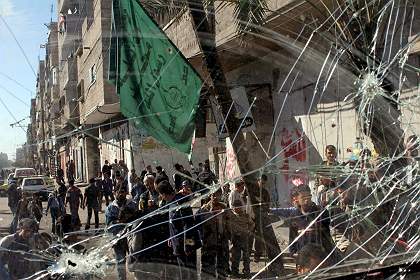
Baumgarten believes that the success of the party, which emerged from the radical Muslim Brotherhood in 1987, is based on two factors: the highly professional work of the group's welfare agencies and Hamas's oft-cited integrity. "In fact, all studies have concluded that Hamas operates without a trace of corruption," says Baumgarten. "This has enabled it to gain the respect of the population over the years."
Nevertheless, Hamas is no moderate party. It sees itself as the spearhead of Palestinian resistance against the Israeli occupation. Following its surprising election victory in January, the organization refused to renounce armed conflict or to recognize Israel. Its repeated use of suicide bombings against Israeli citizens since its founding has also contributed to Hamas being classified as a terrorist organization in the West -- despite its day-to-day charitable activities.
But it is difficult to say whether Hamas deliberately uses its charitable work to generate sympathy within the population. "Social commitment is not a means to an end; I would not interpret this merely as exploitation," says Baumgarten. And even if it were, parties the world over operate no differently.
Building on faith
Al-Mujamma al-Islami, or the Islamic Center, in southeastern Gaza City is proof positive that Hamas literally builds on faith. The mosque on the ground floor of the newly constructed center has been in operation for weeks, while the center's employees sit between boxes on the fourth floor above the women's gallery in the prayer room. The center, founded in 1973 by Sheikh Ahmed Yassin making it the oldest Islamic charity in Gaza, had grown too big for its old headquarters. Its 150 employees just moved in to their new offices on the weekend.
At first the wheelchair-bound Yassin, who founded Hamas in 1987 and was killed in a targeted Israeli missile attack in 2004, managed the organization's funds from the living room of his modest house a few streets away. Today the center has evolved into a giant charitable institution in Gaza, operating 16 kindergartens, 30 Koran schools, and providing thousands of families with money, food and clothing. The center also pays child support for 5,000 orphans. Etidal Sinati also collects aid payment for her seven children here.
Nidal Shabana, the center's director, currently manages an annual budget of about $1 million. Despite his prominent position, Shabana remains a modest man, although a hint of pride for his work trickles through when he talks about the Islamic ping-pong team that recently won the Gaza championships under his tutelage. "Modesty and honesty are principles that are especially valued in Islam," he says. When asked his opinion about the growing strength of Islamist parties in the Arab world -- a phenomenon viewed with great concern in the West -- Shabana becomes circumspect. The behavior of Islamic leaders happens to be exemplary, he says, adding that their hands are clean. In a roundabout way, Shabana is saying that he considers the political leaders in neighboring Arab states to be corrupt and morally weak.
Since the 1970s, the failure of authoritarian regimes in the Arab world -- dominated by ruling families intent on lining their own pocketbooks and bloated, inefficient bureaucracies -- has led to Islamist groups filling a social and political vacuum in the Palestinian Territories, Lebanon, Egypt and Jordan. The fact that Hamas hasn't received recognition as the sole governing party in the Palestinian Territories is by no means just a local quirk. Resistance to Hezbollah's quest for power up the road in Beirut is similar. These religious fundamentalist organizations are a threat to the region's established regimes; it's not just Israel and its Western allies that are interested in keeping the Islamists in check.
Etidal Sitani is also aware that the organization that has thrown her family a lifeline is facing pressure from within the Palestinian Territories and from abroad. But this has only strengthened Sitani's support for her benefactors. Her eldest son recently tried on his father's uniform. But while the father was a reservist in one of the Fatah Movement's security forces, the son plans to fight for Hamas. "I will not allow him to join the militias just yet. After all, he is only 15," says the mother. "He can do it when he is 20."
(Der Spiegel, 12.20)
FATAH BY DAY, HAMAS BY NIGHT
The Double Life of Abu Khaled
By day, he's a member of Fatah security forces. By night, he wages holy war with Hamas. With the two Palestinian groups fighting against each other these days, Abu Khaled's life has become a dangerous balance. If need be, he says, he would even kill his friends.
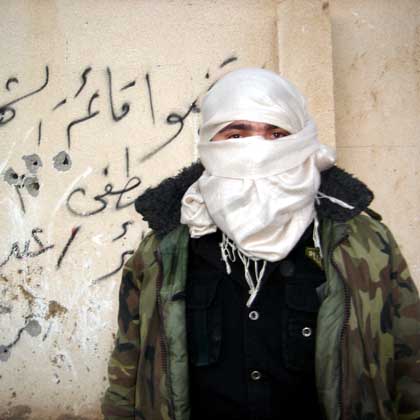
The private car heads north out of Gaza City. A rat-a-tat-tat of machine gun fire echoes through the side streets, belying what remains a fragile cease-fire between Hamas and Fatah in the Palestinian Territories.
Both the driver and the guide are talking nervously into their mobile phones. Instructions are delivered, detours ordered, until finally the vehicle arrives in an empty street and pulls up next to one of Gaza's typical yellow taxi limousines with two rows of back seats. Motors running, the bulletproof vests are quickly loaded from the car into the taxi. The journey then continues in the Mercedes limousine -- until it reaches the end of the road, marked by the wall that separates the Gaza Strip from Israel.
It's cold and the sun is about to set into the Mediterranean. Nevertheless, sweat is running from under Abu Khaled's beard when he jumps into the taxi. Hardly surprising really. If the other soldiers he stands guard with at the gate of an abandoned military base knew his story, the lives of everyone in the taxi would be in danger.
By day, the 23-year-old serves in the Palestinian security forces, which are controlled by Fatah. When Abu Khaled's workday ends, though, he goes home, changes his uniform, pulls out his weapons and transforms himself into a fighter with the Qassam Brigades -- the military arm of Hamas. If his fellow Fatah security officers knew what he did at night, he says, "they would open fire on us immediately."
No wonder the situation in Gaza is so confusing
"We are not a rarity," says the fighter. He estimates that about 30 percent of the men who officially serve with the Palestinian security forces are secretly active members of militia groups with ties to Hamas -- armed men who change sides depending on the time of day. No wonder the situation in Gaza is so confusing. In most of the gun battles between Hamas and Fatah in recent days, it was almost impossible to tell who was shooting at whom, when they were shooting, and why. After each new incident, the barrage of back-and-forth accusations merely triggered the next shoot-out -- a spiral of violence that is difficult to stop.
As the taxi drives slowly through abandoned streets, Abu Khaled tells his story -- the story of a young man who sees no other choice but to fight the enemy any way he can. "The official forces are poorly trained and armed," he says. "They could never do much harm to the Israelis."
He's likely right. A visit to a Fatah training camp that morning was unconvincing. Although the camp's 50 recruits were able to perfectly recite Fatah's various slogans after three months of training, most were incapable of performing even the most rudimentary of combat maneuvers.
But Fatah, the party of Palestinian President Mahmoud Abbas, has recognized Israel and is no longer interested in doing damage to the country. Indeed, it is the party's moderation which has made it a negotiating partner for the West and Israel. Hamas, on the other hand, remains dedicated to eliminating Israel and has yet to renounce violence. Over the years, it has been responsible for numerous suicide attacks on Israeli citizens and is considered a terrorist organization in the West.
Khaled says that even as a teenager he realized that the organizations affiliated with Fatah were "much too soft" to prevail against the Israelis. The Palestinians, he says, are prisoners in their own country. "The Israeli crimes have kindled my emotions and my passion." This passion prompted him to join the Qassam Brigades at 15 -- an early age for a fighter, but not unusual for many of the "converts," as he calls them. "The Islamic ideology is close to my heart and mind."
"Tanks attacked, rockets fired, mines laid
He tells the driver to drive up and down a few more streets. Israeli cameras mounted on balloons hang over the wall and monitor their progress. It wouldn't be the first time a taxi was mistaken for a rocket launcher. "We expect the Israelis to attack at any time," says Abu Khaled. "They have broken cease-fires many times before."
He normally spends five nights a week with the Qassam Brigades, stationed at the border with Israel. "In the past few years, I have attacked Israeli tanks, fired rockets and grenades and laid mines," he says, listing his achievements. According to Khaled, the weapons are homemade; land mines, rocket launchers and even Kalashnikovs and ammunition are produced at Qassam's secret workshops in the Gaza Strip. The material, he says, is smuggled in from Egypt through tunnels or comes "from the Israeli mafia."
Four times, he says, he was almost hit by rocket attacks from Israeli drones; he was injured once in the head and once in the leg. His nighttime duties have been reduced to two nights a week since the cease-fire with Israel came into effect, finally allowing him to turn at least some of his attention to his studies. Khaled, who wants to become a journalist, enrolled in the Islamic University at the beginning of the year. "I would love to work in Hamas's press office."
For his mother's sake, he takes along a mobile phone at night
Though already 23, Abu Khaled doesn't have a family of his own. "I chose the armed path. I could be killed any time. It would be bad enough if my parents and my siblings had to suffer." His mother, he says, is already beside herself out of fear for his safety. He keeps a second mobile phone for her sake alone -- "so that she can call me at night, when I embark on jihad, holy war."
His seven siblings are proud of Khaled, the eldest, who commands a six-man combat unit. "The little ones are anxious to become Qassam fighters themselves. I'm the star of the family," says Abu Khaled, grinning. Financial concerns are partly responsible for the fact that he hasn't married yet. He received his last full pay nine months ago. He uses part of the money he occasionally receives for his daytime services to pay his membership dues in the Qassam Brigades. "It is an honor for us to be permitted to fight for Hamas. We give some our money so that the fight can continue."
In the past, Israel was the only enemy. But now the gun battles between rival Palestinian groups that are audible in the distance force Khaled to confront new problems. He spends his days with 15 other members of the Fatah security forces in the no man's land between the Israeli border and the last few houses in Beit Hanoun. The small unit would be an ideal target for rival militias on the hunt for Fatah supporters.
"It would be difficult for me to shoot them"
Khaled vehemently denies the possibility that the Qassam Brigades could attack his unit. "The Qassam Brigades never attack their brothers. We only defend ourselves." But the possibility has crossed his mind. "If we are attacked by the Qassam Brigades, I will identify myself and switch to their side."
It is a moral dilemma for Khaled, who feels a bond to his fellow members of the Fatah security forces, "as if they were my family. We cook together and spend the entire day talking. It would be difficult for me to shoot at them."
When asked what he would do were his fellow Fatah members to learn of his excursion with a journalist and realize his split loyalties, Khaled says: "I would try to escape."
And if that didn't work, he would kill friends, if necessary. "It has come to this in Palestine."
(Der Spiegel, 12.21)
"ONE BIG PRISON"
A Glimpse at Daily Misery in the Gaza Strip
The 1.5 million inhabitants of the Gaza strip are trapped in poverty and hopelessness. The violence between the Palestinians stems not only from political disagreements, but from deep, daily despair.
Barefoot; dressed in a long gray nightshirt; sleep in his eyes: if his uncle hadn't banged away at the door, Ahmed Kahlout would most likely still be asleep. Instead he dragged himself out of bed at 11:30 a.m., opened the door and invited his visitor in.
Like an old man, he then sank back down onto the two mattresses serving as a sofa in his parents' house -- the only piece of furniture in the living room apart from a fake Persian carpet. He sat there and wearily told his story, one of many such stories in the Gaza Strip: A good education at a school set up by an aid organization, followed by a degree. Since then, the reality of living in Gaza City has ruined all his dreams.
"I did a degree in pedagogy, and wanted to be a teacher," the 23-year-old explained. Instead he is unemployed and spends his days sleeping. "I can't marry, because I have no money to feed a family. So I have a lot of time to kill."
And he does that sitting in semi-darkness. The streets of the Shati refugee camp in the north of Gaza City are so narrow that hardly any light shines into his family's two-room apartment. An old man is perched outside, selling moldy bread as feed for chickens and goats. Palestinian Prime Minister Ismail Haniyeh only lives a few streets away. The Hamas leader didn't move out of the slum following his election to the post of prime minister -- a fact that earns him great respect amongst his followers.
But Ahmed Kahlout is too apathetic to become a radical, despite things going so badly for him. In this respect he is like most of the Gaza Strip's 1.5 million inhabitants: they get on with lives that are marked by poverty and despair. They live an existence in which the bloody conflict between radical Hamas and the seemingly corrupt Fatah is just one more misfortune.
The Gaza strip is just 40 kilometers long and 10 kilometers wide (25 by 6 miles) -- and for years it has been a byword for misery. This year has been even harder for its inhabitants to bear. To understand the sheer scale of the misery, one has to visit John Ging. He is the director of the United Nations Refugee and Works Agency (UNRWA), the body that has been dealing with the Palestinians since they were expelled following the foundation of the state of Israel in 1948.

Gaza, Bureij refugee camp
"Living in one big prison"
The statistics that the Irishman reels off speak for themselves: 89 percent of the population is poverty-stricken, living on less than $2 a day. Over 60 percent are unemployed, and since the election of the Hamas government in January, international aid has dried up. It had been used to pay the salaries of public officials. Now, even those who have jobs have been thrown into poverty, meaning that over 860,000 people in the Gaza Strip are now living on food parcels distributed by the UNRWA. Over half of the population.
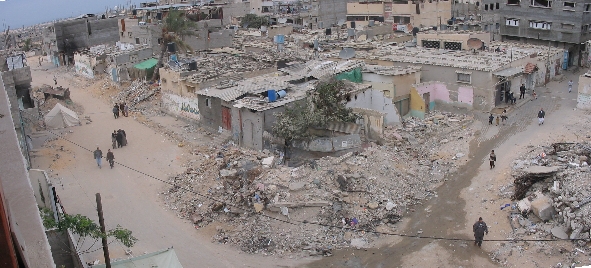
Gaza, Rafah refugee camp
But the real drama, says Ging, is that the Palestinians are "effectively living in one big prison." After the withdrawal of Israeli troops last year, there was a feeling of optimism -- that just as quickly turned into hopelessness. "Everyone was counting on an economic upswing once the border with Egypt was open," Ging says.
Instead, trade has come to a virtual standstill as the border has remained mostly closed. Israeli pressure has ensured that the border crossing for people at Rafah is only open 14 percent of the time. And only 14 trucks get through the crossing at Kareni every day -- instead of 400 originally planned. It is the only crossing for those goods not produced in Gaza and thus have to be imported from Israel.
"According to the Dec. 5 treaty on the freedom of movement, the Rafah border can be open if European observers are present," says Ging. However, these observers live in Israel and Israel can use their discretion to prevent them from crossing into the Gaza Strip. "That's how you close a border."
Travellers are not the only ones affected. Farmers who used to export their fruit and vegetables to Israel are now stuck with them. That is the daily lunacy of the Gaza Strip: there are plenty of tomatoes in the markets, but no fish. The chunk of land is on the coast, but the fishermen are only rarely allowed to go out to sea by the Israelis. And frozen fish seldom makes it over the border from Israel.
"No one has any money"
Mahmoud Abu Djayab operates a repair shop for electrical goods in the central market, and he has more work than ever. People can't buy any new appliances, so they need to get even the most worn out cooker fixed. "But that's no use to me," complains the 51-year-old. "All that I have earned is a book full of IOUs. Everyone is living on credit. No one has any money to pay me."
Ging doesn't blame the Israelis for everything. When he speaks about Hamas, his voice is filled with anger: "Hamas knew that the money would stop flowing if they didn't maintain relations with the international community," he said. "But they didn't do it anyway. That was irresponsible. The party took into account the fact that the people would suffer." He says that international donors have the right to stop their aid payments. "But then they can't act surprised when the psychological strain leads to a greater tendency towards violence." The fact that the Palestinian government was 70 percent dependent on foreign aid wasn't considered either. "The absence of aid deliveries caused chaos."
As bad as the economic situation is for the inhabitants of the Gaza Strip, the psychological strain is even worse. "In the past people hoped that the Israelis would leave. Today there is no more light at the end of the tunnel," Ging says. Morale is terribly low. People feel oppressed. Hopelessness leads to despair, which in turn leads to violence. What worries Ging is that a lost generation is growing up. "Just try inspiring a young person to learn, when he knows that after school absolutely nothing awaits him."
Ahmed Kahlout had finally woken up, and he even put on a shirt and trousers for his visitor. But he remained uncommunicative. No, he had no idea what he would be doing in five years time. No, he wasn't political and he hadn't bothered voting. "The civil war will eat everything up anyway," he said. To John Ging "the Palestinians' spirit isn't broken yet, they have the will and the ability to organize their own affairs." But the UN man may be a bit too optimistic.
(Der Spiegel, 12.18)

최근 덧글 목록