
공지사항
-
- '노란봉투'캠페인/국제연대..
- no chr.!
27개의 게시물을 찾았습니다.

Following some (WITHOUT - nearly - any of my comments^^) articles, reports, pics..
..by indymedia.de:
☞ On the road to Steffanshagen
☞ Decentralized Actions Blockade G8..
☞ State paid agent provocateur unmasked
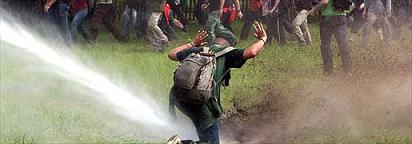
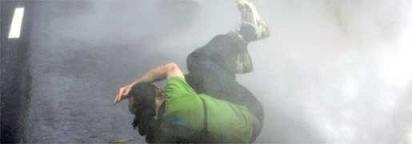
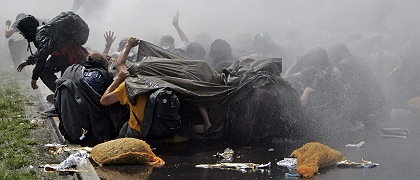
☞ G8 TV
☞ Blocking G8 (indymedia UK)
[BTW.. it's very interesting that especially the "revolutionary" anti-g8 alliances have NO updated informations/reports. You'll find only old stuff from last Sat./Sun...]
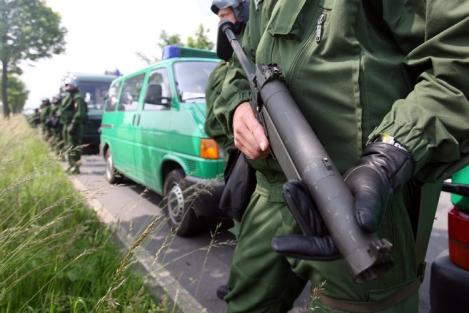
The latest stuff by the bourgeois media:
☞ G-8 Protesters Block Roads to Summit
☞ G-8 Protesters Gear Up for Day Two of Blockades
☞ 15 Police Officers Against 5,000 Demonstrators
☞ Photo Gallery: Demonstrators Outfox Police at Heiligendamm
☞ G8 "summit", the first day in pictures (incl. many pics from the protests/German subtitles)
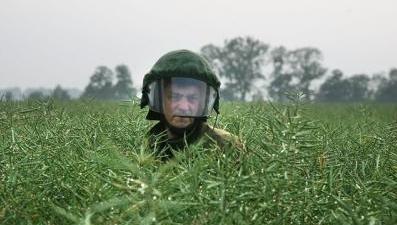
That's not one of my ("sensible"^^) comments:
Today afternoon: The 'Alternative Summit' - "A. Merkel is a bitch" (not literally..^^). The organisers of today's concert 'Your Voice Against Poverty': "A. Merkel.. she's soo sweet" (eeh~ f. them all!!). And A. Merkel on the German press conference: "Eeh~ bla, bla, bla..."
THAT'S JUST THE F.. REALITY!! (sorry!!)



..40 years of failure (Guardian/UK, 6.05)
The world was gripped by Israel's swift triumph in 1967. But today the bitter conflict with the Palestinians seems more intractable than ever

It was Moshe Dayan, the hero of Israel's 1967 victory, who set the tone for what was to follow: "We are waiting for a telephone call," the one-eyed general said disdainfully as the frontline Arab states - Egypt, Jordan and Syria - reeled from their crushing defeat. Of the Palestinians - the newly conquered population of East Jerusalem, the West Bank and Gaza Strip - little was said at the time. But the six-day war put them back at centre stage in their conflict with Israel. They have stayed there ever since.
"Rarely has so short and localised a conflict had such prolonged, global consequences," commented the historian Michael Oren. "Seldom has the world's attention been gripped, and remained seized, by a single event and its ramifications." Israel's triumph, someone else observed wisely, was "a cursed blessing".
Perceptions have changed so much in 40 years that it is hard now to recapture the sympathy that was felt for Israel as Egypt mobilised, and residents of Tel Aviv filled sandbags. If the country's leaders talked emotively about the vulnerable "Auschwitz borders" left after their 1948 war of independence, blood-curdling Arab rhetoric bolstered the image of Israel as the underdog.
But little David, just 19 that May, was rapidly to become a lumbering Goliath. As euphoric Israelis thronged across Jordanian lines to Jerusalem's Old City and marvelled at its Jewish and Muslim holy places, a little-known guerrilla commander named Yasser Arafat fled Ramallah and Palestinians adjusted to a new reality of curfews, informers and military occupation.
And it is that occupation, now as then, that stands at the heart of the conflict between two peoples engaged in a vicious, primordial - and utterly unequal - struggle over one small land. It has taken a terrible toll.
For Palestinians, 1967 was an extension of what began in Ottoman times, before they were a nation in the modern sense, when - half a century before the Nazi Holocaust - Zionists called for "solving" the Jewish problem in "a land without a people for a people without a land". If 1948 was their first nakba (catastrophe), the June war was the next devastating instalment.
It will long be debated whether Israel missed an early opportunity for peace. But the war reignited the dormant debate about the territorial limits of Zionism, fatefully fusing religion, nationalism and security. It produced no strategy for turning military supremacy into a tool to change relations with the Arab world.
"The truth of the matter was that when the Arabs finally called, Israel's line was either busy or there was no one on the Israeli side to pick up the phone," the Israeli scholar Shlomo Ben-Ami wrote later of Dayan's laconic quip.
Israel seemed to care less about peace than territory. It insisted that what it simultaneously called the "administered territories" and "Judea and Samaria" (the Hebrew names for the West Bank) were up for negotiation. (Unlike East Jerusalem and the Syrian Golan Heights, they were never annexed.) But the creation of "facts on the ground" gradually erased the old green line border, and nowhere more completely than around Jerusalem. The result - which some call apartheid - is 450,000 Jews living with full democratic rights in 125 settlements amidst 2.5 million Arabs under illegal occupation.
The wars of 1973 and 1982 and the return of Sinai to Egypt changed nothing on that central Palestinian front. Israel's "liberal occupation" - a flattering self-image that won wide international acceptance - did not outlive the 20th anniversary of the six-day war. The first intifada - the largely peaceful "war of stones" that erupted in 1987 - did more for the Palestinians than two decades of "terrorism" or "armed struggle," reminding the world, and growing numbers of Israelis, that a settlement had to address their demands.
Yitzhak Rabin's recognition of the Palestine Liberation Organisation (PLO) at Oslo was a historic turning-point. But Rabin and Arafat could not translate their "peace of the brave" into a workable final deal. The Islamist movement Hamas, which rejected the legitimacy of Israel even in its pre-67 borders, pioneered suicide bombings and got the Likud's Binyamin Netanyahu elected. The militarised second intifada was the disastrous result.
Netanyahu was right about one thing: the Middle East is a "tough neighbourhood," as he famously remarked. It has got a lot tougher. Today there is a generation of Palestinians who have known nothing but occupation and a generation of Israelis who have experienced only dominance and repression of the Palestinians. As the Israeli philosopher Yeshayahu Leibowitz pointed out, justice and occupation are not compatible. Both societies have been traumatised and brutalised.
Israel has its "separation wall," built to keep bombers away from its restaurants and shopping malls but perceived as another land grab. Palestinian workers have been replaced by Chinese and Filipinos. But its military superiority has not created the security and normality it craves. Gaza - unilaterally abandoned by Ariel Sharon - has become a vast prison, a global byword for misery, desperation and anarchy, a cruel parody of the freedom the Palestinians yearn for.
Pessimists believe too much water and blood have flown down the Jordan in these 40 years, that these changes are irreversible, that this is a land that can now be neither shared peacefully nor divided.
Optimists point out that time has not stood still. Egypt and Jordan have made peace with Israel, with realism if not joy. Syria (and Lebanon) will follow suit if Israel returns the Golan. March's summit in Saudi Arabia confirmed peace as the "strategic choice" of the entire Arab League, a far cry from the three noes - to peace, to recognition and to negotiation - of the Khartoum conference in September 1967. Mayhem in Iraq, jihadist fanaticism and Iranian ambitions are all part of the new geostrategic equation.
Still, the Palestinians remain at centre stage. A solution for the refugees is vital; so are the interlinked questions of Jerusalem, borders and a viable, independent state. Even Hamas claims it will settle for the pre-1967 lines, as it fires rockets - legitimate "resistance," it insists - across them. Much depends on whether it will learn to act pragmatically like the PLO before it: engagement is more likely to encourage that than isolation. Israel's acceptance as part of the Middle East is at stake.
Majorities on both sides say they want peace but few believe it is attainable. It has all been discussed countless times in the last four decades. It all still looks impossibly hard to achieve.
A kind of collection of articles/reports, incl. contributions by Olmert (Israel), Haniyeh (Palestine/Hamas), pictures and some interactive stuff you can check out here:
☞ ..six-day war, 40 years on (Guardian, incl. a lot of stuff..)
☞ Israel's Phyrric Victory (Der Spiegel/D)
☞ Yedioth Ahronoth Special (Israeli bourgeois propaganda)
☞ Haaretz Special (Israeli "left-liberal"..)
☞ Abbas sees Palestinians on brink of civil war (IHT)
Now, three days after the "incident" in Rostock - the bourgeois media was/is calling it "Beginning of the civil war" - and just hours before the next main protests it should be a time to think how it came to such a situation/what was the reason why..
Already Saturday after the demo/"battle" I had several discussions with other (militant) activists and I came to the conclusion that it was/is just an extreme expression of a deep frustration, caused by different factors:
-> First of all, no doubt, the state repression against the militant left in the weeks before the g8 protests was/is one of the main factors.. But this is definetely not everything..
-> Many of the "militants" (i.e. activists of the so-called "black block") had to found out that there is NO "united" g8 protest movement. Unfortunately it tooks about two years (the time of preparation) for them to find out that the majority of the "movement" want to have just a more "human" capitalism.. Only a really small minority (and even this minority is complete without any influence in the society..) wants a "regime change". Actually many of the "g8 protestors" now are complaining that the militants had destroyed their "beautiful, colorful party"..
-> On the other side the ruling class in the last weeks was getting closer and closer to the "protest mevement". For example H. Geissler, the former secretary general of the ruling (conservative) Christian Democratic Party (CDU) became just some days ago a member of Attac, one of the main/leading groups in the g8 "protest movement"..
-> For many of the militant activists it would be no miracle if the g8 summit would also adopt the motto "Another World Is Possible"..
-> In fact for many it became clear that (large parts of) the "anti-g8 movement" and the g8 are just "the two faces of the same coin/medal"..
AND NOW:
Attac: "We don't want to see them (the militants/the "black block") anymore on our demonstrations", they told the bourgeois media..
Die Linke/The Left(좌파당): "We are really outraged.." (of course just about the "black block's" activities..)
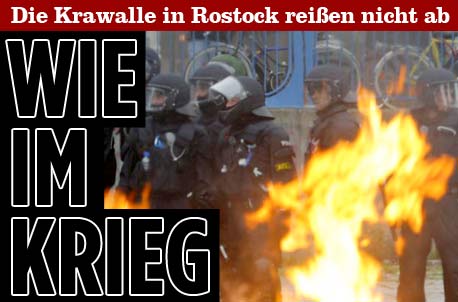
"Like war", so the BZ - mass circulation/yellow press - in Berlin
The bourgeoisie: "We need rubber bullets.." "Anti-Terror units against the 'black block'!!".. etc..
☞ G8 TV
☞ Pictures
Please read also:
(indymedia.de/BTW.. in my opinion: it's not the problem who "took the first stone"!!)

When you read following article, published in yesterday's Observer (UK), you simply can come to the conclusion that the Lebanese Army is preparing for a massacre/blood bath in Nahr el-Bared refugee camp. And meanwhile, since last night, the clashes spread to a second refugee camp, Ain el-Hilweh(*).
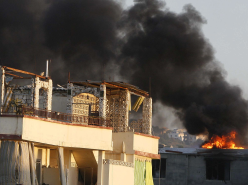
Ain el-Hilweh this morning,
attacked by the Lebanese Army
Lebanese troops move in for the kill
A new emboldened Beirut government is forcing an end to a 10-day stand-off as negotiations fail
Lebanese troops pushing ever farther into a besieged Palestinian refugee camp vowed to kill any members of the al-Qaeda-linked Fatah al-Islam group inside who did not surrender.
Lebanese officers on the scene said they would continue the assault until all of the militant jihadists were dead, and warned that any civilians who remained in the camp after last week's evacuation would be considered combatants.
The threats came as a Gazelle helicopter fired missiles yesterday and strafed buildings. 'There is no way we will give up our weapons because it is our pride. We cannot even contemplate surrendering,' Abu Salim Taha, a spokesman for the militants, said by telephone from the Nahr al-Bared camp. Those inside reported dire conditions. ' More than 60 per cent of the camp has been destroyed,' Abu Darwish, a resident, said.
The fighting followed the deployment of scores of armoured vehicles last Friday to break the two-week siege. As the fighting continued for a second day, smoke rose over the camp amid the constant thud of artillery explosions.
The violence - the worst internal fighting since the end of Lebanon's civil war 17 years ago - has driven up to 25,000 of the camp's 31,000 residents to flee. Thousands remain trapped. The final drive to clear the camp of militants was ordered by Lebanon's Prime Minister, Fouad Siniora, who has been emboldened by a UN Security Council resolution to establish a tribunal to investigate the murder of the former Prime Minister Rafik Hariri.
Officially, the Lebanese government says that army units resumed shelling and attacks on Nahr al-Bared in response to near-daily sniper fire that killed two soldiers last week. Unofficially, military commanders said the Lebanese army would root out several hundred members of Fatah al-Islam.
Yesterday the army claimed it had overrun a series of militant positions used to snipe at soldiers, and had surrounded the Fatah al-Islam leadership. 'This is it. We tried to negotiate, but it didn't work,' said one special forces officer. 'The army will continue until they are all dead. There is no stopping.'
The final push to end the stand-off came after a near 10-day ceasefire to allow for the evacuation of civilians and for Palestinian authorities to negotiate a peaceful settlement. But with the Lebanese government demanding that the militants be turned over for trial negotiations quickly stalled.
Sultan Abu al-Aynayn, the PLO commander in Lebanon who had tried to negotiate an end to the fighting, had apparently given his tacit approval for the operation.
'While it is true that we might disagree on the means, a positive sign lies in the fact that various Palestinian and Lebanese groups agree that Fatah al-Islam should be readily crushed,' Aynayn said.
The Lebanese army commander at the scene said anyone who had not left during the ceasefire was unlikely to be considered a non-combatant.
'We risked our lives for 10 days to allow all the civilians to escape,' he said. 'If someone did not take the decision to leave, then they took the decision to stay, which means they are not a civilian.' Although there has been almost no independent access to the camp for almost two weeks, Red Cross workers estimate that thousands of innocents could be trapped inside with no electricity, food, water or medical care.
Some Lebanese government officials have accused Fatah al-Islam of using civilians as human shields and having fired on people who were attempting to escape the camp.
'The last civilians I took out of the camp were a family with a handicapped father five days ago,' said one civil defence worker. 'Fatah al-Islam would shoot at us every time we entered the camp. The Lebanese army would have to fight them just to get us close enough to take out the sick and the wounded. I could hear them screaming "Allahu Akbar" [God is great] as the soldiers killed them while we were taking out wounded civilians,' he said.
The decision to allow the army to storm the camp comes at the end of a week that saw the pro-western Siniora government make strides in the political struggle against the Hizbollah-led opposition that has paralysed the government for nearly a year. The opposition is demanding 11 cabinet seats, which would allow it to veto government policy.
But after the Security Council established a tribunal to investigate the 2005 murder of Hariri - a killing widely blamed on Syria and the key objection of the opposition - Siniora quickly moved first to welcome Hizbollah and its allies back into the government's ranks and, a day later, to crush the Fatah al-Islam uprising.
The sudden assertiveness of a Lebanese government that was widely thought to be teetering on the brink of failure took both the opposition and the militants by surprise.
Hizbollah found its position weakened after a series of uncharacteristic political mis-steps by its leader, Sayyid Hassan Nasrallah, last week, which Siniora has been quick to exploit. Nasrallah last week warned against storming the camp, just as his Christian ally, Michel Aoun, called on all Lebanon to support decisive military action.
http://www.guardian.co.uk/syria/story/0,,2094174,00.html
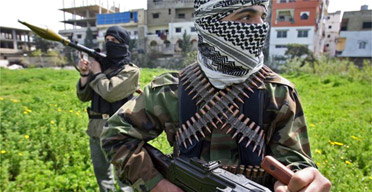
Nahr el-Bared, Fatah al-Islam militants
For more informations/latest news please read:
☞ Fighting Breaks Out at 2nd Lebanon Camp (AP)
☞ More clashes at second Lebanon camp (al-Jazeera)
☞ Lebanese accuse civilians of helping camp militants (Guardian, UK)
☞ A New Generation of Palestinian Militants in Lebanon (Der Spiegel, Germany)
☞ 'We have no rights and no future' (Guardian)
* Ain el-Hilweh is one of the largest camps for Palestinian refugees in Lebanon. In the past - the 1970's/80's - it was several times attacked by Lebanese Christian Militias, the Israeli Air Force and the Syrian Army (of course every time with heavy losses in the civilian population!!)..
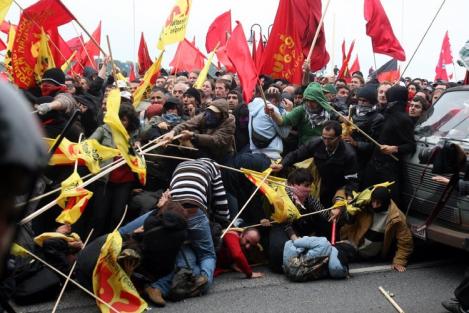
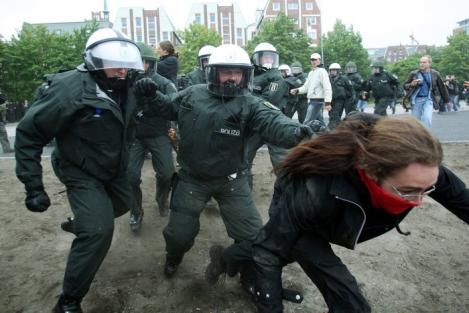
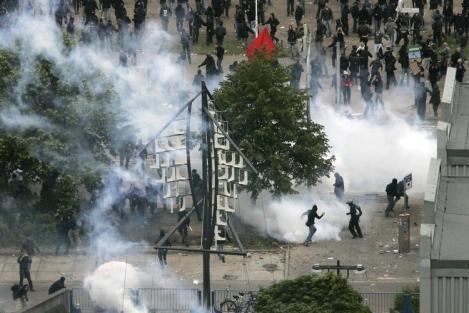
6.02, Rostock: The First Main Anti-G8 Protest
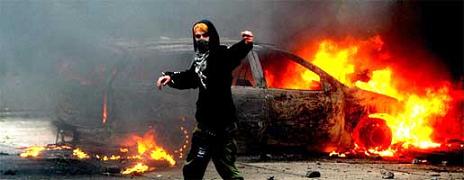
"In the run-up to the G8 Summit next week, tens of thousands of anti-G8 protesters, with several thousands on the Black Bloc alone, took part in the international demonstration in Rostock on 2 June, 2007. With colourful banners and puppets, protesters of different backgrounds tried to draw attention to the bigger problem of capitalism and the 'empire'. Police was very aggressive and provocative, using batons, water cannons and tear gas, not only against the 'bad protestors' but 'normal' ones as well. Violent confrontations were taking place while, on stage, the concert and speeches were trying to continue. Over 100 people were arrested and many injured on both sides" (indymedia Germany)
Well, it seems that yesterday's initial phase - the mass demonstration in the north-eastern German city Rostock under the motto "Another World is Possible" (*/what a surprise!!^^) - against the coming G8 Summit was a "full success" for nearly everyone, except the anti-G8/anti-capitalist movement (eh, is there any in Germany? I really don't know..)
First of all: the organisers of the demo expected 100,000 demonstrators, but only 50,000 people participated. So, it was not a success, not really..
But for the other side of the barricade it was successful: The permanently provocations by the cops before and during that day - only few hours before 150 anti-fascist demonstrators were arrested in Schwerin (a city also in the north-east of Germnany) - were leading to the expected result: some kind of street battles. Finally the proof that the 100 million Euro for the "security measures" are definitive necessary..
The (mainly) bourgeois media got their pictures/reports about "violent anti-g8 demonstrations"..
And last but not least it was a "giant bussines" for the multi-national companies, such as McDonalds, Burger King, Pizza Hut.. Because "thousands of hungry protestors"..(^^)
☞ The Rumble in Rostock (Der Spiegel, incl. video)
☞ German City Rocked by Violent Riots


☞ G-8-Demo in Rostock, pictures (Die Welt, reactionary German daily..)
☞ "Photo Gallery" (incl. f****** Engl. subtitles, Der Spiegel)
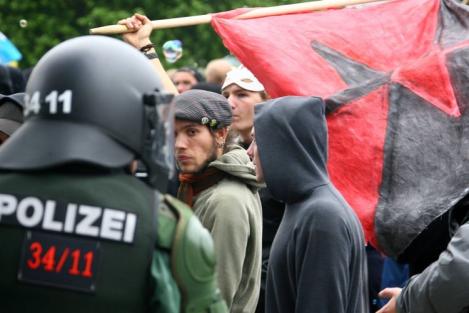
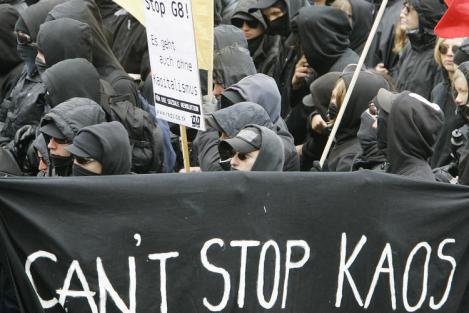
For more informations, reports, videos..
☞ Rostock: Tens of thousands protest.. (indymedia Germany)
☞ GipfelSoli Information Group
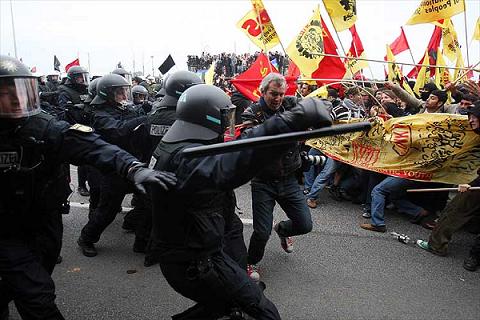
* Unfortunately(harrharr..) the majority of the demonstrators and of course the organisers of the demo just want a more "human"/"beautiful" capitalism, according to the first speeches of the finishing rally..
*****
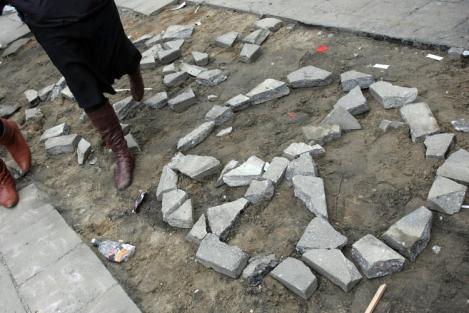
BTW.. 15 years ago the residents (of course not everyone) of Rostock joined (or at least applauded) the racial attacks against migrant workers/refugees in R.-Lichtenhagen
☞ ..Racist pogrom in Rostock..

Especially the German bourgeois media is writing about the - in fact - senselessness of the G8 Summit. Actually it's just a show event of the "leaders" of the "leading" industry countries (plus Russia) - without any result. Except, according to a guest comment in yesterday's Der Spiegel (THE German "leading" bourgeois magazine), that the G8 will try to strengthen the front against the "developing 'power' China" ("The western industry nations are seeing China's boom as an attack against their own supremacy and fearing a World War about/for prosperity - what they only can lose", so today's Berliner Zeitung).
Of course another result will be the increasing repression against the anti-capitalist movement, especially in the days before and during the summit. And last but not least the excessive increasing of security measures and together with it the massive waste of public finances (the money of the "ordinary" tax payers).
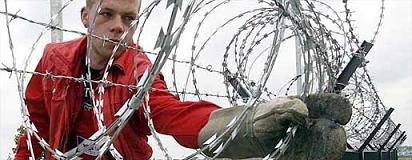
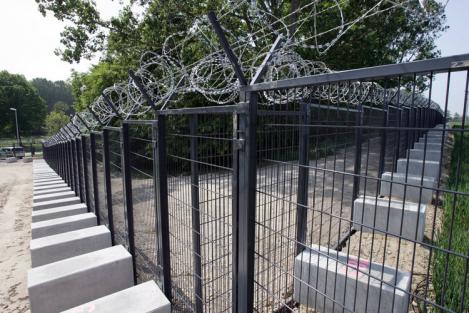
Alone the "security fence/wall" around the Heiligendamm costs 12 million Euro (about 15 billion Won). The entire "security measures", incl. 17,000 cops, 1,100 heavy armed soldiers, US Navy war ships etc.. will cost at least 100 million Euro (around 125,000,000,000 Won^^) - for only a three-day "event"!!
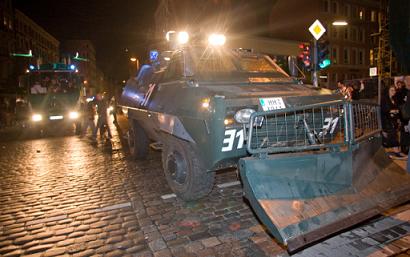
Preparation for a "civil war"?
Anyway.. About the latest developments Der Spiegel published in the last two days following:
Security Tightens as G-8 Summit Approaches
With just a week left before the G-8 summit in Heiligendamm in northern Germany, authorities are ratcheting up security precautions. On Wednesday, the razor-wire fence surrounding the venue was closed. But criticism of German authorities for their draconian security measure remains intense.
Even as foreign ministers from G-8 countries are meeting in Potsdam with their counterparts from Afghanistan and Pakistan on Wednesday, security along the Baltic Sea coast continues to get tighter. At 7 a.m. on Wednesday morning, police officially closed off public access to the seaside resort of Heiligendamm where the G-8 meeting of leaders from eight of the world's most economically powerful countries is to take place next week from June 6-8.
The early lockdown is part of an elaborate security strategy being pursued by the Germans to ensure that protests against the G-8 summit -- to be attended by Britain, Germany, Italy, the United States, Russia, France, Japan, and Canada -- don't get out of hand as they have in the past. Authorities have built a 12-kilometer long, 2.5 meter tall, razor-wire fence around the resort at a cost of some €12.5 million ($17 million) and only residents and those on official business will be allowed inside starting Wednesday.
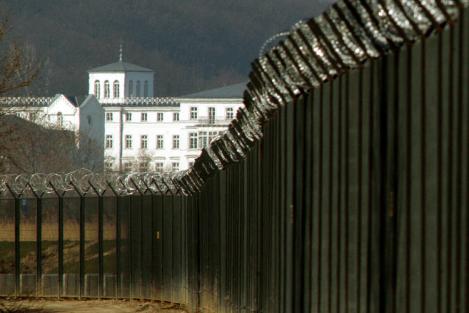
Additionally, the coast in front of the resort will be patrolled by warships and all other boats are banned from the area.
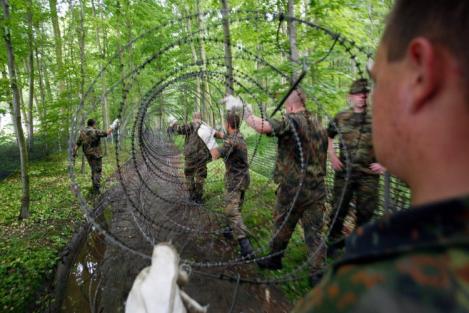
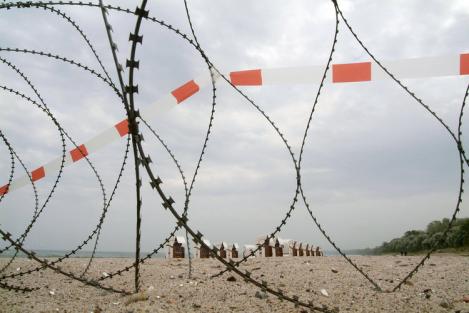
German officials have been heavily criticized for their security strategy ahead of the summit meeting. Not only have demonstrations been banned near the site of the meeting, but police have been making headlines recently for a number of seemingly invasive tactics. Earlier this month it was revealed that the police were collecting odor samples (more...) from anti-globalization activists so that dogs could identify them more easily at demonstrations. Last week, it came out that investigators were opening mail addressed to anti-G-8 groups in Hamburg.
On Wednesday, the mass-circulation tabloid Bild reported that German politicians were considering confiscating the driver's licenses of protesters should they participate in violence. "I have nothing against peaceful demonstrations," conservative Christian Social Union politician Renate Blank told Bild. "But if it becomes violent, then courts have to also be able to ban people from driving."
A number of pre-G-8 protests have already descended into violence. On Monday evening in Hamburg, a 5,000-person-strong protest against the ASEM summit of Asian and European foreign ministers got out of hand as police cars were destroyed and barricades had to be erected in the streets. Earlier this month, another protest in Hamburg likewise turned ugly following police raids on the offices and apartments of violence-prone left-wing activists...
http://www.spiegel.de/international/germany/0,1518,485609,00.html
Related:
☞ Anxious Locals Proving Good Neighbors as Activists Move In (Der Spiegel)
☞ A Protest Culture Attempts to Reawaken Itself
☞ ABC-Waffen sollen G-8-Demos verhindern ("interview"^^, Die Welt)
☞ An Interactive Map of the Summit Site: World Leaders Fenced In
For latest news/informations:
☞ G8 Protests Timeline (indymedia Germany)
BTW.. if you don't know so far: It's absolute possible (^^) to make "good business" (aka maximum profit) in the name of "Another World (is Possible)":

"Bionade - The Official Drink of a Better World" (German commercial)
^^ With the "alternative" (the brand new) capitalism against the "old-school"
and the new (aka neoliberalism) capitalism!!^^
*****


최근 덧글 목록