사이드바 영역으로 건너뛰기

게시물에서 찾기2006/02/12

3개의 게시물을 찾았습니다.

  1. 2006/02/12
    팔레스티나...
    no chr.!
  2. 2006/02/12
    Paradise Now - The movie
    no chr.!
  3. 2006/02/12
    2006年.. (#3)
    no chr.!

팔레스티나...

A story every day happens there

under the Isreali occupation...

Published in today's(2.12) edition of Haaretz

http://www.haaretz.com/hasen/pages/ShArt.jhtml?itemNo=681040&contrassID=2&subContrassID=14&sbSubContrassID=0


"There will be a Vietnam here"

By Gideon Levy


The children threw stones, the border policemen threw grenades. The result: an 8-year-old boy in intensive care with a serious head injury, anesthetized and on a respirator, his situation serious but stable
Abud moves his right leg for a moment. His left side is paralyzed. The respirator tube is stuck in his mouth, his little chest rises and falls at the rate dictated by the machine, his eyes are swollen and closed. A little boy in a coma. Will the border policemen who chased him in the alleys of the refugee camp, tossing stun grenades at little children, see him? Will they think about his fate - to die or to remain a cripple for the rest of his life?

His head is bandaged, hiding the compressed fractures in his skull. The doctors will be able to assess the amount of brain damage only in a few days. This Sunday, two days after he was wounded, there was a slight improvement. A very slight one, says the doctor cautiously. But the child is not waking up. High up in the adjacent building lies an old man in a similar state: Ariel Sharon. But Abdel Malek Zalbani is only 8 years old, a third-grade pupil, a child of refugees. His pet name: Abud.

The Border Police come to the camp almost every day. The residents of the camp say that they provoke the children, they honk and they curse. The children throw stones at them. The border policemen throw grenades at the children, stun and smoke grenades. The thunder makes the walls of the houses tremble, the gas penetrates the crowded homes, suffocating their inhabitants, including many old and sick people, and many children. The residents place plastic sheets on their windows, but it doesn't help.

That has been the situation for several months, since the construction work on the "Jerusalem envelope" wall began, in the valley at the end of this crowded refugee camp, Shoafat. There are 40,000 residents on two square kilometers, refugees from the Jewish Quarter of the Old City in 1967, Jerusalemites with blue ID cards like mine and yours.

Sometimes it ends with temporary suffocation, sometimes it ends with brain damage, as in the case of the child Abud. It didn't happen during the evacuation of Amona, nor in the caravillas of Carmia, and therefore hardly anyone writes about it. The Justice Ministry's Police Investigation Unit is investigating: This week, investigator Shai phoned the central eyewitness, and after a few moments he cut off the conversation impatiently, after the witness asked the investigator to come to the scene of the incident. Investigator Shai refused to come, and said that he would call again 10 minutes later. Shai did not call back.

The investigation was apparently finished. The eyewitness says that he saw Abud hurt by a stun grenade that hit his head. The Border Police claim that the child was hit by a stone thrown by one of his friends. Border Police spokeswoman Superintendent Sarit Philipson didn't even bother to reply to Haaretz. In the Shoafat camp, they are threatening to turn the camp into "Vietnam." At Hadassah University Hospital in Ein Karem, the doctors are fighting for Abud's life.

The site of the incident: a junction of steep, narrow alleys that descend to the wadi and the wall that is gradually being built in the middle of it. Every house leads straight to the street where piles of garbage are strewn, including the remains of the Border Police grenades. Here is the house into which Abud was brought when he fled from the pursuing border policemen. The owner of the house, Ibrahim Amla, awoke to the smell of gas spreading in his house.

Outside the children were running around, and Amla's sister rushed to bring Abud into their house. But the child immediately sneaked outside. Amla came out after him, and then he heard a loud noise, and immediately saw Abud fall on his face, his back to the border policemen and a great deal of blood flowing from his nose and his mouth. Amla is convinced that the stun grenade is what hit Abud. "The noise of the grenade came exactly when he fell."

He identified the commander of the force who was standing behind the corner, a man named Yigal Larouche. Amla says that even after the boy fell, the border policemen did not approach him to administer first aid. Amla picked up the boy and brought him to his neighbor Ahmed Jamil, who was less out of breath than he was, and Jamil ran with the boy to the nearby clinic. The boy's father saw all that in his car mirror, while he was parking, on his way home. The father works as a maintenance man at Shaarei Zedek Medical Center in Jerusalem.

When the border policeman pass through the valley with their jeeps, the children throw stones at them. Afterward the Border Police run after them into the alleys, and throw their stun and gas grenades at them. "Means for dispersing demonstrations" that nobody dreamed of using in Amona, which is now demanding a commission of inquiry.

Last Friday, shortly after 11 A.M., Ibrahim Zalbani, the boy's father, was returning home from his work at Shaarei Zedek and was about to park his car. He already smelled the gas at the entrance to the alleys. When he parked, he heard a boom, and immediately afterward the screams of a woman. Then he saw his neighbor in his mirror, fearfully carrying a bleeding child in his arms. By the time he had emerged from his car, they had already told him that it was his Abud. "I was in shock. Anyone who saw him was sure he was finished. His head was crushed. I didn?t know what to do."

At the nearby HMO branch, they tried to call an ambulance, but an Israeli ambulance won't enter the camp without an escort. Ismail and his horrified brothers rushed to take Abud to Hadassah University Hospital at Mt. Scopus, in their car. They were not sure that he would make it to the hospital alive. At Mt. Scopus they called an ambulance to rush Abud to Hadassah Ein Karem, where they quickly brought the child into the operating room. They told the father that Abud's life was in danger.

The camp residents have been very upset since the construction of the wall began. There isn't a day without stones, and not a day without gas. Aside from Shabbat. This Sunday, too, the camp was silent, and the border policemen disappeared, apparently because of the incidents on Friday. "They overdo it too much here," says the shutter man, Wahal Mohammed Ali, whose house in the camp was demolished a few years ago, along with another two dozen homes. "Why? Because I approached Pisgat Ze'ev. It wasn't Pisgat Ze'ev that approached me. I've been here since 1967, and they came in 1995."

"You're a settler," says Amla to him defiantly. "No, I'm a terrorist," replies the shutter man, from his red van. "They don't want us here. We disturb the view of Pisgat Ze'ev. They look from the balconies and see a refugee camp. That disturbs their view."

Everyone here speaks good Hebrew, and most of them work in Jerusalem. Amla: "I want the world to know that if the situation continues this way, there will be a Vietnam here. If necessary we will open Vietnamese-type traps. We'll do whatever we have to here, because we have nothing to lose. There is nothing more precious to us than our children and our elderly parents."

Shai of the PID is on the phone. He wants Amla to come to give testimony. Amla: "Send the investigators here, to see the scene of the incident. This incident did not come from nowhere. It came after an accumulation of many incidents. I'm not talking to you about politics. I'm talking to you about the behavior of your soldiers. I'll give testimony here. Do you want me to tell you what happened, or do you want me to tell you what you want to hear?"

"I'll call in another 10 minutes, and you decide if you want to come to give testimony," says Shai, hanging up forever, apparently. The PID is investigating.

Amla was married to a Jewish woman, a new immigrant from Argentina, who has been in Eilat since their divorce. Their four children are with him in the camp. They called one of their daughters Millennia, because she was born on the day when the millennium was supposed to begin according to the count of Nostradamus, as Amla explains to us. They called their other daughter Miari, after the hero of the book by Guatemalan author Miguel Angel Asturias, as Amla also explains.

He is an electrician who worked for six years for fat Itzik at Cafe Olga in North Tel Aviv, from where he remembers Judy Nir-Mozes Shalom, and afterward he worked as an installer of satellite dishes and converters for the YES satellite company. When he speaks about the poverty of his camp, he quotes from the film "The Silence of the Lambs," which said that people have a desire, as he puts it, for what they see around them.

"Do you know what it is to come back from an installation at Kibbutz Harel to this camp?" His sister lives in Calabria, Catalonia, north of Barcelona, where she married a local resident who converted to Islam.
"I'm a proud Palestinian, and I know that I'm your enemy. I know that this war will not end, and I know that your attitude toward my existence is like your attitude toward the existence of an insect, even though I have a blue ID card like yours. I heard that during the evacuation of Gaza they taught the soldiers how to show restraint and how to behave nicely. Here they train them in mercenary camps. They don't care who gets hurt. You're building a wall. I don't think that it justifies such a large amount of gas. For every child who throws a stone, you punish 100 families. How far can a child get with a stone? If a child in Pisgat Ze'ev were to throw a stone, would you also use gas against Pisgat Ze'ev?

"I once had an argument with a border policeman. He told me: Keep an eye on the children so they don't throw stones. I told him: I'm not your bodyguard. I didn't invite you here, and I'm not responsible for your safety here. You, on the other hand, are my guest, and I'll kill in order to protect you, but the soldiers are not my guests. We try to prevent the children from throwing stones, but when I saw that even after I disperse the children, sometimes by force, and I ask the Border Police to stop throwing grenades and they continue, I stopped trying to disperse them. The Border Police toss grenades in every situation. They're suffocating us.

"I've been here since I was born. All my life we used to go to the forest opposite. That's the only place where the children can go. Pisgat Ze'ev is there, and now they're building the wall, too. Where will we go? Where will the children go? There isn't a single playground here in the entire camp. Let them take the blue ID cards. We have no problem with that. If a soldier wants to abuse me, he can do so even with a blue ID card."

Amla says that some of the children of the camp walk around with birth certificates in their pockets. There is probably no other place in the universe where children walk around with their birth certificates. The soldiers ask for their ID cards, and if they don't have them, they sometimes have to show their birth certificates. There is a roadblock at the camp, and going out in the morning to the schools outside the camp, where almost all the residents have Israeli ID cards, is sometimes difficult.

Ibrahim Zalbani sits downcast at the entrance of the children's Intensive Care unit at Hadassah Ein Karem. Occasionally he goes in to his son, covers his pale body, and leaves looking even sadder. He is 32 years old, with five children, and Abud is the "sandwich," as he puts it. He praises the care given to Abud in Hadassah, and the attitude toward him, and complains about the rudeness of one of the emergency room nurses at Hadassah Mt. Scopus. Abud's grandparents sit with him, his mother goes back and forth between the children who remain at home in the refugee camp, and the hospital.

The attending doctor, Dr. Jack Brown: "The child arrived with a serious head injury, which we diagnosed according to external signs and a CAT scan. He underwent a head operation, and since then he has been anesthetized and on a respirator. He is still anesthetized and on a respirator, and there are signs of a gradual improvement. We are two days after the injury, and we have to wait a few more days in order to know his condition. He has a brain injury. We can assume that he will be handicapped, but it is still hard to know to what extent. In medical terms, the situation is serious and stable."

진보블로그 공감 버튼트위터로 리트윗하기페이스북에 공유하기딜리셔스에 북마크

Paradise Now - The movie

Here you can read a Israeli voice about it, published in today's(2.12) edition of Ynet/Yediot Ahronot. I. Linor, the writer is a Israeli leftist..

http://www.ynetnews.com/articles/0,7340,L-3212503,00.html

(There are many talkbacks - just read them!)


Anti-Semitism now


Two years ago the Israel Film Foundation refused funding for Paradise Now. Here's why
Irit Linor


Two years ago, the creators of Paradise Now asked the Israel Film Foundation for public funding to help produce the film. They were turned down thanks to a number of reviewers—including myself—who were taken aback by its moral character.

Thus, Israel missed out on the chance to be part to an exciting, quality Nazi film.


I don't use the term "Nazi" frivolously or out of anger. Such a claim must be backed up, particularly when the subject is a film that conforms to all the criteria of quality filmmaking, and which barely contains any Jews. One could, perhaps, have been content with the phrase "anti-Israel" or "anti-Semitic.


But the film hasn't got any "Jews" in it and no "Israel," because Jewish Israel is referred to in the film as "them," or "occupation," or "killing" or an "injustice" that has no historic background or human form.


Ugly Jews


The only Jewish Israeli given a name is called Abu Shabab, the man who takes the terrorists to Tel Aviv and receives payment only after the terror attack (or "operation," in the film's phrasing) takes place. As he takes the terrorists to the Dolphinarium parking lot, the only Hebrew word in the film escapes his lips as he wishes the murderers "good luck."


And so, in just a few seconds, Beyer and Abu-Assad manage to define the Israeli, that is, the caricature Jew: fat, ugly, older, bearded, hungry for young Aryan girls and prepared to do anything for money.


Why use a Jewish Israeli character for this role, when there have been no more than three Jewish collaborators over more than 1000 terror attacks, and in fact most of the Israelis who do aid terror are Arab? How did the creators come to surrender their link to reality? Was it artistic or ideological?


No choice


And since all the participants in the film repeatedly emphasize that all peaceful Palestinian efforts at solving the problems of occupation and ethnic cleansing have failed, and that there is therefore no alternative but to conduct suicide "operations," the film's subtext suggests a solution to the problem: mass murder.


And so we can rightly call "Paradise Now" a Nazi film: it spins a thin thread of understanding for those who resorted to desperate measures to solve the problem of the constant, unremitting evil of the Jews.


No Victims


And who are the suicide bombers in the film? They are no more than innocent victims of an occupation devoid of reason or purpose. Forget politics – at the film's conclusion, I was sadder about hottie Kais Nashef in the role of the suicide bomber than I was about a bunch of statistics in the role of Israelis on a Tel Aviv bus, most of whom were soldiers, as is the norm on Tel Aviv buses, and who we didn't even see die.


The suicide bombing to which the innocent heroes go is an act that, from its genesis to its conclusion, is devoid of victims. There may not even be a bombing, just a close-up on Nashef's soft eyes, and a white screen. Not even a 'boom.'


Maybe in the end he just changed his mind. The two murderers are kind, their clothes – Tarantino style – fit them well, so you like them. How could you not?


Likeable killers


We liked Jackson and Travolta in "Pulp Fiction," and they, too, where murderers who wore the tailored suits. Tarantino prepared the ground for us to like barbaric killers, and to feel good about it.


So although true "martyrs" don't usually appear wearing suits, that's how Hany Abu-Assad chose to portray them. He knew the image it presents.


"Ah, come on," the critics will say, "that's propaganda? What do you mean? It's homage! At most, they'll argue whether the clothes came from "Pulp Fiction" or the "Blues Brothers.”


Another purely artistic consideration was the banding together of hotties Kais Nashef and Ali Suliman in the role of the murderers. I'd have to rack my brain to recall the martyr who could have sidelined as a male model.


But there we've got Kais as one of the bombers, and it's clear that whoever causes him to suffer ought to be punished.


Humble terrorist


It is purely out of artistic considerations, of course, that he recites his ideological speech – some lying, sanctimonious Hamas drivel – not with fanatic shouting, but rather with humility, sadness.


This is no Hitler in a stadium, but rather a delicate wildflower, ravaged by the spring winds – and by the occupation, of course, which is a ritual cleansing bath for every Palestinian moral blight.


The girl who opposes the suicide bombings (and who is also madly attracted to Kais) opposes it so vehemently not because she is opposed to killing civilians but rather because "it just gives them (that is, the Israeli root of evil) the alibi to continue killing."


In other words: it just isn't practical. And she's the humanist in the film. She's also cute.


Out of artistic considerations, the taxi driver in the film explains to Nashef that the settlers poisoned the wells by Nablus in order to harm the quality of Palestinian offspring. Nashef doesn't raise an eyebrow. Neither will viewers abroad. They've already internalized the link between Jews and well poisoning.


The bomber is me


The message of "Paradise Now" is simple: We're all people, even mass murderers." You see, anyone has the potential to blow up children and babies in a restaurant. It can happen to anyone, like dandruff.


The movie is a success because of the sophisticated direction of Hany Abu-Assad. There is no blood, and Nablus apartments with exposed cinderblock walls look every bit as romantic as a Tuscan villa. Everything is so beautiful, it's clear the terrorists are just like us, just with more tastefully decorated homes.


And again the message is clear: if these people can become murderers – than clearly so could I.


Out of artistic considerations, you understand, Hany Abu-Assad doesn't linger on the less photogenic aspects that can lead someone to commit mass murder – a distorted mentality of honor, an anti-Semitic education, Islamic radicalism, the cheapening of human life.


He only sells us a humanity whose outer characteristics we find palatable: young heroes, sweet families – like us – not religious fanatics, but marginally traditional, t-shirt wearing secular folk. You know, just like us.


But that's not wholly accurate, because the two murderers of "Paradise Now" aren't quite like us, nor are they like most other Western viewers. They're much more than that.


Son of God


They're the son of God, in all his splendor and glory. Yes indeed, the screenwriters were well aware of the film's Christian audience, so they prepared something especially for them.


Just before they go out to blow you and me up, the two cool killers sit down to eat a final meal, together with eleven men, in the exact arrangement and with the exact number of participants in Leonardo's famous painting of the Last Supper.


In order to prevent any of the non-Jews from interpreting the scene inappropriately and to maintain its visual context, there are no cuts during the scene.


There isn't a Christian on the planet who isn't familiar with that painting, or who doesn't know who's sitting around that table. The Christian whose mind will have no trouble conjuring up the association of Jesus just prior to his crucifixion.


So we've got a modern day Jesus and an innocent victim who will die – because of whom? An interesting question.


And Abu-Assad marches towards his Oscar, and we'll receive the next martyr. Let's just hope he's as hot as Nashef.
진보블로그 공감 버튼트위터로 리트윗하기페이스북에 공유하기딜리셔스에 북마크

2006年.. (#3)

...INSANITY!!


Today in Jerusalem, about 2,000 women, young boys and older men chanted "Bin Laden, strike again!" as they marched around the Dome of the Rock on the Al-Aqsa Mosque compound, trampling a homemade Danish flags. (Reuters, 2.11)
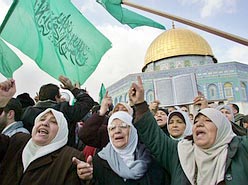


Wow, what a surprise!!

...and don't say that 2,000(Palestinian, or better muslim) women.. don't know what they're doing/chanting! They know it very well!!

진보블로그 공감 버튼트위터로 리트윗하기페이스북에 공유하기딜리셔스에 북마크

  • 제목
    CINA
  • 이미지
    블로그 이미지
  • 설명
    자본주의 박살내자!
  • 소유자
    no chr.!

저자 목록

달력

«   2006/02   »
      1 2 3 4
5 6 7 8 9 10 11
12 13 14 15 16 17 18
19 20 21 22 23 24 25
26 27 28        

기간별 글 묶음

찾아보기

태그 구름

방문객 통계

  • 전체
    2400224
  • 오늘
    226
  • 어제
    855