공지사항
-
- '노란봉투'캠페인/국제연대..
- no chr.!
41개의 게시물을 찾았습니다.
(Federal) State Elections in Germany..
In East Berlin, the former capital of the GDR(German Democratic Republic/East Germany) the Left Party(the former Party of Democratic "Socialism", the former "Socialist" Unity Party of Germany - the ruling party in GDR) had it main strongholds in the entire Germany. During the last election in 2001 in some parts of e. Berlin they got more than 50 percent of the votes. And then they joined the government in Berlin.. as a junior partner of the "Social Democrats"(SPD). In this situation they supported a massive cutting of social services, the destruction of many public work places, and so on..in the city.
And the result now: especially in the eastern part of the city they lost f.. a lot of voters - on average 18 percent. In some areas 30 percent!!
On the other side the neo-Nazis, also active in Berlin, mainly in the eastern part, won seats in five destrict parliaments. In 62 polling stations in Berlin - only in the east - they became the third strongest force after the SPD and Left Party (LP).
The only "left alternative" to the LP, the WASG(Election Alternative Social Justice) got in the most areas only half of the votes of the neo-Nazis. WASG is a group, founded in West Germany(with frustrated former SPD members, old style "socialists" and some trotskyist activists), which want to unite next year with the LP. But WASG in Berlin during the election campaigned against LP. But except a massive confusion in the "left movement" in Berlin they won nearly nothing..
The other election to (federal) state parliament was in Mecklenburg Vorpommern(just check out the articles 9.17 독일/선거 #1/2). There the neo-Nazis won really f.. a lot,
like in:
Postlow: 38,6 percent (of the votes)
Belesewitz: 32,2 percent
Bargischow: 31,1 percent
Neu-Kusenow: 31,1 percent
and so on (where they became the strongest political party).
Of course this results will not change Gemany completely(aeh~ is there something to change here???), not really.. Because, especially in the eastern parts - the former GDR -the ideas of national"socialism" - intolerance, racism.. are common parts of the daily ordinary life in the "normal society".
Something about German neo-nazi movement(better said reality) you can check out here:
http://base21.jinbo.net/christian/020913.html (base21)
*****
Today's edition of the Israeli daily Yedioth Ahronoth wrote following about the election result/success of neo-Nazi party NPD and the background:
Germany's choice
Education cutbacks to blame for far-right party's success?
Mecklenburg-Pomerania, situated in the northeast, is the most anonymous and sparsely-populated federal German state. Its name rarely makes the headlines, not only because of its difficult pronunciation.
Far Right
The Germans, incidentally, have found an original way to solve this semantic problem. They have nicknamed the remote province Mac-Pom, roughly translated as "Mac-Fries," which lends a "foreign" ambience to the historic homeland of the impoverished Prussian nobles and forgotten communist activists.
Some two million of Germany's population of 80 million reside in Mecklenburg-Pomerania. It is the land of a thousand lakes and a well-known tourist destination affording breathtaking views, picturesque castles and long beaches. However, the local economy is in ruin and unemployment is high.
Local mentality a hindrance
Contrary to other areas in former communist East Germany, Mac-Pom has been unable to recuperate since the reunification.
The fact that Mac-Pom is the electoral province of German Chancellor Angela Merkel doesn't help matters much, while the local mentality hasn't been instrumental. When Merkel recently hosted President Bush in Mac-Pom, residents complained about the high expenses incurred by the presidential visit and the inconvenience posed by the strict security measures implemented.
Last Sunday Mecklenburg-Pomerania became the hottest topic in German politics when the neo-Nazi National Party (NPD) made history by passing the voting threshold and entering the local parliament with six representatives. In the last elections four years ago, the party received just 0.8 percent of the total vote. This week it gained 7.1 percent of the popular vote.
Mac-Pom has become the fourth largest German state among the 16 federal states with neo-Nazi representatives in its parliament. For clarification's sake: This figure comprises a quarter of the federal states in Germany.
Three of the federal states that granted representation to neo-Nazi parties are located in East Germany. Added to this is the fact that the NPD succeeded in securing representation in four Berlin states, formerly part of East Germany.
Expressing ceremonial apprehensions
German politicians from both Left and Right expressed the ceremonial apprehensions reserved especially for such occasions. But in fact it was a predictable outcome.
The composition of the current cabinet, a coalition that includes two major parties, and the unification of the conservatives and the social-democrats are a sure path to a people's protest against the political margins.
Although the economic situation has improved somewhat in recent months and even unemployment has declined, the simple man on the street does not feel he is benefiting from the stability. Worse than that, ordinary residents sense they are the ones paying the price.
The neo-Nazi's prime target electorate is the younger generation. The highest number of votes came from voters aged 18 to 24, and NPD became the third largest party after the two ruling parties.
Bloody scuffles
The party is putting a lot of effort into adopting an image of a "centrist" party, while at the same time it is communicating its violent messages that ignite bloody scuffles with its political foes.
The recent elections in Berlin were the most violent since the end of World War II. Such scuffles often ended with injured left-wing activists.
If according to so many youngsters the NPD is a legitimate choice, Germany's future will face a severe problem. Perhaps this is the right time for the German government to reassess its decision to significantly cut back the budget allocated to educational programs aimed at educating youth against right-wing extremism.
http://www.ynetnews.com/articles/0,7340,L-3306233,00.html



"Mish Fidilak" by Natacha Atlas, 2001
ya habibi ana mosh fadiya lak, wo la fadiya li l gharam
hafdo badin a'gui lek, ana lly mak kallam
khalina baid choway
yemkin enssa l'assiya
khalina, khalina, khalina
yemkin enssa l'assiya
denta lli amelta fiy, ya habibi kan ketir
ya habibi ah ah
ya habibi ah ah
ya habibi ah ah ah ah ah aaah...
law geey tahayerni
ibaad, ibaad any
-mosh aweza houbek!
enssa hawak liya, dana chouft bianiya
-el ghadr min albek!
law law law geey tahayerni
ibaad, ibaad any
mosh aweza liya, dana chouft bianiya
-el ghadr min albek
khalina baid choway
yemkin enssa l'assiya
khalina, khalina
yemkin enssa l'assiya
denta lli amelta fiy, ya habibi kan ketir
ya habibi ah ah
ya habibi ah ah
ya habibi ah ah ah ah ah aaah...
bilach tikadebni
law marra sadani
-inta tahiit!
sadani habibi, ya adri wo nassibi
-inta tnassiit!
bilach tikadebni
law marra sadani
inta tahiit!
sadani habibi, ya adri wo nassibi
-inta tnassiit!
khalina baid choway
yemkin enssa l'assiya
khalina, khalina
yemkin enssa l'assiya
denta lli amelta fiy, ya habibi kan ketir
ya habibi ah ah
ya habibi ah ah
ya habibi ah ah ah ah ah aah...
(harrharr.. YA HABIBI..^^, its Arabic and means..^^ ya habibi ah-ah..^^)
To learn more about her(N. Atlas) please check out this(Wikipedia):
http://en.wikipedia.org/wiki/Natacha_Atlas
About before yesterday's state parliament elections in Germany int'l media reported yesterday following (tomorrow I'll write some more details about the final results):
Far right wins seats in Germany (al-Jazeera)
A far-right party compared to the early Nazis by the German government has won seats in a regional parliament, helped by a weak economy and anger at Angela Merkel's ruling coalition.
Results showed the National Party of Germany (NPD), which advocates closing German borders to immigrants, won 7.2 per cent of the vote in Mecklenburg-Vorpommern, a northeastern state on the Baltic Sea which borders Poland.
The result would allow the NPD to enter the regional assembly, making Mecklenburg-Vorpommern the third state in the former communist east with far-right representation.
The result alarmed mainstream politicians and Jewish groups, who called on the federal government to renew its bid to ban the party after a previous attempt failed.
Dieter Graumann, vice-president of the Central Council for Jews in Germany, said: "The government must look for ways to impose a ban."
Narrow victory
Final results gave the Social Democrats (SPD) 30.2 per cent in Mecklenburg, down from nearly 41 per cent in the state vote in 2002. It was uncertain if they would continue their local coalition with the former communist Left Party or ally with Merkel's Christian Democrats.
Election data showed 15 per cent of 18- to 24-year olds voted for the NPD in Mecklenburg.
In a federal election exactly one year ago, Merkel won a disappointingly narrow victory over Gerhard Schroeder, her predecessor, forcing her into a coalition with his SPD party.
Many Germans had hoped her "grand coalition", with its big majorities in both houses of parliament, would be able to push through crucial reforms.
But it has been plagued by infighting and struggled to deliver promised changes to the healthcare system. Experts say this has helped boost smaller parties such as the NPD.
Weak economy
In Mecklenburg-Vorpommern, the state where Merkel has her local constituency and where she hosted George Bush for a barbecue in July, the economy is weak and nearly one in five is without work, and the jobless rate hovers above 30 per cent in some areas. Like other states in the former communist east, it has seen many leave in search of jobs.
Those conditions have provided fertile ground for the NPD, which was accused of using thugs to bully rival parties during the campaign. Its leaders have played down Nazi responsibility for the second world war and questioned the extent of the Holocaust.
Several hundred protesters gathered outside the parliament building in the Mecklenburg state capital Schwerin, waving "Nazis Out" posters on Sunday.
The federal government has compared the party to the Nazis of the 1920s and tried to ban them in the country's highest court in 2003. It failed after members of the party who testified turned out to be informants planted by the police.
http://english.aljazeera.net/NR/exeres/127DE884-A102-4907-8E4F-A22364A0E52C.htm
Far-right party wins seats in German election (NYT/IHT)
A far-right party made further inroads in Germany's economically fragile east on Sunday, winning seats in a state election in Mecklenburg-West Pomerania, a lonely land of farms and fishing villages that is the home constituency of Chancellor Angela Merkel.
The National Democratic Party, which openly espouses xenophobic and neo-Nazi views, was projected to win slightly more than 7 percent of the vote, according to preliminary results. That was less than analysts here had feared, but enough to clear the threshold of 5 percent for seats in the state legislature.
Extreme-right parties will now be represented in three of Germany's six eastern states - a trend that worries officials and underlines the divide between the country's eastern and western halves. Far-right parties have negligible support in more-prosperous western Germany.
"This shows the extreme right is a stable and growing force in the east, but it is not an earthquake," said Hajo Funke, a political scientist at the Free University of Berlin. "It's not a danger for our democracy."
The result, however, is a rebuke for Merkel and her conservative party, the Christian Democratic Union, which lost votes in Mecklenburg and fared even worse in the second of the two state legislative elections on Sunday, in Berlin. There, the popular mayor, Klaus Wowereit, led his Social Democratic Party to a comfortable victory.
Voters appeared to be punishing Merkel's party, 10 months after it squeaked into power in an unwieldy "grand coalition" with the Social Democrats. The Social Democrats, who govern Mecklenburg-West Pomerania, lost ground there, too, and it was not clear whether they could salvage their coalition with the Party of Democratic Socialism, the former East German Communist party.
Merkel, who began her political career in Mecklenburg 15 years ago, has tried to focus attention on the region, inviting President Bush in July for a visit. But the state has one of the highest unemployment rates in Germany, which makes it a breeding ground for extremism, analysts say.
The National Democratic Party, which the German government once tried to ban, won seats in Saxony, a similarly depressed eastern state, in 2004. Another far-right party is represented in Brandenburg, the state that surrounds Berlin.
"The grand coalition hasn't presented a forceful program to tackle Germany's problems," Funke said. "These parties take advantage of the frustration of those who have no chance of a social or economic future."
One of the few winners on Sunday was Wowereit, who was given a strong mandate as mayor of Berlin, with the choice of renewing his coalition with the Party of Democratic Socialism or forming a new one with the Greens, the largest vote-gainer since the last election, in 2001.
The victory may foretell a greater national role for Wowereit, a 52-year-old lawyer who has become a star in Berlin. His party-going style seems to suit his late-night town, and his disclosure before the last election that he is gay only added to his appeal. On Sunday, Wowereit appeared on stage with his partner, Jörn Kubicki, a neurosurgeon.
With the departure of Social Democratic leaders like Gerhard Schröder, and a lack of other rising stars, Wowereit has made his ambitions plain. "I would like to have more say that I have had in the last five years, when we had to clean up the city," he said in a recent interview with the German magazine Stern.
Whether he has done so is a matter of debate. Berlin is strangled by debt, a jobless rate of nearly 20 percent and a shrinking commercial base. Wowereit, who is known as Wowi, prefers to focus on its role as a cultural center and tourist magnet. Berlin, he said last year, is "poor but sexy" - a line that has become a tongue-in-cheek slogan for the city.
His opponent, Friedbert Pflüger, a Christian Democratic member of Parliament, tried to portray the mayor as a lightweight. But in a city that rewards flamboyance, Pflüger, an establishment politician originally from the western city of Hanover, never stood a chance.
"Up until now, he hasn't been a strong voice in politics on the national level," Uwe Andersen, a political scientist at Ruhr University, said of Wowereit. "He may think this result strengthens his position."
FRANKFURT A far-right party made further inroads in Germany's economically fragile east on Sunday, winning seats in a state election in Mecklenburg-West Pomerania, a lonely land of farms and fishing villages that is the home constituency of Chancellor Angela Merkel.
The National Democratic Party, which openly espouses xenophobic and neo-Nazi views, was projected to win slightly more than 7 percent of the vote, according to preliminary results. That was less than analysts here had feared, but enough to clear the threshold of 5 percent for seats in the state legislature.
Extreme-right parties will now be represented in three of Germany's six eastern states - a trend that worries officials and underlines the divide between the country's eastern and western halves. Far-right parties have negligible support in more-prosperous western Germany.
"This shows the extreme right is a stable and growing force in the east, but it is not an earthquake," said Hajo Funke, a political scientist at the Free University of Berlin. "It's not a danger for our democracy."
The result, however, is a rebuke for Merkel and her conservative party, the Christian Democratic Union, which lost votes in Mecklenburg and fared even worse in the second of the two state legislative elections on Sunday, in Berlin. There, the popular mayor, Klaus Wowereit, led his Social Democratic Party to a comfortable victory.
Voters appeared to be punishing Merkel's party, 10 months after it squeaked into power in an unwieldy "grand coalition" with the Social Democrats. The Social Democrats, who govern Mecklenburg-West Pomerania, lost ground there, too, and it was not clear whether they could salvage their coalition with the Party of Democratic Socialism, the former East German Communist party.
Merkel, who began her political career in Mecklenburg 15 years ago, has tried to focus attention on the region, inviting President Bush in July for a visit. But the state has one of the highest unemployment rates in Germany, which makes it a breeding ground for extremism, analysts say.
The National Democratic Party, which the German government once tried to ban, won seats in Saxony, a similarly depressed eastern state, in 2004. Another far-right party is represented in Brandenburg, the state that surrounds Berlin.
"The grand coalition hasn't presented a forceful program to tackle Germany's problems," Funke said. "These parties take advantage of the frustration of those who have no chance of a social or economic future."
One of the few winners on Sunday was Wowereit, who was given a strong mandate as mayor of Berlin, with the choice of renewing his coalition with the Party of Democratic Socialism or forming a new one with the Greens, the largest vote-gainer since the last election, in 2001.
The victory may foretell a greater national role for Wowereit, a 52-year-old lawyer who has become a star in Berlin. His party-going style seems to suit his late-night town, and his disclosure before the last election that he is gay only added to his appeal. On Sunday, Wowereit appeared on stage with his partner, Jörn Kubicki, a neurosurgeon.
With the departure of Social Democratic leaders like Gerhard Schröder, and a lack of other rising stars, Wowereit has made his ambitions plain. "I would like to have more say that I have had in the last five years, when we had to clean up the city," he said in a recent interview with the German magazine Stern.
Whether he has done so is a matter of debate. Berlin is strangled by debt, a jobless rate of nearly 20 percent and a shrinking commercial base. Wowereit, who is known as Wowi, prefers to focus on its role as a cultural center and tourist magnet. Berlin, he said last year, is "poor but sexy" - a line that has become a tongue-in-cheek slogan for the city.
His opponent, Friedbert Pflüger, a Christian Democratic member of Parliament, tried to portray the mayor as a lightweight. But in a city that rewards flamboyance, Pflüger, an establishment politician originally from the western city of Hanover, never stood a chance.
"Up until now, he hasn't been a strong voice in politics on the national level," Uwe Andersen, a political scientist at Ruhr University, said of Wowereit. "He may think this result strengthens his position."
http://www.iht.com/articles/2006/09/18/europe/web.0918germany.php
Ghosts of Nazi past (Guardian)
A regional election in Germany saw a province dip back into the darkest parts of the
In the end, the result was as bad as everyone had feared. Germany's neo-Nazis pulled off a widely anticipated electoral coup last night, with the far-right winning 7.3 % of the vote during elections in the north east state of Mecklenburg-Vorpommern.
The NPD comfortably exceeded the 5 % hurdle necessary to win seats. It will now sit in the state's regional assembly in Schwerin for the first time. This is the second time that the NPD has got into a regional parliament in three years, confirming fears that the party is now an established part of the political landscape, especially in Germany's depressed former communist east.
Ahead of yesterday's poll, hundreds of neo-Nazis flooded the rustic state, turning the party's stronghold town of Anklam into a neo-Nazi HQ. The tactic worked. In some Baltic villages in the east of the state, the NPD got as much as 15 % of the vote. The NPD did best where unemployment was highest. In many areas here it is more than 25 %.
This morning's German papers, reporting on the poll and yesterday's election in Berlin, gave a gloomy reaction. Der Tagesspeigel said there was no point in pretending that the NPD's voters - most of them under the age of 30 - had somehow been tricked into voting for a bunch of unashamed racists. "Whoever voted for this party, knew what they were doing," the paper said.
The Berliner Zeitung conceded that the "real winner" of yesterday's election was the NPD's leader in Mecklenburg-Vorpommern, Udo Pastörs. The fact that other parties treat him as a 'pariah' merely helps his cause, the paper said, adding: "Nobody had so many cameras and microphones thrust at him".
It was not clear this morning, meanwhile, what coalition would govern in Mecklenburg-Vorpommern, a lush Baltic region which includes Angela Merkel's seaside constituency. The Social Democrats (SPD) emerged as the biggest party with 30.2 % of the vote - but only after a night of heavy losses.
The state's SPD premier, Harald Ringstorff, now has to decide whether to continue his existing left-wing coalition with the post-communist Party of Democratic Socialism (PDS) - or enter into a new one with the conservative Christian Democrats (CDU).
The CDU won 28.8 %; the PDS 16.8 %; and the right-wing liberal FDP party made it back into the assembly with 9.6 %.
In Berlin, the picture is a bit clearer. Berlin's popular Social Democrat mayor Klaus Wowereit was the undisputed winner of yesterday's election - winning 30.8 % of the vote in Berlin and another term as mayor. This morning's papers show him putting an affectionate arm round his partner, Jörn Kubicki.
Wowi, as Berliners call him, now has to decide whether to govern in coalition with the Greens or the PDS. The Greens did better than expected with 13.1 %.
Die Linke - as the PDS is known - had a terrible night, and saw much of their support, especially in east Berlin, evaporate. The party polled 13.4 %, almost 10 % less than during the last election in 2001.
Two trends this morning appear clear. Firstly, the neo-Nazis in Germany appear to be here to stay. Secondly, the Christian Democrats do not appear to have benefited much from the fact that their leader Angela Merkel is Germany's chancellor, and the head of a 'grand coalition' government in Berlin with the Social Democrats. Her long term ability to win elections is still in doubt.
http://www.guardian.co.uk/germany/article/0,,1875278,00.html
Following strange story K. Times will publish in its tomorrow's edition:
US Envoy’s Wife Violated Work Law
Lisa Vershbow, a costume jewelry maker and the wife of U.S. Ambassador to South Korea Alexander Vershbow arrived in Seoul last year, bringing with her many pieces of her work. In a recreation room near the embassy residence’s pool behind Toksu Palace, she soon set up a workshop, complete with a cozy fireplace.
At diplomatic receptions she handed out an attractive parchment name card, identifying herself as a working jewelry designer. Then in June, Mrs. Vershbow entered into an arrangement with the Sun Gallery located in fashionable Insa-dong.
Over a two-week period, the gallery sold 20 million won ($20,000) of Mrs. Vershbow's aluminum and plastic ornaments seemingly without concern that the ambassador's wife had a workshop, but no work permit. The ambassador’s wife and the gallery split the revenue.
The question became what difference is there between Mrs. Vershbow and anyone else who comes to Korea and earns money without the government's authorization?
Hundreds of such illegal immigrants are rounded up each year and deported. In 2005, the Justice Ministry took 27,295 people into custody for working in violation of their visa status...
(Please read the entire article here: http://times.hankooki.com/lpage/nation/200609/kt2006091817372211990.htm)
Well, just call Immigration Office in Mok-dong!
SHE HAS TO BE ARRESTED AND DEPORTED! (as soon as possible!!!)
PS: Likely her husband - the so-called "ambassador" of the U.S.A. is her broker.. So, of course, he have to be arrested and deported too!!
"The developing destruction of the industrialization in the West created a new class of un-productive and mentally neglected. These alliens in the own country become a serious danger for the democracy." (Der Spiegel, 9.16)
This sentences should describe just the growing number of more and more unemployed proletarians in Europe, especially in Germany.
Today in two German (federal) states, Berlin and Mecklenburg-Vorpommern, parliamentarian elections are taking place.
Both states, including the former West-Berlin, are located in the east of the country. Mecklenburg-Vorpommern(M.V.) is located in the far east of Germany, on the border to Poland and the Baltic Sea(like the eastern part of Berlin it's a part of the former GDR/East Germany).
Already a few days ago German newspapers, such as Berliner Zeitung, wrote about the "phenomenon" that a large majority of the voters, especialy in the east of Germany, don't believe in democracy anymore. Instead more than 60 percent of the voters think that the "Socialism is a good model for the society".
In this situation it will be perhaps no surprise that a large percentage of the voters will elect a neo-Nazi party. Because they represent a real German "Socialism" for them, just a National "Socialism". A "Socialism" where the state is strong, where "law and order" is ruling, where no foreigners are disturbing their life, where work places are reserved only for Germans(even there are only few foreigners living in this regions!!).. Slogans like "German 'Socialism' instead of the One-World-Order" or National 'Socialism' against globalization" are very attractive for large parts of the population, especially in the former East Germany. So it's no surprise that representatives of neo-Nazi organisations are arrived since long time in the middle of the society, they are nor just "honored" parts of many eastern communities.
Anyway.. in about 4 hours we know more about the results of the elections..
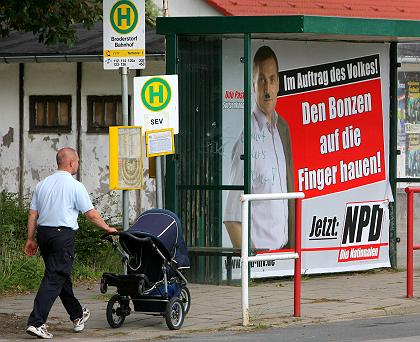
Skinhead family father and neo-Nazi
election propaganda in M.V.
About the role of neo-Nazi organisations in this election campaign The Guardian(UK) wrote yesterday following:
Neo-Nazis poised to win seats in German state parliament
· Polls put party above 5% threshold for success
· Poor economic conditions in east fuel discontent
Germany's racist neo-Nazi party is poised to make a stunning breakthrough at elections this weekend, entering a regional parliament for the second time in three years, polls suggest.
According to a poll for ZDF television, the far-right National Party of Germany (NPD) is likely to win 7% of the vote in elections on Sunday in the north-east state of Mecklenburg-Vorpommern. A poll by Infratest puts the party on 6%.
The projected result is above the 5% of the vote parties must achieve before they can sit in parliament, and means the far-right MPs could have seats for the first time. "We are very confident. It's extremely likely we are going to make it," Michael Andrejewski, the NPD's candidate in its stronghold town of Anklam, told the Guardian yesterday.
Mr Andrejewski said voters in Germany's depressed former communist east were turning to the neo-Nazi right because they were disillusioned with mainstream politics and fed up with the region's unemployment rate.
"People are furious. They are disappointed with this government. Unemployment here is 30%. If we can win here we will have established a trend. Our mid-term goal is to win seats in the Bundestag [Germany's federal parliament]."
A result above 5% would be an embarrassment for Germany's leader, Angela Merkel, whose seaside Baltic constituency is part of Mecklenburg-Vorpommern. The region is abundant in lakes and forests, but is one of the most economically depressed parts of the country. Unemployment is officially put at 18%.
Hundreds of neo-Nazis have flooded into the state. The party has teamed up with local Kameradschaften, gangs of far-right skinheads - some of whom are standing as NPD candidates. Volunteers have hung up thousands of xenophobic placards and distributed copies of the party's far-right newspaper, the Island Messenger. They have also intimidated workers from other parties, it is alleged.
Rival candidates concede the NPD has waged a meticulous, professional campaign. "I have to admit that to a certain degree we have failed," said Uwe Schulz, Anklam's Social Democratic candidate.
Mr Schulz, whose party governs in the state's regional assembly in Schwerin with the post-communist Party of Democratic Socialism, added: "My father came back from the second world war with a leg missing. These people appear to have learned nothing from the Nazi era. To hear these ideas and slogans again makes me furious."
Nationally, the NPD has had little impact. But in 2004 it won 9.25% of the vote in the east German state of Saxony in a surprise result, entering a regional parliament for the first time since 1968. Victory tomorrow would confirm fears that the party is an established feature of Germany's political landscape, analysts say.
In several Baltic villages in Mecklenburg-Vorpommern the far-right now provides social services. It runs businesses and organises discos. The NPD has abandoned its skinhead image, fielding candidates in immaculate suits.
"There are a large number of people in east Germany who have become estranged from democracy," said Hajo Funke, a political scientist at Berlin's Free University. "Mainstream parties have failed to address local problems."
Günter Hoffmann, founder of Anklam anti-Nazi group Bunt statt Braun, said: "The big mistake happened after the fall of the Berlin wall. The need to establish and teach democracy in the east was overlooked. We are now picking up the bill."
The quiet, stealthy rise of extremism in the state is linked to its woeful economic condition, analysts say. After reunification in 1990 manufacturing industry collapsed. Anklam's population shrank from 22,000 to 14,000 as the young fled west.
Success for the NPD tomorrow is likely to provoke an anguished debate among the ruling Christian and Social Democrats about what went wrong. Both govern in Berlin in a coalition led by Mrs Merkel.
http://www.guardian.co.uk/germany/article/0,,1873834,00.html
And about today's elections in general AP wrote today this:
Germans vote in state elections that could mean gains for far right
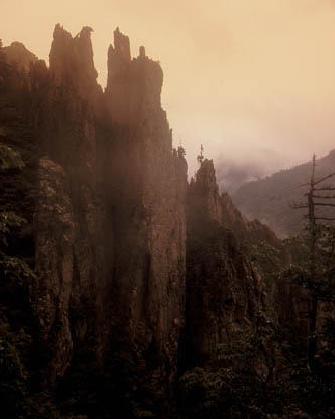
金剛山
Yesterday KCNA/조선통신 "reported" following:
Kim Jong Il's Field Guidance to Mt. Kumgang Resort
General Secretary Kim Jong Il provided field guidance to Mt. Kumgang resort on his way of inspection of the front. Mt. Kumgang covers a vast area of 530 square kilometers extending 60 km from south to north and 40 km from east to west including Kosong, Kumgang and Thongchon counties of Kangwon Province. It is known as a famous mountain of Korea and a world-famous mountain from old times as it presents a myriad of diverse, majestic and spectacular scenery.
It is called a mountain of superb scenic beauty as everything there presents fantastic scenery. It is superb not only in the beauty of its peaks and ravines but in the scenery of the sea and its shore, lakes, kaleidoscopic changes seen around the peaks due to winds and clouds, thick forests rich in rare animals and plants and falls presenting ever-changing scenery.
He climbed the Piro Peak, the main peak of the mountain, and commanded a bird's-eye view of the mountain presenting kaleidoscopic scenery.
He said that Mt. Kumgang, which had long been a resort for the exploiting class only, turned into a splendid recreation ground for the people in the era of the Workers' Party
.
Our country has many scenic spots wherever its people go, the objects of foreigners' envy, as its mountains are beautiful and its water is clear, he said, adding that our people are highly proud of fully enjoying a worthy life in the beautiful socialist country with brilliant culture and long history.
Noting that one can display patriotism only when one knows well about the history, culture and scenic beauty of the country, he underscored the need to intensify the education through scenic spots.
He specified tasks to be undertaken to permanently preserve the superb scenery of Mt. Kumgang and ways to do so, underlining the need to spruce up the beauty spots in a peculiar manner and prevent the damage by natural phenomena.
He was accompanied by Korean People's Army Generals Ri Myong Su, Hyon Chol Hae and Pak Jae Gyong.
*****
First of all KCNA and the people who are publishing this stuff in the internet must think that everyone who is reading it must be a complete ignorant pro-DPRK idiot or some one who have absolutely no idea about the reality on the Kor. Peninsula.
Secondly: Nearly the entire area of Geumgang-san is occupied by the S.K. capitalists. So, of course, no(ordinary) N.K. citizen is allowed to enter this area.
Thirdly: The N.K. people have complete other interests as to climb on mountains! They just want to get something to eat, warm clothes and heating material for the coming winter(aeh~ so they also have to climb mountains, but not for fun..).
And so on, and so on..
Anyway, thanks to KCNA and everybody who is republishing this f.. sh..!!
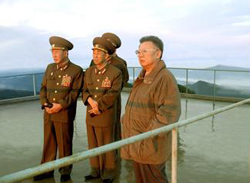
The Dear Leader in Geumgang-san..
*****
PS: When Kim Jong-il visited Geumgang-san Resort he had to pay entrance fee? S.K. Won? US$? Or what..?
For more about the Geumgang-san Resort please check out this:
North Korean wouldn't normally spring to mind as a choice holiday destination. But hundreds of thousands of tourists are flowing into the secretive realm of.. Kim Jong Il as part of vacations organized by the South Korean conglomerate Hyundai..
Please read more here(Der Spiegel, 06.03.13. - just for example):
http://service.spiegel.de/cache/international/spiegel/0,1518,406426,00.html
NEXT WEEK: JAPAN WILL DECLARE WAR TO THE D.P.R.K.(*)
S.K. Yonhap news agency reported today:
Japan considers financial sanctions against N. Korea
Japan has reportedly decided to impose financial sanctions against North Korea amid concerns that the communist state may be preparing to launch additional missiles or test a nuclear bomb.
Japanese news outlets reported that the country may take action as early as next week.
"Japan is considering releasing specifics of financial sanctions on North Korea in line with a U.N. Security Council resolution as early as Tuesday and has begun final consultations on the matter with the United States," Kyodo News reported, quoting unidentified sources.
The U.N. Security Council unanimously passed a resolution on July 15 condemning North Korea's test-firing of seven ballistic missiles earlier that month and to prohibit any transfer to or from the communist state of material, technology and financial resources that are related to the North's weapons program.
North Korea immediately rejected the resolution, calling it a "gangster-like" act by Washington and its allies to isolate and stifle its communist regime. Japan and the United States have been calling for additional sanctions against the North amid Pyongyang's boycott of international negotiations over its nuclear weapons program.
The move, if taken, is expected to deal a severe blow to the North as its firms in Japan and pro-Pyongyang Koreans in the country have been one of the largest sources of hard currency for the communist state.
Japan's prime minister, Junichiro Koizumi, told reporters Thursday that the plan has yet to become final, saying his country would "have to consult on the matter with the United States and South Korea."
But his Deputy Chief Secretary of Cabinet Jinen Nagase said the country was moving toward that end.
"At the moment, relevant government ministries and agencies are making preparations as to whom the sanctions will target and when the sanctions will be implemented," Nagase was quoted as saying Thursday.
News reports here said the envisioned sanctions were likely to target 12 North Korean or pro-Pyongyang businesses and organizations that have been outlined by the United States for having suspected links to the North's communist regime and one person suspected of similar links.
Tokyo banned a North Korean passenger ferry in July from its ports for six months as part of a nine-point resolution, imposing economic and diplomatic sanctions against the North.
The total amount of North Korea's exports to Japan dropped to 440 million yen (US$3.75 million) in July, a 44.2 percent decrease from that of June, Japan's Finance Ministry said late last month.
The amount also represented a 42.2 percent decrease from the same month in 2005, according to the ministry.
Japan is part of the multilateral negotiations aimed at persuading North Korea to abandon its nuclear ambitions. But the talks, also attended by South Korea, China, Russia and the United States, have been stalled since November due to a North Korean boycott.
http://english.yna.co.kr/Engnews/20060915/610000000020060915091104E8.html
DailyNK(no comment please!!) wrote this today:
“Japan, Imposing Financial Sanctions Against North Korea”
Mainichi “Freezing assets of enterprises suspected to be involved with WMD”
A Japanese newspaper, the Mainichi reported that on the 14th the Japanese government confirmed its policy to implement financial sanctions against North Korea this month and freeze assets of individuals or corporations speculated to be involved with weapons of mass destruction.
The newspaper reported that “The government will ban withdrawals and overseas remittances from accounts held in Japan by organizations and individuals suspected of being linked to North Korea’s development of weapons of mass destruction” and “may implement the sanctions before Prime Minister Junichiro Koizumi resigns on September 26th.”
The newspaper relayed that “Top government officials deemed it indispensable to impose additional sanctions against the secluded state after North Korea refused to hold talks on its missile development plan and failed to express its readiness to return to the six-party talks even though two months have passed since the United Nations adopted the resolution.”
After the U.S urged members of the United Nations resolution to pass the North Korea financial sanctions, it appears that further cooperation will be advocated through the U.S.-Japan mutual support.
Although it is difficult to anticipate cooperation from China or Russia, it is expected that European countries, Canada, Australia and such will be provoked to cooperate.
The Japanese government plans to identify the individuals or organizations subject to the sanctions based on information from investigative authorities in various countries. Even if dozens of individuals and organizations receive sanctions though it would not have direct affect on North Korea, the Japanese government anticipates that these measures will portray a strong message of ‘pressure’ to each country.
After the missile launch on July 5th, the Japanese government implemented the nine-point sanctions prohibiting the North Korean vessel ‘The Mangyongbong’ and North Korean officials to enter Japan. In addition, the ruling Liberal Democratic Party is deliberating drafting a law to further impose sanctions against financial institutions suspected of being involved in money-laundering.
http://www.dailynk.com/english/read.php?cataId=nk00100&num=1101
* Several times the D.P.R.K.(KCNA/Rodong Shinmun..) said that any sanctions against it will be seen as a "declaration of war"!!(^^)
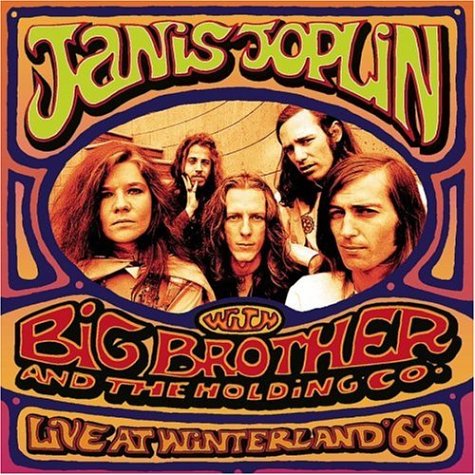
1968, J. Joplin, Ball and Chain
Sittin’ down by my window,
Honey, lookin’ out at the rain.
Oh, Lord, Lord, sittin’ down by my window,
Baby, lookin’ out at the rain.
Somethin’ came along, grabbed a hold of me, honey,
And it felt just like a ball and chain.
Honey, that’s exactly what it felt like,
Honey, just dragging me down.
And I say, oh, whoa, whoa, now hon’, tell me why,
Why does every single little tiny thing I hold on to go wrong ?
Yeah it goes wrong, yeah.
And I say, oh, whoa, whoa, now babe, tell me why,
Does every thing, every thing.
Hey, here you gone today, I wanted to love you,
I just wanted to hold you, I said, for so long,
Yeah! Alright! Hey!
Love’s got a hold on me, baby,
Feels like a ball and chain.
Now, love’s just draggin’ me down, baby,
Feels like a ball and chain.
I hope there’s someone out there who could tell me
Why the man I love wanna leave me in so much pain.
Yeah, maybe, maybe you could help me, come on, help me!
And I say, oh, whoa, whoa, now hon’, tell me why,
Now tell me, tell me, tell me, tell me, tell me, tell me why, yeah.
And I say, oh, whoa, whoa, whoa, when I ask you,
When I need to know why, c’mon tell me why, hey hey hey,
Here you’ve gone today,
I wanted to love you and hold you
Till the day I die.
I said whoa, whoa, whoa!!
And I say oh, whoa, whoa, no honey
It ain’t fair, daddy it ain’t fair what you do,
I see what you’re doin’ to me and you know it ain’t fair.
And I say oh, whoa whoa now baby
It ain’t fair, now, now, now, what you do
I said hon’ it ain’t fair what, hon’ it ain’t fair what you do.
Oh, here you gone today and all I ever wanted to do
Was to love you
Honey you can still hear me rock and roll the best,
Only it ain’t roll, no, no, no, no, no.
Sittin’ down by my window,
Lookin’ out at the rain.
Lord, Lord, Lord, sittin’ down by my window,
Lookin’ out at the rain, see the rain.
Somethin’ came along, grabbed a hold of me,
And it felt like a ball and chain.
Oh this can’t be in vain
And I’m gonna tell you one more time, yeah, yeah!
And I say oh, whoa whoa, now baby
This can’t be, no this can’t be in vain,
And I say no no no no no no no no, whoa,
And I say whoa, whoa, whoa, whoa, whoa
Now now now now now now now now now no no not in vain
Hey, hope there is someone that could tell me
Hon’, tell me why love is like
Just like a ball
Just like a ball
Baaaaaaalllll
Oh daddy, daddy, daddy, daddy, daddy, daddy, daddy, daddy
And a chain.
Yeah.
One of the last videos of J. Joplin you can watch here:
http://blog.naver.com/1dynasty?Redirect=Log&logNo=140027368291

최근 덧글 목록