공지사항
-
- '노란봉투'캠페인/국제연대..
- no chr.!
30개의 게시물을 찾았습니다.

KCNA - The World's No. 1 Trash Magazine
♦ 'The music-based politics of the Workers' Party of Korea has brought about a great turn in the development of the Korean revolution..
There are many famous songs including.. "All Servicepersons and People Will Become Human Bullets and Bombs."'
☞ Great Vitality of Music-based Politics
Wow it must be really great to wake up in the morning with beautiful songs like that on the lips..^^
♦ 'In the postwar period the President (Kim Il-sung) set forth the slogan "Hold a rifle in one hand and a sickle and hammer in the other!""
☞ Songun, Life and Soul of Korea
Well, it might be very effective if the Koreans had/have at least four (4) arms and hands, but...^^


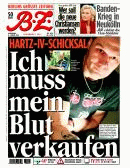
"Hartz-4-fate(*)
I must sell my blood to
survive"(**)
* Hartz 4: German law to spend (by the office of "labour") for unemployed persons (345 Euro per month)
** The front page of BZ, THE MAIN "yellow press" newspaper in Berlin - one week ago, last Saturday, 1.13
If you follow even the German bourgeois media, such as the TV station ZDF, it will be just the beginning of the future, especially for the older people (at least over 50-years-old) without a regular work (nowadays several Millions..)
♦ Check out this (just the first two verses of "2. Marsch der Mumien"!!):
http://memolog.blog.naver.com/nosugaradded/145
Today in the early morning (CET) Ynet/AP reported:
N. Korea claims 'agreement' reached in talks with US nuclear envoy
North Korea said Friday that it had reached an agreement with the US during talks with Washington's main nuclear envoy this week in Germany, but gave no further details.
North Korea's Foreign Ministry said the talks between US envoy Christopher Hill and North Korea's main nuclear negotiator Kim Kye Gwan had been held "in a positive and sincere atmosphere and a certain agreement was reached there."
♦ But just a short while later in al-Jazeera, for example, it was written that Chr. Hill said following:
"I'm sorry, I'm not really sure what he's referring to," after (his) arriving in South Korea..
(☞ Confusion over N Korea 'agreement')
♦ "Certainly the discussions with the DPRK were very useful," Hill said earlier at Incheon International Airport.. (Yonhap)
But perhaps the meaning of this sentence was just: "..very useful to find a reason to f.. them (the DPRK) definitely!"??
Because: only some hours later Korea Times reported about W. Perry's (a former U.S. secretary of "defense") latest "great idea":
BOMB THE DPRK!!
"..William Perry proposed Thursday that the United States should consider military action against North Korea if China and South Korea refuse to prod Pyongyang to end its nuclear weapons program, according to a report by Agence France-Presse (AFP).
Although the move is dangerous, there is no alternative left.."
(☞ Ex-US Defense Chief Suggests Military Action Against NK)
KCTU/THE S.K. LABOUR MOVEMENT:
The big, fat, evil monster, oppressing the poor capitalists
and their devote workers (^^)..

..this is actually the summarized content of following editorial, published in today's Chosun Ilbo:
Inside the Hyundai Motor Strike
It was difficult to find even the entrance of Hyundai Motor’s Ulsan plant. There were 18 different entrances to the 4.95 million sq.m compound. Once in, 13 tents pitched by striking workers came into view, with red banners reading “Vanguard of Struggle” and “Labor Oppression.” In front of the main building across from the tents were placards demanding the resignation of group chairman Chung Mong-koo, as well as signs demanding the immediate payment of a performance bonus. Inside the hall, unionized workers were playing Go games sitting on Styrofoam mats covered with heated blankets.
One union member in his 30s said he was aware of the resentment of the Korean public toward the workers. But he said the strike was justified as they were simply demanding unpaid dues. A union spokesman said the company led the union to strike on the back of public opinion. One senior union official screamed at the visiting journalists, angry at the way the media had portrayed them.
Not all of the unionized workers agreed. One union member said during lunch that outside people blame the workers for following the orders of the union leadership. But inside, the union member would suffer “a curse” if they say one wrong thing. When the union leadership stops the assembly lines, they are the ones who lose their wages. Another union member in his 40s expressed disgust at the fact that another strike had begun following more than 10 political ones last year. He was rather disappointed to hear that the bonus dispute had been settled without resolving the age-old problem.
One office worker at the Ulsan plant said the union structure resembled a French commune during the country’s 18th century revolution. “We can’t say anything against them,” the office worker said. He added that early in the week as unionized workers were carrying out partial strikes, union officials blocked lunch from being served at the company cafeteria, afraid workers would leave the protests to eat, while others blocked exits to make the workers continue striking.
At Hyundai Motor, everyone is afraid of the union. One high-ranking company official said in the factories, the power went over the union ten years ago. It’s the union leaders who have the authority to give orders, not the factory directors and managers. Another company official said, once a worker becomes a high-level union official, he ignores all of the company’s hierarchy. Company documents show high-level union officials receive a salary, overtime pay, their own car and gasoline from the company. Hyundai Motor even pays for their traffic fines. The company also pays for the furniture and all of the equipment inside the 1,155 sq.m union office. When asked how they feel about the arrest of a former union leader on charges of receiving 200 million won from the company in exchange for ending a strike during his tenure, one member said management officials were just as guilty for paying the bribe money.
There are people who end up with the short end of the stick. One contract worker said his take-home pay has shrunk drastically, because unionized workers, representing only full-time workers, were refusing overtime work. As he was saying those words, he looked around to make sure no union official was close by. Another contract worker said he probably wouldn’t be able to pay for his kid’s private lessons next month. He quoted union officials as saying production losses incurred during strikes should be covered by Chairman Chung’s slush fund.
The president of a subcontractor which has been supplying automotive parts to Hyundai for ten years said he and the 521 other parts suppliers were virtually held hostage by Hyundai’s union. He voiced jitters at the fact that a strike had taken place so early in the year following ten last year. The head of another parts supplier said Hyundai Motor should have played hard ball and refused to give into the union’s demands. He was afraid strikes would continue over other issues later in the year.
Hyundai Motor’s labor union was founded 20 years ago and they held strikes for 19 of those years. When a Hyundai worker, clad in a company coat, entered a restaurant in town, all eyes centered on him. The worker tried to ignore the glares, but finally walked out of the restaurant. The owner of another restaurant said she used to let Hyundai workers to write up a tab. But now she feels like slapping them. Some restaurants refuse to serve high-ranking Hyundai union officials, identifying them by their red jackets.
The heads of 49 business associations in Ulsan held a press conference at city hall urging the company to deal harshly with the union. One university student said he believed Hyundai’s union will hold more strikes. He wondered why they were doing that when people were getting more concerned about difficult business conditions facing the Korean auto industry.
The Hyundai Motor plant in Ulsan turns 40 this year. There are 28,000 regular workers and another 8,000 contract workers making a living there. When you include employees of partner companies, there are another 41,000 workers whose lives depend on Hyundai. One official at Ulsan City Hall said the lives of over 200,000 people, including the families of workers, depend on Hyundai Motor. But the company is at the mercy of the labor union. One business association official in Ulsan said Hyundai Motor’s management style needs to change too.
The residents of Ulsan did not appear happy to hear news of a breakthrough in negotiations Wednesday afternoon. They seemed to believe that unless radical changes happen in the way Hyundai Motor manages its workers, it will not see a drastic improvement in the quality and prices of its products sold overseas. Unless a miracle happens, the future of Hyundai Motor, the bulwark of Ulsan’s economy, which accounts for 4.4 percent of Korea total exports, is not very bright. This is what the people of Ulsan seemed to feel.
http://english.chosun.com/w21data/html/news/200701/200701180013.html
But finally - in my opinion(!!) - the fact that the S.K. bourgeois media is able to publish such a stuff, is also (partly) a fault of KCTU/the labour union's activists.. Just remember - for example - this:
☞ Today's struggle inside our union!
For more about the end of the strike of Hyundai Motor Workers Union:
☞ Hyundai Motor agrees to bonus, ending strike (JoongAng Ilbo, 1.18)
☞ Hyundai Motor deal draws mixed reactions (K. Herald, 1.19)
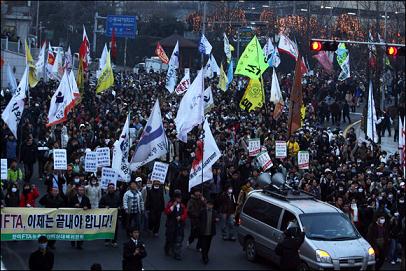
Thousands protest against FTA (Korea Herald)

Thousands of activists took to the streets in Seoul yesterday, protesting against the ongoing free trade negotiations between Korea and the United States as the sixth round of talks opened here Monday.
As police vowed to take stern action against protestors - in the wake of last year's violent anti-FTA rallies - physical confrontation and social unrest were feared.
Despite a police ban, over 10,000 farmers and workers gathered in Daehangno, Seoul for a massive rally, and marched through the city to the Shilla Hotel, causing severe traffic congestion. The Shilla Hotel is the venue for the free trade talks.
Authorities deployed a total of 15,000 police to shield the talks' venue from protesters and 2,000 riot police guarded the hotel to inspect all vehicles and individuals entering the building.
As police tried to block regional activists from entering Seoul to join in the rally, about 40 Jeju islanders clashed with riot police at Jeju International Airport.
"Because the anti-FTA protest led by the Korean Alliance against the Korea-U.S. FTA has not been permitted, we plan to block all regional protesters from entering Seoul in the first place," police said.
Last week, the police banned protest rallies organized by civic groups including the Korean Alliance against the Korea-U.S. FTA - a coalition of anti-FTA civic groups - citing turmoil caused by last year's protest led by the alliance.
The violent anti-FTA protest last December injured over 60 people, causing some 670 million won ($720,000) in property damage nationwide.
Attempting to dodge the authoritative measure, the radical Democratic Labor Party applied for a demonstration permit under its name.
Although it expects the party's demonstration to turn into a coordinated rally of all anti-FTA groups, as was the case last December, it cannot refuse the party's request to abide by the demonstration law, police said.
The police asked lawmakers to disband immediately after the party demonstration, warning stern action would be taken should last year's violent scenes be repeated.
Despite orders from police, anti-FTA activists joined with the DLP members in Daehangno in another massive protest against the negotiations.
Religious groups held a separate anti-FTA protest in front of the hotel yesterday, announcing a joint prayer meeting of Christians, Catholics and Buddhists that call for the halt of the talks. Leaders of the three religious groups including Pastor Lee Se-woo and Father Kim Si-young took part in the public action.
The anti-FTA demonstrations are to continue throughout the five-day negotiations as the Korean Alliance against the Korea-U.S. FTA said it would stage a series of demonstrations despite the police ban..
http://www.koreaherald.co.kr/SITE/data/html_dir/2007/01/17/200701170005.asp
☞ Anti-FTA Rallies Clog Traffic (K. Times)

☞ 경찰봉쇄 뚫고 모인 6천여명 "졸속협상 즉각 중단하라" (VoP, incl. 4 videos)
☞ "한미FTA, 이제는 끝내야" ("Tongil" News)
☞ Thousands of protesters voice opposition to FTA.. (Yonhap)
☞ "한미FTA 광기, 허준 선생도 못 고쳐" (OhmyNews)
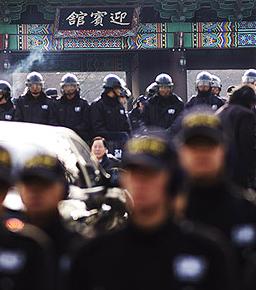
A NEW CHAPTER IN NEPAL'S
STRUGGLE FOR DEMOCRACY (??)
Nepal's rebels ready to join establishment (IHT/Reuters, 1.16)
Nepal's Parliament opened Monday at the start of a historic day that was expected to see Maoist rebels take their seats in an interim legislature for the first time after a decade of civil war that killed thousands.
The sight of 83 rebel nominees sitting alongside those they opposed for so long may comfort even the most cynical Nepalis, whose country has been brutalized by killings by both the state and the rebels that have severely damaged its tourism-dependent economy.
The Parliament's speaker, Subhash Nemwang, said the existing House of Representatives would approve a new temporary constitution, prepared by the ruling seven-party alliance and the rebels.
It would then establish an interim legislature, in which the Maoists would be the second biggest group, perhaps the most significant step toward cementing a lasting peace since the rebels put down their guns in April.
"The House of Representatives will be dissolved after passing the constitution and declaring the composition of the interim legislature," Nemwang said of the parliament only reinstated in 2006 following weeks of bloody street protests against the king.
"This is the achievement of 10 years of people's war waged by the Nepali people," a Maoist leader, Khim Lal Devkota, said.
"We think the new interim legislature will give a new direction for the creation of a new Nepal," said Devkota, one of the nominees of the Communist Party of Nepal (Maoist) to the proposed 330-member interim legislature.
The Maoists began fighting the monarchy in 1996, but they declared a ceasefire last year after mass street demonstrations forced King Gyanendra to give up direct rule.
In November, the multiparty government and the guerrillas struck a peace deal and declared an end to the conflict in which more than 13,000 people died in the Himalayan kingdom.
The pact called for the rebels to lock up their weapons under United Nations supervision in return for a promise by Prime Minister Girija Prasad Koirala to name them in an interim government.
That administration is meant to oversee elections for an assembly that is required to prepare a new constitution and decide the future of the monarchy, which the Maoists want abolished.
The Maoists will have to learn the politics of compromise, said Kunda Dixit, editor of the Nepali Times weekly.
The interim body will consist of 209 current members and the Maoists with 38 seats to be shared by constituents of the ruling alliance.
Critics say the draft interim constitution gives unlimited power to the prime minister, including the right to appoint the chief justice of the Supreme Court and has no provision for legislative control over the executive.
The Maoists, who have vowed not to return to war, were also set to start storing their arms in metal containers under UN supervision on Tuesday, but keep the keys as part of the deal.
http://www.iht.com/articles/2007/01/15/news/nepal.php
☞ Maoists enter parliament, first sitting of interim legislature begins, all MPs sworn in
Poor and powerless overnight (eKantipur, 1.16)
The Shah Kings, through royal decree, usurped power and amassed wealth umpteen times during the last 238 years. But today people have turned the tables on the monarchy: By proclaming a constitution invoking their sovereign rights the people have made the reigning king both poor and powerless overnight.
The king will no longer act as head of state - let alone exercise any political power. Significantly, the constitution has also snatched away a major chunk of the royal assets. According to the interim constitution, property belonging to the late King Birendra will go into a trust and the property inherited by King Gyanendra by virtue of ascending the throne will be nationalized. But the king will continue to enjoy his private property, including his businesses. How much does the king own in business? Contrary to popular perception, The Kathmandu Post investigation revealed that he owns "very little"
The common perception that the king is "super rich" comes from an assumption that he owns a majority share in the Soaltee Group, which does not exist any longer. However, the investigation also revealed that he owned only a "miniscule" share in the Group's businesses that expanded rapidly over last two decades. Before being dismantled in December 2005, the Group had nine business enterprises in its fold: Surya Nepal Pvt Ltd, Bhotekoshi Company Pvt Lt, Himal International Power Corporation, Sipradi Trading Pvt Ltd, Gorkha Lawrie Pvt Ltd, Himalaya Goodricke Pvt Ltd, Amaravati International Pvt Ltd, Maersk Nepal Pvt Ltd and Amaravati Travels Pvt Ltd. Out of these nine enterprises, Gorkha Lawrie was sold off in 2004.
Now a majority of these enterprises are owned and managed by Tara Management, which belongs to Prabhakar Sumsher Rana and his son, Siddhartha Rana. Records at the Office of the Company Registrar show that the king and his family own only 0.15 percent share in Himal International Power Corporation; 56 percent in Himal Goodricke, 40 percent in Soaltee Hotel and 10 percent in Surya Nepal Pvt Ltd.
But the king and his family have no share in Bhotekoshi Company Pvt Ltd, Sipradi Trading Pvt Ltd, Amaravati International Pvt Ltd, Amaravati Travels Pvt Ltd and Maersk Nepal Pvt Ltd.
Among the enterprises that the king has a share in, both Soaltee Hotel and Himal Goodricke are currently loss making ventures. While Soaltee Hotel, a public limited company, hasn't distributed any dividend for the last six years, Himal Goodricke has paid out about Rs 1.5 million as dividend during the last one decade. The only company that seems to be paying a significant dividend to the royal family is Surya Nepal. Last year it paid Rs 12.5 million to the family.
A source privy to King Gyanendra's financial situation said, "The income from his [king's] businesses is hardly enough to meet his expenses." The source also said the king often withdrew dividends from the companies in advance. This claim has a lot of credence since officials at the Kaushitosh Khana - the office that disburses state sanctioned funds to the royal palace - also said the palace used to withdraw all annual allocations within 48 hours of the budget announcement till last year.
The source also claimed that King Gyanendra was neck deep in debt by the time he ascended the throne in June 2001. "In 2002, he sold 10 percent of his stake in Surya Nepal to Indian Tobacco Company Ltd and used the proceeds to repay his huge debt."
In terms of share capital, the king and his family have Rs 80 million worth of share capital in Soaltee Hotel; Rs 6.5 million in Himal Goodrick; Rs 33.6 million in Surya Nepal and Rs 250 thousand in Himal International Power Corporation.
http://www.kantipuronline.com/kolnews.php?&nid=97660

The Historic Day, today we Nepali kick off new Journey collectively!
This day will be remembered as one of the historical days in Modern Nepal. Today, the House of Representatives popularly known as reinstated parliament by the Janaandolan–II has completed its historical task. Bringing Maoist in mainstream political process and paving way to hold election of Constituent Assembly for sustainable peace, the parliament has endorsed Interim Constitution of "New Nepal". Just after the endorsement, the House itself dissolved along with existing National Assembly (the upper House of the parliament) clearing way for New Interim Parliament, which is inducting 83 Maoists in the 330- member Interim Legislature as the new partner in the forth coming 8-party coalition interim government of the country.
The new Statute has ended any political role of Monarchy of Shah Dynasty, which was continued in Nepal since 238 years. Obviously, there is no room for King Gyanendra as the Head of the State. This is a landmark step taken by the parliament after May 18, 2006 historical proclamation to make Nepali a sovereign citizen.
Furthermore, GEFONT has as well, point to express its joy. Two senior leaders of GEFONT- one of the two vice-chairmen Comrade Lalit Basnet and One of the three regional coordinators Com. Chudamani Jungali became new law maker in the Interim Parliament. Vice-chair Basnet was sitting parliamentarian in old Upper House where as Coordinator for western Region Chudamani has been nominated by CPN (UML) on the quotas designated for Dalit, Women, professional Organisation, ethnic-minority groups. Com. Chudamani also represents outcaste (Dalit) community.
Expressing its gratitude, GEFONT has today issued a press communiqué welcoming declaration of Interim Constitution and establishment of New Interim Parliament.
"Two ensure workers right, we call upon all concerned parties to establish parliamentary office for trade unions in the newly launch Interim Parliament", the communiqué says.
GEFONT, 1.15
Korea Times in its today's edition is writing following:
Anti-FTA Groups Stage Rally
Civic groups and labor unions staged a series of rallies against the Korea-U.S. free trade agreement (FTA) as new round of FTA talks opened Monday. The anti-FTA groups estimated at about 2 million people will also have a large-scale protest at downtown Seoul on Tuesday.
The police banned all protests (democracy?? blabla..!!) by the civic groups worrying about potential violent clashes and traffic congestion, but the leftist (?) Democratic Labor Party registered its rally as resolution event of the party.
Although the rally is likely to draw other civic groups and labor unions, there is no way to ban it according to rallies and demonstration laws, the police said.
Authorities deployed 15,000 riot police in Seoul and tightened security to deter possible violence.
A civic group involved with violent anti-FTA protests last December also plans to hold a series of protest rallies during the negotiations until Friday.
A series of news conference was held and nine leftist lawmakers from the party launched a hunger strike for five days at the Shilla Hotel in Seoul, the venue for the sixth round of talks to oppose the deal in downtown.
"We are here to protest the FTA because we believe it will devastate the livelihood of low-income people and our nation," Kwon Young-gil, a representative of the group, said.
Following yesterday’s demonstration, about 30,000 farmers, laborers and Oriental medical college students joined the large-scale rally in downtown Seoul and marched toward the Shilla Hotel after the rally, chanting anti-globalization slogans. (???)
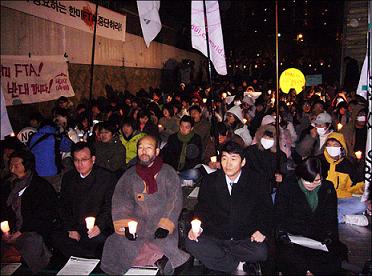
Y'day evening's candle light rally against US-ROK FTA near Shilla Hotel
Farmers and laborers have strongly opposed the deal because it would damage their livelihoods. The demonstrations have often turned violent.
Last November, over 73,000 farmers, workers and activists collided with riot police in 13 cities and 63 people were injured, including 35 police officers and causing some 670 million won ($720,000) in property damage nationwide.
http://times.hankooki.com/lpage/nation/200701/kt2007011518321511990.htm
TODAY'S DEMO:
1월 16일
한미 FTA 저지 범국민대회
일시, 장소 : 1월 16일 오후 2시, 대학로 -> 신라호텔
Korea Herald is writing following in its today's edition:
Tension mounts over anti-FTA rallies
Tension is escalating as activists prepare to stage massive rallies against the ongoing free trade negotiations between Korea and the United States as talks resumed in Seoul yesterday.
Civic activists and members of the minor Democratic Labor Party skirmished with riot police at the Shilla Hotel in Seoul in the morning as they tried to storm the main venue for the sixth round of the FTA talks.
Nine DLP members including Reps. Kwon Young-gil and Sim Sang-jung launched a five-day hunger strike (^^) demanding the immediate halt of talks.
The Korean Alliance against the Korea-U.S. FTA, a coalition of civic groups, said it would stage a series of demonstrations during the five-day negotiation despite a police ban.
"The Korean government has gained nothing during the past year of negotiations which have been kept secret from the public. There is no reason for the talks to go on," the alliance said in a news conference in front of the hotel.
The alliance held a candlelight rally in central Seoul, preparing for today's massive protest. The group had already launched a protest rally at Incheon International Airport as Wendy Cutler, a top U.S. negotiator, arrived in Korea on Sunday.
The group expects about 20,000 farmers and workers to faceoff against 2,000 riot police in demonstrations planned for Daehakno, Seoul, today.
As police banned all protest rallies organized by civic groups - citing fears of violence and traffic congestion - the radical (??^^) DLP yesterday applied for a demonstration permit under its name.
"Although we expect the demonstration to turn into a collaborated rally of all anti-FTA groups as was the case last December, we could not refuse the party's request according to the demonstration law," police said.
The anti-FTA demonstrations are to continue throughout the five-day negotiation with farmers planning large-scale protests tomorrow and Wednesday.
Police vow to crackdown on illegal protestors in the wake of last year's violent anti-FTA rallies which injured over 60 people, causing some 670 million won ($720,000) in property damage nationwide.
A group of Oriental Medicine doctors also held a press conference yesterday to reaffirm their opposition to a possible market opening.
Members of the Association of Korean Oriental Medicine said that it will take every possible means to block the market opening, reportedly on the negotiation table for the free trade agreement with Washington.
Washington has reportedly asked Seoul to allow its medical doctors to practice here without having to obtain a new local business license. The government, however, has made clear that the issue is not being discussed during the sixth round of talks.
Seoul and Washington have held five rounds of discussions so far on the proposed FTA, aiming to conclude the talks by March 2007 at the latest.
Korea's anti-FTA activists and farmers are opposed to the talks, fearing that the deal will damage their livelihoods by enabling a flood of cheap U.S. farm products to enter the country.
http://www.koreaherald.co.kr/SITE/data/html_dir/2007/01/16/200701160014.asp
Welcome to Chávez-land, the new Latin mecca for the sandalistas (Guardian, UK, 1.15)
Tourists flock not to the beaches, but the slums to see '21st-century socialism'
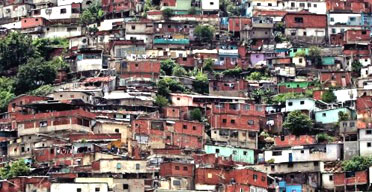
Tourists now visit Caracas slums such as La Planicie to see the
Chávez revolution. Some praise progress such as Bach playing
in the streets, but others are wary of increasing one-party control.
To sceptics they are naive westerners seduced by hype who would not recognise communist tyranny if it expropriated their sandals. "Malodorous, leftwing, US and European peace creeps armed with mom's credit card and brand new Birkenstocks," according to American Thinker, a rightwing magazine.
To the Venezuelan government they are valued friends who witness firsthand the positive changes in the slums and countryside and who return home, a volunteer army of ambassadors, to spread the good news. To others they are simply curious souls drawn to this corner of South America to see what all the fuss is about.
Meet the revolutionary tourists, a wave of backpackers, artists, academics and politicians on a mission to discover if President Hugo Chávez really is forging a radical alternative to neoliberalism and capitalism.
From a trickle a few years ago there are now thousands, travelling individually and on package tours, exploring a leftwing mecca which promises to build social justice in the form of "21st century socialism".
Successors to the so-called "sandalistas" who flocked to Sandinista-ruled Nicaragua in the 1980s and to Cuba in earlier decades, their ranks are to swell further now that Mr Chávez is accelerating his self-styled revolution after last month's landslide re-election. "Socialism or death - I swear it," he said last week, and declared himself a communist.
Passion
"It's just amazing being here. There is so much vibe and passion, there is truly a sense of revolution," Lucy Dale, 20, a university student from Chicago on a 17-day trip, said last week. "I want to return to do volunteer work."
Global Exchange, a San Francisco-based group which doubles as a travel agent, organised trips for almost 500 Americans last year, five times the 2003 figure, said Jojo Farrell, its Venezuela liaison worker.
From Britain, the Wolverhampton-based Venezuela Solidarity Campaign is planning to send at least six delegations this year, mostly of trade union members. "Interest is growing significantly," said Andy Goodall, the coordinator.
The visitors tend to shun the Caribbean beaches in favour of tours to agricultural cooperatives, shantytown medical clinics and adult literacy programmes, part of the government's effort to spend petrodollars improving the lives of the poor majority.
"We saw healthy, happy well-dressed children taught by well-qualified teachers who get paid a decent salary. These are opportunities that did not exist for poor people before Chávez," said Kate Young, who travelled with the Rotary Foundation.
Others hail Caracas and its alliance with other leftwing governments for loosening Washington's traditional grip over the region. "We need checks and balances to US unilateralism and any good north American would laud Chávez for doing that," said Clif Roberts, a Californian writer who stayed on in Venezuela after attending a poetry festival.
Visiting celebrities such as the actor Danny Glover, the singer Harry Belafonte and the anti-Iraq war activist Cindy Sheehan have echoed the sentiment. London's mayor, Ken Livingstone, and the US doctor-turned political activist Hunter "Patch" Adams, are expected later this year.
"Given the history of gringo intervention in Latin American affairs, the Venezuelans have greeted us with an amazing degree of hospitality and openness," said Edward Ellis, an American anthropologist who coordinates tours.
Many enthusiasts set up solidarity groups when they return home and detail their impressions in blogs, amplifying the message sent out by Venezuela's embassies, information offices and Bolívarian Circles, an expatriate network named after the 19th-century Latin American independence fighter.
The aim is to correct alleged corporate media distortion which depicts the paratrooper-turned president as an autocratic megalomaniac and plays down the groundbreaking social progress.
"The UK media is very disappointing, always a negative slant," said Rod Finlayson, 62, a Ford Dagenham trade union official who was thrilled by the nationalisations and cultural events. "Bach in the slums. Stuff you could only dream about."
Dreaming, say some critics, is the problem: instead of investigating complexities - such as the corruption and mismanagement undermining some social programmes - visitors sleepwalk through government spin and never hear allegations that Venezuela's oil bonanza is being wasted or that democracy is being smothered.
Mr Finlayson said his TGWU delegation ignored such voices because the goal was to express solidarity, not investigate. However, the delegation did encounter some Chávez critics: when walking through an upmarket district of Caracas it was pelted with eggs.
Some groups, such as those travelling with Global Exchange, meet opposition figures and hear claims that Mr Chávez is hoarding power by fusing his movement into a single socialist party, not renewing the licence of an opposition-aligned TV station and plotting to abolish limits on terms of office
Beacon
"I was encouraged by much of what I saw in Venezuela but the focus on one person as the source of hope and improvement strikes me as unfortunate," said Sarah Gelder, an editor at Yes!, a magazine based near Seattle. Another leftwing journalist, Monica Vera, a documentary-maker, hailed the country as a progressive beacon but voiced unease: "I just hope it continues on that track."
On Saturday Mr Chávez welcomed his latest visitor, the Iranian president Mahmoud Ahmadinejad, and announced a plan to build new cities from scratch in the countryside. He also vowed to replace municipal governments with councils inspired by the Paris commune, France's shortlived experiment with radical socialism in 1871.
Socialist TV, by George:
George Galloway wants Venezuela to sponsor a web TV station which will broadcast political satire and speeches by President Hugo Chávez from the Respect MP's home in London.
The political firebrand, below, hopes to visit Caracas next month to request funding and technical support for the venture.
"I'm definitely headed that way," he told the Guardian. "I want to talk to the Veneuzuelans about television."
Mr Galloway, 52, also known as Gorgeous George for his suntan and cigars, said he would host his own version of The Daily Show with Jon Stewart, the Emmy-winning US satirical programme.
The MP for Bethnal Green and Bow, who was expelled from the Labour party in 2003 after outspoken opposition to the Iraq war, knows Adán Chávez, Venezuela's education minister, and shares the rhetorical skill and leftwing radicalism of his brother, the president.
The South American leader has launched Telesur, a pan-regional TV station intended to rival CNN, and hosts his own TV show, Alo Presidente, in which he interviews guests and gives monologues which can last more than four hours.
Mr Galloway said his venture required modest resources but that it still needed technical support and content, such as tapes of Mr Chávez's speeches, to fill the time when he was not doing a Scottish socialist version of The Daily Show.
"The plan is pretty advanced but I need help to run the thing. It will probably be broadcast from my front room."
http://www.guardian.co.uk/venezuela/story/0,,1990414,00.html
For more about Venezuela's latest developments:
☞ Archived articles by the Guardian
PS:
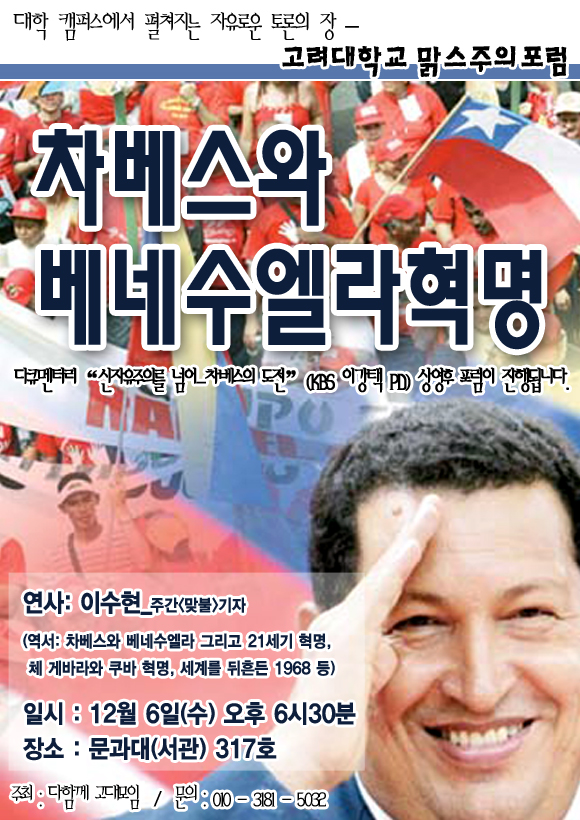
Just a some days ago Chavez called, according to the German "left/marxist" daily newspaper Junge Welt, Jesus Christ(!!!) as the greatest socialist..^^(aeh~ actually it was just few days before he(Chavez, not Jesus..) had his "friendship meeting" with his "anti-imperialist brother" Ahmedinejad!!)
"The U.S. Air Force on Tuesday said it will start deploying a squadron of F-117A stealth fighters and some 300 airmen in South Korea for four months..", Chosun Ilbo reported last Thursday (1.11) and on the same day it happened..
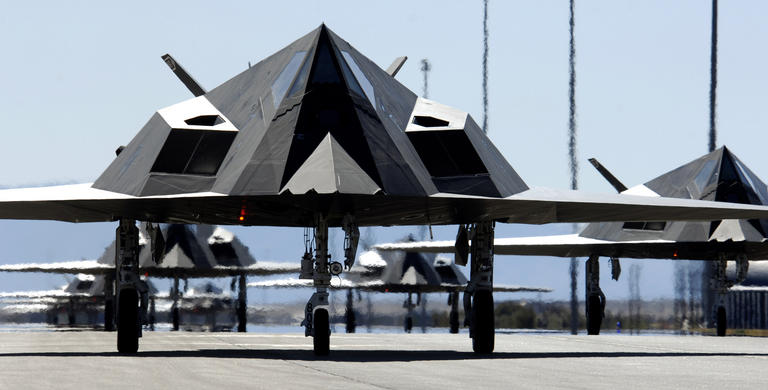
..and so JoongAng Ilbo was able to report yesterday following:
‘Routine' arrival of U.S. fighters here also a signal
F-117 stealth jets' deployment is a test of ability to react to North, analyst says
The arrival of a U.S. F-117 Nighthawk stealth fighter squadron at Kunsan Air Base on the southwest coast Thursday has been called a "routine" deployment by U.S. officials, but one U.S. military analyst said the deployment of the unit served to test U.S. readiness to deter a North Korean threat quickly.
The number of arriving aircraft was not announced, but a squadron usually consists of 15 to 24 fighter planes.
Bruce E. Bechtol Jr., a faculty member of the Marine Corps Command and Staff College, said Wednesday in an interview that the deployment and another one of F-22 Raptor fighter planes to Japan recently had motives beyond the official explanation.
In military terms, he said, the deployments were tests of what the U.S. military calls "flexible deterrent options."
Mr. Bechtol said the philosophy behind the term was at least partly to ensure that an attack on South Korea by the North could be repelled quickly.
Other military analysts commenting on earlier deployments of stealth (radar-evading) aircraft here also served to give air crews a look at a potential combat theater and test the aircraft operating systems in the field (NK's air space..??)
The deployment comes at a time when speculation is mounting that North Korea may conduct a second nuclear test; its first, on Oct. 9, is generally considered to have been only partly successful.
Last month, six-nation talks to induce North Korea to abandon its nuclear weapons programs ended inconclusively after a year's pause in the negotiations.
Mr. Bechtol has worked as a senior analyst at the Defense Intelligence Agency and as a cryptographer at several duty posts. He worked in South Korea for four years in that capacity..
http://joongangdaily.joins.com/200701/12/200701122112250539900090409041.html
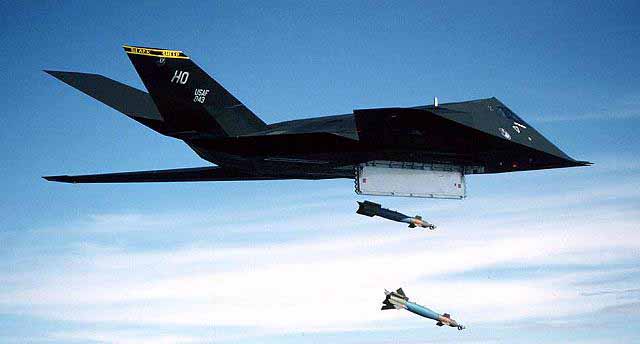
When I remember well, US military strategists/"scientists" suggested few years ago in one of the OPLAN's (just) one way how to f.. the KPA: temporally limited violations of the DPRK air space would leed to increased activities of NK's airforce - hunt them from east to west and from north ot south and after a short while they will run out off kerosene..^^
20 additional war planes might be enough for to carry out this plan...
For the details of some of the different OPLAN's please check out this:
OPLAN 5027 - Major Theater War
OPLAN 5026 - Air Strikes
OPLAN 5029 - Collapse of DPRK
OPLAN 5030 - Rollback of DPRK
오늘:
그리스
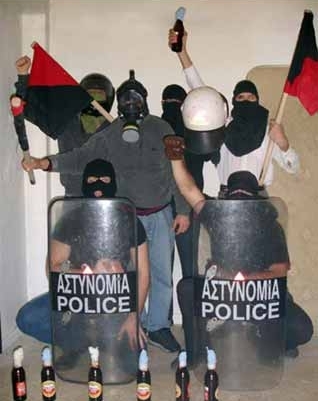
Activists of the Greek (anarchist) resistance movement..
Just today (CET), in a "heroic attack", militants of the Greek anti-imperialist movement - in this case the "Revulotionary Struggle" organisation - perforated the US embassy in Athens. With the help of a RPG(!!) they broke the window(!!) of one of the toilets in the building.^^
Shell hits US embassy in Athens (Guardian)
Rocket grenade attack hits U.S. Embassy in Athens (IHT)

최근 덧글 목록