












공지사항
-
- '노란봉투'캠페인/국제연대..
- no chr.!
30개의 게시물을 찾았습니다.
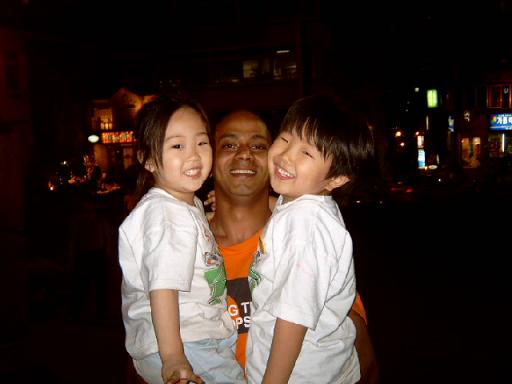
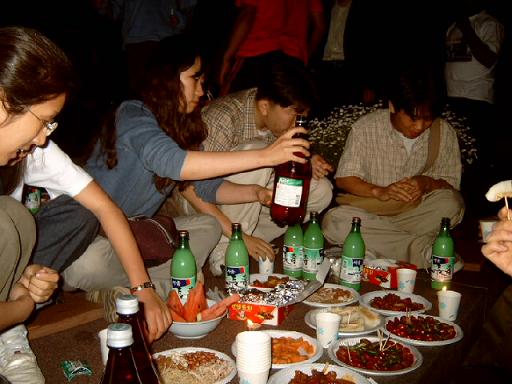
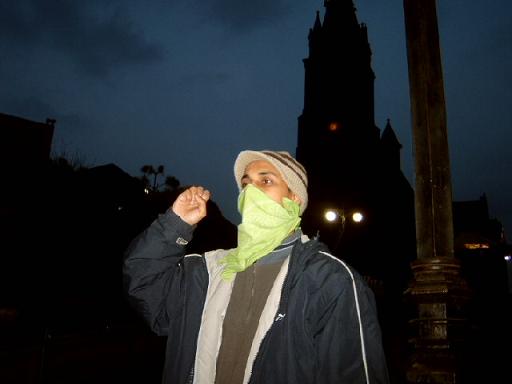
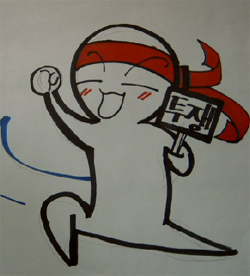
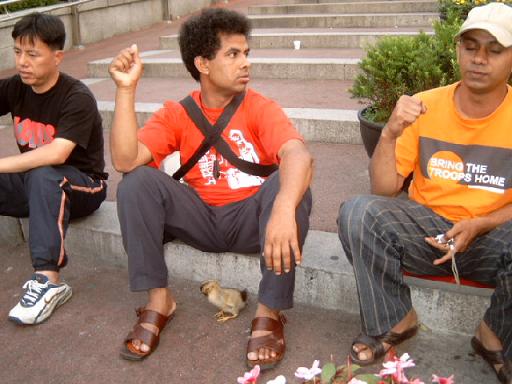
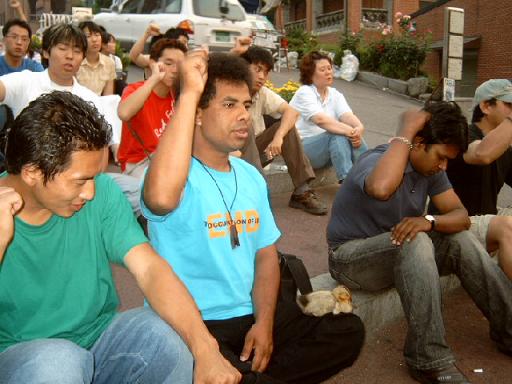
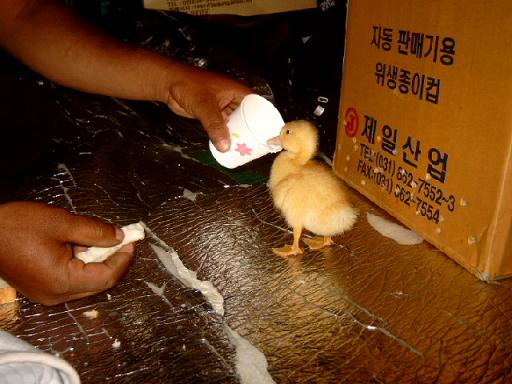
Some days ago I had to check the old reports about our sit-in strike for an article about the struggle of migrant workers in S.K. And - oops!! - I found following, in my opinion very beautiful pictures.
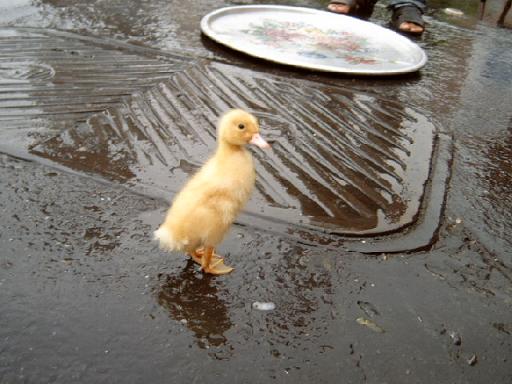
In spring 2004, just few month after the beginning of our sit-in strike on Myeong-dong cathedral's compound, comrade Kabir gave birth(^^) to our new comrade: 우리 오리새끼同志^^ - as you can see on the first picture..






RADICAL WELFARE IN THE GAZA STRIP
Uncle Hamas Cares for Palestinians
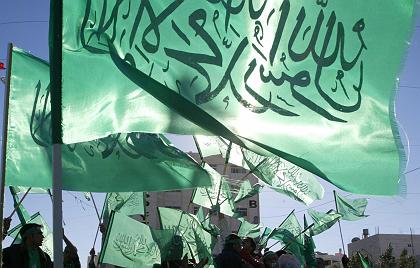
The West classifies Hamas as a terrorist organization, but in the Gaza Strip, the Islamist organization is widely respected for helping families in need. International aid groups also praise Hamas for being free of corruption.
Etidal Sinati's life in poverty began one night in March 2003. Israeli helicopters were flying air attacks on the Jabalia refugee camp in northern Gaza City and Etidal's husband Mohammed and a group of other men from the neighborhood went out to assess the damage. But the Israelis weren't done; an attack helicopter returned and fired on the onlookers. Etidal's husband was killed, leaving her with seven children and no one to provide for them. Overnight, the Sinatis became a welfare case -- and loyal to Hamas. The radical Islamist group took the destitute family under its wing.
"My husband was not a Hamas supporter. In fact, he was for Fatah," says Sinati, now a widow. It is cold in her two-room hut; a mentally ill uncle sits in a corner occasionally laughing to himself and pulling his wool blanket over his head. "But without Hamas we wouldn't have survived, and even with their support it's been difficult."
The official pension for the wife of a "martyr" -- a Palestinian killed by the Israeli military -- is €100 every three months. For a large family living in Gaza, this is about enough for one good seafood meal, but is not enough to live on. "So Hamas adopted my children," says Etidal Sinati. The widow receives €15 a month in child support for each child, and all of her children attend a school run by Hamas free of charge. "I voted for the crescent in the January election," says the illiterate Etidal. The crescent moon is Hamas's symbol.
A party for the poor
At first glance Hamas, a party that looks after the poor with its money and charity, appears to be playing a well-known tune on the instrument of populism. On the other hand, every major international aid organization is singing the Islamist group's praises when it comes to the quality of its work. "In the International Crisis Group's 2003 report, the most important American NGOs gave perfect marks to Hamas's work; they couldn't have achieved a better result," says Helga Baumgarten, a lecturer at Birzeit University in Ramallah.
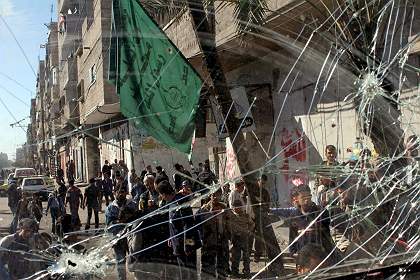
Baumgarten believes that the success of the party, which emerged from the radical Muslim Brotherhood in 1987, is based on two factors: the highly professional work of the group's welfare agencies and Hamas's oft-cited integrity. "In fact, all studies have concluded that Hamas operates without a trace of corruption," says Baumgarten. "This has enabled it to gain the respect of the population over the years."
Nevertheless, Hamas is no moderate party. It sees itself as the spearhead of Palestinian resistance against the Israeli occupation. Following its surprising election victory in January, the organization refused to renounce armed conflict or to recognize Israel. Its repeated use of suicide bombings against Israeli citizens since its founding has also contributed to Hamas being classified as a terrorist organization in the West -- despite its day-to-day charitable activities.
But it is difficult to say whether Hamas deliberately uses its charitable work to generate sympathy within the population. "Social commitment is not a means to an end; I would not interpret this merely as exploitation," says Baumgarten. And even if it were, parties the world over operate no differently.
Building on faith
Al-Mujamma al-Islami, or the Islamic Center, in southeastern Gaza City is proof positive that Hamas literally builds on faith. The mosque on the ground floor of the newly constructed center has been in operation for weeks, while the center's employees sit between boxes on the fourth floor above the women's gallery in the prayer room. The center, founded in 1973 by Sheikh Ahmed Yassin making it the oldest Islamic charity in Gaza, had grown too big for its old headquarters. Its 150 employees just moved in to their new offices on the weekend.
At first the wheelchair-bound Yassin, who founded Hamas in 1987 and was killed in a targeted Israeli missile attack in 2004, managed the organization's funds from the living room of his modest house a few streets away. Today the center has evolved into a giant charitable institution in Gaza, operating 16 kindergartens, 30 Koran schools, and providing thousands of families with money, food and clothing. The center also pays child support for 5,000 orphans. Etidal Sinati also collects aid payment for her seven children here.
Nidal Shabana, the center's director, currently manages an annual budget of about $1 million. Despite his prominent position, Shabana remains a modest man, although a hint of pride for his work trickles through when he talks about the Islamic ping-pong team that recently won the Gaza championships under his tutelage. "Modesty and honesty are principles that are especially valued in Islam," he says. When asked his opinion about the growing strength of Islamist parties in the Arab world -- a phenomenon viewed with great concern in the West -- Shabana becomes circumspect. The behavior of Islamic leaders happens to be exemplary, he says, adding that their hands are clean. In a roundabout way, Shabana is saying that he considers the political leaders in neighboring Arab states to be corrupt and morally weak.
Since the 1970s, the failure of authoritarian regimes in the Arab world -- dominated by ruling families intent on lining their own pocketbooks and bloated, inefficient bureaucracies -- has led to Islamist groups filling a social and political vacuum in the Palestinian Territories, Lebanon, Egypt and Jordan. The fact that Hamas hasn't received recognition as the sole governing party in the Palestinian Territories is by no means just a local quirk. Resistance to Hezbollah's quest for power up the road in Beirut is similar. These religious fundamentalist organizations are a threat to the region's established regimes; it's not just Israel and its Western allies that are interested in keeping the Islamists in check.
Etidal Sitani is also aware that the organization that has thrown her family a lifeline is facing pressure from within the Palestinian Territories and from abroad. But this has only strengthened Sitani's support for her benefactors. Her eldest son recently tried on his father's uniform. But while the father was a reservist in one of the Fatah Movement's security forces, the son plans to fight for Hamas. "I will not allow him to join the militias just yet. After all, he is only 15," says the mother. "He can do it when he is 20."
(Der Spiegel, 12.20)
K. Times published on Tuesday (12.26) following article:
Expats Risk Expulsion for Satire
Foreigners may face deportation or fines if they volunteer at orphanages or organize performances without reporting them to the authorities.
The interpretation came from Joo Jae-bong, an official at the Ministry of Justice. He said there should be no problem with joining a poetry club but that volunteer activites should be registered with the ministry.
``If it 's just a gathering of friends, there should be no problem,’’ he said. ``But if they are organizing performances, they need to register to do those things because they are changing the purpose of their stay here.’’
He said the same rule applies to those who wish to volunteer in an orphanage. Foreigners need to register those activities with the ministry...
Read the entire stuff here:
http://times.hankooki.com/lpage/200612/kt2006122617295710230.htm
So I ask myself what will be happen to "foreigners" who are joining for example labour unions, such as (the still "illegal") Migrant Workers' Trade Union or radical left political organizations??
Or joining protest demonstrations... harrharr.. "even worse" taking parts in street battles??
Ha, of course IMPRISONMENT & DEPORTATION!!
The S.K. semi-official news agency Yonhap was publishing 12.24 following report(based on an article by the magazine Oriental Economist):
China may decide to engineer coup in N.K. next year..
Participants in an unpublicized White House meeting, called by U.S. President George W. Bush himself, two months ago discussed the possibility that China may arrange a coup in Pyongyang to bring down the regime sometime late next year, the Oriental Economist reported in its December edition.
China was still oscillating between options, but participants generally agreed that Beijing's mood is changing toward the North's Kim Jong-il regime, "with Beijing gradually, somewhat grudgingly, concluding that some kind of 'regime change' may be needed," the monthly said.
There was also "explicit discussion in the meeting of the possibility that, sometime next year, after China's President Hu Jintao has further consolidated his power, that China may try to engineer a military coup in Pyongyang against Kim Jong-il," it said.
National Security Adviser Stephen Hadley arranged the meeting with Michael Green, the former Asia director at the National Security Council, on Oct. 25 with Vice President Dick Cheney also attending, according to the monthly.
White House chief of staff Josh Bolton and chief political adviser Karl Rove, who has special interest in East Asia, were also at the one-hour meeting.
Green took with him Bonnie Glaser, China specialist at the Center for Strategic and International Studies, and Nicholas Eberstadt, a North Korea expert at the American Enterprise Institute.
Former Assistant Secretary of State Jim Kelly was invited but declined, the monthly said.
President Bush wanted to hear the assessments of what China was likely to do about North Korea, particularly how far Beijing is willing to pressure its neighbor and close ally to give up its nuclear weapons and programs.
The monthly said the participants emphasized the importance of keeping China engaged on North Korea issues.
Beijing's three options, as described by the participants, are that it can stay close to North Korea and help strengthen it; turn aggressive and intensify pressure; or maintain the status quo and accept North Korea as a nuclear arms state.
The notion of a China-engineered coup was discussed as a possibility, one participant was quoted as telling the monthly, "but it was very academic and hypothetical and speculative, and hardly the basis for a new policy at this point."
China is one of the key players in the six-party denuclearization negotiations that also involve South and North Korea, the U.S., Japan and Russia. It hosts the multilateral forum and mediates talks between Pyongyang and Washington.
http://english.yna.co.kr/Engnews/20061225/610000000020061225092456E6.html
On the one side this kind of articles we might see as just ridiculous but on the other side this kind of reports are very dangerous. Especially for N.K. "activists"/cadres who are refering them self to the Communist Party of China/a kind of Chinese model of "socialist" development. Remember the early/middle 1950th when the WPK/Kim Il-sung launched a campaign against (N)Korean militants/cadres who fought with the (Chinese) PLA against the Japanese occupation: many of them, like members of the so-called "Yenan-Group", ended in NK's prison camps or were "simply " just executed.
FATAH BY DAY, HAMAS BY NIGHT
The Double Life of Abu Khaled
By day, he's a member of Fatah security forces. By night, he wages holy war with Hamas. With the two Palestinian groups fighting against each other these days, Abu Khaled's life has become a dangerous balance. If need be, he says, he would even kill his friends.
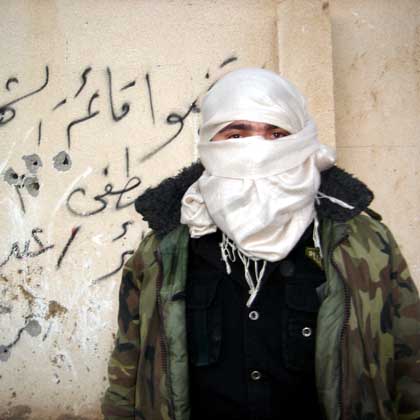
The private car heads north out of Gaza City. A rat-a-tat-tat of machine gun fire echoes through the side streets, belying what remains a fragile cease-fire between Hamas and Fatah in the Palestinian Territories.
Both the driver and the guide are talking nervously into their mobile phones. Instructions are delivered, detours ordered, until finally the vehicle arrives in an empty street and pulls up next to one of Gaza's typical yellow taxi limousines with two rows of back seats. Motors running, the bulletproof vests are quickly loaded from the car into the taxi. The journey then continues in the Mercedes limousine -- until it reaches the end of the road, marked by the wall that separates the Gaza Strip from Israel.
It's cold and the sun is about to set into the Mediterranean. Nevertheless, sweat is running from under Abu Khaled's beard when he jumps into the taxi. Hardly surprising really. If the other soldiers he stands guard with at the gate of an abandoned military base knew his story, the lives of everyone in the taxi would be in danger.
By day, the 23-year-old serves in the Palestinian security forces, which are controlled by Fatah. When Abu Khaled's workday ends, though, he goes home, changes his uniform, pulls out his weapons and transforms himself into a fighter with the Qassam Brigades -- the military arm of Hamas. If his fellow Fatah security officers knew what he did at night, he says, "they would open fire on us immediately."
No wonder the situation in Gaza is so confusing
"We are not a rarity," says the fighter. He estimates that about 30 percent of the men who officially serve with the Palestinian security forces are secretly active members of militia groups with ties to Hamas -- armed men who change sides depending on the time of day. No wonder the situation in Gaza is so confusing. In most of the gun battles between Hamas and Fatah in recent days, it was almost impossible to tell who was shooting at whom, when they were shooting, and why. After each new incident, the barrage of back-and-forth accusations merely triggered the next shoot-out -- a spiral of violence that is difficult to stop.
As the taxi drives slowly through abandoned streets, Abu Khaled tells his story -- the story of a young man who sees no other choice but to fight the enemy any way he can. "The official forces are poorly trained and armed," he says. "They could never do much harm to the Israelis."
He's likely right. A visit to a Fatah training camp that morning was unconvincing. Although the camp's 50 recruits were able to perfectly recite Fatah's various slogans after three months of training, most were incapable of performing even the most rudimentary of combat maneuvers.
But Fatah, the party of Palestinian President Mahmoud Abbas, has recognized Israel and is no longer interested in doing damage to the country. Indeed, it is the party's moderation which has made it a negotiating partner for the West and Israel. Hamas, on the other hand, remains dedicated to eliminating Israel and has yet to renounce violence. Over the years, it has been responsible for numerous suicide attacks on Israeli citizens and is considered a terrorist organization in the West.
Khaled says that even as a teenager he realized that the organizations affiliated with Fatah were "much too soft" to prevail against the Israelis. The Palestinians, he says, are prisoners in their own country. "The Israeli crimes have kindled my emotions and my passion." This passion prompted him to join the Qassam Brigades at 15 -- an early age for a fighter, but not unusual for many of the "converts," as he calls them. "The Islamic ideology is close to my heart and mind."
"Tanks attacked, rockets fired, mines laid
He tells the driver to drive up and down a few more streets. Israeli cameras mounted on balloons hang over the wall and monitor their progress. It wouldn't be the first time a taxi was mistaken for a rocket launcher. "We expect the Israelis to attack at any time," says Abu Khaled. "They have broken cease-fires many times before."
He normally spends five nights a week with the Qassam Brigades, stationed at the border with Israel. "In the past few years, I have attacked Israeli tanks, fired rockets and grenades and laid mines," he says, listing his achievements. According to Khaled, the weapons are homemade; land mines, rocket launchers and even Kalashnikovs and ammunition are produced at Qassam's secret workshops in the Gaza Strip. The material, he says, is smuggled in from Egypt through tunnels or comes "from the Israeli mafia."
Four times, he says, he was almost hit by rocket attacks from Israeli drones; he was injured once in the head and once in the leg. His nighttime duties have been reduced to two nights a week since the cease-fire with Israel came into effect, finally allowing him to turn at least some of his attention to his studies. Khaled, who wants to become a journalist, enrolled in the Islamic University at the beginning of the year. "I would love to work in Hamas's press office."
For his mother's sake, he takes along a mobile phone at night
Though already 23, Abu Khaled doesn't have a family of his own. "I chose the armed path. I could be killed any time. It would be bad enough if my parents and my siblings had to suffer." His mother, he says, is already beside herself out of fear for his safety. He keeps a second mobile phone for her sake alone -- "so that she can call me at night, when I embark on jihad, holy war."
His seven siblings are proud of Khaled, the eldest, who commands a six-man combat unit. "The little ones are anxious to become Qassam fighters themselves. I'm the star of the family," says Abu Khaled, grinning. Financial concerns are partly responsible for the fact that he hasn't married yet. He received his last full pay nine months ago. He uses part of the money he occasionally receives for his daytime services to pay his membership dues in the Qassam Brigades. "It is an honor for us to be permitted to fight for Hamas. We give some our money so that the fight can continue."
In the past, Israel was the only enemy. But now the gun battles between rival Palestinian groups that are audible in the distance force Khaled to confront new problems. He spends his days with 15 other members of the Fatah security forces in the no man's land between the Israeli border and the last few houses in Beit Hanoun. The small unit would be an ideal target for rival militias on the hunt for Fatah supporters.
"It would be difficult for me to shoot them"
Khaled vehemently denies the possibility that the Qassam Brigades could attack his unit. "The Qassam Brigades never attack their brothers. We only defend ourselves." But the possibility has crossed his mind. "If we are attacked by the Qassam Brigades, I will identify myself and switch to their side."
It is a moral dilemma for Khaled, who feels a bond to his fellow members of the Fatah security forces, "as if they were my family. We cook together and spend the entire day talking. It would be difficult for me to shoot at them."
When asked what he would do were his fellow Fatah members to learn of his excursion with a journalist and realize his split loyalties, Khaled says: "I would try to escape."
And if that didn't work, he would kill friends, if necessary. "It has come to this in Palestine."
(Der Spiegel, 12.21)
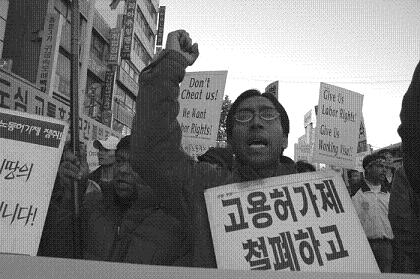
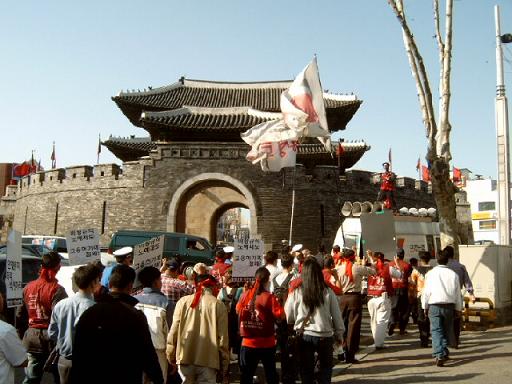
단속추방 중단, 자만 동지 석방, 모든 미등록
이주노동자 합법화를 위한 결의대회
Rally for stop crackdown,
release Jaman and legalize
all undocumented migrant workers
일시 : 2006년 12월 24일(日) 오후 3시
2006. Dec. 24.(Sun.), 3 p.m.
장소 : 보신각 앞(종각역 4번 출구)
(subway: Jonggak Stn, ex. 4)
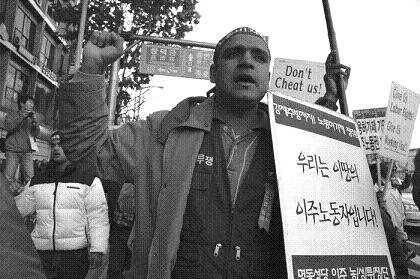
주최 : 서울경기인천 이주노동자 노동조합(MTU)
WHAT A SURPRISE (^^):
North Korea nuclear talks fail (al-Jazeera)
Talks on North Korea's nuclear programme have ended, without an agreement reached on disarmament or further negotiations.
The negotiations broke up "without concrete result", the Interfax news agency reported on Friday, quoting a source close to the Russian delegation.
Wu Dawei, Chinese envoy, said delegates reaffirmed a September 2005 agreement in which Pyongyang agreed to disarm in exchange for security guarantees and aid.
Wu said there had been "useful discussions" about how to implement the agreement in "candid and in-depth exchanges of views".
China, Japan, Russia, the US and the two Koreas agreed to "reconvene at the earliest opportunity," Wu said.
The talks in Beijing are the first since North Korea tested a nuclear device in October.
Refusal
During five days of meetings in Beijing, negotiators said Pyongyang refused to discuss its nuclear weapons programme and demanded that the US remove financial restrictions it has imposed on the government.
In more than three years of meetings, the North has committed in principle to disarm, but has not taken any decisive steps to curb its nuclear weapons programme. It conducted its first nuclear test on October 9.
"There will be opinions questioning the credibility of the six-party talks," Kenichiro Sasae, Japanese envoy, said. He did not say what alternatives existed to multinational dialogue.
Speaking before the fifth day of talks commenced, Christopher Hill, the US assistant secretary of state and envoy to the talks, said North Korea had not addressed the issue of its atomic programme.
"When the [North] raises problems, one day it's financial issues, another day it's something they want but they know they can't have, another day it's something we said about them that hurt their feelings," Hill said.
"What they need to do is to get serious about the issue that made them such a problem ... their nuclear activities...Our goal is denuclearisation. Period," he said.
Isolation
Pyongyang says the US is trying to isolate North Korea from the international financial system and has insisted that such a campaign ends.
The US accuses North Korea of involvement in the counterfeiting and laundering of money. It has blacklisted Banco Delta Asia, a Macau bank that it alleges the North used to launder money to fund its weapons programme.
Negotiators say North Koreans have refused to talk about their nuclear weapons programme until financial restrictions are dropped.
Condoleezza Rice, US Secretary of State, echoed the US administration's view that financial issues and nuclear talks should be dicussed separately. She said the North Koreans had themselves asked for a separate working group on the matter...
http://english.aljazeera.net/NR/exeres/5E9A987F-22DC-4058-878A-48A65699355E.htm
Nuclear talks end with no deal (Guardian)
The S.K. ("left"-liberal) daily Hankyoreh is writing following:
6-party talks end quickly; frugal progress made
A related article, published today in Asia Times (China/HK) you can read here:
The ever-threatening nuclear shadow
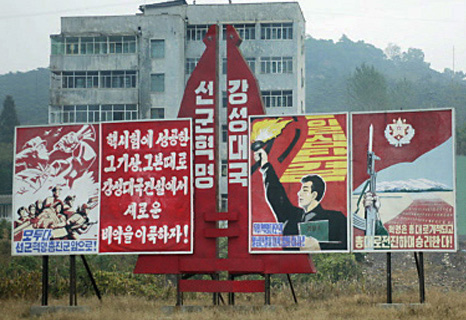
NK propaganda praises its own (nuclear) "power".
BTW: "The most important event of this year: The socialist Korea's break of the nuclear monopol. This is one very important contribution for the peace, not only in Asia, but in the entire world." (so the German fascist organization "Struggle Federation of German Socialists")
But actually I still don't understand why the DPRK's leadership is feeling forced to join such ("empty and worthless") meetings, when everything is going sooo well, like you can read here:
Dear Leader Keeps The People Warm
It's getting colder in Korea, but that's only for those who go outside. Inside, the apartments are nice and warm, thanks to a large increase in fuel imports, facilitated by dear leader Kim Jong-Il.
Although the imperialists have attempted to block off all access to fuels in order to freeze the country inside and out, the dear leader has made many close friends with leaders of oil rich countries such as Venezuela and Turkmenistan. As such, the blackouts that have plagued many Korean nights will now cease to exist for good thanks to these new worldwide friendships.
In contrast, it is predicted that over 30% of the American people will have to spend a few cold nights a week without heat or power. In South Korea, thousands have already frozen to death, as the imperialists have stolen all of the oil out of that country and left the common citizens with nothing. (!!!)
http://www.pyang.su/11122006-01.htm
Or it's just a stupid lie(^^) and following report presents more the "truth"??
Electricity Resumption in Border Area, Temporarily
Inside source from North Korea said each house in Musan, Onsung, Hoeryong in North Hamkyong Province, would receive electricity from the December 19th to 24th, commemorating Kim Jong Il’s mother, Kim Jong Suk’s birthday (Dec. 24).
In a telephone interview with the Daily NK, thirty-eight years old resident of Musan, North Hamkyong K said electricity supply was resumed on Tuesday. “Public service workers visited each house and asked them to use only one light bulb per household.”
K said with delightful voice “I’m so happy that I could eat in a bright house, and I could watch TV and VCR, too.”
In this year, North Korea’s electricity production has been worsened than ever that only army barracks, strategic facilities and rice mills were provided electricity.
Lack of electricity has been common since the mid-1990s economic collapse. And it becomes worse in winter, because hydro-electric power plants, which comprise most of North Korea’s electricity-production, cannot produce energy in arid season.
Therefore, North Korea in winter is once described as a “wilderness” by a Korean-Chinese visitor.
Some wealthy North Koreans are equipped with own electric generators, including Chinese solar-light collectors
.
In North Korea, electricity is supplied on holidays such as Kim Il Sung’s birthday April 15, Kim Jong Il’s birthday February 16, or Party Foundation Day. Since 1997, Kim Jong Il’s mother, Kim Jong Suk’s birthday has become an official holiday.
http://www.dailynk.com/english/read.php?cataId=nk00100&num=1468
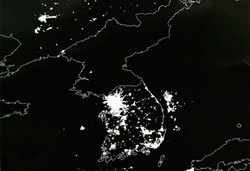
The Korean peninsula at night (satellite photo)
^^

덧글 목록
관리 메뉴
본문
부가 정보