
공지사항
-
- '노란봉투'캠페인/국제연대..
- no chr.!
30개의 게시물을 찾았습니다.
"ONE BIG PRISON"
A Glimpse at Daily Misery in the Gaza Strip
The 1.5 million inhabitants of the Gaza strip are trapped in poverty and hopelessness. The violence between the Palestinians stems not only from political disagreements, but from deep, daily despair.
Barefoot; dressed in a long gray nightshirt; sleep in his eyes: if his uncle hadn't banged away at the door, Ahmed Kahlout would most likely still be asleep. Instead he dragged himself out of bed at 11:30 a.m., opened the door and invited his visitor in.
Like an old man, he then sank back down onto the two mattresses serving as a sofa in his parents' house -- the only piece of furniture in the living room apart from a fake Persian carpet. He sat there and wearily told his story, one of many such stories in the Gaza Strip: A good education at a school set up by an aid organization, followed by a degree. Since then, the reality of living in Gaza City has ruined all his dreams.
"I did a degree in pedagogy, and wanted to be a teacher," the 23-year-old explained. Instead he is unemployed and spends his days sleeping. "I can't marry, because I have no money to feed a family. So I have a lot of time to kill."
And he does that sitting in semi-darkness. The streets of the Shati refugee camp in the north of Gaza City are so narrow that hardly any light shines into his family's two-room apartment. An old man is perched outside, selling moldy bread as feed for chickens and goats. Palestinian Prime Minister Ismail Haniyeh only lives a few streets away. The Hamas leader didn't move out of the slum following his election to the post of prime minister -- a fact that earns him great respect amongst his followers.
But Ahmed Kahlout is too apathetic to become a radical, despite things going so badly for him. In this respect he is like most of the Gaza Strip's 1.5 million inhabitants: they get on with lives that are marked by poverty and despair. They live an existence in which the bloody conflict between radical Hamas and the seemingly corrupt Fatah is just one more misfortune.
The Gaza strip is just 40 kilometers long and 10 kilometers wide (25 by 6 miles) -- and for years it has been a byword for misery. This year has been even harder for its inhabitants to bear. To understand the sheer scale of the misery, one has to visit John Ging. He is the director of the United Nations Refugee and Works Agency (UNRWA), the body that has been dealing with the Palestinians since they were expelled following the foundation of the state of Israel in 1948.

Gaza, Bureij refugee camp
"Living in one big prison"
The statistics that the Irishman reels off speak for themselves: 89 percent of the population is poverty-stricken, living on less than $2 a day. Over 60 percent are unemployed, and since the election of the Hamas government in January, international aid has dried up. It had been used to pay the salaries of public officials. Now, even those who have jobs have been thrown into poverty, meaning that over 860,000 people in the Gaza Strip are now living on food parcels distributed by the UNRWA. Over half of the population.
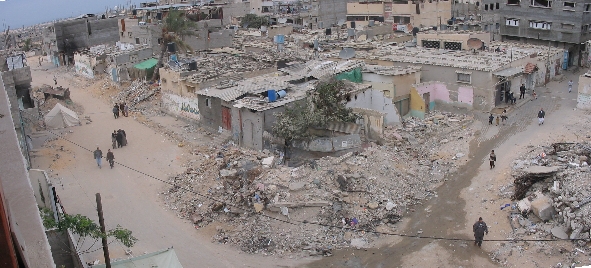
Gaza, Rafah refugee camp
But the real drama, says Ging, is that the Palestinians are "effectively living in one big prison." After the withdrawal of Israeli troops last year, there was a feeling of optimism -- that just as quickly turned into hopelessness. "Everyone was counting on an economic upswing once the border with Egypt was open," Ging says.
Instead, trade has come to a virtual standstill as the border has remained mostly closed. Israeli pressure has ensured that the border crossing for people at Rafah is only open 14 percent of the time. And only 14 trucks get through the crossing at Kareni every day -- instead of 400 originally planned. It is the only crossing for those goods not produced in Gaza and thus have to be imported from Israel.
"According to the Dec. 5 treaty on the freedom of movement, the Rafah border can be open if European observers are present," says Ging. However, these observers live in Israel and Israel can use their discretion to prevent them from crossing into the Gaza Strip. "That's how you close a border."
Travellers are not the only ones affected. Farmers who used to export their fruit and vegetables to Israel are now stuck with them. That is the daily lunacy of the Gaza Strip: there are plenty of tomatoes in the markets, but no fish. The chunk of land is on the coast, but the fishermen are only rarely allowed to go out to sea by the Israelis. And frozen fish seldom makes it over the border from Israel.
"No one has any money"
Mahmoud Abu Djayab operates a repair shop for electrical goods in the central market, and he has more work than ever. People can't buy any new appliances, so they need to get even the most worn out cooker fixed. "But that's no use to me," complains the 51-year-old. "All that I have earned is a book full of IOUs. Everyone is living on credit. No one has any money to pay me."
Ging doesn't blame the Israelis for everything. When he speaks about Hamas, his voice is filled with anger: "Hamas knew that the money would stop flowing if they didn't maintain relations with the international community," he said. "But they didn't do it anyway. That was irresponsible. The party took into account the fact that the people would suffer." He says that international donors have the right to stop their aid payments. "But then they can't act surprised when the psychological strain leads to a greater tendency towards violence." The fact that the Palestinian government was 70 percent dependent on foreign aid wasn't considered either. "The absence of aid deliveries caused chaos."
As bad as the economic situation is for the inhabitants of the Gaza Strip, the psychological strain is even worse. "In the past people hoped that the Israelis would leave. Today there is no more light at the end of the tunnel," Ging says. Morale is terribly low. People feel oppressed. Hopelessness leads to despair, which in turn leads to violence. What worries Ging is that a lost generation is growing up. "Just try inspiring a young person to learn, when he knows that after school absolutely nothing awaits him."
Ahmed Kahlout had finally woken up, and he even put on a shirt and trousers for his visitor. But he remained uncommunicative. No, he had no idea what he would be doing in five years time. No, he wasn't political and he hadn't bothered voting. "The civil war will eat everything up anyway," he said. To John Ging "the Palestinians' spirit isn't broken yet, they have the will and the ability to organize their own affairs." But the UN man may be a bit too optimistic.
(Der Spiegel, 12.18)


Following just a selection of some of the latest news and related articles about the current (5th) round of the 6-Party Talks on DPRK's nukes in Beijing:
Six-party nuclear talks resume amid cautious expectations (Xinhua)
First-day talks "candid", "pragmatic"
U.S., N. Korea open crucial talks on sanctions row (Yonhap)
|
N.Korea Demands Mutual Disarmament Talks (Chosun Ilbo)
North has a long list of demands in Beijing (JoongAng Ilbo) |
Nuclear envoys struggle to move talks forward (Korea Herald)
Sanctions row in N Korea talks (al-Jazeera)
Six-Nation Talks Resume On N. Korea Disarmament: Return to '05 Nuclear Pact Called Unlikely (Washington Post)
North Korea Might Drag the Talks (DailyNK)
How to turn the tables on Pyongyang (A-Times)
N Korea talks: Not a meeting of minds
“한국정부는 단속추방 중단하고 이주민 협약 비준하라”
세계이주민의 날 기념 이주노동자대회
(by Voice of People/민중의소리)

(pic: VoP)
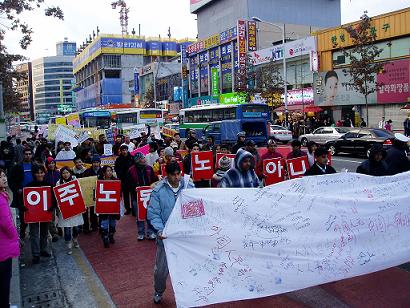
단속이라는 미명아래 진행되는 혹독한 인간사냥에 한 겨울이 더욱 춥고 시리다는 이주노동자들, 그들이 한 자리에 모였다.
17일 오후 방글라데시, 네팔, 필리핀, 버마, 태국 등 세계 각지에서 온 이주노동자들이 세계 이주민의 날을 기념하고 한국정부에 이주노동자에 대한 인권과 노동권 보장을 촉구하기 위해 대학로에 모인 것...
Please read the complete article: here!
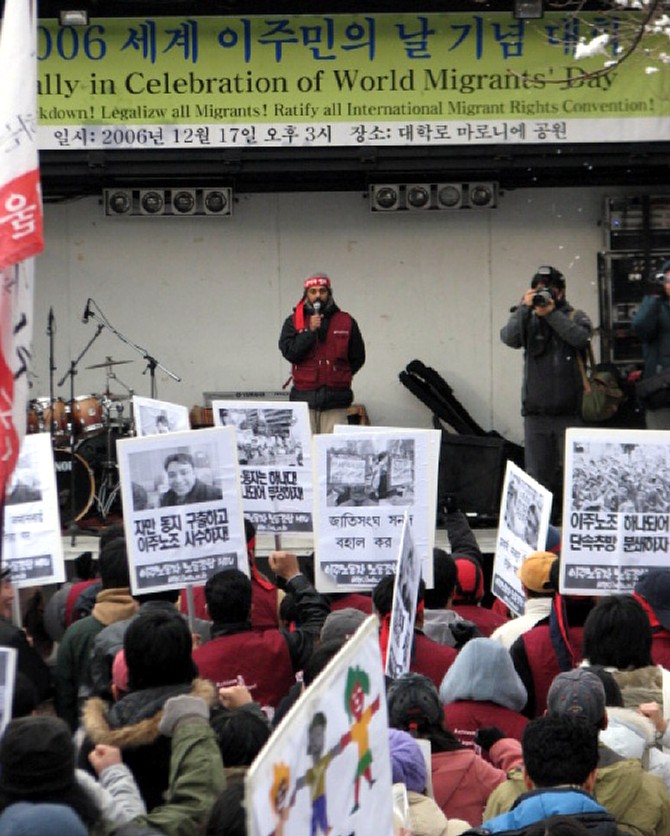
Another short report incl. several pics you can check out here: 2006 세계 이주민의 날 기념대회 열려.
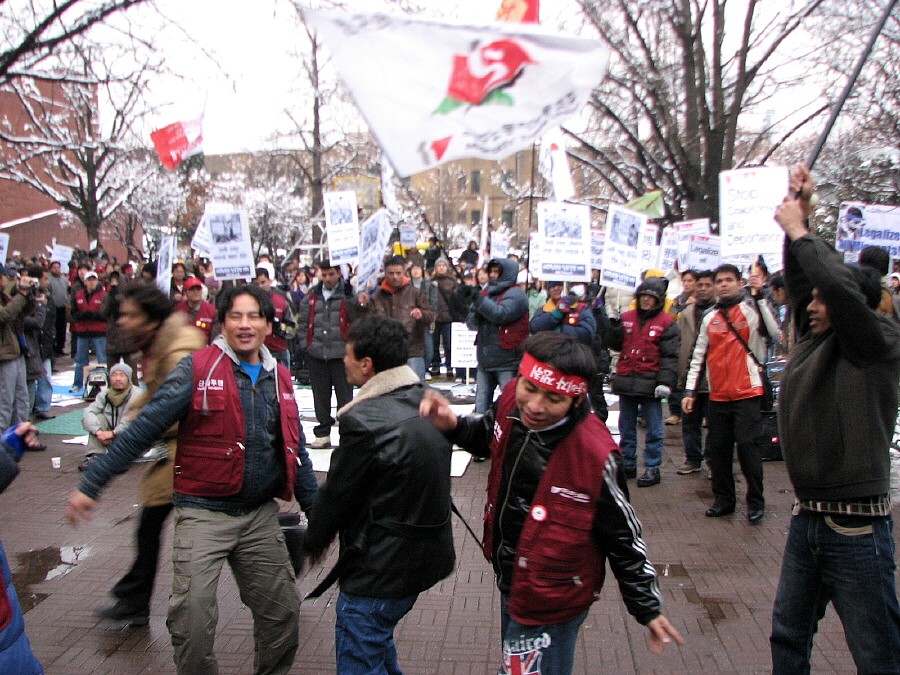
(pics: http://blog.jinbo.net/chmanho/?pid=83)
이주노동자방송국 has made a long video report about the (nearly) entire event and you can see it here (harrharr../편집: not really..^^)
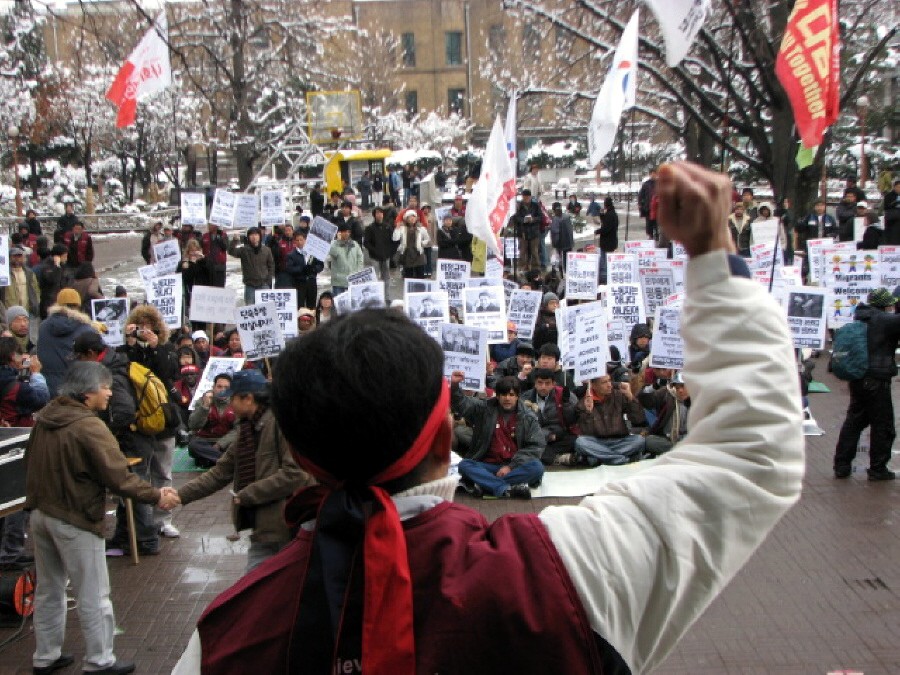
Korea Times wrote today: "On Sunday, hundreds (^^) of migrant workers gathered at the Marronnier Park in Hyehwa-dong in Seoul to celebrate their day." (*)
http://times.hankooki.com/lpage/200612/kt2006121817205910160.htm
And last but not least MWTV (이주노동자의방송) produced a special video for the Int'l Migrant Workers' Day and you can watch it here.
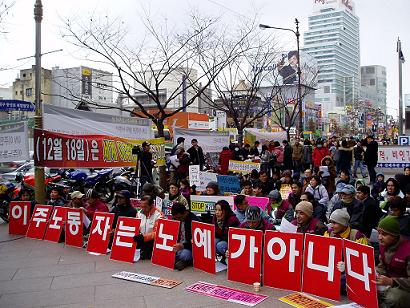
In Daegu 12.18, the Int'l Day of Migrant Workers was celebrated with a small rally and demo, organized by Seongseo Industrial Complex Trade Union (STU):
PS:
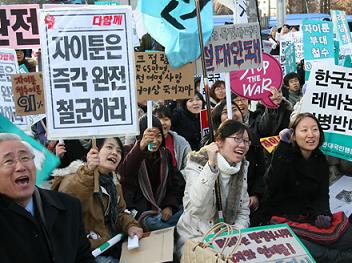
In its today's article Korea Times (**) wrote following:
"The leader of an association that represents the country’s 470,000 migrant workers..
..Lee Chul-seung, head of the Joint Committee for Migrant Workers in Korea.."
Aeh~ did I miss something???
* pic also by http://blog.jinbo.net/chmanho/?pid=83
** http://times.hankooki.com/lpage/200612/kt2006121817205910160.htm
hmm..
Some more pics about the event you can see here:
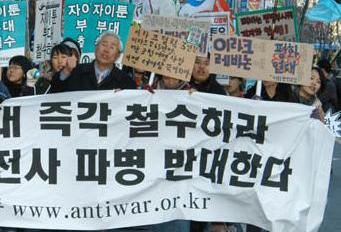
20061216 - 자이툰 부대 즉각 철군을 위한 반전행동
http://blog.jinbo.net/tkdcjsdk/?pid=101
..hmmhmm...^^
Three related articles (in Korean) about it you can read here:
“끝나지 않은 싸움, 진실을 다해야죠.”
‘자이툰부대 즉각 철군 및 레바논 파병 반대’ 집회 열려
http://www.newscham.net/news/view.php?board=news&id=38205
자이툰, '임무종결해도 철군 안한다?'
이태호, '파병반대 반전행동 집회'서 의혹제기
http://www.tongilnews.com/article.asp?mainflag=Y&menuid=101000&articleid=70366
전쟁은 꼰대들이나 해
http://blog.jinbo.net/dopehead/?pid=501
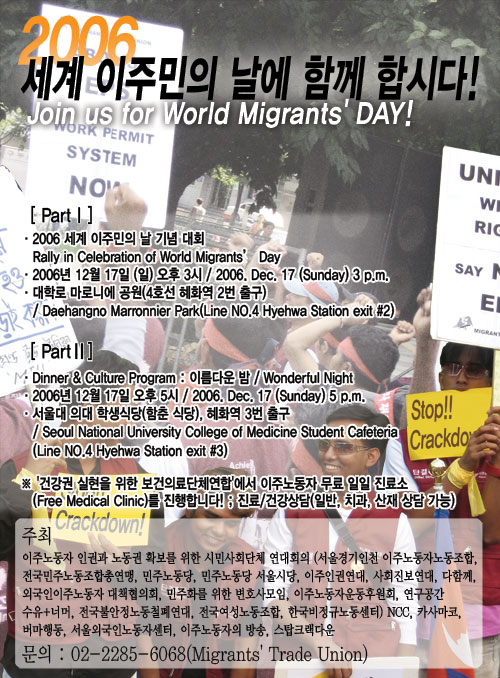
Here the program of the entire afternoon and evening/night events (according to 피플메신저):
□ 일시 : 12월 17일(일) 오후 3시
□ 장소 : 마로니에 공원
□ 주최 : 이주노동자 인권과 노동권 확보를 위한 시민사회단체 연대회의(이주노조, 민주노총, 민주노동당, 민주노동당서울시당, 외노협, 이주인권연대, 다함께, 민변노동위, 사회진보연대, 수유+너머, 여성노조, 이주후원회, 철폐연대, 한국비정규노동센터), 카사마코, 네팔공동체(NCC), 이주노동자의 방송(MWTV), 스탑크랙다운
□ 프로그램
* 대회사 : 민주노총
* 이주민 발언
- 이주노조
- 각 공동체(단속 피해자와 보호소 실태 발언)
- 이주 여성
- 스탑크랙다운 공연
- 난민
- 이주 아동
- 이주노동자 테러리스트 취급 규탄 발언
* 국제 연대 메시지 낭독
* 이주노동자와 그 가족의 권리에 관한 국제협약 비준 촉구 성명
* 상징의식
세계 이주민의 날 기념 “아름다운 밤(WONDERFUL NIGHT)”
□ 일시 : 12월 17일(일) 오후 5시
□ 장소 : 서울대 의대 학생식당(함춘식당)
□ 프로그램
5:00~6:00 만찬(이주 음식)
6:00~7:20 공연
- 영상상영(이주 노동자의 방송 제작)
- 여는 말
- 카사마코 노래 공연
- 버마액션 율동
- 의정부 이주노동자 밴드 WMA 공연
- 이주 아동 공연
- 민주노동당원들과 이주노동자들의 합동 공연
7:20~8:00 편안한 어우러짐[댄스 파티(^^)]
Well, I'm so sorry that I can't be there (uhuu~^^) but I wish a successful rally and a funny party!!
The HOLY LAND, a.k.a. Palestine, is preparing for the HOLYday season..
(freedom fighters fighting freedom fighters)
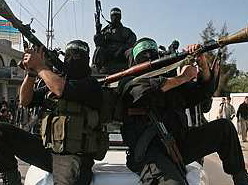
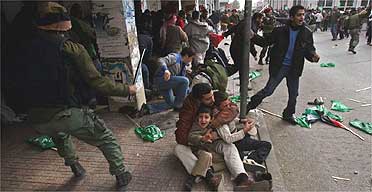
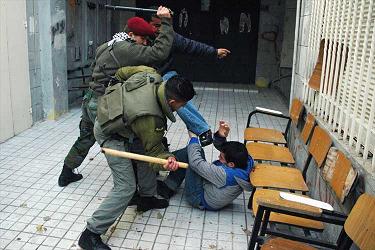
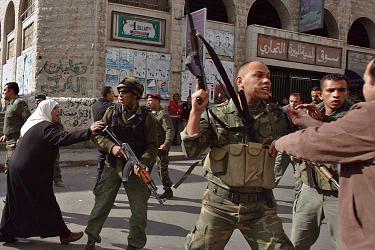
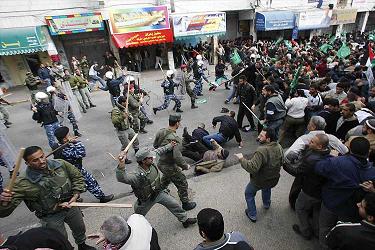
Right now, it's afternoon in the Holy Land, heavy gun battles are taking place in (at least) Gaza and Ramallah, following a week of attacks and assassinations inside the PA territories.
Just a short while ago Ynet (IL) reported following about the current situation there:
Ramallah has become a battlefield
Escalating tensions in Palestinian Authority deteriorate into gunbattles in streets – 20 people reported wounded. PA officials say gov't training special security force in West Bank
Civil war?
Twenty Palestinians were wounded, two critically, in exchanges of fire between warring factions in the Palestinian Authority Friday.
Sixteen people were wounded in Ramallah, four in Gaza. Fatah officials reported that several Hamas gunmen have barricaded themselves in the Nazer mosque in the city of Ramallah and are firing at Fatah and Palestinian security forces inside the mosque compound.
Witnesses added that PA security forces have begun covering their faces with masks as they try to overpower protestors and gunmen from both factions, mostly against Hamas.
The atmosphere in the city is reminiscent of a battlefield say residents, against the soundtrack of massive gunfire.
In Ramallah reports say that the Palestinian government has begun training a special security force in the West Bank which will answer directly to the government, similar to the one formed in Gaza which operates under the direct command of the minister of the interior.
Power struggle
According to a Fatah source it would appear that Hamas is seeking to emphasize that the movement also has power and presence in Ramallah – the largest West Bank city and home to President Mahmoud Abbas.
The Fatah official expressed concern that further deterioration of the situation will cost many lives.
Witnesses told Ynet that some of the wounded are bystanders and protestors who were beaten by Palestinian security forces seeking to clear the streets, primarily from the center of town which was declared a closed military zone.
Meanwhile in Gaza four Palestinians were wounded in exchanges of fire between Fatah gunmen and Palestinian security forces loyal to Hamas.
The Fatah gunmen opened fire at a Hamas security forces outpost in central Gaza, the gunbattle continues.
http://www.ynetnews.com/articles/0,7340,L-3340493,00.html (now updated)

31 hurt in Fatah-Hamas clashes in Gaza, Ramallah (Haaretz, IL)
Hamas, Fatah Gunmen Exchange Fire in Gaza (AP)
32 wounded during Hamas-Fatah clashes in Ramallah (Jerusalem Post)
Hamas rally comes under Fatah fire (al Jazeera)
http://english.aljazeera.net/NR/exeres/C0D7201A-3736-4C50-A6CE-EDDC1F65CFA8.htm
More about the background of the current "crisis" please read here:
Fatah blamed for attack on PM (Guardian, UK)
High noon (Haaretz)
Latest news (12.16):
Hamas: Abbas declaration meaningless (Ynet)
Organization's officials say Palestinian president has no legal authority to dismantle government, although express willingness to return to negotiations
Senior Hamas officials were quick to reject the Saturday declaration by Palestinian President Mahmoud Abbas announcing his intention to move up presidential and general elections in the Palestinian authority, calling the decision "meaningless".
According to Hamas leaders, Abbas has no legal authority to dismantle the government and, thus, his decision is illegal.
As such, Palestinian Foreign Minister Mahmoud al-Zahar said that Hamas rejected Abbas' decision regarding elections, but said the organization is ready to return to the negotiating table.
Nonetheless, al-Zahar emphasized that a return to negotiations "would not be based on recognizing Israel or the demands of the Quartet."..
Please read the entire article here:
http://www.ynetnews.com/articles/0,7340,L-3340727,00.html
Abbas calls for elections in PA as soon as possible (Haaretz)
Gaza: Hundreds of Fatah members fire into air (12.16, 15:24 CET)
Hundreds of armed Fatah members and Palestinian defense personnel fired shots into the air throughout the streets of Gaza Saturday as a sign of solidarity with Palestinian President Mahmoud Abbas’ call for advancing elections.
Hamas, Fatah gunmen clash in Gaza (12.16, 17:22 CET)
Gunmen from the governing Hamas movement and the Fatah faction of President Mahmoud Abbas exchanged fire in southern Gaza on Saturday, hours after the president called for early Palestinian elections.
One person had been wounded during the clash in Khan Younis, witnesses said. They said the combatants were mainly firing rocket-propelled grenades.
Gaza: 8 injured in exchanges of fire; officer kidnapped (12.16, 17:54 CET)
Eight people were injured in exchanges of fire taking place between Fatah and Hamas gunmen in the Gaza Strip. According to the report, five were injured in clashes in Rafah, two were injured in Khan Younis, and another person was injured in Gaza.
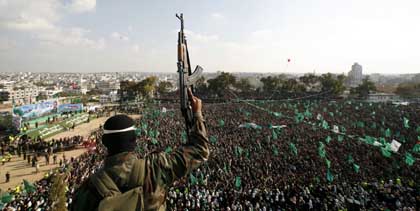
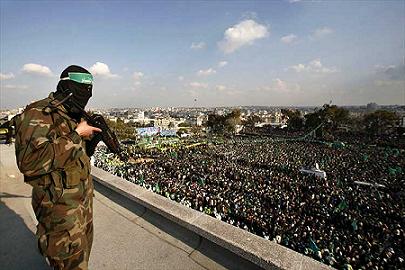
In addition, a Palestinian police officer was kidnapped by Hamas members in Gaza City, where thousands of people took to the streets, most of them Hamas activists.
Islamic Jihad, PFLP mediate between Hamas, Fatah (12.16, 18:18 CET)
The Islamic Jihad and the Popular Front for the Liberation of Palestine (PFLP) began mediation Saturday between Hamas and Fatah in an attempt to try and end the exchange of fire between the two.
Witnesses in the Gaza Strip said a withdrawal of gunmen from sides in the Strip was observed in recent minutes. Nevertheless, there were still reports of tension in the streets.
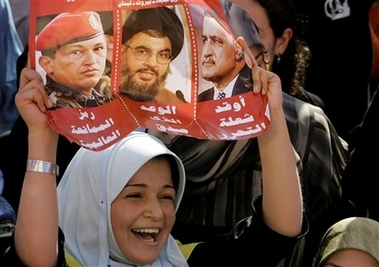
The "Trinity of Social Progress": Chavez, Nasrallah and Nasser
But where is the rest of all the Saints: Khomeini/Ahmadinejad, Trotsky,
bin Laden, Castro, Mullah Omar, Kim Il-sung/Kim Jong-il, etc..?(^^)
[actually this pic (Beirut/RL) is related to an article by 다함께 (*)]
* ⓒ 맞불(www.counterfire.or.kr)
지난 10일 레바논 수도 베이루트에서 열린 헤즈볼라 주도의 반정부 시위에 레바논 전체 인구의 거의 절반인 무려 2백만 명이 참가했다.
레바논의 정치 위기는 지난 7월 이스라엘의 레바논 침공 뒤 심화한 정치적 양극화 때문이다. 이스라엘의 패퇴 이후 헤즈볼라가 이끄는 반정부 진영은 전쟁 기간에 레바논 친미 정부가 보인 무능력을 비판하며 ‘거국 내각’ 구성을 요구해 왔고, 이것이 거부당하자 지난달 중순부터 정권 퇴진 운동에 돌입했다.
첫 대규모 동원이었던 1일 시위에 1백만 명이 참가했고, 그 뒤 수천 명의 시위대가 베이루트 시내에서 천막 농성에 돌입했다. 10일 시위 전에는 베이루트 도심에서 매일 저녁 5만 명이 참가한 집회가 열렸다. 특히, 도심 천막 농성장들은 운동 내 정치적 논쟁의 장이 되고 있다.
시니오라 정부 지지자들과 서방 지배자들은 반정부 진영이 레바논을 또다시 종파간 내전으로 몰아넣을 것이라고 위협하지만 반정부 운동의 종파적 구성은 오히려 더 다양해지고 있다. 헤즈볼라를 비롯한 시아파 정당들, 공산당, 기독교계 정당인 자유애국동맹 등이 시작한 이 운동은 최근 수니파 정당들과 레바논민주당 같은 드루즈파 정당들로까지 확대됐다. 반면, 친정부 시위대의 규모는 고작 몇 천 명 수준으로 줄었다.
양극화
레바논의 친미 정부가 물러난다면 이는 서방 ― 특히 미국 ― 에 커다란 타격이 될 것이다. 그런 사태는 중동에서 미국의 영향력이 자신의 편에 선 정부조차 보호할 수 없을 만큼 약해졌다는 증거로 여겨질 것이고, 따라서 중동의 다른 친미 정부들의 불안감을 증대시킬 것이다.
지금 사우디아라비아나 요르단의 친미 왕정들은 1979년 이란 혁명 이후 중동에서 벌어진 적이 없는 일, 즉 반제국주의 대중 운동이 친미 정부를 타도하는 일이 재연될까 봐 겁내고 있다.
시니오라 진영과 미국도 반정부 운동의 승리를 막기 위해 필사적이다. 지금 나오는 보도들을 보면, 아랍연맹이 제시한 중재안을 놓고 반정부 진영과 시니오라 총리 사이에 타협이 이뤄질 가능성이 있다. 정확한 내용을 미리 알 수 없지만 시니오라와 미국에게 달갑지만은 않은 것일 가능성이 농후하다.
(기사 입력일 : 2006년 12월 12일)
IT'S JUST THE DAILY CAPITALISM..
Following article was published few days ago in the S.K. ("left-liberal") daily Hankyoreh. Aktually this story is not about a problem, unique just in S.K., it's just a story about the daily life in the capitalism.
For example in Germany you can find thousands of similar stories: according to last week's media reports at least 10,6 million people in Germany are threaten by poverty or are already poor...

"Line of shame: 1779 Berlin families
must stay here for daily food alms"(*)
But the main difference between (for example) the poor in Germany and in S.K.: in Korea many are actively resisting against their daily oppression. Like the poor, street vendors, people who are defending their homes (against demolishing and expulsion) etc. who are fighting daily organized against the existing (capitalist) society.
[Following the article I'll bring some links to examples of S.K. resistance against the system.., just wait for a short while..(**)]
Eun-gyeong, 15, feels the weight of a life of poverty
Seoul's Yangji Village is a hard place for hope
Located on Seoul's northern outskirts, Yangji Village is a typical slum. Once a public cemetery, it was settled from the 1960s by the "refugees" pushed out of downtown Seoul by redevelopment projects. Some 90 percent of the land is the property of the Korea Forest Service, and nine in 10 of the houses there are without permit.
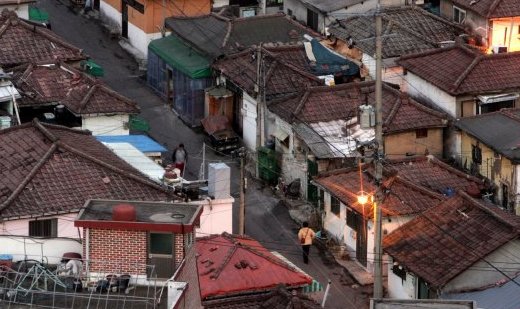
Seoul, Yangji-dong
Of the 2,383 residents living there, 348 citizens belonging to 236 households are welfare recipients, and 546 are disabled. There are 26 households run by single mothers.
I rented a room there in November, staying in Yangji Village for a month, and interviewed a young girl living there.
Eun-gyeong (not her real name), 15, began to cry when talking with me. Yet, despite her grief, she maintained her poise, speaking to me in a level voice and a composed expression. It was as if she had grown inured to the tears streaming down her cheeks.
Eun-gyeong lives with her father in Yangji Village. Her mother passed away just after Eun-gyeong's first birthday. Eun-gyeong has never seen her father work, as he suffers from back pain and barely gets by from monthly welfare payments of 400,000 won (US$420). Eun-gyeong in turn receives a trickle-down monthly allowance of 80,000 won, leaving her no money to buy even stockings, stationery, textbooks, snacks, or tampons. She rides the public bus to school, but walks alone for 30 minutes on the long path home, trying to save money. She is already worried about next year, when she will have to attend a high school even further away.
Another reason Eun-gyeong normally walks home is because she attends an after school private study academy (hagwon in Korean). She attends for free, thanks to the letter of support she received from a welfare organization. Eun-gyeong received this support because she is one of the more diligent students of Yangji Village. Though her math skills need improvement, she does not dare mention the special math classes offered at the academy to her father, for the enrollment fee is 120,000 won.
She is always hungry during her afterschool academy classes around dinnertime. While her classmates at the academy go buy the snacks they want to tide them over until dinner, she is left to buy whatever she can afford, or skip eating snacks altogether.
She has no close friends in which to confide. There are other students in her classroom in dire situations, but they at least have the income of their mothers or grandmothers upon which to rely. When she feels even those friends cannot grasp her plight, she simply keeps her mouth shut.
Eun-gyeong has seen a lot of generosity. Teachers have quietly given her lunch money or paid for her to attend field trips. She has also learned that sometimes it is necessary to parade her poverty to match the expectations of others. Though this is the behavior required to gain gifts, she hates to act in such a manner, so she has decided against doing this anymore. She does not want her classmates to see her in such a light. If her friends invite her to see a movie, she demurs, explaining that the film will be boring, and similarly refuses to accompany her friends.
Eun-gyeong likes to write. She even wrote a novel as a sixth grader. Her dream was to become a novelist, but such a line of work is not known for being lucrative, so she gave it up. She also wanted to become an archaeologist, but gave up on that for the same reason. She does not know what to study anymore. She decided to go to a humanities geared high school, but she still has moments of doubt. Many of the children in her neighborhood go to industrial technology-geared high schools. She has to compete with other hard-working children to enter college, giving her yet another thing to worry about. After all, even the monthly welfare payments of 400,000 won (US$420) her father is given will end upon her graduation from high school, as she will legally become a 'head of household.' Having lived at her aunt's house for a long time, she does not feel much of a bond with her father. Yet she still feels pity for him.
Eun-gyeong's sole wish is "to live without worry." Preoccupied by her thoughts and fears, she finds these days that long distances melt away beneath her feet as she walks and contemplates. Yet, some time ago, she realized that her woes would not be solved, no matter how much she dwelled upon them. Thus, she decided in general just to think less. Of course, she wants to live like other children, who swipe their transit cards and buy clothes without a second thought. She is jealous of those ordinary children, who can rely on their parents.
It was about this time that tears started to trickle down Eun-gyeong's cheeks, not when recounting her mother's passing, but in acknowledging the difficulties that lay before her of finding a source of support in her hard, young life.
I met Eun-gyeong in a study room on the 29th of last month. I would like to express my gratitude to her for granting me such a taxing interview.
http://english.hani.co.kr/arti/english_edition/e_national/177452.html
* and that's only about one district in Berlin..
** here some examples for the resistance (docu videos by comrade "Hong Gil-dong from the Forest"):
☞ 날마다 전쟁
*****
☞ South Korea, Terror of the Construction Mafia
☞ S. KOREA. Construction Mafia in Action Again
☞ 빈민대회
...etc, etc...

최근 덧글 목록