공지사항
-
- '노란봉투'캠페인/국제연대..
- no chr.!
31개의 게시물을 찾았습니다.
11.29: S.K. in State of Emergency
Despite at least 50,000 riot cops in readiness, massive street blockades by the cops all across the S.K. highway tollgates some thousand of demonstrators filled the streets in downtown Seoul, especially in the area around Myeong-dong, to protest the planned U.S.-ROK FTA(later I'll write more about it, especially my opinion about the current wave of protests..).
Here some articles about y'day's protests by today's S.K. bourgeois newspapers:
Anti-FTA protesters defy police ban (K. Herald)
Thousands of farmers and workers yesterday clashed with riot police across the country in the second massive demonstration in a week against a free trade deal with the United States.
Despite stern warnings from state authorities, about 120,000 anti-FTA protesters took to the streets in Seoul and six other major cities including Busan, Daegu and Gwangju, the Korea Alliance Against the Korea-U.S. FTA said.
About 10,000 protesters, including 5,000 farmers from rural regions, converged in central Seoul to press for an end to the trade negotiations and reform of the government's agricultural policy.
Around 50,000 policemen were mobilized to prevent rallies nationwide including some 10,000 in Seoul, the police agency said.
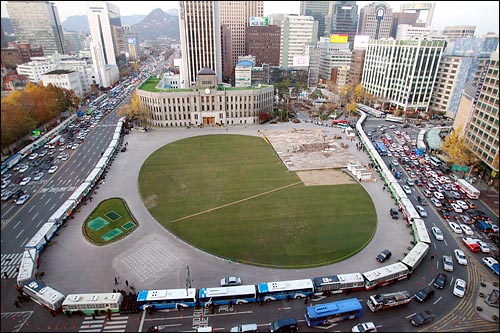
11.29 Seoul City Hall Plaza..
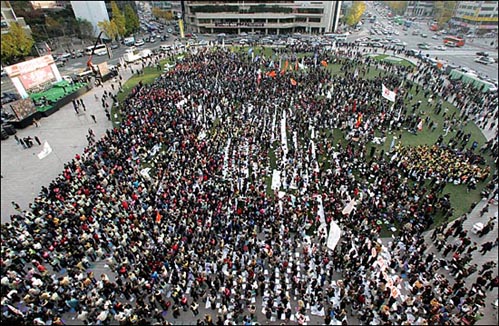
..and the same place one week before (http://blog.jinbo.net/CINA/?pid=1001)
Collisions took place at some highway tollgates as police tried to block farmers from entering Seoul. To keep regional activists from reaching Seoul, 13,000 policemen were at guard at over 1,000 tollgates.
The police was .. on high alert following last week's massive rallies...
The anti-FTA coalition of about 300 civic groups has been banned from staging further rallies after the turmoil.
Pledging a peaceful demonstration this time, the alliance requested the police to permit its second rally, but their request was turned down. Despite the rejection, activists are also planning even more protests on Dec. 6, as Seoul and Washington prepare to open the fifth round of formal FTA talks...
After declaring a "zero tolerance" policy toward violent rallies, the government has been seeking to take harsh measures not only against anti-FTA protests but all other potentially violent rallies.
Blocking tollgates leading to Seoul, the police prevented several small groups of regional protesters from joining the demonstration in Seoul.
About 40 members of a construction labor union in Daegu and 33 farmers from North and South Gyeongsang Provinces were forced to return home.
A member of the Korean Confederation of Trade Unions, one of the nation's umbrella unions, was arrested in Daejeon for violence against two policemen who tried to block him from entering Seoul.
"We have already asked leaders of the alliance to halt all demonstrations. We have no other means but to forcibly disband all protests under lawful procedures," the police said.
State police have already summoned 170 activists involved in last week's violent rallies. Since 163 of those protesters failed to show up, the police are planning to request arrest warrants.
Labor workers joined in yesterday's unrest with the KCTU launching its second general strike opposing government-led labor bills and the FTA.
Some 36,000 union members of Hyundai Motor, the nation's largest carmaker, and Ssangyong Motors joined in yesterday's walkout.
The radical labor group launched a general strike last week, demanding the government scrap new labor regulations. The KCTU continued additional partial strikes throughout last week...
http://www.koreaherald.co.kr/SITE/data/html_dir/2006/11/30/200611300006.asp
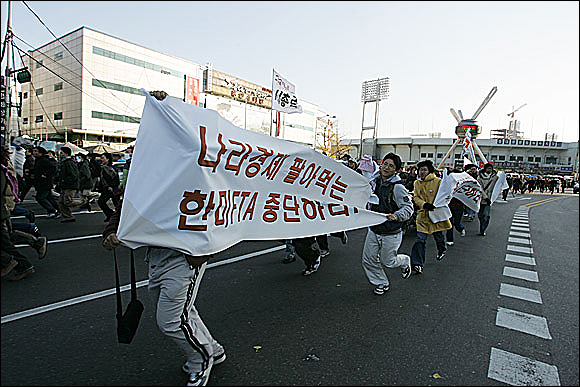
Demo near Dongdaemun Stadium at around noon
Anti-FTA Protestors, Police Clash (K. Times)
Rallies in 8 cities go off without major violence (JoongAng Ilbo)
Pitched Battles in Seoul as Police Block Anti-FTA Rally (Chosun Ilbo)
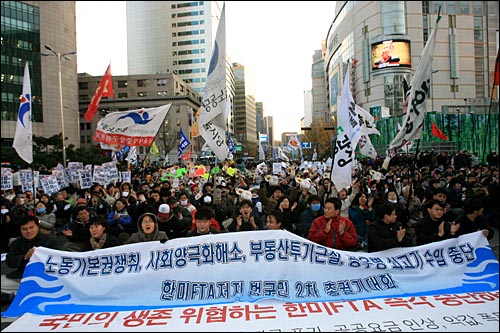
Eulji-ro, downtown Seoul, in the afternoon
Some independent reports you can see, incl. video documentaries, here:
http://www.ohmynews.com/articleview/article_view.asp?at_code=376689&ar_seq=2
The Second People's Rally against FTA (VoP)
Myeong-dong area during the evening:
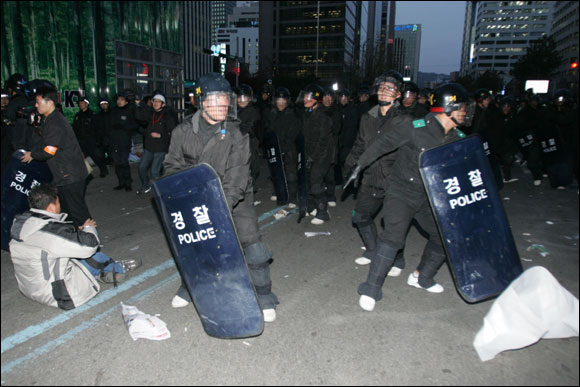
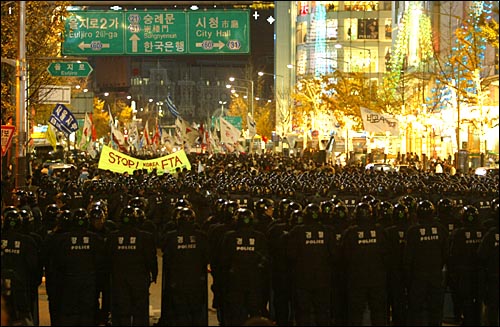
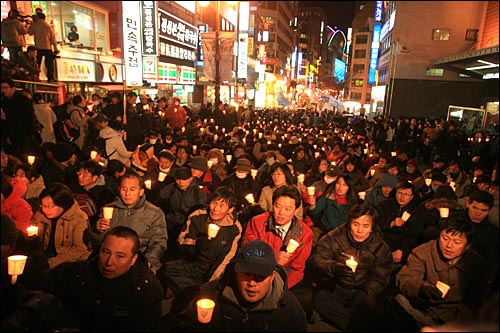
(sources of the pics: OhmyNews, VoP)
S.K. TV coverage:
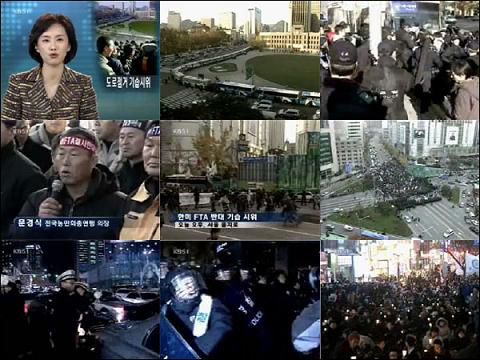
KBS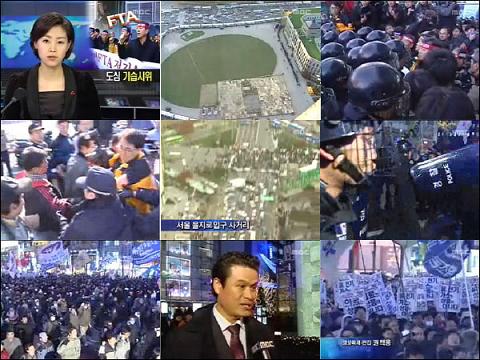
MBC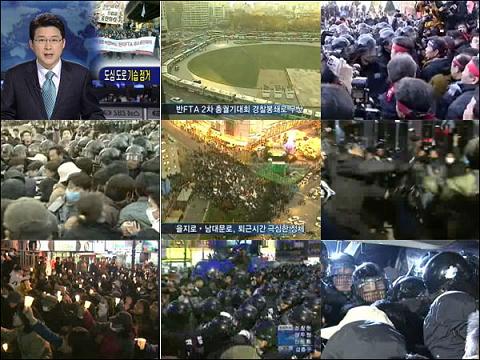
SBS



11.29, 2nd Central Protest Day
While yesterday "Police said .. (that) they have sought arrest warrants for 42 farm leaders in connection with violent street demonstrations last week..." (Yonhap) the "entire" S.K. anti-capitalist movement is preparing for today's 2nd central protest day against the U.S.-ROK FTA.
But also the S.K. national suppression machinery, i.e. nearly all units of the riot cops, are preparing for the event (for its crackdown?!!):
Police prepare to curb ‘illegal' rally attempt (JoongAng Ilbo)
Violence between riot police and protesters could be in the offing today, with the Korean Alliance against KorUs Free Trade Agreement vowing to go ahead with protest rallies for which permits have been denied and the police vowing to disperse protesters who gather.
During a conference call with all provincial police heads yesterday, the National Police Agency agreed to deploy all available police to rally sites named by the organizer and attempt to break up the demonstrators before they coalesce.
Kim Sung-ho, the justice minister, said yesterday that urban rallies by organizations with a history of violent protests are not allowed in principle. Police notified the anti-trade alliance yesterday that their rally permits had been denied, but the group told a press conference yesterday that it would not cancel its "peaceful protest."
The police estimate that 20,000 farmers and protesters plan to converge in Seoul, with smaller demonstrations planned in other cities. The authorities said they would mobilize all 400 riot police units around the nation, some 50,000 men, for the expected confrontation today. They plan, they said, to block highways leading to major cities.
The strike-prone Confederation of Trade Unions said that it had called a three-day general strike today to coincide with the anti-trade rallies...
http://joongangdaily.joins.com/200611/29/200611290010061509900090409041.html
*****
Here the "official" schedule of the anti-FTA movement:
4. 한미 FTA 저지 범국민촛불문화제
시간: 2006-11-29 오후 08:00:00 ∼
- 장소: 광화문
3. 한미FTA 저지 2차 범국민총궐기 대회
시간: 2006-11-29 오후 04:00:00
- 장소: 서울시청 앞 광장
- 본집회 이후 광화문까지 행진
2. 한미FTA 반대 민주노총 집회
시간: 2006-11-29 오후 03:00:00
- 장소: 청와대 인근 국민은행 청운동 지점
- 민주노총 집회 이후 4시 본대회로 집결
1. 한미FTA 반대 농대위 집회
시간: 2006-11-29 오후 02:00:00
- 장소: 서울역
- 농대위 집회 이후 4시 본대회로 집결
*****
Korea Herald is writing following about today's planned events:
Demonstrators defy protest ban
A head-on collision is anticipated today between police and the nation's farmers and anti-FTA activists who plan to go ahead with a second massive rally despite warnings from state authorities.
With about 5,000 protesters gathering in central Seoul, large anti-FTA demonstrations will be held in seven other provincial cities including Busan, Daegu, Gwangju and Jeju, according to statements from the Korea Alliance Against the Korea-U.S. FTA.
Farmers from Chungcheong, Gangwon and other rural provinces will be joining the rally in Seoul.
"As the constitution guarantees the right to hold peaceful rallies, we have decided to go ahead with our second protest despite police warnings," the alliance said in a press conference yesterday. "Although we plan to protest peacefully, we will fight back if the police clamp down on us without a justifiable reason."
As a coalition of about 300 anti-FTA civic groups, the alliance has been banned from staging further rallies after last week's nationwide protests which caused turmoil in some regions.
Over 73,000 farmers, workers and activists collided with riot police in 13 cities in one of the most violent protests in recent years...
Pledging a peaceful demonstration this time, the alliance requested the police to permit its second rally, but their request was turned down. Despite the rejection, activists are also planning even more protests on Dec. 6, as Seoul and Washington prepare to open the fifth round of formal FTA talks.
After declaring a "zero tolerance" policy towards violent rallies, the government reaffirmed that it will take harsh measures should the alliance disobey its restrictions.
"We will disallow any rallies by activist groups with past records of violence," Justice Minister Kim Sung-ho said in a radio interview yesterday, indicating that the government will take suppressive action not only against anti-FTA protests but all other potentially violent rallies.
"While fully securing the right to hold peaceful demonstrations, the government will use all possible measures through criminal charges, indemnity for damages and disciplinary steps to punish leaders and active participants," he added. "I have asked the prosecution to act following the 'zero tolerance' principle."
But Kim said he was against the idea of introducing a stricter permit system for demonstrations.
"As a democratic country, Korea should still guarantee the right for collective action - but only if it does not harm the public welfare," he said.
State police have already summoned 170 activists involved in last week's violent rallies. Since 163 of those protesters failed to show up, the police are planning to request arrest warrants.
The police also raided regional offices of the alliance in Daejeon, Daegu, Gangwon and North Gyeongsang - where the most violent rallies were held - and said officers had secured evidence that protesters were acting under specific orders.
The evidence shows that the act of breaking into regional government offices and setting fires on the streets were intentionally planned before the protest, the police said.
But the alliance emphasized that last week's violence was purely "accidental."
"Violent collisions took place because some governors and mayors had failed to earnestly answer the protesters' questions during the demonstrations. It is only natural that farmers in rural regions are more concerned and enraged about the FTA issue," it said.
"Instead of taking coercive measures, the government should try to analyze the reason why protesters became so violent."...
http://www.koreaherald.co.kr/SITE/data/html_dir/2006/11/29/200611290015.asp

Following article The Guardian(UK) published today:
Violence and persecution follow Europe's downtrodden minority across the continent
Eight million Roma find political voice in face of evictions and mob attack
Miha Strojan was tending to his sick mother when the mob arrived. Wielding clubs, guns and chainsaws, several hundred villagers converged on the cottage in a clearing in the beech forest with a simple demand. "Zig raus [Gyppos out]," they called in German, deliberately echoing Nazi racist chants. "Bomb the Gypsies."
It was the last Saturday of last month, when the mob terrorised the extended family of more than 30 Roma, half of them children, into fleeing their clearing a mile over the hill from the farming village of Ambrus in eastern Slovenia.
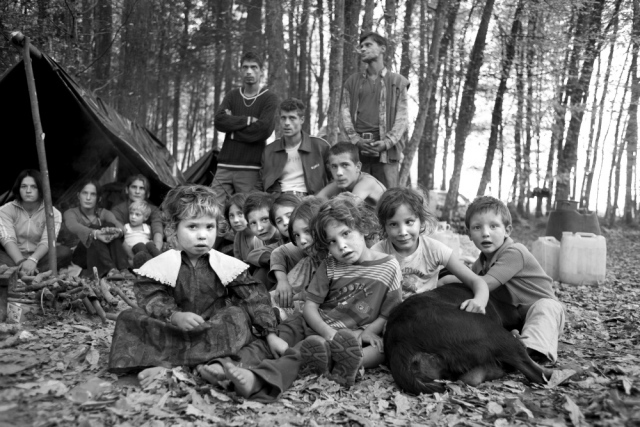
After the pogrom in Ambrus: Roma families are hiding in the forest
"They were building bonfires on our land and shouting that if we don't move out, they will bomb us and crucify our children," recalls Mr Strojan, 30.
A Slovene filmmaker, Fillip Robar Dorin, present at the scene, said it reminded him of the Kristallnacht pogroms of 1938 when the Nazis rampaged against the Jews of Germany and Austria. "We would have torched the place, but we were too late. The police got there before us," bragged one Ambrus villager.
If the expulsion of the Strojans, living in Ambrus for decades and owners of the place they were living in for 12 years, was a trauma for the family, it was also an increasingly routine example of the epidemic of forced evictions of Roma settlements across the European Union, particularly in central and eastern Europe where the Roma are concentrated.
Last week in the Czech town of Vsetin police descended on a crumbling block of flats, put more than 100 Roma on lorries and dumped them in Portacabins up to 50 miles away. The mayor, Jiri Cunek, then sent in the bulldozers. "Cleaning an ulcer," he announced to local applause.
Last month in the eastern Romanian town of Tulcea, police evicted 110 Roma from where they had lived for seven years, their previous accommodation having burned down.
The European Roma Rights Centre in Budapest, Hungary, says the forced evictions are not restricted to eastern Europe. It is also dealing with incidents in Britain, France, Spain and Italy.
The scandal in Ambrus occurred not in the poorest parts of Europe where such persecution is more common, but in Slovenia, the wealthiest, westernmost, and most successful of the eight new central European members. In January, Slovenia will adopt the euro.
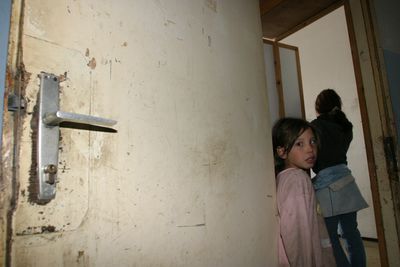
Slovenia: terrible situation in a camp..

..for Roma refugees
"The case of the Strojans in Slovenia is part of a pan-European pattern at the moment," said Claude Cahn, the centre's programmes director. "It's really a crisis this year. This raw destruction of neighbourhoods is quite new."
As well as frequent forced evictions across the towns and villages of eastern Europe, Mr Cahn points to major slum clearance and urban regeneration schemes currently planned in the capital cities of southern Europe. Istanbul, Sofia in Bulgaria, and Bucharest in Romania all have ambitious reconstruction projects under way. "These can have dreadful effects, entailing the large-scale destruction of Roma housing."
In a recent study the Dzeno Association, a Prague-based Roma lobby group, noted: "The growing trend of forced evictions of Roma in Europe is becoming a human rights crisis."
The evictions underline the plight of Europe's 8 million Roma as the continent's most downtrodden minority. Subject to entrenched harassment, discrimination, and ghettoisation, the Roma are liberty's losers in the transformation wrought by recent free elections and free markets.
Last month Bulgaria's minister of health proposed compulsory abortions and criminalisation for pregnant under-18s from "minority groups", a categorisation that would affect most Roma girls. In Hungary, a mob beat a 44-year-old Roma man to death after he ran over an 11-year-old girl. A Budapest newspaper told its readers to drive off if they run over a Roma child.
Confronted with this torrent of abuse and prejudice, Europe's Roma are beginning to fight back. Getting organised politically for the first time, they are engaging in grassroots, national and regional campaigns, in some ways recalling the black civil rights movement in the US, ranging from contesting segregation in schools, tenancy rights, legalisation of settlements to demanding political representation in local councils, national parliaments, and governments.
One trigger for the rise in Roma consciousness and activism is the EU itself. When Romania and Bulgaria expand the union to 27 countries in January, up to 8 million Roma will be EU citizens, the bloc's biggest ethnic minority and a community that outnumbers the populations of at least eight EU states.
There are now two Roma MPs in the European parliament. Last month a town in Romania got its first Roma mayor and a Roma administration. In Hungary or the Czech Republic there are Roma MPs, occasional government members, scores of local councillors.
The courts are also being used to seek redress. Showing that Roma children are 27 times more likely to be dumped in remedial education classes than ethnic Czechs, Roma activists have taken the government to the European court of human rights in Strasbourg accusing Prague of deliberate segregation in schools. A similar case against Croatia has also gone to the court.
In Slovakia there is a Roma news agency. In Slovenia the Roma are to get airtime on national television. A few years ago there was one Roma councillor in Slovenia, now there are 20.
"Now in Slovenia in almost every municipality, the Roma voice can be heard," said Zoran Grm, Roma councillor for the town of Novo Mesto.
Jernej Zupancic, a geographer and Roma researcher in the Slovene captal, Ljubljana, said: "The Roma are getting organised ... They're taking more responsibility and becoming much better negotiators."
Still, it is a long-term process of small steps. "There is growing international Roma activism. A lot of progress. But is it enough to counter the pernicious determination in most places to see the Roma excluded?" asked Mr Cahn.
Outside Ambrus, the geese, chickens, and turkeys are scratching around the Strojans' hurriedly abandoned homestead. In the forest opposite, sodden mattresses, children's clothing, and old car batteries still lie under a "tent" of plastic sheeting and tree branches where the family sought refuge from the mob attack, which was apparently triggered following a violent brawl between a local man and a non-Roma man living within the Strojan compound.
In Postojna, at the other end of Slovenia, the Strojans are condemned to the squalour of a disused barracks once used as a refugee centre until it was closed last year as unfit for human habitation. There is neither heating nor hot water. They have been there for a month.
When the mob marched on the Strojans' house, the government sent in riot police and cabinet ministers. The interior minister announced an "agreement". The family had volunteered to leave.
"We left because of the pressure from the police and the people. We were afraid," says Mr Strojan.
Matjaz Hanzek, the parliament-appointed human rights ombudsman, asks: "How can an agreement be voluntary when 500 people are threatening to kill you? The state and the government did what the angry crowd wanted. They moved the people from their home. Such events are inconceivable in a state governed by the rule of law."
The Strojans tried to go home at the weekend, but did not get far. Another mob, 1,000-strong, set up roadblocks and fought with riot police. The Strojans turned back. At least two other attempts to house them elsewhere in the Ambrus district and in Ljubljana have also foundered because of local protests.
Backstory
The Roma, who can be sub-divided into at least five different groupings, migrated to Europe from the Indian sub-continent 1,000 years ago. Although commonly seen as nomadic, more than 90% of Roma in Europe are settled and sedentary. Of some 10 million worldwide, around 7-8 million live in Europe, concentrated in central and eastern Europe and the Balkans. Around half a million Roma perished in the Holocaust. Accurate figures on the spread of Roma are unavailable. Figures are estimates: Romania 2 million; Bulgaria 800,000; Slovakia 600,000; Hungary 600,000; Greece 300,000; Czech Republic 250,000; former Yugoslavia 250,000; and Poland 50,000.
http://www.guardian.co.uk/international/story/0,,1958405,00.html
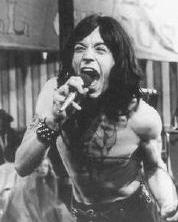
"..every cop is a criminal.."
The Rolling Stones
Sympathy for the Devil (*)/Rock and Roll Circus, Dec. 1968 (**)
Please allow me to introduce myself
I'm a man of wealth and taste
I've been around for long, long years
Stole many man's soul and faith
And I was 'round when Jesus Christ
Had his moment of doubt and pain
Made damn sure that Pilate
Washed his hands and sealed his fate
Pleased to meet you
Hope you guess my name
But what's puzzling you
Is the nature of my game
I stuck around St. Petersburg
When I saw it was a time for a change
Killed the tsar and his ministers
Anastasia screamed in vain
I rode a tank
Held a general's rank
When the blitzkrieg raged
And the bodies stank
Pleased to meet you
Hope you guess my name, oh yeah
Ah, what's puzzling you
Is the nature of my game, oh yeah
I watched with glee
While your kings and queens
Fought for ten decades
For the gods they made
I shouted out,
"Who killed the Kennedys?"
When after all
It was you and me
Let me please introduce myself
I'm a man of wealth and taste
And I laid traps for troubadours
Who get killed before they reached Bombay
Pleased to meet you
Hope you guessed my name, oh yeah
But what's puzzling you
Is the nature of my game, oh yeah, get down, baby
Pleased to meet you
Hope you guessed my name, oh yeah
But what's confusing you
Is just the nature of my game
Just as every cop is a criminal
And all the sinners saints
As heads is tails
Just call me Lucifer
'Cause I'm in need of some restraint
So if you meet me
Have some courtesy
Have some sympathy, and some taste
Use all your well-learned politesse
Or I'll lay your soul to waste, um yeah
Pleased to meet you
Hope you guessed my name, um yeah
But what's puzzling you
Is the nature of my game, um mean it, get down
Woo, who
Oh yeah, get on down
Oh yeah
Oh yeah!
Tell me baby, what's my name
Tell me honey, can ya guess my name
Tell me baby, what's my name
I tell you one time, you're to blame
Oh, who...
What's my name
Tell me, baby, what's my name
Tell me, sweetie, what's my name...
* For more about the song:
http://en.wikipedia.org/wiki/Sympathy_for_the_Devil
** For more about the show:
http://en.wikipedia.org/wiki/The_Rolling_Stones_Rock_and_Roll_Circus
11.22 SHORT, SMALL
"PEOPLE'S UPRISING"
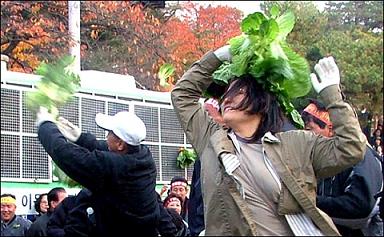
AND NOW.. THE S.K. GOV'T IS
STRIKING BACK!
Police Raid Anti-FTA Rally Organizers (K. Times)
Police raided nine offices of civic and farmers’ groups in five regions nationwide early yesterday as part of their investigation into Wednesday’s violent rallies, which were organized by a coalition of civic groups opposing the nation’s proposed free trade agreement (FTA) with the United States.
The raid was conducted to find evidence of allegations that the nationwide violent rallies were planned in advance after demonstrators in the five regions attacked public buildings and broke into them at similar times.
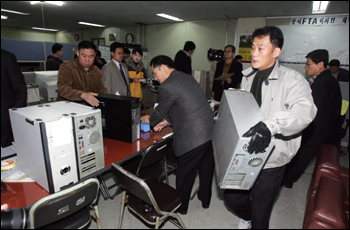
State terror against civic organizations, here in Gwangju
The groups included the anti-FTA coalition, a farmers’ association and the Korean Advanced Farmers Federation...
http://times.hankooki.com/lpage/nation/200611/kt2006112417315211990.htm
Read also:
Police Will Get Tough With Rallies
Seoul declares 'zero tolerance' on violent rallies (K. Herald)
The government yesterday declared a "zero tolerance" policy towards defiant rallies, vowing to launch a massive crackdown on unionized laborers and activists who protested against a free trade deal with the United States earlier this week.
"The government will no longer tolerate illegal and violent protests. We will see to it that all participants of the illegal collective action receive the rightful punishment," Justice Minister Kim Sung-ho read from a joint statement of four ministers...
http://www.koreaherald.co.kr/SITE/data/html_dir/2006/11/25/200611250002.asp
Gov't has 'no tolerance' for violent anti-FTA rallies (Yonhap)
Police vow legal crackdown on violent protests (Hankyoreh)
But, dear comrades, always remember Mao Zedong's (毛澤東) words: "When your enemy is fighting you, this is good and not bad."^^
11.21 Nepal Peace Agreement
To end the civil war that raged for more than 10 years the Communist Party of Nepal [Maoist/CPN(M)] signed a peace deal with the government on Tuesday night, with a pledge to lock up their guns, at least for now, and let voters decide the future of the country.
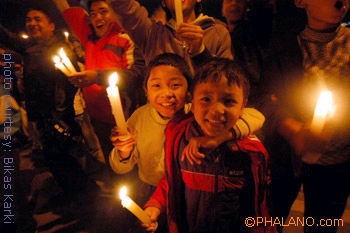
11.22, Kids in Kathmandu celebrating the Peace Accord
Everywhere in the world the political "leaders", even the S.K. government (*), praised the agreement as a "new beginning for a bright future" for the South-Asian country.
But actually it's not really clear if the "People's War" now is on its very end.
At least after I read an Interview in the German "socialist" daily Junge Welt (11.23) with Dinanath Sharma, a member of the CPN(M) central committee (I met him nearly 4 weeks ago in Berlin on a meeting and I was a kind disappointed because except some empty political statements he had nothing new to say, especially about the current situation in Nepal).
Asked if a in the future Nepal will have a multiple-party-system (mps) he answered: "Yes, after we smashed all fuedal and capitalist structures, there will be a mps, formed by all anti-feudal and anti-imperialist forces." (**)
But please remember the interview by Daily Telegraph with CPN(M) chairman Prachanda (http://blog.jinbo.net/CINA/?pid=979).. And there was nothing written about "smashing all .. capitalist structures".
But actually it might mean that either comrade Sharma don't know what's going on in his party, or that there are already (at least) two complete different political lines in the party and perhaps also in the PLA. And this, perhaps, is not a good base for a "bright furure", not really..
Anyway, here you can read a NYT/IHT article about the agreement:
Maoist rebels sign peace deal in Nepal
Here a statement by Gefont (General Federation of Nepalese Trade Unions):
http://www.gefont.org/summary.asp?flag=3&cid=195
And finally here you can read the entire text of the "Comprehensive Peace Accord":
http://www.kantipuronline.com/englishagree.php
* S. Korea welcomes Nepali peace accord (Yonhap)
** The entire interview (in German^^) you can read here:
http://www.jungewelt.de/2006/11-23/028.php
Just let's see what will bring the future!!
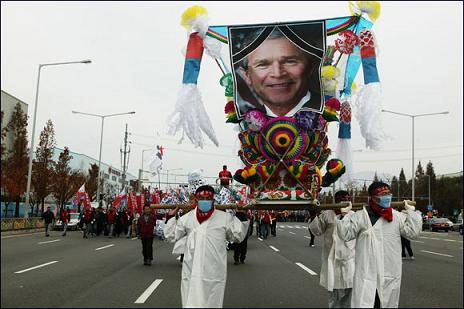
Rallies Blanket Nation (K. Times)
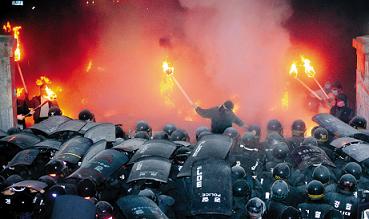
Tens of thousands of anti-globalization demonstrators fought (yesterday, 11.22) with police in cities across the country, attacking pubic buildings and blockading streets in protests against a proposed free trade accord between Korea and the United States.
The rallies _ organized by unionized workers, teachers and farmers called for the government to withdraw from its talks with the U.S. _ began peacefully but turned violent in many cities, resulting in the injuries of dozens of police officers and protestors.
According to police, public buildings and facilities in more than 15 cities nationwide were attacked by the protestors. More than 80,000 people participated in Wednesday's rallies, including 13,000 in Seoul.
More than 10,000 people joined the rallies in Kwangju with some protestors wielding rocks, steel pipes, and enflamed tin cans as they attempted to advance into the city hall building. Riot police put up barricades and fought back with riot cannons, forcing the protestors to disperse.
During the morning hours, about 600 farmers blockaded a section of the Honam Expressway, which connects the southwest of the city with downtown, causing massive traffic disruption.
In Taejon, demonstrators smashed the windows of the South Chungchong Provincial Office with rocks and steel pipes, and even attempted to set the building on fire by burning trees planted nearby.
The largest rallies were organized in the capital city of Seoul, which added to the city's severe traffic congestion during the commuting hours, but ended without reports of violence.
About 13,000 people, including members of the Korean Teachers and Education Workers' Union (KTU) and the Korean Confederation of Trade Unions (KCTU), held demonstrations in front of the Seoul Plaza, the grass square in front of Seoul City Hall.
About 7,000 KTU members from around the country gathered there at 1 p.m. to blast plans to introduce teacher assessments and a graded bonus system. The participants all took a day's leave from work, despite warnings that authorities will take stern measures against their ``illegal'' collective action.
About two hours later, the Korean Confederation of Trade Unions (KCTU) staged a demonstration at the same place to protest the government's plan to legislate a labor reform bill.
The umbrella labor union said it would hold an indefinite strike until their demands are met.
It said about 200,000 unionists nationwide took part in a full walkout yesterday. The union said its members would stage partial strikes for four hours per day from today through next Tuesday, and full strikes again on Nov. 29 and Dec. 6.
The Ministry of Labor said only 56,000 workers participated in the walkout Wednesday.
About 3,500 unionists who gathered at the demonstration site joined another rally held there by a coalition of civic groups opposing South Korea's plan to sign a free trade agreement (FTA) with the U.S.
From 4 p.m., the KCTU unionists and about 5,000 members of the coalition demanded the nation scrap the FTA negotiations, stop importing beef from the U.S. and increase the screen quota.
The coalition's regional branches also held rallies in 12 other cities nationwide with a total of 72,000 people participating.
The rally in downtown Seoul got bigger as some 1,500 street vendors joined it after holding a separate rally in front of Seoul Station.
After the rally, about 1,000 participants marched from the plaza to Chongno and held a candlelight vigil at the Chonggye Plaza. The coalition previously planned 5,000 members for the march, but reduced the number as police refused to allow the larger group to march. The union is also planning rallies for Nov. 29 and Dec. 6.
Police mobilized 7,700 riot control officers to maintain order, but failed to prevent traffic jams in the city center.
http://times.hankooki.com/lpage/nation/200611/kt2006112217570710510.htm
Actually, according to some S.K. independent/progressive media all across the country between 100,000 and 150,000 people - workers, farmers, street vendors, student activists... - took the streets.
But the "left-liberal" daily Honkyoreh is writing following:
Turnout low for nationwide labor demonstrations
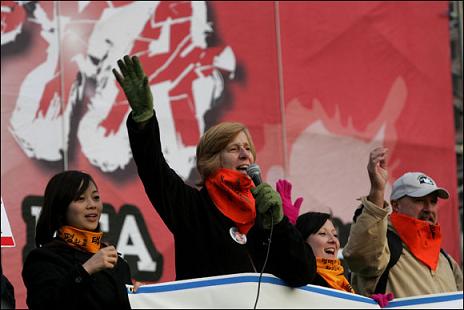
C. Sheehan (U.S. "anti-war activist") on the rally in Seoul
Following you can read more reports in English by (bourgeois) S.K. newspapers:
Defiant unions stage mass rallies (Korea Herald)
Even street vendors shun FTA (JoongAng Ilbo)
Korea Sees Worst Labor Protests in Years (Chosun Ilbo)
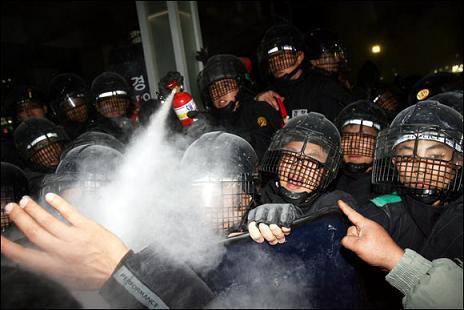
Some trouble...
A (nearly) complete coverage, incl. many pictures, but "only" in Korean, about all rallies and demonstrations, held all across S.K. you can find on Voice of People (VoP):
http://www.voiceofpeople.org/new/index.html
A collection of photos (by VoP) you can see here:

...in the province.. (source of the pics: VoP)
"Photo News slide show":
성난 농심, 전국 곳곳서 폭발 (OhmyNews)

Uprising in..
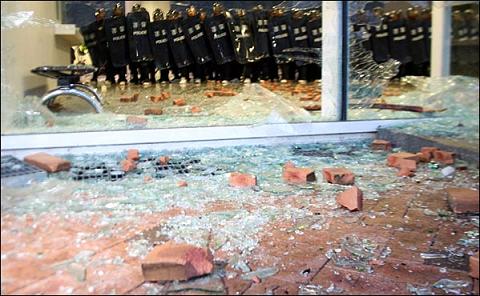
Gwangju..

..and Daejeon (Source: OhmyNews)
"Public buildings and facilities in more than 15 cities
nationwide were attacked by the protestors" (K. Times)
BTW.. already eight days ago K. Times wrote about the then planned demos/rallies, actually took place y'day: "..sources forecast the scale of the protest to be massive enough to rival the ``June Protest’’ against the then-military dictatorship in 1987."
And it was, perhaps, just the beginning: According to the organizers of y'day's demos the same will be happen at least next Wednesday and on Dec. 6! (*)
UPRISING/REVOLUTION
UNTIL VICTORY!!
투쟁!(**)
* For this case S.K. bourgeois, i.e. the reactionary, newspapers (11.24 editions) are reporting following:
Police to Block Anti-FTA Rallies (K. Times)
Police chief orders ban on anti-FTA protests (K. Herald)
Seoul considers flat ban on anti-trade protests (JoongAng Ilbo)
** ^^

^^WHAT A SURPRISE^^
Today in the morning(CET) AP reported following:
N. Korea Won't Abandon Nukes
A senior North Korean diplomat strongly indicated that his country has no plans to abandon nuclear weapons, despite its agreement to return to six-nation disarmament talks, according to news reports Wednesday.
North Korea's deputy foreign minister, Kang Sok Ju, speaking to a group of reporters while passing through Beijing from Russia, instead demanded that the United States lift financial sanctions against the North, Japan's NHK television and Kyodo News agency said.
Kang said North Korea had not tested nuclear weapons only to get rid of them, the reports said.
"Why would we abandon nuclear weapons?" NHK and Kyodo quoted Kang as saying in a Japanese translation of his comments in Korean. "Are you saying we conducted a nuclear test in order to abandon them?"
Asked if Pyongyang planned to demand the U.S. lift sanctions, Kang said, "of course," NHK and Kyodo reported...
In September 2005, Pyongyang agreed to abandon its nuclear program in exchange for security guarantees and aid, but it withdrew from the talks with the U.S., China, South Korea, Japan and Russia two months later, protesting Washington's financial sanctions over suspected money laundering...
http://www.washingtonpost.com/wp-dyn/content/article/2006/11/21/AR2006112100338.html
Remembering that date..
..after all, I think I lost all my means of expression..
The False and Reactionary Nature of Bourgeois "Democracy" (Rodong Shinmun, 11.19)
Democracy calls for shaping policies according to the intention of the broad popular masses, implementing them to serve their interests and substantially providing them with genuine freedom, rights and happy life. Such genuine democracy is socialist democracy, says Rodong Sinmun Sunday in a signed article. There can never be genuine democracy in the capitalist society where all the state power is in the hands of a few capitalists and it is based on individualism, the article says, and goes on:
The popular masses cannot seize power and they are excluded from independent political activities and the state power is in the clutches of a handful capitalists. This is one of main reasons why there can never be genuine democracy in the capitalist society.
Another reason why there can never be genuine democracy in the capitalist society is that this society is based on extreme individualism.
Democracy claimed by the imperialists is sham democracy and it is no more than a camouflage to deceive the popular masses and cover the reactionary nature of bourgeois dictatorship and the unpopular nature of the capitalist system.
Bourgeois democracy, so-called democracy in the capitalist society, provides freedom and rights to the privileged capitalists only and no rights and equality are given to the broad grassroots masses. This democracy, therefore, can not be called democracy in its true sense of the word.
The false and reactionary nature of bourgeois democracy can be found in the socio-political lives of Americans.
There are many youngsters roaming about to get food and homeless and unemployed people in the U.S.
The freedom of speech and the freedom of the press in the U.S. where the reactionary American rulers loudly propagandized about the application of democracy are no more than bourgeois democracy, bogus democracy.
Free election campaigns which the U.S. rulers advertise as model of democracy clearly prove the true nature of bourgeois democracy.
They say equal opportunity and equal freedom and rights are provided to all people but, in fact, it is only a handful of privileged strata who benefit from them. Herein lies another reactionary nature of the bourgeois democracy...
..(of course) in complete opposition to the "People's Democracy" of Juche ideology ^^
And just to prove Rodong Shinmun's article, Korea Times, a bourgeois (of course reactionary^^) daily in "south Korea" published today following example of the "sick bourgeois democracy":
"Many Koreans get angry over some foreign Web sites that despoil the Korean image...
Japanese Web sites that give an account of history that Korean disagree with exceed 400. They claim Dokdo islets are a Japanese territory, and they use ``Sea of Japan'' instead of the ``East Sea,''...
By typing the word ``Korea'' to the biggest online search engine in China, one can get access to more than 30,000 postings about conflicts between Korea and China over the history of the Koguryo Dynasty...
While most of the Japanese or Chinese online postings indicated ``hatred'' toward Korea, most of the Web sites from the west displayed ``ignorance.'' Many Web sites from the United States or Australia showed that all they really know about Korean culture is eating dogs...
Some of the laid-off workers at the LG-Phillips factory in Aachen, Germany, conducted an online boycott of Korean products to protest the closing of the factory...
Many of these sites are quite damaging to the Korean image and Hallyu. The sites are not easy for the government to control because it concentrates on promoting the Korean image rather than regulating or correcting the contents of individual Web sites..."
Read the entire sh.. here:
http://times.hankooki.com/lpage/nation/200611/kt2006112017443111970.htm
Ya, it's complete impossible, that everyone have the possibility to say/write what he/she is thinking!!
What a shame that "the sites are not easy for the government to control"! F.. (bourgeois) DEMOCRACY!!
"..laid-off workers at the LG-Phillips factory.. conducted an online boycott of Korean products.." In the DPRK it would be complete impossible that fired workers, for example in Gaeseong, express their disappointment/anger (Yodok is just waiting!!)..
But just wait until the reunification under the wise leadership of... Then (at the latest) all this sick style of f.. democracy will be abolished!!
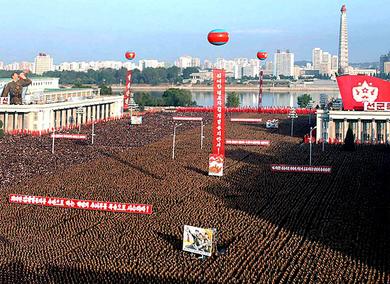
The Korean nation condemning the
"sick bourgeois democracy"^^
로동신문 부르죠아민주주의의 허위성과 반동성
(평양 11월 19일발 조선중앙통신)19일부 《로동신문》은 광범한 인민대중의 의사에 따라 정책을 세우고 인민대중의 리익에 맞게 그것을 관철하며 인민대중에게 참다운 자유와 권리, 행복한 생활을 실질적으로 보장하여주는것이 바로 민주주의이라고 하면서 세상에 이러한 참다운 민주주의는 오직 하나 사회주의적민주주의이라고 지적하였다.
론설의 필자는 국가의 모든 권력이 소수 자본가들의 수중에 장악되여있으며 개인주의에 기초하고있는 자본주의사회에서는 결코 진정한 민주주의가 있을수 없다고 하면서 다음과 같이 썼다.
자본주의사회에서는 인민대중이 정권의 주인으로 되지 못하고 자주적인 정치생활에서 제외되고있으며 국가의 모든 권력이 소수 자본가들의 손에 쥐여져있다.바로 여기에 자본주의사회에 진정한 민주주의가 있을수 없는 주되는 근거의 하나가 있다.
자본주의사회에 진정한 민주주의가 있을수 없는 근거는 또한 극단한 개인주의에 기초하고있는 자본주의제도자체의 본질에도 있다.
제국주의자들이 떠드는 《민주주의》는 가짜민주주의이며 오직 인민대중을 기만하고 부르죠아독재의 반동성과 자본주의제도의 반인민적본질을 가리우기 위한 위장물에 지나지 않는다.
자본주의사회에서의 이른바 《민주주의》,부르죠아민주주의는 자본가계급,소수 특권계급에게만 자유와 권리를 보장해주고 광범한 인민대중에게는 무권리와 불평등을 가져다준다. 따라서 그것은 본래의 의미에서 민주주의가 아니다.
론설은 부르죠아민주주의의 허위성과 반동성은 무엇보다도 미국의 사회정치생활에서 잘 나타나고있다고 하면서 다음과 같이 계속하였다.
오늘 미국에는 먹을것을 찾아 떠돌아다니는 청소년들,집없는 사람들,일자리를 찾아 헤매이는 실업자들이 헤아릴수 없이 많다.
미국반동지배층이 입을 모아 《민주주의의 철저한 구현》에 대해 요란하게 선전하는 미국에서의 이른바 《언론의 자유》,《출판의 자유》 역시 부르죠아민주주의,가짜민주주의에 지나지 않는다.
미국지배층이 《민주주의의 표본》이라고 광고하는 미국에서의 이른바 《자유로운 선거경쟁》도 부르죠아민주주의의 진면모를 잘 보여준다.
외견상으로는 모든 사람들에게 평등한 기회,똑같은 자유와 권리를 주는듯이 꾸며놓고 실제에 있어서는 소수 특권계층만이 그것을 누리며 행사할수 있게 하는데 부르죠아민주주의의 반동적특징의 하나가 있다.
http://www.kcna.co.jp/calendar/2006/11/11-20/2006-1119-006.html
^=^

최근 덧글 목록