
공지사항
-
- '노란봉투'캠페인/국제연대..
- no chr.!
27개의 게시물을 찾았습니다.

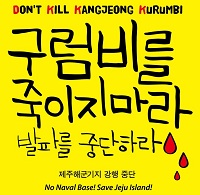
Release peace activist Dr. Song Kang-ho (since 100 days in prison for his involvement in the resistance struggle against the Jeju Naval Base)!!



Well, it seems that the S. Korean ministry of information(^^) has really taken leave of its senses...
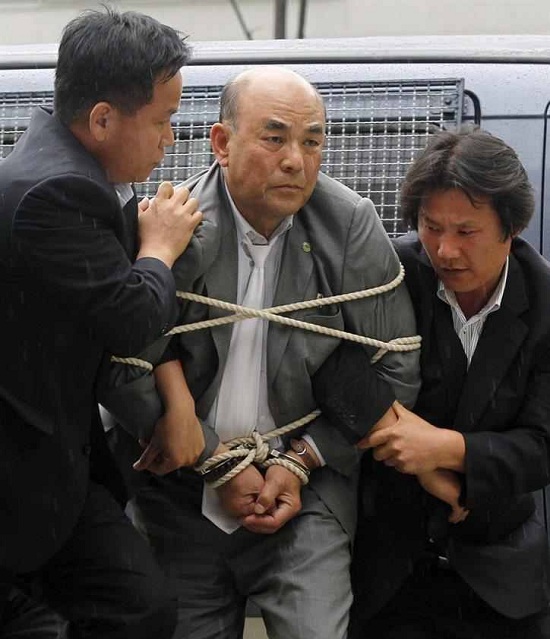
Yesterday afternoon: Ro Su-hui was arrested, handcuffed and tied with a rope, upon crossing the inter-Korean border at the truce village of Panmunjom from North Korea after spending more than three months there..., according to Yonhap
For two consecutive nights at the end of June, (North)Korean Central TV showed footage of a news conference with Park In-sook(aka Park Jong Suk), an elderly N. Korean woman who successfully(^^) 're-defected’ to the DPRK in late May after six years living in Seoul(*)
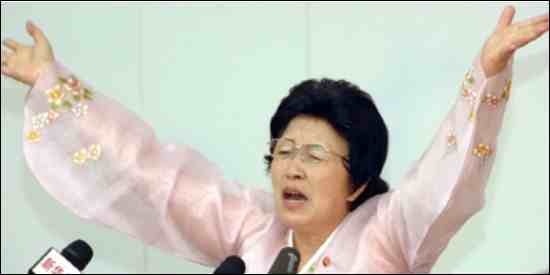
* Yesterday's KCNA 'reported' the following under the titel "DPRK Woman Interviewed upon Her Return Home (6)":
Referring to her feelings after coming back to the DPRK, she said as follows:
A single misstep made me fall into a bottomless pitfall. But my motherland injected life-giving water to me who might have become a forlorn wandering spirit.
When I deplaned, quieting my thumping heart, I was stunned by the cordial reception given by officials concerned.
Had I been handcuffed, I would not have found any word to say.
That night I thought and thought, looking up at the starry sky over Pyongyang.
I felt at that time how affectionate and great the motherland is for me. I would have no more to desire in the world before I die.
Until that time I could not imagine what profound loving care awaited me.
The dear respected Kim Jong Un did not blame me who did so many wrongs in the past but brought me under his warm care.
Kim Jong Un made sure that I, little different from an offender, reside in Pyongyang with my son who is a teacher at Pyongyang Kim Won Gyun Conservatory and daughter-in-law.
I am an ingrate who had betrayed my motherland to seek better living while others devoted themselves to building a thriving nation, tightening their belts.
I visited the statues of Generalissimos Kim Il Sung and Kim Jong Il on Mansu Hill to express thanks to Kim Jong Un who helped me to be reborn.
I atoned for my wrong doings and renewed my pledge to uphold Kim Jong Un with my pure conscience by showing intense loyalty to the Generalissimos though I failed to do so in the past.
The world does not know such tender-hearted leader as the dear respected General Kim Jong Un.
I was reborn thanks to Kim Jong Un identical to the great Generalissimos.
http://www.kcna.co.jp/item/2012/201207/news05/20120705-10ee.html
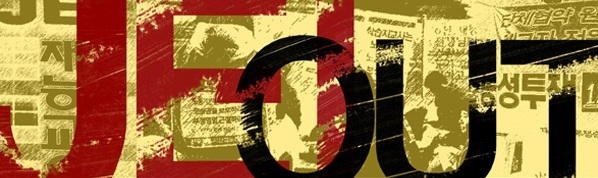
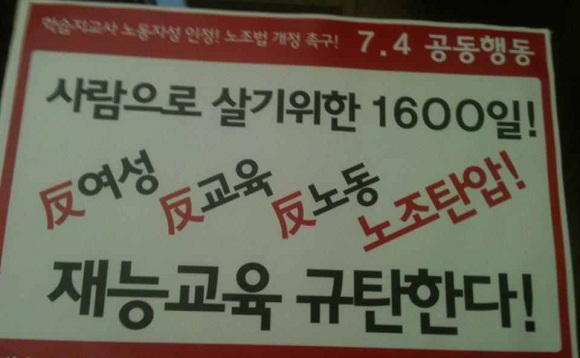
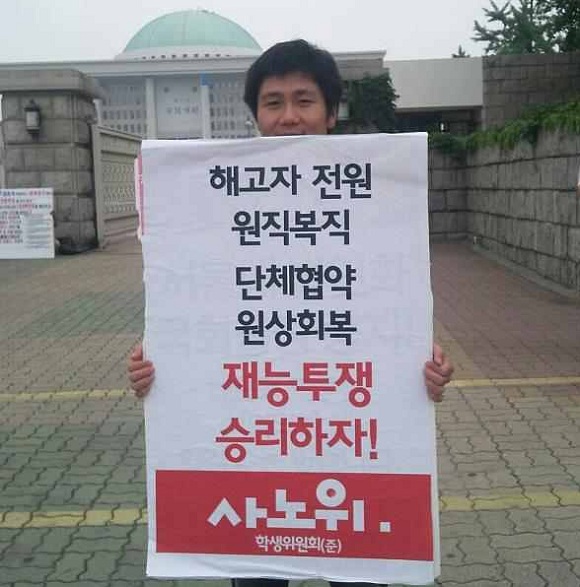
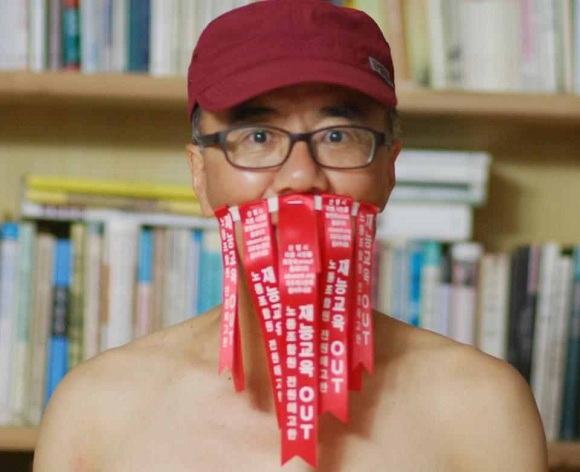
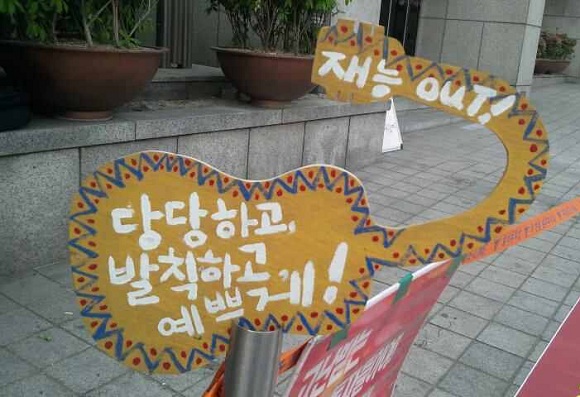
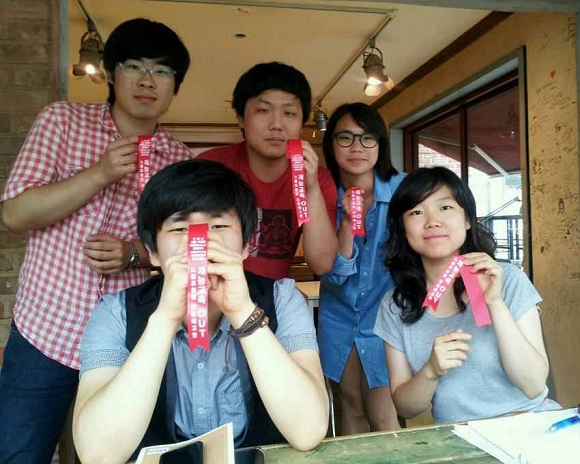
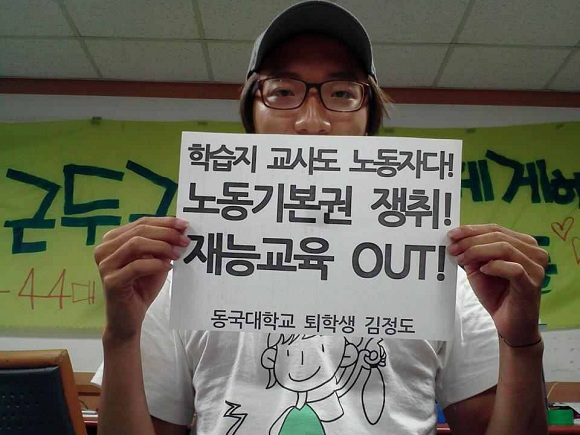
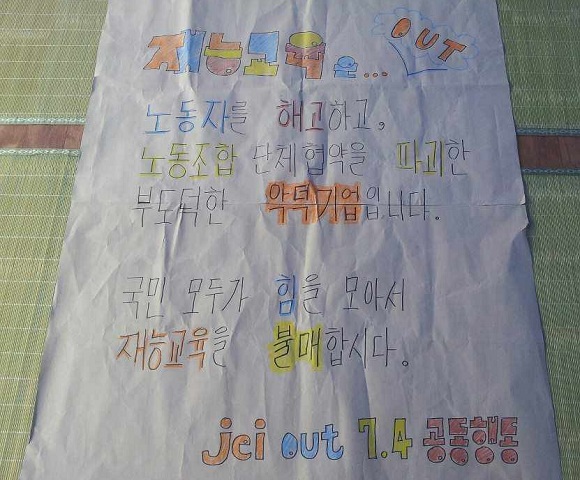
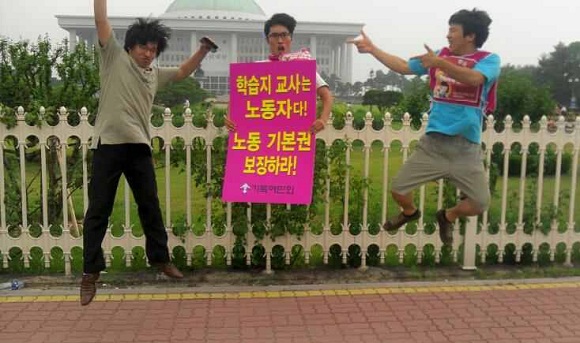
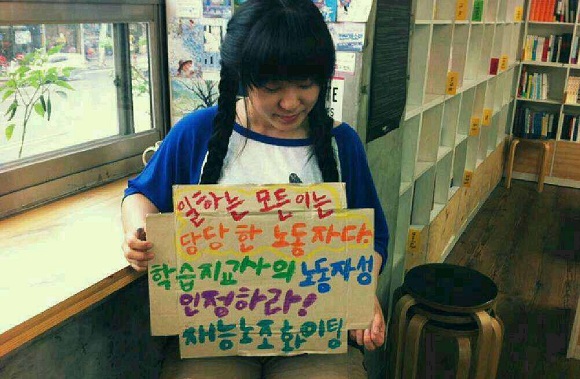
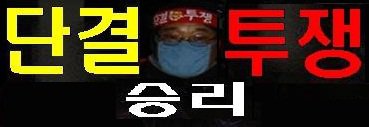
Impressions from yesterday's Joint Action Day to support the struggle of fired Jaenueng employees, now since more than 1,650 days in sit-in strike (detailed info about the strike you'll find here!):
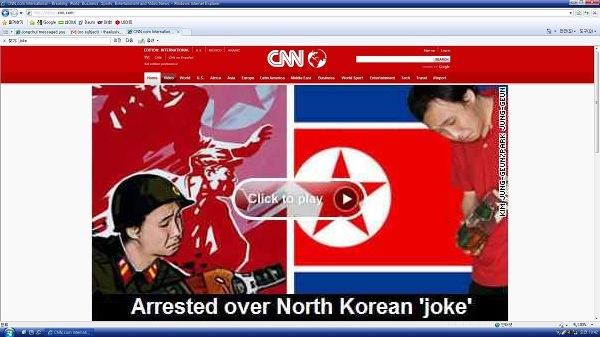
Everyone's made a joke they thought was funny only to see it fall flat, but Park Jung-geun's attempt at humor could see him jailed for up to seven years in South Korea.
Park, a photographer by profession, re-tweeted some messages from North Korea's official twitter feed, such as reports on the late leader Kim Jong Il's travels across the country and negative tweets about South Korea.
"I found the messages ludicrous because they are so harsh and the language is so out-dated. I found them funny, so I re-tweeted them," Park told CNN.
Park, 23, also took a photo of himself holding a whiskey bottle and edited in a North Korean flag as a background for a joke. His supporters then doctored a North Korean military poster, replacing a smiling soldier with a sad photo of Park and the image of the gun with another whiskey bottle.
But Park was imprisoned in January of this year, accused of "acts that benefit the enemy" and spreading North Korean propaganda. He was released on bail in February and has another court appearance in mid-July. He's still hoping the charges against him will be dropped.
"To be honest, if you did this in North Korea, you would be severely punished," Park said. "But this is South Korea and I thought there wouldn't be a problem as I did it for fun. It certainly wasn't for propaganda purposes."
Park is the latest person to fall foul of South Korea's controversial National Security Law (NSL). Used widely used during the years of military dictatorship in the 1970s and 80s, the law was designed to protect the state against North Korean propaganda and to prosecute spies.
But human rights groups say it was also used to persecute political dissidents and stifle freedom of speech.
Amnesty International says the law is still being abused, especially against those critical of the government's policies on North Korea.
"The NSL has a chilling effect on freedom of expression in South Korea," said Sam Zarifi, Amnesty's Asia-Pacific director.
"It is used, not to address threats to national security, but instead to intimidate people and limit their rights to free speech. It should be reformed in line with human rights law and if the government cannot do this, it must be abolished," he said.
The United Nations has also called on Seoul to change or repeal the law.
President Lee Myung-bak's office declined to comment on the issue but the law has certainly been more widely used since the conservative president came to power in 2008. That year, just five people were prosecuted on charges of pro-North Korean online postings. Two years later that number had jumped to 82.
Some within the South Korean media are also criticizing the Lee administration for interfering in press freedom.
Journalists from four major networks went on strike earlier this year. Employees from two of those stations have since gone back to work after promises from employers their concerns would be heard, but close to one thousand journalists remain on strike.
"President Lee Myung-bak has appointed pro-government people as presidents of the media companies, what we call 'parachutes,'' said Kim Jong-wook, head of the YTN labor union which is still on strike.
"They are now trying to censor our voice and stop criticism of the government," he added.
The government denies interference but picketing journalists say they are worried they are seeing increased censorship reminiscent of the dark days of dictatorship.
http://edition.cnn.com/2012/07/03/world/asia/south-korea-north-joke/index.html

[7.01] The 2nd "Weekly Solidarity Street Concert"(*), nearby Daehanmun in downtown Seoul, to support the struggle of the victims of mass dismissals at SsangYong Motors and elsewhere in S. Korea... was performed by the comrades of "Kkotdaji"(꽃다지):


* The "Weekly Solidarity Street Concert" will be held every Sunday evening at least until the beginning of August...
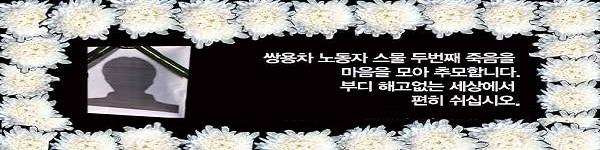
Last week Slavoj Žižek, the Slovenian philosopher and cultural critic visted S. Korea for a lecture tour. But his last stop led him to the SsangYong Memorial Site in downtown Seoul, to pay his respect to the fatal victims of the SsangYong mass dismissal. Yesterday's Hankyoreh reported about it:
Slavoj Zizek shows solidarity with dismissed Ssangyong Motors workers
Prominent philosopher Slavoj Zizek locked hands with Ssangyong Motors laid off workers during a June 29 visit to the site of a collective memorial in front of Daehan Gate at Deoksu Palace, across from Seoul City Hall.

Zizek greets Kim Jeong-woo, head of the Ssangyong chapter of the Korea Metal Workers’ Union
The site was set up to honor 22 workers and family members who have died in the wake of massive layoffs by the automaker. A solemn Zizek expressed his solidarity and sympathies to the workers there. The infamous cultural critic is wrapping up a weeklong visit to South Korea.
After arriving at 11:30 am, Zizek talked for about a half hour with Kim Jeong-woo, head of the Ssangyong chapter of the Korea Metal Workers’ Union. Afterwards, he joined Kim in lighting incense for the victims before their portraits. In the visitors’ log, he left a message saying, “You are a hope to us all. I hope you keep fighting.”

In his conversation with Kim, Zizek said the layoffs and their devastating effects on ordinary lives were a matter of concern not just for them but for everyone living under a capitalist system. “Your case shows us that the lives we are living are not at all happy,” Zizek said.
The philosopher said that it was a falsehood for businesses to claim that layoffs are economically necessary measures rather than the company’s own decision. The Ssangyong Motors struggle, he said, raises fundamental questions about the importance of democracy.
Kim asked for Zizek’s continued support, saying, “We need to alert the world to the contradictions of layoffs that are taking place through the exploitations of capital, and the reality here in South Korea as an example of neoliberalism.”
Zizek responded that a good friend was someone you are able to put to use without any reservations. “Put me to use,” he said. “I’ll gladly be used.”

The philosopher also emphasized the importance of the memorial, which he said alerts people to what they really need to be aware of. Through it, the people who pass by are able to understand the nature of the current situation in South Korean society, he said.
Zizek also said that as a symbol of suffering, the memorial would eventually have a snowball effect even if it doesn’t result in any resolution in the short term.
Kim related an episode in May when police demolished a previous memorial. “The government isn’t even showing a willingness to have dialogue or to placate us,” he explained. Zizek expressed his astonishment, calling this “very foolish.”
After the incense lighting, Zizek talked for an hour with artist Lim Min-ouk, 44, who installed a work of interactive video art beside the memorial...
http://english.hani.co.kr/arti/english_edition/e_international/540344.html
Related article:
☞ 슬라보예 지젝, 쌍용차 분향소 방문 (NewsCham, 6.29)

최근 덧글 목록