

공지사항
-
- '노란봉투'캠페인/국제연대..
- no chr.!
45개의 게시물을 찾았습니다.
Here the first stuff from the bourgeois S.K. media about the so-called General Strike by KCTU, starting tomorrow, 12.01. More about it will follow soon.
Semi-official news agency Yonhap today, 11.30:
Violent clashes between police and protesters expected Thursday
Violent clashes between police and protesters are expected Thursday as thousands are set to protest further liberalization of the rice market and discrimination against non-regular workers at a rally in downtown Seoul, the National Police Agency (NPA) said Wednesday.
Nearly 8,000 people are to gather in the district of Daehakro as both a continuing form of protest and a memorial to Jeon Yong-cheol. Jeon was a farmer who died of brain injuries sustained in a recent clash with police during a street protest against opening the rice market.
Umbrella labor groups at odds over non-regular worker issue
South Korea's two umbrella labor groups are on the verge of severing their alliance of more than a year after failing to settle differences over how to best deal with the non-regular worker issue, labor officials said Wednesday.
The Federation of Korean Trade Unions (FKTU), the more amicable of the two influential labor groups, said that it will go ahead with the submission of a labor law revision bill to a National Assembly panel in December.
In Tuesday's meeting of standing committee members, the federation decided to present the bill independently as opposed to its rival group's push for a general strike scheduled for Thursday.
"It is impossible to leave the non-regular issue in limbo anymore, so we've come up with our own revision bill aimed at satisfying 60 percent to 70 percent of the labor community," a federation official said, asking to remain anonymous.
Another representative umbrella labor group, the Korean Confederation of Trade Unions (KCTU), decided Monday to go ahead with a general strike to demand greater labor rights for non-regular workers.
The KCTU said that its nationwide strike will be staged in alliance with trade groups of local farmers and teachers, who are fighting government policies for wider market opening and a new teacher evaluation system, respectively.
"Hope for the improvement of non-regular workers' labor rights
is turning into despair, while the rice-market opening bill passed
the National Assembly last week," said Jeon Jae-hwan, a spokesman for the KCTU.
The Korean Teachers & Education Workers' Union is planning to call a strike in protest against the government-led teacher assessment program, while groups of farmers stage demonstrations almost every day to vent their anger at wider rice market opening.
The KCTU has about 750 affiliated labor unions from across 18 industrial sectors and claims a total membership of about 620,000.
It has been one of the most influential forces in the nation's labor movement over the past decade.
However, it recently lost public confidence as a result of a rise in corruption cases ranging from embezzlement of union funds to bribe-taking in return for job placements.
The FKTU is also struggling in the aftermath of its own corruption scandals.
In October, former FKTU leader Lee Nam-soon was sentenced to one and a half years in prison for receiving bribes from construction companies in return for helping them win a bid to build a union welfare center.
The Ministry of Labor called the planned strike illegal and politically motivated, because it will happen while dialogue is under way between representatives of labor unions and the employers' group on introducing a bill on the rights of non-regular workers.
"It is not a responsible attitude by the labor community to try to have their demands met through physical power rather than dialogue. It should withdraw the strike, which is illegal," Vice Labor Minister Chung Byung-suk said.
Daily newspaper Korea Times, 11.27:
Umbrella labor groups at odds over non-regular worker issue
South Korea's two umbrella labor groups are on the verge of severing their alliance of more than a year after failing to settle differences over how to best deal with the non-regular worker issue, labor officials said Wednesday.
The Federation of Korean Trade Unions (FKTU), the more amicable of the two influential labor groups, said that it will go ahead with the submission of a labor law revision bill to a National Assembly panel in December.
In Tuesday's meeting of standing committee members, the federation decided to present the bill independently as opposed to its rival group's push for a general strike scheduled for Thursday.
"It is impossible to leave the non-regular issue in limbo anymore, so we've come up with our own revision bill aimed at satisfying 60 percent to 70 percent of the labor community," a federation official said, asking to remain anonymous.
Another representative umbrella labor group, the Korean Confederation of Trade Unions (KCTU), decided Monday to go ahead with a general strike to demand greater labor rights for non-regular workers.
The KCTU said that its nationwide strike will be staged in alliance with trade groups of local farmers and teachers, who are fighting government policies for wider market opening and a new teacher evaluation system, respectively.
"Hope for the improvement of non-regular workers' labor rights
is turning into despair, while the rice-market opening bill passed
the National Assembly last week," said Jeon Jae-hwan, a spokesman for the KCTU.
The Korean Teachers & Education Workers' Union is planning to call a strike in protest against the government-led teacher assessment program, while groups of farmers stage demonstrations almost every day to vent their anger at wider rice market opening.
The KCTU has about 750 affiliated labor unions from across 18 industrial sectors and claims a total membership of about 620,000.
It has been one of the most influential forces in the nation's labor movement over the past decade.
However, it recently lost public confidence as a result of a rise in corruption cases ranging from embezzlement of union funds to bribe-taking in return for job placements.
The FKTU is also struggling in the aftermath of its own corruption scandals.
In October, former FKTU leader Lee Nam-soon was sentenced to one and a half years in prison for receiving bribes from construction companies in return for helping them win a bid to build a union welfare center.
The Ministry of Labor called the planned strike illegal and politically motivated, because it will happen while dialogue is under way between representatives of labor unions and the employers' group on introducing a bill on the rights of non-regular workers.
"It is not a responsible attitude by the labor community to try to have their demands met through physical power rather than dialogue. It should withdraw the strike, which is illegal," Vice Labor Minister Chung Byung-suk said.


The following article was published in yesterday's Guardian (UK, internet edition)
http://www.guardian.co.uk/elsewhere/journalist/story/0,7792,1653453,00.html
Nowhere to run
After what has been described as the most foolish war in over 2,000 years, is there a way out of Iraq for President Bush, asks Brian Whitaker
Tuesday November 29, 2005
To describe Iraq as the most foolish war of the last 2,014 years is a sweeping statement, but the writer is well qualified to know.
Professor van Creveld has previously drawn parallels between Iraq and Vietnam, and pointed out that almost all countries that have tried to fight similar wars during the last 60 years or so have ended up losing. Why President Bush "nevertheless decided to go to war escapes me and will no doubt preoccupy historians to come," he told one interviewer.
The professor's puzzlement is understandable. More than two years after the war began, and despite the huge financial and human cost, it is difficult to see any real benefits.
The weapons of mass destruction that provided the excuse for the invasion turned out not to exist and the idea that Iraq could become a beacon of democracy for the Middle East has proved equally far-fetched.
True, there is now a multi-party electoral system, but it has institutionalised and consolidated the country's ethnic, sectarian and tribal divisions - exactly the sort of thing that should be avoided when attempting to democratise.
In the absence of anything more positive, Tony Blair has fallen back on the claim that at least we're better off now without Saddam Hussein. That, too, sounds increasingly hollow.
The fall of Saddam has brought the rise of Zarqawi and his ilk, levels of corruption in Iraq seem as bad as ever, and at the weekend former prime minister Iyad Allawi caused a stir by asserting that the human rights are no better protected now than under the rule of Saddam.
Noting that some two-thirds of Americans believe the war was a mistake, van Creveld says in his article that the US should forget about saving face and pull its troops out: "What had to come, has come. The question is no longer if American forces will be withdrawn, but how soon - and at what cost."
Welcome as a pullout might be to many Americans, it would be a hugely complex operation. Van Creveld says it would probably take several months and result in sizeable casualties. More significantly, though, it would not end the conflict.
"As the pullout proceeds," he warns, "Iraq almost certainly will sink into an all-out civil war from which it will take the country a long time to emerge - if, indeed, it can do so at all. All this is inevitable and will take place whether George W Bush, Dick Cheney, Donald Rumsfeld and Condoleezza Rice like it or not."
This is one of the major differences between Iraq and the withdrawal from Vietnam. In Vietnam, it took place under a smokescreen of "Vietnamisation" in which US troops handed control to local forces in the south.
Of course, it was a fairly thin smokescreen; many people were aware at the time that these southern forces could not hold out and in due course the North Vietnamese overran the south, finally bringing the war to an end.
Officially, a similar process is under way in Iraq, with the Americans saying they will eventually hand over to the new Iraqi army - though the chances of that succeeding look even bleaker than they did in Vietnam.
"The new Iraqi army is by all accounts much weaker, less skilled, less cohesive and less loyal to its government than even the South Vietnamese army was," van Creveld writes.
Worse still, in Iraq there is no equivalent of the North Vietnamese regime poised to take power. What will happen once the Americans have gone is anyone's guess, but a sudden outbreak of peace seems the remotest of all the possibilities.
Not surprisingly, many who in principle would argue that the Americans had no right to invade Iraq in the first place are apprehensive about what might happen once they leave. The conference organised by the Arab League in Cairo last week was one example: it called for "the withdrawal of foreign forces according to a timetable" but didn't venture to suggest what that timetable might be.
With or without American troops, the war in Iraq has acquired a momentum of its own and threatens to spill over into other parts of the region.
There are four major issues: terrorism, Sunni-Shia rivalries, Kurdish aspirations, and the question of Iraq's territorial integrity - all of which pose dangers internationally.
Back in July 2003, terrorism in Iraq seemed a manageable problem and President Bush boldly challenged the militants to "bring 'em on". American forces, he said, were "plenty tough" and would deal with anyone who attacked them.
There were others in the US who talked of the "flypaper theory" - an idea that terrorists from around the world could be attracted to Iraq and then eliminated. Well, the first part of the flypaper theory seems to work, but not the second.
As with the Afghan war in the 1980s that spawned al-Qaida, there is every reason to suppose that the Iraq war will create a new generation of terrorists with expertise that can be used to plague other parts of the world for decades to come. The recent hotel bombings in Jordan are one indication of the way it's heading.
Contrary to American intentions, the war has also greatly increased the influence of Iran - a founder-member of Bush's "Axis of Evil" - and opened up long-suppressed rivalries between Sunni and Shia Muslims.
The impact of this cannot be confined to Iraq and will eventually be felt in the oil-rich Sunni Gulf states (including Saudi Arabia) that have sizeable but marginalised Shia communities.
Kurdish aspirations have been awakened too - which has implications for Turkey, Syria and Iran, especially if Iraq is eventually dismembered.
With a fragile central government in Baghdad constantly undermined by the activities of militants and weakened by the conflicting demands of Sunnis, Shias and Kurds, the demise of Iraq as a nation-state sometime during the next few years has become a distinct possibility.
The effect of that on the regional power balance is difficult to predict, but at the very least it would bring a period of increased instability.
No one can claim that any of this was unexpected. The dangers had been foreseen by numerous analysts and commentators long before the war started but they were ignored in Washington, mainly for ideological reasons.
There were, of course, some in the neoconservative lobby who foresaw it too and thought it would be a good thing - shaking up the entire Middle East in a wave of "creative destruction".
The result is that even if the US tries to leave Iraq now, in purely practical terms it is unlikely to be able to do so.
Professor van Creveld's plan for withdrawal of ground troops is not so much a disengagement as a strategic readjustment.
An American military presence will still be needed in the region, he says.
"Tehran is certain to emerge as the biggest winner from the war ... Now that Iraq is gone, it is hard to see how anybody except the United States can keep the Gulf states, and their oil, out of the mullahs' clutches.
"A divided, chaotic, government-less Iraq is very likely to become a hornets' nest. From it, a hundred mini-Zarqawis will spread all over the Middle East, conducting acts of sabotage and seeking to overthrow governments in Allah's name.
"The Gulf States apart, the most vulnerable country is Jordan, as evidenced by the recent attacks in Amman. However, Turkey, Egypt and, to a lesser extent, Israel are also likely to feel the impact. Some of these countries, Jordan in particular, are going to require American assistance."
As described in the article, van Creveld's plan seems to imply that the US should abandon Iraq to its fate and concentrate instead on protecting American allies in the region from adverse consequences.
A slightly different idea - pulling out ground troops from Iraq but continuing to use air power there - is already being considered in Washington, according to Seymour Hersh in the latest issue of the New Yorker magazine.
The military are reportedly unhappy about this, fearing it could make them dependent on untrustworthy Iraqi forces for pinpointing targets.
One military planner quoted by the magazine asked: "Will the Iraqis call in air strikes in order to snuff rivals, or other warlords, or to snuff members of your own sect and blame it on someone else?"
Focusing on air power has obvious political attractions for the Bush administration, since it is the safety of US ground troops that American voters are most concerned about.
But, again, that would not amount to a real disengagement and would do little or nothing to improve America's image in the region - especially if reliance on air strikes increased the number of civilian casualties.
The inescapable fact is that the processes Mr Bush unleashed on March 20 2003 (and imagined he had ended with his "mission accomplished" speech six weeks later) will take a decade or more to run their course and there is little that anyone, even the US, can do now to halt them.
In his eagerness for regime change in Iraq, Mr Bush blundered into a trap from which in the short term there is no way out: the Americans will be damned if they stay and damned if they leave.
Following documentary I found on MTU's (이주노동자 노동조합) freebord.
I think it shows at least some important evidence of the brutality of the cops, even the docu is, for my "taste" a "little" to pathetic (actually we don't need martyrdom - a revolutionary (?) movement is not a crusader society...).
Finally here you can read the latest (11.29) article from Yonhap (by the way, I don't agree with their opinions, not at all!):
Civic groups file petition demanding probe into farmer's death
South Korean civic groups on Tuesday filed a petition with the nation's human rights watchdog, asking for a thorough investigation into the controversial death of a farming activist.
The groups claimed that Jeon Yong-cheol died of brain injuries sustained in a clash with police during a street protest two weeks ago.
The 43-year-old Jeon collapsed in front of his house in Boryeong in the central province of South Chungcheong a day after he participated in the demonstration in Seoul on Nov. 15. He underwent two brain operations but died six days later.
About 60 civic and farming organizations alleged that Jeon was beaten up by police during the protest against the government's decision to open its rice market wider to cheap imports.
Police, backed by a state-supervised autopsy, denied the use of any violence against Jeon, saying pictures they obtained showed Jeon was in the rear area during the rally so there was little chance that he clashed with riot police.
A day after his death, the National Institute of Scientific Investigation said Jeon died from cerebral hemorrhaging and skull fractures as a result of a fall, not from direct blows to the head by police.
But the civic groups claimed they see problems in the autopsy results. The country's religious groups also made similar claims.
"The police used violence at the rally, which infringed on the freedom of assembly and association and eventually claimed Jeon's life," the groups said in a petition submitted to the National Human Rights Commission of Korea.
On Monday, the groups said another farmer is in critical condition from injuries sustained during the rally and that they will not hold Jeon's funeral until the cause of his death is completely disclosed.
South Korean farmers have staged violent demonstrations after the National Assembly ratified a government motion last week calling for Seoul to gradually double its rice import quota to 8 percent of domestic consumption by 2014.
Two farmers committed suicide this month to demonstrate their opposition to the market opening agreement.
Source: Minjung-ui Sori
Korea Herald will write this today:
Farmers step up fight
Farmers and civic groups yesterday demanded that the police chief resign, blaming police violence for the death of a farmer after their recent demonstration against the wider opening of the domestic rice market. Jeon Yong-cheol, a 44-year-old farmer, died from cerebral hemorrhaging Thursday, ten days after attending the demonstration held in front of the National Assembly. Activists claimed that he died after being beaten by police during a mass rally on Nov. 15 in Seoul An emergency committee, composed of 59 civic groups protested in front of the National Police Agency yesterday calling for the resignation of Huh Joon-young, commissioner-general of the National Police Agency, to take responsibility for his death. They claimed that the police agency is attempting to cover up police brutality during the rally. An autopsy by the National Institute of Scientific Investigation showed that he died from cerebral hemorrhaging and skull fractures as a result of a fall, not from direct blows to the head by police. But, protesters claim that they witnessed the police being severely violent toward Jeon. "Jeon tried to prevent the police from charging before he fell onto his back as the police hit him in the chest and face with their shields," said Bae Geom, one of the witnesses. The committee showed Sunday a picture of four farmers, including Bae, helping Jeon, had collapsed, away from the site of the protest. "Whether Jeon was killed by a direct hit or the fall on his back after being hit by the police shields, it is the police violence that caused his death," the committee said in a statement. Police, on the other hand, presented yesterday four photos taken of Jeon on the day which show him standing at back of the demonstration group and said he hardly had physical contact with the police. "If the demonstrators took pictures which indicate a violent scene, they should have released them because they take more photos during the protest than we do," said a police official. "Jeon was not even on the list of names of causalities that they offered," he added. Police opened the photo evidence to reporters yesterday, however, did not allow them to take pictures of them. Leaders from religious groups also joined the force yesterday and urged police to investigate the death of a farmer. Buddhist and Christian leaders held a joint news conference and questioned the autopsy results which the investigation institute announced last week. "We see problems in the autopsy results of the National Institute of Scientific Investigation," they said in a statement. "The government should reveal the truth and apologize to the farmers." The religious groups claimed that Jeon died from "serious" injuries during scuffles with police at the rally, considering witness testimonies and photos taken at the scene. They rejected the explanation by that Jeon died from an accident. Farmers have held a series of demonstrations across the nation before and after the National Assembly ratified a government-proposed bill further opening rice market last Wednesday. The bill allows the nation to gradually double its rice import quota by 2014. Before the ratification of the bill, two farmers committed suicide this month against the market opening.
And here
http://joongangdaily.joins.com/200511/28/200511282224306939900090409041.html
JoongAng Ilbo will write their sh...
Today (11.28) semi-official (of course bourgeois) news agency Yonhap wrote this:
Religious groups call for probe into death of farmer
South Korea's religious groups on Monday called for a thorough investigation into the death of a farmer who collapsed from brain injuries last week after attending a rally opposing further opening of the country's rice market.
Human rights panels from the country's Buddhist, Catholic, Protestant and Won-Buddhist sectors held a joint news conference at Seoul National University hospital in downtown Seoul, where the farmer's body was located.
Jeon Yong-cheol, a 43-year-old farmer from Boryeong of South Chungcheong Province, collapsed in front of his house a day after he participated in the demonstration in Seoul on Nov. 15. He underwent two brain operations on Nov. 18, but died six days later.
The religious groups claimed that Jeon died from serious injuries during scuffles with police at the rally, considering witness testimonies and photos taken at the scene. They rejected the explanation by the state-run forensic agency that Jeon died accidentally.
"We see problems in the autopsy results of the National Institute of Scientific Investigation," they said in a statement. "The government should reveal the truth and apologize to farmers."
The agency announced on Friday after its autopsy that Jeon died from cerebral hemorrhaging and skull fractures as a result of a fall, not from direct blows to the head by police.
The police said it obtained four pictures showing Jeon was in the rear area during the rally, which indicates he didn't have much of a chance to physically clash with riot police. The police said one of the four pictures showed Kim lying on the ground, but his face and clothes were clean and didn't have evidence of being beaten by the police.
In a separate news conference on Monday, an emergency committee established by 59 civic organizations demanded the resignation of Huh Joon-young, commissioner-general of the National Police Agency for allegedly hiding police brutality.
Whether the injuries occurred as the result of a direct hit or by Jeon falling on his back after being hit by police shields, it was police violence that caused his death, the committee said.
The committee said it will not hold Jeon's funeral until the cause of his death is completely disclosed.
It also said another farmer is also in critical condition from injuries sustained during the rally. After the news conference, some angry farmers tried to march into the National Police Agency building in Seoul, but were stopped by security guards.
Earlier on Sunday, Bae Geom, who claims to have witnessed the police violence against Jeon during the rally, said the farmer fell on his back when he tried to prevent the police from charging, and the police hit him in the chest and face with their shields.
In recent weeks, South Korean farmers have staged demonstrations almost daily in various locations across the country before and after the National Assembly ratified a government motion last Wednesday calling for Seoul to gradually double its rice import quota by 2014.
Two farmers committed suicide this month in protest of the market opening agreement.
More about this killer units you can read (in Korean) here:
http://www.voiceofpeople.org/new/2005112833352.html
Some years ago, during the anti-USFK struggle, my comrade told me, we were joining a mass demonstration, that we should not use force, violence against the cops, because "...they're not our enemies". But when I see this docus, I have some doubts about her opinion...
Yonhap wrote this yesterday:
Police brutality under spotlight after farmer's death
Police brutality at a demonstration against further opening of the South Korean rice market caused the death of a farmer from cerebral hemorrhaging Thursday, an emergency committee established by 59 civic organizations claimed Sunday.
Jeon Yong-cheol, 44, collapsed in front of his house a day after attending the demonstration on Nov. 15. He underwent two brain operations on Nov. 18, but died six days later.

11.15: Riot cops' attack on Yeouido against the farmers demonstration
Here:
http://www.voiceofpeople.org/new/2005112733315.html
and in the following articles you can read about it in Korean.
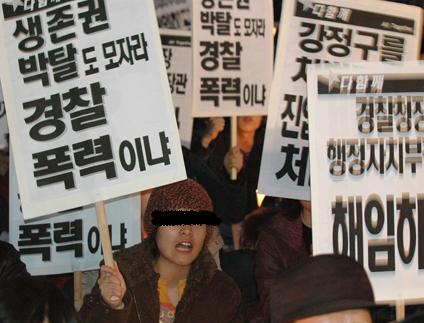
Before yesterday (11.26) a rally in Seoul, near Gwanghwamun, took place to protest against this. About 300 (still I'm waiting for the confirmation) people participated.
Sunday November 27, 2005 9:46 AM
LONDON (AP) - Human rights abuses in Iraq are as bad now as they were under Saddam Hussein and could become even worse, the country's former interim prime minister said in an interview published Sunday.
``People are doing the same as Saddam's time and worse,'' Ayad Allawi told The Observer newspaper. ``It is an appropriate comparison.''
Allawi accused fellow Shiites in the government of being responsible for death squads and secret torture centers and said the brutality of elements in the new security forces rivals that of Saddam's secret police. The entire article in "The Observer" (UK) you can read here: http://observer.guardian.co.uk/international/story/0,6903,1651789,00.html
26 November 2005
DOHA WORK PROGRAMME
Preparations for the Sixth Session of the Ministerial Conference
Draft Ministerial Text
In line with the procedure set out at the General Council meeting in October and the meetings of the TNC in September and October, the attached draft text is being presented by the Chairman of the General Council and the Director-General for Members' consideration, with the following observations.
It should be emphasized that this draft text does not purport to represent agreement overall, and it is without prejudice to any delegation's position on any issue. It draws on and incorporates much work done by the Chairs of the negotiating bodies and other WTO bodies. Their consultations have in many cases produced inputs for the present draft which are either fully agreed by Members or reflect a high level of convergence. In other areas, the text reflects a lower level of convergence. In some areas where important substantive differences persist, this draft attaches a report by the relevant Chair, on his own responsibility, setting out the present situation as he sees it.
The attached text is a first draft. Any possible revision of it will depend upon further progress towards convergence among Members, with whom we shall be consulting intensively in the very limited time remaining before the General Council considers the text it will send to Hong Kong.
In carrying out these further consultations, we shall continue to be guided by the principles of consensus-building and working in a "bottom-up" way.
We urge Members to approach this draft text in a constructive spirit and with respect for the positions of others. We will continue to work with you all to facilitate agreement in the short time ahead of us.
_______________
The full text you can get here:
http://www.wto.org/english/thewto_e/minist_e/min05_e/draft_min05_text_e.doc
Mi-anh haeyo... just a little belated...
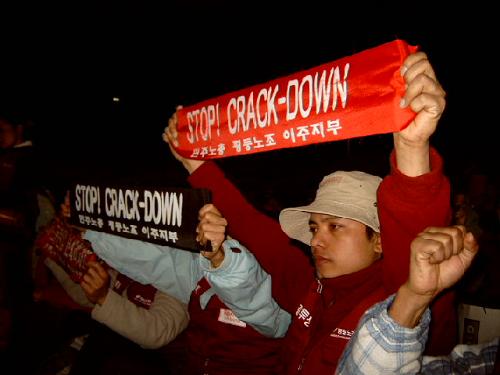
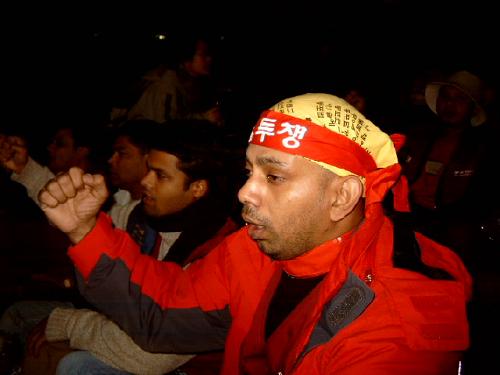
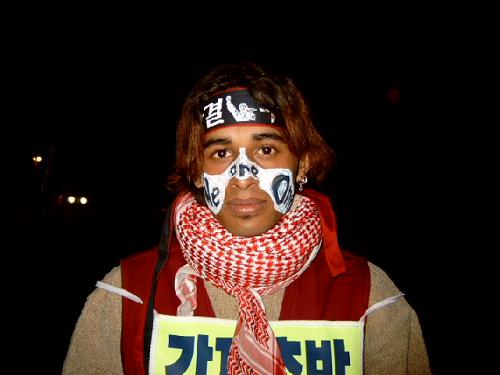
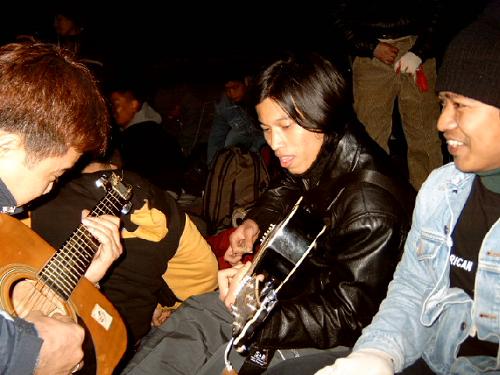
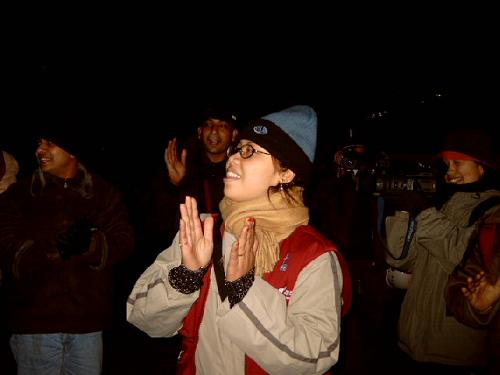
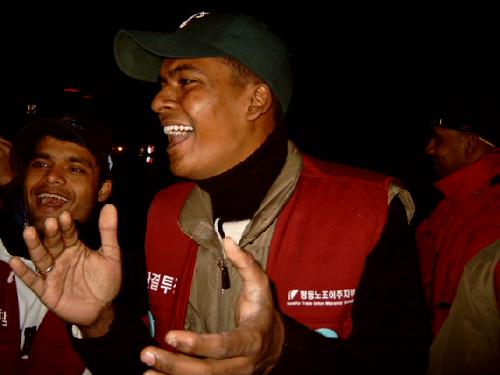
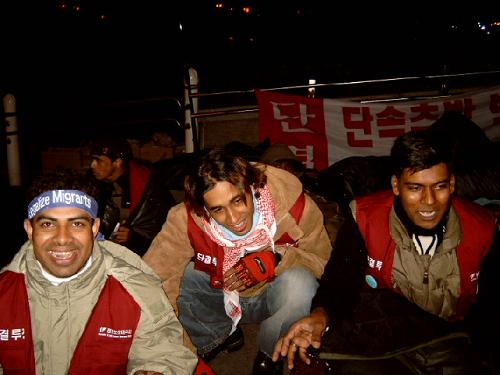
2003.11.15: MIGRANT WORKERS IN
S. KOREA STARTED THE SIT-IN STRIKE...
...for more than one year in front of Myeong-dong Cathedral in downtown Seoul, to protest and fight back against the S.K. government's policy of crackdown and mass deportation of migrant workers.
The following pictures I took during the first night of the Sit-in struggle.
Nearly all the pics about the Sit-in Strike you can see here:
ETU-MB http://migrant.nodong.net/ver2/index_e.html
(-> PDS -> Photo... the Sit-in stuff is beginning on page 48)
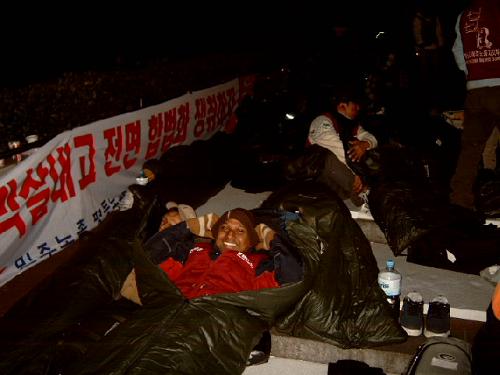
LEGALIZE ALL MIGRANT WORKERS
IN S. KOREA AND EVERYWHERE!
FULL HUMAN AND LABOR RIGHTS
FOR MIGRANT WORKERS!
LET'S FIGHT TOGETHER FOR A WORLD
WITHOUT EXPLOITATION AND OPPRESSION!
"Korean Dream", a.k.a. 코리안 드림
..."Humanity and Equality"...
On 11.19 in Poznan, Poland, hundreds of activists wanted to demonstrate for more tolerance, equality, women rights and against the discrimination of people with "other sexual orientation" (so the call of the organizers).
But instead to enjoy their "right of freedom to express their opinion" (Poland is since last year a part of the E.U.), at first they were attacked by fascist gangs, ideologically backed by the (still/again ruling) catholic church.. And just a short while later they were attacked and cracked down by the cops (at least 68 people were arrested).
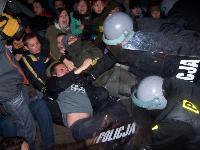
LONG LIFE DEMOCRACY AND FREEDOM
(haha~)

덧글 목록
관리 메뉴
본문
christian: how are you. a friend of mine here in america just surprised me by refering to your name. he used to get info about migrants in kor through your writings at international websites...? and that base21 is never being updated...im going to italy this winter and maybe have a chance to see you, but maybeeeee...부가 정보
관리 메뉴
본문
It was just my job in ETU-MB to inform the "entire" world about our struggle...Actually I would like to be back "home" this winter..
I'm just waiting for the best idea how to find a way back home as soon as possible..
Where are you now exactly? America... North? South? f... USA (shame on you!!^^)?
Actually I don't work for B21 anymore and the colleague who is responsible for the site has to much work (I think..). So he don't find enough time to update the stuff there.
Anyway, I hope to see you again soon!
부가 정보
관리 메뉴
본문
yes i am just right in the valley of the beast. just 5 hours down south from washington, where the monkey performs the war. where in germany are you now? if it is the south, perhaps i could try. i will be in the northeast of italy. i also wish to go back home but its impossible until the summer. do you know taht SAMAR IS GETTING MARRIED IN NEPAL???부가 정보
관리 메뉴
본문
well, i'm in berlin - actually not in the south, not really. what you do in the US? what you want in italy? about samar i dont'n know... it makes happy, to be married? i'm not sure...^^부가 정보
관리 메뉴
본문
im studying anthropology here. migrant labor in korea is my topic. what i want in italy? i am gonig to see my boyfriend whose name is the same as yours. i think i told you about it. hey, berlin is a way too far from italy!!부가 정보