공지사항
-
- '노란봉투'캠페인/국제연대..
- no chr.!
According to the German daily Berliner Zeitung the French govt. is worrying about a huge revolt by the trade unions and student organisations in the coming days..
The British Guardian wrote about the issue following stuff..
Sarkozy suggests labour law 'experiment'
The French interior minister, Nicolas Sarkozy, attempted to distance himself from an unpopular new employment law today by suggesting a six-month trial period for the measure.
The new law, which would allow employers to fire people under 26 without giving a reason, has sparked violent protests and the threat of a national strike.
It has also highlighted divisions between the prime minister, Dominique de Villepin, and Mr Sarkozy, who is expected to run in next year's presidential election.
Mr de Villepin has seen his popularity slump after pushing through the measure, known as the CPE first job contract.
He claims it would help cut youth unemployment, which is currently about 23% and rises to 50% in some poorer parts of Paris.
Opponents have said the contracts, which allow workers to be sacked during a two-year trial period, would create a generation of young workers with no job security.
Demonstrations by students have so far closed 18 universities and partially blocked 41 others. Trade unions have called for a national strike next Tuesday to try to force the government to reconsider.
Mr Sarkozy's remarks, made in an interview with the weekly magazine Paris Match, are being seen by some French commentators as an attempt to distance himself from Mr de Villepin.
"The wise thing would be for all to agree to a six-month experiment" in order to pull the country out of the crisis, he told the magazine.
Mr de Villepin has refused to withdraw the contract, despite the mounting pressure. He is seeking talks with the unions to amend the law but they have refused.
Mr Sarkozy denied rumours that he intended to leave the government. "One doesn't leave the government on an opportunistic decision," he said. "I have solidarity while being different."
Yesterday saw the fourth student-led protest in eight days with at least 5,000 people marching through the Left Bank. Some demonstrators threw bottles at police.
A 39-year-old demonstrator who was caught up in skirmishes with police on Saturday remained in a coma today.
Mr Sarkozy attracted international criticism, but won the backing of many French people, after the Paris riots last year during which called the urban poor a "rabble" and threatened to "clean them off the streets".
http://www.guardian.co.uk/france/story/0,,1737101,00.html


Following article was published yesterday, in the Israeli bourgeois daily Yedioth Achronoth...
MK Tibi: Jewish racism pays off
Arab-Israeli leaders hit back after poll shows strong anti-Arab attitudes among Israeli Jews. MK Tibi: Racism became mainstream in Israel long time ago; MK Barakeh: Poll results direct result of racist government policies
The reality of anti-Arab racism has become mainstream in Israel a long time ago, Knesset Member Ahmed Tibi said Wednesday in response to a poll showing strong anti-Arab attitudes among Israeli Jews.
Among the survey's highlights: Half of Israelis do not want an Arab to visit their homes, while 40 percent believe Israel should encourage Arab emigration.
"Racists have a long time ago moved from the street to government benches," Tibi added. "Every anti-Arab phenomenon is accepted with understanding within Israeli society."
"Overall, it pays to be racist in Israel because you don't pay a price for it and you can always explain it away by a security need and a self-defense mechanism," Tibi said.
Fellow Arab-Israeli Knesset Member Taleb el-Sana also issued a scathing response, saying the poll is a "stain on democracy, moral bankruptcy, and a complete failure by the Israeli education system."
"In my opinion, this shows we're not talking about a few people but rather, a worrying phenomenon that places question marks over the Zionist movement," he added. "The mosquitoes of this racism apparently grew in the swamp of incitement against the Arab public, as well as the occupation and the settlements. This is definite proof occupation corrupts."
El-Sana added that had a similar poll been released in France, Jews would initiate a media frenzy and claim France was anti-Semitic.
"Yet when it happens at their (Jews) own home, they're quiet, and that's why this is a two-fold failure – they are racist, and they're also not attempting to address their own racism," he said.
'The problem – walls between Jews and Arabs'
Hadash Chairman MK Mohammad Barakeh said that the poll findings testify to the depth of racism toward Israeli Arabs.
"This is a direct result of the official racist discrimination policy that has been led by all Israeli governments. This policy was extended in light of the occupation, which created Liebermanism, Kahanism, Olmertism and Netanyahuism," he charged.
Shawki Khatib, chairman of the Israeli-Arab Supreme Monitoring Committee, was not surprised to hear the findings.
"These data stem from the walls existing between the Arab and Jewish populations. For a number of years now I have been warning against these walls and against the de-legitimization of the Arab public and its leaders, in which the media take an active role," he said.
"The discourse and the terminology, the establishment and the separation between the Jews and the Arabs, have added more and more walls, and this is the result. When we say that we want to live together we mean it, but the Jewish public up till now did not want to deal with it," he charged.
Khatib went on to say that "the establishment, the public and the education establishment must take the matter into their own hands. If there is a fascist party running in the elections like that of Avigdor Lieberman and Baruch Marzel, and candidates who have already crowned themselves are sucking up to them, what is left to say?"
"In all the countries of the world no one has sucked up to the fascist parties, something that is being done in Israel today. These are data that should concern all those who rebuke the Arab public and now have to rebuke the population. The one who has to take a look at itself is the Israeli population," he claimed.
The Mossawa Advocacy Center for Arab Citizens of Israel was also not surprised by the findings.
"These data translate to what is happening in practice every day, and we at the Mossawa Center receive reports of these acts of racism on an ongoing basis," said Abir Kopty, the center's media coordinator.
"Whoever thinks that he hates an Arab and that it's okay can hit him and kill him and it will also be okay. These findings are also dangerous for the Jews, who have suffered themselves from racism," she added.
According to Kopty, "racism is unhealthy for any society. Today it's directed against an Arab and tomorrow against anyone else, and that's why every Arab citizen is responsible to fight this racism. This battle is not over the fate of the Arab public, and out of this vision we set up special headquarters to fight racism, made up of Arab and Jewish organizations that are active among various groups. In the next vote, Jewish citizens are responsible for voting against racism. Their vote is part of this struggle."
Sikkuy, the Association for the Advancement of Civic Equality in Israel, also referred to the poll findings, saying that "ever since the October 2000 incidents, racism has reached worrying dimensions."
Meanwhile, National Jewish Front leader Baruch Marzel welcomed the poll results, saying that "the Israeli public sobered up from the illusions of peace and coexistence. More and more people realize today our views are right."
http://www.ynetnews.com/articles/0,7340,L-3231156,00.html
MK... Member of the Knesseth, the Israeli parliament
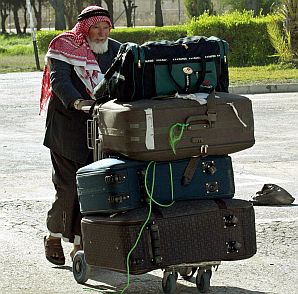
ARABS GO.. Where ever you want.. but leave Israel!
Many peoples in the country are thinking.
The related article Poll: Israeli Jews shun Arabs you can read here
http://www.ynetnews.com/articles/0,7340,L-3231048,00.html
The rightwing Jerusalem Post wrote about the same issue
Survey: 40% favor encouraging Arab emigration
And the so called left liberal Israeli daily Haaretz published following article yesterday
Poll: 68% of Jews would refuse to live in same building as Arab
Interview with Neocon Francis Fukuyama, made by the German magazine Der Spiegel, 3.20
"A Model Democracy Is not Emerging in Iraq"
Francis Fukuyama was a life-long neo-conservative prior to the election of the Bush Administration. The Iraq war led him to change his mind. SPIEGEL ONLINE spoke to Fukuyama about the US handling of Iraq, the moral superiority of America and Europe's dangerous addiction to anti-Americanism.
SPIEGEL ONLINE: Your new book, "America at the Crossroads: Democracy, Power, and the Neoconservative Legacy," is a rejection of the political views you have held throughout your academic career. What happened?
Fukuyama: Iraq happened. The process of distancing myself from neo-conservatism happened four years ago really. I had decided the war wasn't a good idea some time in 2002 as we were approaching the invasion of Iraq.
SPIEGEL ONLINE: Why? After all, one of the neo-conservative pillars is a profound belief in democracy and the spread of democracy.
Fukuyama: I was partly unsure whether the United States could handle the transition to a democratic government in Iraq. But the biggest problem I had was that the people pushing for the intervention lacked self-knowledge about the US. When I look back over the 20th century history of American interventions, particularly those in the Caribbean and Latin America, the consistent problem we've had is being unable to stick it out. Before the Iraq war, it was clear that if we were going to do Iraq properly, we would need a minimum commitment of five to 10 years. It was evident from the beginning that the Bush administration wasn't preparing the American people for that kind of a mission. In fact, it was obvious the Bush people were trying to do Iraq on the cheap. They thought they could get in and out in less than a year.
SPIEGEL ONLINE: Where did this belief come from? Was it naivete, hubris or just plain ignorance?
Fukuyama: A lot of the neo-conservatives drew the wrong lessons from the end of the Cold War and the collapse of communism. They generalized from that event that all totalitarian regimes are basically hollow at the core and if you give them a little push from the outside, they're going to collapse. Prior to the fall of the Berlin Wall, most people thought that communism would be around for a long time. In fact, it disappeared within seven or eight months in 1989. That skewed the thinking about the nature of dictatorships and neo-conservatives made a wrong analogy between Eastern Europe and what would happen in the Middle East.
|
SPIEGEL ONLINE: So it was an invasion based on misinformation and misinterpretation?
Fukuyama: Yes.
SPIEGEL ONLINE: There were, of course, a number of justifications offered by the Bush administration for invading Iraq. Spreading democracy was one element, but so were fear of weapons of mass destruction and fear of terrorism. How much neo-conservatism went into the final decision to invade?
Fukuyama: The invasion of Iraq was not based primarily on the desire to democratize Iraq. The US was sincerely worried about weapons of mass destruction. The Bush administration also asserted a terrorist link -- though I think that was much less honest than the belief in WMDs. The political constitution of the Middle East was the third of three motivations for undertaking the war.
SPIEGEL ONLINE: Now, of course, the original list of justifications for the war has been cut down to one.
Fukuyama: The Bush Administration pulled a bit of a bait and switch because the other rationales -- WMDs and terrorism -- have disappeared. By the time of Bush's second inaugural, the democracy justification was the only one left.
SPIEGEL ONLINE: And that justification isn't selling very well in the United States.
Fukuyama: The polling data indicate that, especially among Republican voters, the democracy project doesn't have much resonance. Obviously, if Bush had gone to the country prior to the war and said we're going to spend however many trillion dollars and thousands of casualties for the sake of democracy in Iraq, he would have been laughed out of the White House.
SPIEGEL ONLINE: A look at the Iraq of today makes that skepticism seem justified.
Fukuyama: Iraq has become a breeding ground for terror. The upside to the war is not very high. We could get a government in Iraq, but it will be relatively weak. There will be a continuing level of violence and continued instability in that area. A model democracy is not going to emerge and set off a further wave of democratization.
SPIEGEL ONLINE: The results of recent democratic or quasi-democratic elections in the region have not been promising. We now have Hamas in the Palestinian Authority, Mahmoud Ahmadinejad in Iran, expanded influence for the Muslim Brotherhood in Egypt and pro-Iran Shiites more or less calling the shots in Iraq. How can anyone argue that democracy is good for security in the region?
Fukuyama: That's a complicated issue. I agree with US Secretary of State Condoleezza Rice when she says it is not possible to hold back the forces of social change by supporting authoritarian regimes. Right now, unfortunately, a lot of the leading voices of social change in the region are Islamist groups. In the long run, their voices are going to be heard no matter what you do. The task is trying to get them to enter a democratic form of political discourse. There is a real danger with Hamas in the Palestinian Authority, for example. But on the other hand, you can't build a lasting peace based on a highly corrupt Fatah group either.
SPIEGEL ONLINE: In other words, the radicalization we are seeing is the first step in a debate?
Fukuyama: It's the first step in a very, very long process. But I do not agree with the Bush administration that this is a necessary phase to win the war on terrorism. If that's the case, we're still going to be fighting this thing 30 odd years down the road. But it is part of a broader pattern of political change that is going to take place in the Middle East and I don't think you can stop it in the end.
SPIEGEL ONLINE: You have written that modernization itself is one of the main factors fuelling worldwide terror. Can the war on terrorism really be won?
Fukuyama: The metaphor "war" is the wrong metaphor. We are engaged basically in a battle for the hearts and minds of people -- a struggle over ideas. It's the struggle between the ideas of a pluralistic, democratic modern society versus theocracy. In the end there's no question which one of these is preferable to live in for Muslims as well as for non-Muslims.
SPIEGEL ONLINE: How is the United States doing in the battle for hearts and minds?
Fukuyama: Not well. The Iraq war was a big setback. The original theory was that if you undercut Saddam Hussein and transition to a very appealing democracy, there would be a big positive effect. But it didn't happen, and instead Iraq has become a recruiting cry for the other side -- it has stimulated a lot of people to join the resistance and to commit themselves to jihad.
SPIEGEL ONLINE: You can't fight for hearts and minds using guns and bombs?
Fukuyama: The metaphor I use for the theory the Bush administration was operating under is that of a broken television set. The picture was flickering on and off. The hope was, if you take a big baseball bat and whack the TV as hard as you can, this would jar something loose and make the television set work. It wasn't more sophisticated than that. The idea was that the shock of overthrowing an Arab dictator and replacing him would stir things up. In certain ways it has. But it's a very, very blunt instrument and the television is as bad as ever.
SPIEGEL ONLINE: During his first term, Bush presented his first strike doctrine that allowed the US to engage in pre-emptive strikes should the need arise. Why did the US think that the world would accept this doctrine?
Fukuyama: We believed we could do this because of our notion that US motives are better than other people's and that we can be trusted with this sort of power. Neo-conservatives argued in 2000 for exactly this form of benevolent hegemony. The question posed was: 'Are other people and countries going to resist and resent this assertion of American power?' Their answer was no. America, they thought, was more moral than other countries and other people would recognize that our hegemony is much more benevolent than other empires of the past. That is something they were wrong about.
SPIEGEL ONLINE: It sounds like you're saying neo-conservatism is a nice theory, but it doesn't work if you put it into practice.
Fukuyama: Even with a more skillful diplomacy, there still would have been big problems. Part of that is a structural problem in the world right now where America is so powerful that it creates a huge amount of resentment. There's a very high background level of anti-Americanism no matter what. The Bush people made it worse by the way they proceeded, but it would have been difficult even in the absence of that.
SPIEGEL ONLINE: With the result that neo-conservatism, whether it was a direct factor in the pre-war thinking or not, has been discredited.
Fukuyama: I would think so at this point. Right.
SPIEGEL ONLINE: The US, too, seems to have been discredited, at least in the eyes of the world. Does the US really not care about global opinion?
Fukuyama: It was almost as though the Bush Administration went out of its way to annoy the rest of the world. The Kyoto Protocol was a good example. The Clinton Administration signed the Kyoto Protocol but Clinton understood that the treaty would never get through the Senate. He just let it sit there instead of trying to get it ratified. Bush could have done the same thing but instead, he went out of his way to pull out of the protocol and he didn't come up with an alternative. Instead of working on a solution, he stuck his thumb in the face of people who really believe that there is a problem.
SPIEGEL ONLINE: And then the Iraq war kicked off a wave of anti-Americanism in Europe. Is that maybe the biggest damage done by the Iraq war?
Fukuyama: The Iraq war, of course, has done a lot of damage in a lot of different areas. It's going to take at least the next generation to restore America to the kind of position it had prior to this in terms of respect and being a model. Now, when we talk about democracy, people think about Abu Ghraib and Guantanamo.
SPIEGEL ONLINE: Much of the international criticism against the US has been justified. But has Europe been too content to sit back and criticize the US while doing little to deal with the hotspots around the world?
Fukuyama: There has been a kind of self-indulgent anti-Americanism on the part of a lot of Europeans. More than most other Americans, I appreciate many of the criticisms that Europeans have made and I think some of them -- especially those of the Bush Administration -- are quite justified. But there is also this revelry in what I think is irrational anti-Americanism -- this idea that America is the source of all the injustice in the world. Americans are responsible for a lot of good outcomes; just look at the Balkans in the 1990s. Europeans should be careful. It feels good to indulge in a lot of this casual anti-Americanism but it's not healthy and it's not just. In the long run it's going to lead to Americans saying, "to hell with Europe."

최근 덧글 목록