공지사항
-
- '노란봉투'캠페인/국제연대..
- no chr.!
Jerusalem Post reported yesterday, 3.18, following..
Hamas announces formation of Cabinet
Palestinian Authority sources said Saturday afternoon that PA Chairman Mahmoud Abbas was considering resigning from his post, dispersing the PA, and returning control of the territories to Israel.
The statement was an apparent last-ditch effort to convince Hamas to adopt a more moderate stance regarding Israel. Abbas was still expected to approve the makeup of the Cabinet, even though he warned Hamas that their failure to adopt a more moderate platform could hurt Palestinian interests, said Nabil Abu Rdeneh, Abbas' spokesman.
Abbas' office related that he would not veto the Cabinet list, however, once the government is formed, he would strongly urge Hamas to soften their platform, particularly regarding what the terrorist group calls "resistance to the occupation," Israel Radio reported. Abbas aides said Friday the Palestinian leader considers the Hamas platform too vague and wants it rewritten.
The comments came shortly after Hamas officials announced Saturday that they had finished assembling the new Palestinian Authority government, two weeks ahead of schedule, and was to present the new government to Abbas on Sunday. Initially, the list was scheduled to be presented to the PA chairman on Saturday, but the Hamas-Abbas meeting was postponed.
Hamas was expected to retain the key portfolios. According to a preliminary list of Cabinet ministers given to The Associated Press by anonymous officials in Hamas and the Popular Front for the Liberation of Palestine, Mahmoud Zahar would most likely be assigned foreign minister. Said Siyam was expected to head the Interior and Civil Affairs Ministries.
Earlier, the group announced that Omar Abd el-Razek, a professor of economics, and a member of Hamas, would be appointed as the Palestinian Authority's new Finance Minister in the new government. Lower-level postings may be assigned to technocrats, officials said
Although other factions have all turned down Hamas' offer to join the new government, Prime Minister Elect Ismail Haniyeh said his movement had "left the door open" for the PFLP to join the Cabinet.
Hamas cannot present its Cabinet to parliament for approval without backing from Abbas, who was elected separately and wields considerable authority. However, Abbas cannot impose his own Cabinet lineup on Hamas, which swept January parliament elections and controls an absolute majority in the legislature.
It appears that for now, having failed to reach a coalition agreement with other parties, Hamas will sit alone in the government.
Hamas leader in exile Khaled Mashaal said in Damascus on Friday that Hamas' primary objective was to "continue the struggle against Israel." According to Mashaal, assuming power in the PA was of secondary importance for the party and would not "distract Hamas from its main goal."
Mashaal also attacked Abbas's Fatah party for working to establish a Palestinian state on only part of what he called "the occupied territories."
Mashaal promised the Palestinian people that the right of return in entirety would be theirs.
Meanwhile, incoming Palestinian prime minister Ismail Haniyeh said in an interview on CBS on Friday that he never instructed anyone to carry out terror attacks against Israel. He also called on Israel to recognize the Palestinian state.
Haniyeh said that he hoped the time would come when a peace agreement would be signed with Israel. He added that he had no "blood on his hands."
Israel Radio reported that Haniyeh was asked what he would do if one of his children decided to become a martyr. "I would not even consider giving him my blessing", the future Palestinian PM exclaimed.
Haniyeh stressed that in order to bring an end to the cycle of violence, Israel needed to recognize the Palestinian state.
Last Friday, Acting Prime Minister Ehud Olmert said that whoever was involved personally and directly in terror is a target for the IDF. "We haven't forgotten that Haniyeh was an aide to Sheikh [Ahmed] Yassin, and that Yassin was targeted because he was involved in terror. So if Haniyeh commits acts of terror, he is opening himself up to the possibility of being targeted. I hope he doesn't."
http://www.jpost.com/servlet/Satellite?cid=1139395623572&pagename=JPost%2FJPArticle%2FShowFull


Also yesterday, according to the French trade unions, nearly 1,5 million protestors took the streets all across France..
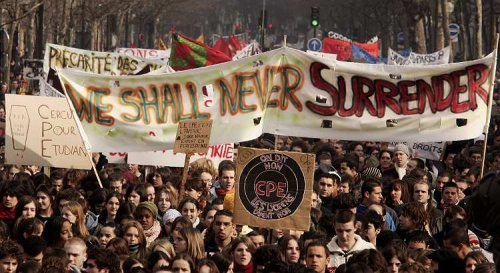
The German magazine Der Spiegel wrote before yesterday following article about the protests..
STUDENTS REVOLT IN FRANCE
Paris Flambé
The student protests in France are getting worse. On Thursday, some 250,000 demonstrators took to the streets with more than 300 arrests made. The student violence is the worst since 1968.
Two weeks into the violent protests, the rage of French students shows no signs of subsiding. How angry are they? So angry that they're even carrying protest banners written in English in the anglophobic Republique. "Villepin: Give Up, in France You Are not the King!" and "We Shall Never Surrender!" The Academie francaise surely won't be pleased, but the banners do help ensure the maximum international media impact.
On Thursday, the violence intensified in Paris, where police reported that 46 security officials were injured -- 11 seriously enough to require hospital treatment. Police arrested more than 300 protestors across the country, including 180 in Paris, French Interior Minister Nicolas Sarkozy reported. Nationwide, hundreds of thousands attended demonstrations.
For several weeks now, students in France have been protesting a new law introduced by Prime Minister Dominique de Villepin that makes it easier for employers to fire young workers under the age of 26 from their first jobs. De Villepin's logic is that companies will be more inclined to hire younger workers if they know they also have the option of laying them off. More than 20 percent of France's 18-25 year olds are jobless, and that figure rises to 50 percent in the Parisian suburbs where rioting broke out last autumn. Though the autumn riots were dominated by immigrant youth, they do share a common theme with the March protests: Whether Muslim, Catholic or Jewish, France's young are desperate for better career prospects. That's the emotion fueling the current protests, which have erupted in violent scenes reminiscent of the student rioting that took place in France in 1968.
In Paris on Thursday night, hundreds attended a rally at the Place de la Sorbonne -- in front of the famous university -- where they set fires and vandalized cars. Protesters also vandalized nearby cafes and burned down a bookstore, filling the area with clouds of smoke. Police sought to break up the violent crowd using tear gas and water cannons and said that right-wing extremists had also infiltrated the demonstrations, running through the streets with face masks and attacking other protesters with sticks.
Violent protests also spread to other cities across France. In the western city of Rennes, organizers said 15,000 people attended a peaceful demonstration. But even there several dozen youth were reported to have set trash cans on fire, vandalized cars and attacked police.
Police estimate that close to 250,000 students took to the streets across France on Thursday, but student groups have put that figure at about 500,000. In Paris alone, police estimated a total of 33,000 protestors; organizers said there were 120,000. In Bordeaux, 25,000 stormed the barricades; 15,000 in Marseille; 12,000 in Lille; 10,000 in Clermont-Ferrand and Angers and 8,000 in Lyon.
At demonstrations planned for Saturday, those numbers are expected to swell dramatically as unions and members of France's leftist parties join the students. On Tuesday, last time the two groups converged, organizers estimated there were a total of 1.1 million protesters.
French officials, though, are showing no signs of budging on the new measure. Prime Minister de Villepin says he is "open to dialogue, in the framework of the law, to improve the first job contract," but he has not indicated he would withdraw the measure. However, French Labor Relations Minister Gerard Larcher told RTL radio that the two-year trial period in the new contracts was not "hard and fast," and employers and unions could still negotiate the exact terms.
On Wednesday, 46 university heads called on students and the government to open a dialogue. And on Friday evening, de Villepin planned to meet with the heads of France's universities in an effort to deescalate what is fast becoming a national crisis. According to student organizations, students are on strike at 66 of France's more than 80 universities.

최근 덧글 목록