공지사항
-
- '노란봉투'캠페인/국제연대..
- no chr.!
The Nepalese bourgeois eKantipur published yesterday following articles
Mass movement aimed at restoring people’s sovereignty: Koirala
Former Prime Minister and Nepali Congress (NC) President Girija Prasad Koirala has said that the present mass movement launched by the seven-party alliance was aimed at restoring the people’s sovereignty in the country.
In a special interview with media persons at his residence in Maharajgunj on Saturday morning, NC President Koirala made it clear that the parties’ mass movement against last year’s Feb.1 royal takeover would be peaceful.
“This time the movement will be different than the previous one,” said Koirala, adding, “Our movement will be peaceful. Wherever the people of this country are, Nepalis from all walks of life are being agitated.”
Hinting at the government’s allegation that the seven-party alliance’s April 6-9 general strike could be infiltrated by the Maoist rebels, Koirala ruled out any such possibility.
“One thing is clear, we won’t jointly move ahead with the Maoists. We will advance our movement in our own peaceful manner,” he said.
Though protests will be organised across the country, Koirala said, the parties’ movement would focus on the capital “since the international community is in the capital and all eyes are on the capital.”
When asked about the 12-point understanding reached with the Maoists, Koirala said, “Several persons have misunderstood this issue. I talked to all-- the Maoists and the international community (on the issue) as per my own basic principles. I have my principle that there should be an end to the autocratic rule, (there should be) peace, full-fledged democracy and an independent, sovereign, progressive and prosperous Nepal.”
He said, “I have told them (Maoists) that I have no trust in your and the King’s guns, because several incidents have happened in the meantime. I have told the Maoists that when I met you (Maoists), you told me that the King offered you joint rule of the country by putting all (leaders of the parties) in jail. Then after differences surfaced between you two (Maoist Chairman Pranchanda and politburo member Baburam Bhattarai), I told Baburam that you accused Prachanda of being pro-palace and Prachanda accused you of being pro-Indian. So I told them how could I trust your guns?”
Koirala added that during his meetings with the Maoist leaders he told them that the third party—the democrats—have their important role when the two gun-wielders (King and Maoists) unite.
He also said that no one could stop the nation from opting for a republican setup if the monarch refused to be ceremonial.
“The seed (of a republic) has already been sown, no one can stop it unless the king changes his behaviour entirely,” Koirala said, adding, “History can be built through that process.”
Asked about the Maoists’ opinion on a “ceremonial king,” Koirala refused to answer. He said, “I don’t want to say everything. If I say everything about our talks (with the Maoists) the thing that is developing positively, will be knocked down. Don’t ask me more about this. I am not speaking whimsically. I am speaking with conviction.”
Koirala, however, said that he was in favour of national reconciliation.
He said, “At the time when B.P (Koirala) and the king reached national reconciliation, there was no third party like the Maoists. As there is a third party now, I aim to make the environment conducive for reconciliation among the three (forces). We should go through the present Constitution even if we move to a constituent assembly.”
Koirala also said that he had not been in contact with the palace for the last 15 months while claiming that royalists over this period had made several “failed attempts” to split the seven-party alliance.
http://www.kantipuronline.com/kolnews.php?&nid=70025
And
Rare show for democracy by SPA, Maoist representatives
In a rare show of unity and solidarity for a 'new Nepal', exiled representatives of Nepal's Seven Party Alliance and the Communist Party of Nepal (Maoist) on Saturday announced simultaneous protest programs in India coinciding with the April 9 showdown in Nepal.
The eight parties' representatives also requested the Indian government, media and the civil society to lend support to Nepal's struggle for a "new democratic republic". By Nepali New Year on April 14, they also hoped that "a new Nepal will emerge with a promising democratic future".
On April 6, they will organize a seminar on Nepal's democratic struggle in New Delhi, which will be followed by a big showdown at Jantarmantar on April 9, or the People's Movement Day. About 50,000 Delhi-based Nepali workers are expected to turn up for that.
Those representing the eight parties today included: pro-Maoist Nepali Janadhikar Surakshya Samiti's Laxman Pant, pro-CPN-UML Pravashi Nepali Sangh's chief advisor Chhabilal Biswokarma and functionary Ramlal Kafle, Janamorch Representative Iswori Bhattarai and Nepali Congress (Loktantra newsletter) representatives Shailesh Acharya and Dinesh Prasain.
Conspicuously, Delhi based SPA negotiators Bam Dev Gautam, Jhalanath Khanal, Mahantha Thakur -- who until last week were hopeful about an "eight party joint statement around April 9", but now understandably frustrated because of "deepening differences with the SPA itself" -- were absent.
http://www.kantipuronline.com/kolnews.php?&nid=70024
But unfortunately there are no real independent informations about the current situation and developments there..
But try it with
http://www.cpnuml.org/newsticker.html
and


ANOTHER STEP FORWARD TO A REAL DICTATORSHIP..
IHT reported yesterday, 4.1 following
Philippine press comes under official heat
The Philippine press, one of the most vigorous and free-wheeling in Asia, is coming under serious government pressure for the first time since the martial law government of Ferdinand Marcos more than 20 years ago.
Along with hints that the authorities might restrict public assembly, the campaign against the press strikes at the heart of the freedoms that were won in 1986 when Marcos was driven from the presidency by a popular uprising.
It is an insidious form of pressure that involves warnings, watch lists, surveillance, court cases, harassment lawsuits and threats of arrest on charges of sedition.
No one from the press has yet been arrested, although three journalists from The Tribune, a daily newspaper, have been charged with rebellion. No news outlets have been shut down, although troops surrounded television stations for several days.
Journalists say the situation is all the more unnerving because of the uncertainty of what is happening or may happen to them.
"I have a number of people on my list," Justice Secretary Raul Gonzalez said in a recent television interview. "We are studying them."
This aggressive posture follows a one-week state of emergency imposed Feb. 24 by President Gloria Macapagal Arroyo in response to what she said was a coup attempt involving an array of people who have been calling for her resignation.
Since then, the police have broken up several gatherings that were seen as critical of the president and have briefly detained some participants.
The gatherings included an annual celebration of International Women's Day on March 8, in which a congresswoman who opposes Arroyo was forcibly detained "to get her out of harm's way."
They also included a mock beauty pageant in which each contestant was to be made up with a mole on her face in imitation of Arroyo.
There also was something else that seemed like a joke - small weekly protest gatherings that at first amounted to buying a cup of coffee at Starbucks.
The protesters got away with that one, but on March 19, the same group was dispersed by the police as its members walked through a park wearing T-shirts reading, "Out Now" in an evident reference to the president.
Officials have spoken of "intelligence" they had received about planned gatherings in the same manner they have talked about monitoring reporters.
Government statements about the press have played on the intimidation caused by uncertainty.
"The press is not a target of censorship," said the president's press secretary, Ignacio Bunye, "but some members of the press have been charged with violations of law and shall be prosecuted just like any ordinary citizen."
The director of the National Police, General Arturo Lomibao, has told the press it must conform to certain standards, but unspecified ones, subject to government interpretation on a case-by-case basis.
He referred to a new catch-all regulation that bans "actions that hurt the Philippine state by obstructing governance including hindering the growth of the economy and sabotaging the people's confidence in government and their faith in the future of this country."
The apparent goal of all this is self-censorship, said Maria Ressa, senior vice president for news and public affairs at the ABS-CBN broadcasting network.
"It's crazy," she said. "You don't know what's happening, but you feel they can move on you at any time."
Ressa has been a leader in demanding clarification of the government's policies toward the press and in filing a class-action lawsuit to bar prior restraint.
"There is definitely fear and uncertainty," she said.
"When government officials say, 'We have the power to shut you down, we have the power to look at your content,' it's intimidation."
Some news organizations have prepared for possible searches or arrests by backing up computer files, setting aside bail money and instructing their staffs on their legal rights if the police enter their offices.
Some journalists have noted that the president's executive secretary, Eduardo Ermita, is experienced in censorship and press manipulation, having served at the top of the Department of Public Information under Marcos.
If the current restrictions are pointing the way toward de facto martial law, as some critics suggest, Ermita said, it is a "smiling" or "laughing" martial law.
The government has chosen in its threatening statements to single out the Philippine Center for Investigative Journalism, a small, aggressive group of journalists headed by Sheila Coronel, a prominent figure in Southeast Asian press associations.
The center's exposés of corruption, presented during congressional impeachment hearings, were instrumental in bringing down Arroyo's predecessor, Joseph Estrada.
Government officials have said they might charge Coronel and members of her staff with sedition, but the evidence they cite is strangely lackadaisical.
Their only references are to an audiotape posted on the center's Web site in which Arroyo apparently consults with an election official about rigging the presidential vote in 2004.
But as Coronel pointed out in a statement, portions of the tape have been played on radio and television and are posted on a dozen other Web sites and blogs. A version was even played for the press by Bunye, the press secretary.
"It's very insidious," Coronel said. "They say they are studying filing sedition charges. They say they have lists, but they don't say who is on them. This is not how the game should be played. We know our rights, and we should not be harassed by psychological pressure."
Coronel was one of a group of young female reporters who became well known for defying Marcos in the early 1980s when journalists were being harassed and arrested.
The press freedom that is now under threat is something she struggled for herself.
"People went to prison, people died for this freedom," Coronel said, "and if you give it up, it is a betrayal of all the sacrifices that people have made in the past, people I know personally. It really makes me mad."
http://www.iht.com/articles/2006/03/31/news/manila.php
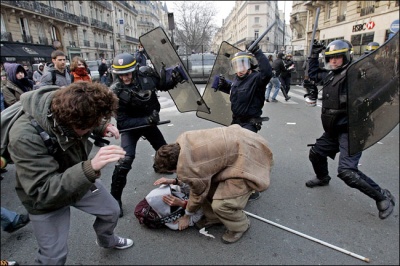
The police have so far acted with relative restraint, IHT wrotes...
IHT was asking in its yesterdays edition..
What's next for the protesters?
The French government's decision not to rescind its disputed labor law risks radicalizing the protest movement and plunging France into a new, more dangerous phase of disturbances, students, labor unionists, opposition politicians and sociologists warned Friday.
With labor unions planning another day of nationwide strikes and demonstrations Tuesday, unauthorized protests by students have already begun multiplying across the country - a clear change of tactics from traditional demonstrations and strikes, which are planned with police authorization.
For a second day Friday, decentralized groups of protesters disrupted traffic and invaded public buildings in Paris and other cities, prompting the riot police to intervene.
"They have opened a Pandora's box," said François Dubet, a prominent sociologist. "The decision of the government is an extremely dangerous one."
Student leaders called on students throughout the country Friday to rally in the main squares of their cities before a televised address to the nation by President Jacques Chirac.
At the Place de la Bastille in Paris on Friday evening, thousands of students crowded around a set of loudspeakers to listen to Chirac's speech. They greeted his announcement that he would enact the law with cries of "Resign, Chirac! Resign."
"In my opinion, things are going to explode, and it's going to hurt," said Jeanne Enaut, a 22-year-old economics student at the rally.
Before the Bastille rally, the police blocked exits from the Métro, apparently to prevent people who were arriving via the underground train from gathering there. Early in the day, riot police officers broke up an attempted sit-in at the square. Métro exits were also blocked at the Concorde and Champs-Élysées- Clémenceau stations, near the presidential palace where Chirac lives, because of student actions above ground, a police officer said.
Elsewhere, students blocked train tracks in Libourne, in the southwest, and invaded a post office in Montpellier, in the south. In the Mediterranean city of Marseille, two youths were injured when a motorist forced his way through a blockade across a road to a school campus, French news organizations reported. Incidents were reported in many other cities across the country.
High school students, who were less represented in the movement initially, have now joined the protests in droves. Karl Stoeckel, the head of the UNL, the national union of high school students, said Friday that he expected unauthorized protests to continue through the weekend, with youths occupying train stations, roadways and public buildings.
"Demonstrations and strikes didn't do the job, so we need to diversify our ways of protesting," he said.
Even students at the Lycée Victor Hugo in Paris's wealthy Marais neighborhood walked out Friday to protest the youth employment law. As Chirac prepared to enact the legislation, hundreds of Victor Hugo students gathered at the nearby Place des Vosges, one of Paris's most venerable squares, with banners and drums.
"Enough is enough," said Ulysse Mathieu, 16. "In the beginning only a few of us actually joined the protests. But now most students are mobilized. The government is really asking for it."
Zoë Miniconi, 16, predicted that the movement would grow - and grow more radical. "This could blow up in their faces, just like the suburbs last year," she said, referring to three weeks of rioting in immigrant suburbs across France last November.
Dubet, who is research director at Paris's School for Higher Studies in the Social Sciences, and other political scientists warned that Chirac's decision to enact the law could widen the gulf between moderate students and a radical fringe of youths willing to use violence to make themselves heard.
If the movement becomes more radical and clashes with the police turn more violent, the protests risk drawing in youths from immigrant neighborhoods who were at the center of three weeks of rioting last autumn, the analysts said. Some youths from the poorer suburbs ringing Paris have joined the protests already, but those numbers could swell, the experts said.
Finally, they warned, if youths resort to the kind of violence that has broken out in some areas during the protests - smashing storefronts, battering cars and setting them on fire, attacking the police - labor unions that have acted as a moderating force on the young people could distance themselves from the movement for fear of alienating their members. This could amplify the radicalization.
"So far we have been in a phase of protest that in general was less explosive because there has been a strong coalition between unions and students," Dubet said. "If divisions emerge, it would create a very high risk of violence, chaos and police violence."
François Hollande, leader of the opposition Socialist Party, warned Friday that by signing the law Chirac would be "opening a major crisis."
For the moment, labor unions are planning to step up their resistance to the law. At the headquarters of the powerful CGT union, a spokeswoman said that France's five main unions would decide in coming days what "new forms of protest" would be pursued next week.
The unions and student organizations are hoping that strikes next Tuesday will exceed the mass protests of the past week, which brought more than one million demonstrators into the streets.
The police have so far acted with relative restraint, although students say tensions are increasing.
Anna Mélin, 22, a law student in the southern city of Toulouse, where students occupied a post office Friday, said the riot police had reacted "very aggressively" when she and others occupied a local government building, hitting students with their batons and arresting scores of them.
http://www.iht.com/articles/2006/03/31/news/paris.php

최근 덧글 목록