공지사항
-
- '노란봉투'캠페인/국제연대..
- no chr.!
4개의 게시물을 찾았습니다.
Yesterdays IHT wrote this..
France prepares again for a day of strikes
France prepared for another week of protests and a nationwide strike on Tuesday after student organizations and labor unions rejected a compromise offer by President Jacques Chirac on the government's new youth employment law.
Chirac formally enacted the legislation on Sunday and sought at the same time to defuse a political crisis by calling on lawmakers to soften two of the law's most contested provisions: a probation period of two years and the right of employers to fire workers with no justification during that period.
On the face of it, Chirac's decision to sign the measure was a face-saving effort for the embattled Prime Minister Dominique de Villepin, who had almost single-handedly championed the measures.
But by leaving changes in the hands of the governing Union for a Popular Movement party, or UMP, the president effectively bolstered Interior Minister Nicolas Sarkozy, Villepin's main rival on the right, who also is head of the UMP.
"We now have a clear sense that we are no longer dealing with the prime minister but with the UMP lawmakers, and their leader is Nicolas Sarkozy," François Chérèque, head of the CFDT, France's second largest union, said in a radio interview over the weekend.
But critics of the law appeared more determined than ever to bring it down, with or without modifications.
"The declarations by the president will boost the mobilization" on Tuesday, said Jean-Claude Mailly, leader of the labor union Force Ouvrière. "I have made a list of all strike notices. It will be a big day."
Like last week, when strikes were organized across much of the country and hundreds of thousands of people poured into the streets of Paris alone, public transportation is expected to be significantly affected Tuesday. Both the national rail company, the SNCF, and the Paris transportation system, the RATP, predicted disruptions, while walkouts also were planned by employees at Air France.
Six of seven civil service unions said they backed the strike and, in a sign that the protests this week may surpass those last week, workers in media, banking and telecommunications said they would join the effort.
In addition, the opposition Socialist Party made a formal call for the first time to join the strikes. On Sunday members were at the Richard Lenoir market in Paris, near the Bastille monument, distributing fliers stating: "Now more than ever: Withdraw the CPE," the French acronym for the labor measure.
Meanwhile, a new opinion survey by the CSA institute, published Sunday in Le Parisien newspaper, indicated that 62 percent of France's citizens found Chirac's offer unconvincing. Two out of three said they thought the student movement had been strengthened, and three out of four thought that Villepin, the architect of the law, had been weakened.
The president's double-barreled approach of enacting the legislation while calling for changes has left the country in a legal limbo: Companies have the right to employ new staff members under the new youth contract in its current form, even though the president has asked them not to do so until the changes have gone through Parliament.
In a televised address Friday night, which was watched by more than 20 million people, Chirac asked that lawmakers halve the current probation period to one year and oblige employers to justify any decision to dismiss a young employee.
Laurence Parisot, head of the Medef, France's biggest employer federation, said on Europe 1 radio over the weekend that she hoped companies would not use the new contract before it was revised.
Jack Lang, one of many potential Socialist presidential candidates, was quoted in Le Parisian on Sunday as saying, "Legally speaking, it's incomprehensible to sign a law and say that you should not apply it."
And in a front-page editorial in the newspaper Le Monde, its publisher Jean-Marie Colombani described Chirac's request as a nondecision that leaves the country adrift: "He did not come down on either side. He was content to evade the issue."
The leader of the UMP in the lower house of Parliament, Bernard Accoyer, said he would try to meet union leaders to discuss changes in the law as early as Tuesday. He said that, at the earliest, a new bill could be expected in early May.
Sporadic protests against the legislation continued through the weekend, although the police said the country was relatively calm compared with the heated end of the week. About 1,500 demonstrators assembled in Paris, while 300 people organized a counterdemonstration nearby. Students, who late last week embarked on a series of wildcat protests, pledged similar actions in the days ahead.
http://www.iht.com/articles/2006/04/03/news/france.php
................................................................................
To follow today the latest developments there, please check out
English language coverage of the young workers’ revolt in France


While the National General Strike in Nepal, starting on Thursday, organized by the Seven Parties Alliance, together with the CPN.M is coming closer, eKantipur published following article
Maoists halt "military actions" in Kathmandu Valley
The Maoist rebels have brought to a halt all kinds “military actions” in the Kathmandu Valley with effect from Monday evening.
Issuing a statement this afternoon, Chairman of the Communist Party of Nepal-Maoist (CPN-M), Prachanda alias Pushpa Kamal Dahal, said his party had decided to “halt all kinds of military actions in the Kathmandu Valley until the next statement from the party.”
The Maoist declaration comes three days ahead of the seven-party alliance’s (SPA) April 6-9 nationwide general strike and a major showdown in Kathmandu on April 8.
In the statement Prachanda has made it clear that his party had taken this decision “keeping in view the requests made by the seven parties and civil society groups and also to expose the claims by the royal government that the Maoists were planning to infiltrate the protest programmes organized by the SPA.
“To expose the conspiracy of the autocratic feudal group to instill military terror on the capital-focussed peaceful showdown under the pretext of infiltration by the People’s Liberation Army, to create an easy environment for the general public to move forward with the peaceful movement with determination, and taking seriously the requests made by the seven political parties and the civil society,” the statement reads, “all military actions in the Kathmandu Valley have been suspended until the next statement from the party.”
The statement, however, reiterates the Maoists’ active support to SPA’s peaceful protest programmes and has appealed to the people of all levels “to come out on the streets to create a new history of a Loktantrik Nepal.”
Govt orders employees not to attend parties’ programmes
The warning came in a letter sent to all the ministries and constitutional bodies by the Office of the Council of Ministers.
Yesterday, Chief Secretary Lok Man Singh Karki had said that the government would immediately take action against employees who participate in the SPA’s movement.
Parties welcome Maoist moveMeanwhile, talking to eKantipur over the phone, Nepali Congress Spokesperson Krishna Prasad Sitaula welcomed the Maoists’ announcement.
“The step taken by the Maoists in view of the peaceful demonstrations in Kathmandu is a welcome move,” said Sitaula, adding that it would help make the alliance’s programme peaceful.
Welcoming the Maoists’ declaration on a light note, UML Standing Committee member K.P. Sharma Oli urged the Maoist leadership to declare a truce nationwide.
“The valley-centred ceasefire is not satisfactory in the sense that it cannot make a positive contribution to restore peace in the country. The ceasefire should be made nationwide to make it a complete success,” he said.
Minendra Rijal, spokesperson of the Nepali Congress-Democratic said the Maoists have made an encouraging move.
He, however, said a nationwide ceasefire would be more effective to make the environment conducive for the alliance's peaceful movement. He said, “I hope the Maoists will think about it in the days ahead.”
Earlier this week, Home Minister Kamal Thapa claimed that the government will foil the upcoming parties’ four-day nationwide general strike, “at any cost”.
The Minister also reiterated that the government would “treat the seven-party alliance like the Maoists as the pre-planned programmes are that of the rebels.”
The government also issued a statement urging the public to defer visits to Kathmandu except in urgent cases saying that the measure was part of its strict security arrangement aimed at controlling "terrorist activities".
http://www.kantipuronline.com/kolnews.php?&nid=70203
..from the Israeli point of view
Yesterdays Isreali bourgeois daily Yedioth Achronoth published following article
Corrupt kleptocracy vs. tyrannical theocracy
It is time to re-think the conventional wisdom about the Israeli-Palestinian conflict
A central tenet of prevailing conventional wisdom regarding the Arab-Israeli conflict is that the establishment of an independent Palestinian state on the territory that came under Israeli administration in 1967 – the West Bank (Judea and Samaria) and Gaza - is a sine qua non for a resolution of a seemingly intractable dispute.
Indeed this position is so widely held that it has become almost an "article of faith" in international circles - and woe betide anyone with the temerity to question its validity. In fact, one of the remarkable aspects of this belief is that appears totally immune to the ravages of empirical fact and historical experience.
While it is reasonably understandable why this view has taken root in the Arab and Muslim world, it is far more puzzling why this should be the case among those who purport to be liberal intellectuals. For there is an accumulating body of evidence to suggest that the establishment of a Palestinian state, under any foreseeable future leadership, is likely to have the perverse consequence of promoting values that are diametrically opposed to those to which its liberal intellectual proponents allegedly subscribe… and which, curiously enough, they invoke to justify their support for such a state.
Little reason for hope
There is, of course, little reason to believe that a nascent Palestinian state will blossom into a political entity significantly different from all the other Arab states in the region, where accepted parameters of liberal democracy such as the freedom of the press, individual liberties, due process, the equitable dispensation of justice and the rule of law, and the status of women are hardly the distinguishing hallmarks of the incumbent regimes.
And although the Palestinians indeed managed to conduct a reasonably orderly election (albeit in large measure under Israeli auspices and which brought Hamas to power), the first decade of self-rule has often been characterized by persecution of journalists, harassment of the press, arbitrary arrests, mob lynchings (by Palestinians of Palestinians), and a high rate of "honor killings" of Palestinian women by their male kinfolk.
With the election of Hamas, it is doubtful, to say the least, that matters will improve. Indeed, quite the reverse is likely to be true. Thus, it is puzzling why those who profess support for the tenets of liberal democracy should push for the establishment of an entity in which such anti-liberal features are likely to flourish.
Intellectual honesty
This conundrum needs to be addressed seriously, for it seems highly anomalous that the notion of statehood should be given such overriding sway that it outweighs all other considerations – including those of the personal welfare and quality of life of individual Palestinians who have been left languishing in misery while a failed and fraudulent leadership has lead, or rather mislead, them deeper and deeper into an endless saga of tragedy.
Surely then, at some point, the international community should pause and reassess the moral validity and the practical viability of the Palestinian statehood issue. In many respects it is becoming increasing difficult to defend the moral merit and the political prudence of the entire endeavor.
The enduring inability of the Palestinians to succeed in establishing the apparatus of a state for themselves is a matter that its proponents – in the interest of intellectual integrity - must address. For only the dogmatic, the doctrinaire, and the demagogic can overlook the irksome question of why the Palestinians have failed so resoundingly and consistently to achieve statehood when so many other national movements with far less moral and material support have succeeded in far more daunting conditions – even against mighty empires rather than a micro-state like Israel.
Unprecedented support
Of course, some will protest that it is misleading to characterize Israel in this manner and point out that it has enjoyed strong superpower support of the US. True enough.
But it should also be remembered that for almost four decades, the Palestinians, too, had had even more unmitigated support from a superpower, the USSR, plus that of China and of India, the whole "non-aligned" bloc of nations, and the entire Muslim world. To this one might add the strong endorsement of major international institutions such as the U.N., and highly favorable coverage of nearly all the leading media channels together with strong sources of sympathy within the U.S. administration, particularly the Arabists down at "Foggy Bottom".
So a lack of international political backing certainly cannot account for the poor Palestinian performance. Neither can the lack of international economic support - for in the period between the signing of the Oslo Accords in the early 90's and the outbreak of the Palestinian "intifada" late in 2000, the Palestinians the highest per capita recipients of international aid in world.
Yet in spite of these very favorable conditions – certainly far more benign than those experienced by almost any other movement of national freedom since WWII - the Palestinians have not managed to produce any semblance of a stable productive society. Indeed, quite the opposite is true.
Almost a decade-and-a-half has passed since the benevolent Oslo Accords were virtually thrust upon the Palestinians by an unprecedented accommodative Israeli administration which, to a large degree, not only recognized their claims for self determination, but actually identified with them.
Yet in this period the Palestinian leadership used the Oslo process to create a repressive and regressive interim regime that provided little, but successfully managed to pillage the Palestinian people. Indeed the Palestinian Authority has perhaps the unique, if dubious, distinction of attaining "failed state" status even before it was established.
Kleptocracy or theocracy
It is highly doubtful that the radical Islamists who have now assumed power will be able to remedy this condition. Almost half a century after the establishment of their "national liberation" movement, the Palestinian leadership has provided its people with a harsh choice between two distinctly unpalatable alternatives: the corrupt kleptocracy of the former regime or tyrannical theocracy of the present one.
In light of these grim and grisly facts, it seems only proper that the international community pause to reflect on the feasibility and desirability of persisting with the idea of a Palestinian state as if it were an axiomatic inevitability. This should be especially true for those who have a genuine concern for the humanitarian plight of the Palestinian people.
Other possibilities
It seems not only proper, but pressing, that the international community begin to seriously consider scenarios for the resolution of the Middle East conflict that do not include the creation of a Palestinian state. Such alternative paradigms should focus on attempting to alleviate genuine humanitarian suffering rather than endeavoring to implement spurious political enterprises.
While the details of such alternatives are beyond the scope of this article, one alarming point should, in closing , be emphasized: Unless there is a paradigmatic shift in the thinking applied to the Palestinian predicament, the recent events in the Palestinian administered territories – particularly the widespread lawlessness and factional gunfights – suggest that the Palestinian people may soon be forced to face a third alternative even more uninviting than the previous two – that is the prospect of a descent into chronic chaos and anarchy.
Dr. Martin Sherman is a political scientist at Tel Aviv University
http://www.ynetnews.com/articles/0,7340,L-3235672,00.html
.....................................................................................
Btw.., if you want to fight your enemy you have to study him, or her... W.I. Lenin
.....................................................................................
PS.. Latest news and articles
IDF kills Palestinian boy in clashes north of Jerusalem
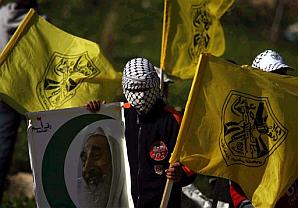
Fatah activist makes propaganda for Hamas+Fatah
The German bourgeois magazine Der Spiegel published some days ago following article..
Player Silences German Racists With Hitler Salute
Mired in betting scandals, riven by infighting and alarmed by recent poor performances on the pitch, German soccer needs anything but more controversy in the few months remaining before it hosts the World Cup. But some recent cases of blatant racism are doing further damage to its image.
It started with a Hitler salute. Two eastern German soccer teams in the fourth division, FC Sachsen Leipzig and Hallesche FC, had just drawn 2-2 on March 25 in Halle, and the fans weren't happy.
Leipzig's Nigerian midfielder Adebowale Ogungbure was walking off the pitch when hooligans ran up to him, spat at him and called him "Dirty Nigger," "Shit Nigger" and "Ape." He ignored it and walked on. Then, when he passed the main stand and heard fans making whooping monkey noises at him, he decided he'd had enough. He put two fingers above his mouth to symbolise a Hitler moustache and stuck out his right arm in a Nazi salute to the crowd.
Given their behavior, one might think they would have appreciated the gesture and even returned it. But a Halle supporter attacked him from behind with a corner flag and another grabbed him in a stranglehold. Ogungbure pushed them away as a teammate intervened and dragged him towards the tunnel, to the safety of the changing rooms.
"I was just so angry, I didn't care. I could have been killed but I had to do something," Ogungbure told SPIEGEL ONLINE last week. "I thought to myself, what can I do to get them as angry as they have made me? Then when I lifted my arm I saw the anger in their faces and I started to laugh."
"I've faced some sort of racist abuse at about half the matches I've played," he said, but the spitting was too much on March 25. "I've never seen anyone spit at a dog or a cat in Germany -- why should I be spat at?"
The story took a grotesque turn when Ogungbure was charged with "unconstitutional behavior" for making the Hitler salute, which is illegal in Germany. The public prosecutor's office wisely dropped proceedings within 24 hours. But the incident made nationwide headlines and spurred a flurry of reports suggesting racist abuse is rife in the lower leagues where crowds are smaller and fewer police are present.
Rolf Heller, president of FC Sachsen Leipzig, played down the incident and said it was an isolated case. "This has nothing whatsoever to do with right wing extremism, it is just misguided fervor on the part of the fans," he said. Ogungbure said he informed Heller long ago about the hostility he faces. His answer: "They only want to wind you up."
FIFA toughens penalties
The case came to the attention of the governing body of world football, FIFA, which recently implemented tougher penalties for clubs whose fans engage in racist behavior. Possible sanctions now include match suspensions, the deduction of points, relegation or elimination from competitions.
The new rules were introduced in response to recent acts of racism in the top Spanish and Italian leagues but FIFA Secretary-General Urs Linsi told German newspaper Tagesspiegel last week: "We will of course also make sure that something like this is punished in Germany's fourth division as well."
So clubs had better start getting their act together, because greeting black players with ape noises and riling against foreigners is a frequent occurrence, especially, it appears, at matches involving teams from eastern Germany where unemployment is high and support for far-right parties has been strongest in recent years.
Last weekend at a second division match between Hamburg St. Pauli and eastern club Chemnitz FC, visiting Chemnitz fans stormed Turkish-owned stores chanting "Sieg Heil" and waving imitation Nazi flags. Some shouted: "We're going to build a subway from St Pauli to Ausschwitz."
Such behavior is bad enough at any time, but especially damaging now with Germany trying to project a cosmopolitan image under a World Cup slogan: "A Time to Make Friends."
Neo-Nazis plan to spoil World Cup
German officials last week admitted the far right may try to capitalize on the month-long World Cup, which starts July 9. Interior Minister Wolfgang Schäuble said neo-Nazi groups were planning to use the tournament to raise their profile.
|
|
|
|
The far-right NPD party and other neo-Nazi groups apparently want to stage a "freedom of speech" march in Gelsenkirchen, in the Ruhr Valley, and further demonstrations in Leipzig, Berlin, and Nuremberg, to show solidarity with Iranian President Mahmoud Ahmadinejad, who has openly denied the Holocaust and suggested that Israel should be "wiped off the map."
The NPD is also already actively fomenting soccer xenophobia by offering a World Cup match fixtures guide that calls for Germany to field only white-skinned players.
The list is headlined "WHITE -- not just a soccer shirt color -- for a real NATIONAL team." It has a picture of a player bearing the number 25 -- the number used by national team player Patrick Owomoyela, who has a Nigerian father.
........................
The 2006 Soccer World Cup is staying under the motto THE WORLD TO GUEST IN GERMANY... harrharr

최근 덧글 목록