
공지사항
-
- '노란봉투'캠페인/국제연대..
- no chr.!

North Korea test- fires 7th missile (IHT/NYT)
North Korea test-fired at least six missiles over the Sea of Japan on Wednesday morning, including an intercontinental ballistic missile that apparently failed or was aborted 42 seconds after it was launched, White House and Pentagon officials said.
Later Wednesday, North Korea launched a seventh missile amid international outrage that had erupted over the first missile test, the Associated Press reported, citing an official at the South Korea Joint Chiefs of Staff. The launchings came in defiance of warnings from President Bush and the governments of Japan, South Korea and China. Of the launchings, intelligence officials focused most of their attention on the intercontinental missile, called the Taepodong 2, which American spy satellites have been watching on a remote launching pad for more than a month. It is designed to be capable of reaching Alaska, and perhaps the West Coast of the United States, but American officials who tracked its launching said it fell into the Sea of Japan before its first stage burned out. "The Taepodong obviously was a failure - that tells you something about capabilities," Stephen Hadley, President Bush's national security adviser, told reporters in a phone call on Tuesday evening in Washington. But other officials warned that even a failed launching was of some use to the North Koreans, because it will help them diagnose what went wrong with the liquid-fueled rocket. The missiles have been the source of considerable diplomatic tension in recent weeks, because of North Korea's declarations that it already possesses nuclear weapons. American intelligence agencies have told President Bush they believe that North Korea has the fuel for such weapons. However, the country is not believed to have developed a warhead small enough to fit atop one of its missiles, and it has never conducted a nuclear test, to the knowledge of American officials. The other missiles that the North fired Wednesday morning appeared to be a mix of short-range Scud-C missiles and intermediate-range Rodong missiles, of the kind that the North has sold to Iran, Pakistan and other nations. Those missiles also landed in the Sea of Japan. None of the launchings were announced in advance. But the first came just minutes after the space shuttle Discovery lifted off in Florida - an event the North Koreans could monitor on television. Administration officials said they could only speculate as to whether the missile launching had been timed to coincide with the shuttle launching, or with Independence Day, but outside analysts had little doubt. "It's very in your face to do it on the Fourth of July," said Ashton Carter, a Harvard professor who, with former defense secretary William Perry, had urged the Bush administration to destroy the Taepodong missile on the launching pad, advice the administration rejected."Hooray if it failed," Carter said. While the test itself was a sign of North Korea's defiance of the United States, for the administration, the outcome was as favorable as officials could have hoped for: the North's capacity was called into question, and the North's enigmatic leader, Kim Jong Il, has now put himself at odds with the two countries that have provided him aid, China and South Korea. "Our hope is that the Chinese are going to be furious," said one senior American official, who declined to be identified. Another official noted that only days ago, the Chinese indicated that they were trying to put together an "informal" meeting of the long-dormant six-party talks on North Korea's nuclear program. The North has boycotted the talks since September, citing American efforts to close down the banks it uses overseas. But North Korea had apparently not responded to the Chinese invitation, and American officials said last week that the Chinese would not have made that gesture if they believed that they were about to be embarrassed by the country that they once considered a close ally. The launching also makes it difficult for the South Koreans to continue their policy of providing aid and investment to the North, a program that has caused deep rifts with Washington. Administration officials said that Christopher Hill, the assistant secretary of state for East Asia and the main negotiator with North Korea, would leave for Asia on Wednesday, and that they expected him to use the launchings to try to bring South Korea and China into the fold on imposing some kind of sanctions. At the same time, the launching is likely to strengthen the hand of hard-liners in the Bush administration who have long argued that the six-party talks were bound to fail. They now have what one American diplomat called "a clear runway" to press for a gradually escalating series of sanctions, which some officials clearly hope will bring down Kim's government. But it is far from clear that China - which provides the North with its oil and much of its food - would go along with any move for sanctions. As one central figure in American policymaking told visiting Asian officials late last month, "the Chinese are very worried about collapse," and likely would try to prevent that form happening. The firing ended weeks of speculation about the intentions of Pyongyang, which had rolled out the Taepodong 2, its new long-range missile, in full view of American spy satellites, and came despite severe warnings from the United States and countries in this region that a test would entail further isolation and sanctions. The first missile was fired around 3:30 a.m. Wednesday, according to the Japanese government. American officials said they believe the Taepodong 2 was the third missile fired, with the U.S. Northern Command saying that it was launched at 5 a.m. on Wednesday. American and Japanese officials immediately condemned the launchings Wednesday morning. But American officials had never considered it a serious threat to the United States, especially because there was no evidence the missile was equipped with a warhead. Bush's spokesman, Tony Snow, only went so far as to call the launching "provocative behavior." The Japanese government said it would take "severe actions" against the North, possibly including economic sanctions. Those could include shutting down the ferry service to North Korea and attempting to stem the flow of the transfer of cash to the North from Koreans in Japan, though officials acknowledge that would be difficult. At the United Nations, John Bolton, the United States ambassador, was "urgently consulting" with other members of the Security Council to try to schedule a meeting of the panel, according to his spokesman, Richard Grenell. Later in the evening, it was announced that the Council would meet to take up the matter at 10 a.m. Wednesday at the request of Japan. Hadley acknowledged that "what we really don't have a fix on is, you know, what's the intention of all this, what is the purpose of all this? " He noted it was a violation of North Korea's previous pledges to hold to a moratorium on missile tests. He said one possibility was that the North was attempting to seize the spotlight from Iran, whose efforts to develop its nuclear program - which is years behind North Korea's nuclear abilities - had grabbed all the headlines. But he noted that "it's hard to get a sense on what they think is to be achieved by this." It was also unclear why it fired short- and mid-range missiles, which it has tested successfully in the past and of which it is said to own several hundred. "One theory is that they knew that there was a probability that things with the Taepodong 2 wouldn't work, so it was good to fire off a few missiles that would actually work," said a senior Bush administration official, who asked that his name not be used because he was not authorized to speak about this issue. In 1998, the last time the North tested a missile outside its territory, Pyongyang fired the Taepodong 1, which flew over Japan before falling into the sea. That test set off a negative reaction in the region, especially in Japan, which responded by strengthening its military capabilities and its alliance with the United States. Wednesday morning's tests are likely to increase calls inside Japan to strengthen its missile defense efforts with the United States, and could increase support for hawkish candidates in the race to succeed Prime Minister Junichiro Koizumi, who is scheduled to retire in September. Shinzo Abe, Japan's chief cabinet secretary, who is the leading candidate to succeed Mr. Koizumi and who has gained popularity in recent years by being tough on North Korea and China, said the tests were "a serious problem from the standpoint of our national security, peace and stability of the international community and proliferation of weapons of mass destruction." The tests are sure to anger China - which expended considerable diplomatic prestige in pressing the North not to go ahead with the launching and to rejoin the six-nation talks - and raise doubts anew about the real extent of Beijing's influence on Pyongyang. The Chinese foreign ministry said it had no comment to make yet on the launching. In South Korea, whose government publicly urged the North not to test-fire but privately played down the risk, opponents of the government's engagement policy toward the North might gain support in presidential elections next year. Intelligence from American satellite photographs indicated in mid-June that the North was proceeding with the test-firing of the Taepodong 2 at a launching pad on North Korea's remote east coast. Satellite photographs showed that the North Koreans had taken steps to put fuel into the missile, but the missile sat there until Wednesday morning, leading to speculation that the North was simply staging the event in order to gain attention from the United States. American officials had suggested that they might use missile defense to shoot down the Taepodong 2 in midair. Bad weather in this region was said to have delayed the launching, because poor visibility would prevent the North from tracking its missile.But the North contradicted expert opinion by launching its long-range missile in predawn darkness today
http://www.iht.com/articles/2006/07/05/asia/web.0705missile.php
North Korea Test-Fires Seventh Missile (Washington Post)
Anger at N Korea missile tests (Al Jazeera)
Australia predicts more launches
N Korea's missiles met by Japanese sanctions (Asia Times)
Just hours after North Korea's provocative series of missile launches, Japan has reacted by banning the docking of the Mangyongbyon-92, a ferry that shuttles between Wonson in North Korea and Niigata, and which is the main direct link between the two countries...
http://www.atimes.com/atimes/Korea/HG06Dg02.html
Here the latest news by IHT/NYT:
UN Security Council meets to discuss North Korean missiles
China caught off guard, but strong rebuke is unlikely
CNN reported a short while ago(ha, now its already 7.05, 11 P.M. CET..) following:
U.S.: World firm against NK threat
Later perhaps more about the issue..


DAY 6
Here just the latest news:
Guardian:
Palestinians end talks on Israeli hostage 
Palestinian students stand around the rubble of a building destroyed following an
Israeli missile strike on the Islamic University in Gaza City.
Photograph: Mohammed Abed/AFP/Getty
The Hamas-led militants holding Corporal Gilad Shalit had said that if Israel had not begun releasing some of the 1,500 prisoners by 6am today it would "bear the consequences". A spokesman for the Army of Islam, one of Cpl Shalit's abductors, said they had "decided to freeze all contacts and close the files of this soldier" but added: "We will not kill the soldier, if he is still alive."..
http://www.guardian.co.uk/israel/Story/0,,1812450,00.html
IHT/NYT:
Deadline set by Palestinan militants passes
Al Jazeera:
Discussion 'closed' on soldier's fate
Ynet/Yedioth Ahronoth:
Haniyeh: Don't kill Israeli soldier
Haaretz:
IDF troops move into Palestinian side of Erez border crossing
Bomb-laden car found in Jenin; Asheri murder suspects nabbed
..once again Ynet:
Qassam rocket lands in heart of Ashkelon
New reality for southern city's residents: Houses in range of rockets. Loud explosion heard in heart of city, damage caused to high school; no injuries reported...
http://www.ynetnews.com/articles/0,7340,L-3271207,00.html
Hamas military wing claims responsibility; rocket causes damage
but no casualties
Qassam rocket hits school in center of Ashkelon (Haaretz)
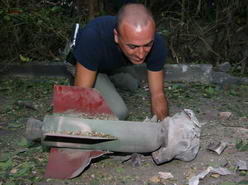
A Qassam rocket landed at the center of the southern coastal city of Ashkelon for the first time on Tuesday evening, hitting the ORT Ronson High School building, causing light damage to the structure but no injuries.
Hamas - via its military wing, the Iz al-Din al-Qassam Brigades - later claimed credit for the rocket attack, the deepest ever a Qassam has reached into Israeli territory.
"This is a major escalation in the war of terror that the Hamas organization is responsible for," Prime Minister Ehud Olmert said in a speech..
...........................................................................
Murderers: Asheri shot to death
Youth's murderers, who surrendered to IDF forces, tell questioners about kidnap, murder. Central Command chief: Palestinian security forces were asked to hand over murderers, but nothing was done. PRC: our sword will reach Ramallah's chief of police...
Palestine Information Center(a news"agency" close to Hamas) wrote about the arrests in Ramallah/El Bireh(see also the article before by Ynet) following story:
IOF storm El-Bireh police station, kidnap three citizens
IOF troops at an early hour Tuesday stormed the main police station in El-Bireh city and arrested three citizens working in the Palestinian national security force, witnesses in the city reported.
They said that around 50 IOF soldiers encircled the building in Balo' suburb north of the city and called on all those inside via loudspeakers to surrender or else they will be killed.
The soldiers fired at the building live bullets and sound bombs then broke into it and arrested the three, no information are available on those citizens so far.
The IOF troops prevented journalists and correspondents from approaching the scene and detained them hundreds of meters away from the police headquarters.
Local sources noted that the IOF troops last night burst into the Balo suburb and used trained dogs in combing the suburb under heavy gunfire other than the presence of reconnaissance planes overhead.
IOF disguised soldiers used civilian cars to roam the streets of the suburb at the pretext of looking for citizens who took part in abducting and killing the Israeli conscript Eliyahu Asheri early last week.
http://www.palestine-info.co.uk/am/publish/article_19008.shtml
...................................................................................
Well, here the very, very latest news for today:
Olmert: Hamas will be first to get hurt (Ynet)
In first response to rocket fired at Ashkelon, prime minister says 'this serious act and this criminal attempt to hurt Israel's citizens will have far-reaching consequences.' Cabinet to convene Wednesday for emergency meeting. Sources in Jerusalem: Harsh response expected...
http://www.ynetnews.com/articles/0,7340,L-3271253,00.html
Aeh~ I think he(Olmert) just wanted to say: "NOW we really wanna FUCK Hamas!", or something like that..
BTW.. only few hours before IAF missiles were "landing" in the University of Gaza..

최근 덧글 목록