

공지사항
-
- '노란봉투'캠페인/국제연대..
- no chr.!
55개의 게시물을 찾았습니다.

DAY 19
Actually today I wanted to report about yesterday's "Solidarity Demonstration Against the Israeli Aggession in Lebanon and Palestine", which took place in Berlin. But considering the latest developments in the Middle East, especially in Lebanon I don't want to comment this trash-event(the demo in Berlin) today(perhaps I'll do it tomorrow or so..).
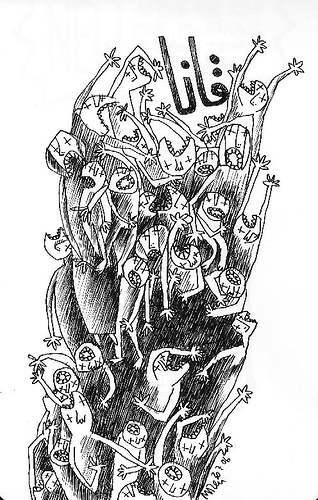
As I wrote in the beginning of the IDF operation in Gaza, about 4 weeks ago - some in the region were already talking about the "Israeli mass murder" - that's just a matter of time that real war crimes, or worse a massacres by the IDF will take place. Today in the morning(local time) it was happen: an Israeli air strike against the south Lebanese village Qana killed, according to CNN Int'l(tv), 54 civilians/34 children.
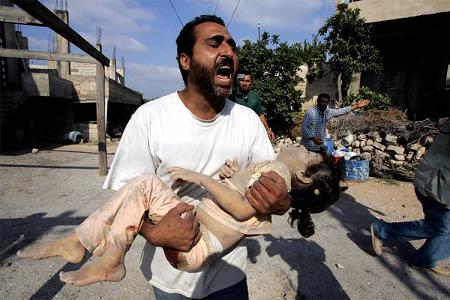
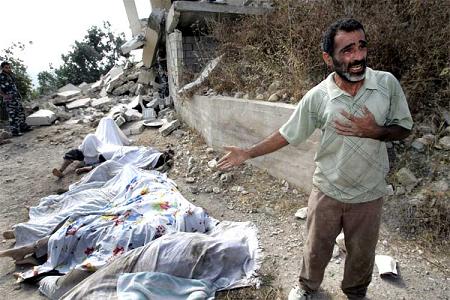
Of course the int'l condemnation of Israel is very strong. Even CNN Int'l brought full coverage about it and denounced it clearly as war crime. For example the anchor-woman of the 1 pm(CET) edition was extreme strange and angry during an interview with the Israeli spokes-woman of the foreign ministry.
In the course of the early afternoon thousands of extreme angry protestors - muslims AND christians, but also "communists" and "ordinary" people - took the streets of Beirut and stormed the UN compound there.
UN stormed amid fury over Qana bombing (Al Jazeera)
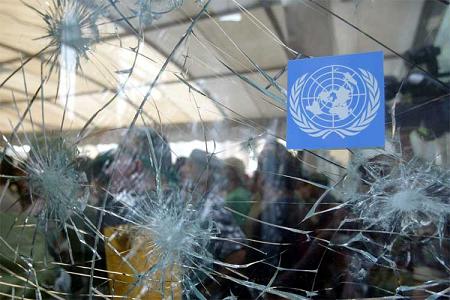
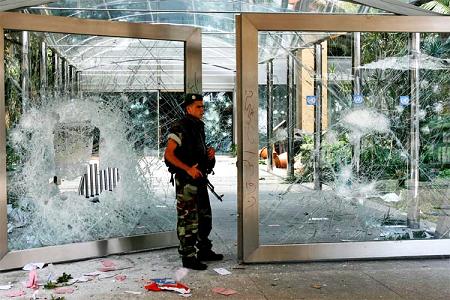
BTW.. this wasn't the first deadly attack against Qana: In April 18, 1996, IDF attacked a UNIFIL base there where hundreds of Lebanese refugees took shelter and killed about 150 of them.
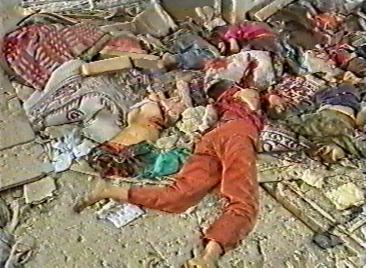
1996 massacre in Qana
Here the first facts by int'l news agencies...
Children hit hard in Israeli strike (IHT/NYT)
An Israeli airstrike killed at least 50 people - more than half of them children - in a southern Lebanese village Sunday in the deadliest attack in 19 days of fighting. The U.S. secretary of state, Condoleezza Rice, postponed a visit to Lebanon in a setback for diplomatic efforts to end hostilities.
Infuriated Lebanese officials said they had asked Rice to postpone the visit after Israel's missile strike. But Rice said she had called Prime Minister Fuad Siniora to say she would postpone the trip, and that she had work to do in Jerusalem to end the fighting.
The missiles destroyed several houses in the village of Qana as people were sleeping. Rescue officials said at least 50 people were killed, and the bodies of 27 children were found in the rubble.
Israel said it attacked Qana because it was a base for hundreds of rockets launched at Israel, including 40 that wounded five Israelis on Sunday. Israel said it had warned civilians several days before to leave the village.
"One must understand that Hezbollah is using their own civilian population as human shields," said an Israeli Foreign Ministry official, Gideon Meir. "The Israeli defense forces dropped leaflets and warned the civilian population to leave the place because the Hezbollah turned it into a war zone."
Rescuers aided by villagers dug through the rubble by hand. At least 20 bodies wrapped in white sheets were taken away, including 10 children. A row of houses lay in ruins and an old woman was carried away on a plastic chair.
Villagers said many of the dead were from four families that had taken refuge on the ground floor of a three- story building, believing they would be safe from bombings.
"We want this to stop!" shouted Mohammed Ismail, a middle-aged man pulling away at the rubble in search for bodies, his brown pants covered in dust. "May God have mercy on the children. They came here to escape the fighting."
"They are hitting children to bring the fighters to their knees," he said.
Rice said she was "deeply saddened by the terrible loss of innocent life" in Israel's attack. But she did not call for an immediate cease-fire.
"We all recognize this kind of warfare is extremely difficult," Rice said, noting that it came in areas where civilians lived. "It unfortunately has awful consequences sometimes."
"We want a cease-fire as soon as possible," she added...
Please read the full article here:
http://www.iht.com/articles/2006/07/30/news/mideast.php

Rice says time for cease-fire after IAF strike kills 54 people in Qana (Haaretz)
U.S. Secretary of State Condoleezza Rice, speaking after the Israel Air Force strike bombing of the Lebanese village of Qana, said it was time for a cease-fire in the war between Israel and Hezbollah.
Rice will hold a second round of talks with Prime Minister Ehud Olmert on Sunday evening, after cancelling a scheduled trip to Beirut to hammer out a cease-fire deal with Israel.
At least 54 Lebanese citizens were killed, at least 37 of them children, in the IAF strike on a building early Sunday, Lebanese police said. Dozens of others were reportedly trapped in the rubble. Several houses collapsed and a three-story building where about 100 civilians were sheltering was destroyed, witnesses and rescue workers said.
Israel, meanwhile, expressed "deep regret" for the deaths and said it would investigate the bombing.
"Israel deeply regrets, is greatly saddened, by this attack on innocent civilians in Lebanon. Israel takes full responsibility and is going to start an open investigation to find out how this happened," government spokeswoman Miri Eisin said...
The entire article here:
http://www.haaretz.com/hasen/spages/744295.html
Dozens killed in Lebanon air raid (BBC World)
Lebanon described the bombing as a "heinous crime"
More than 54 civilians, at least 34 of them children, have been killed in a town in south Lebanon in the deadliest Israeli strike of the conflict so far.
Displaced families had been sheltering in the basement of a house in Qana, which was crushed after a direct hit.
Lebanon's prime minister denounced "Israeli war criminals" and cancelled talks with the US secretary of state.
Israel said it regretted the incident - but added that civilians had been warned to flee the village...
http://news.bbc.co.uk/2/hi/middle_east/5228224.stm
Meanwhile..
..Hizbullah(said): We won't ignore massacre (ynet/Yedioth Ahronoth)
Terror groups threaten to avenge what they refer to as 'Qana village massacre.' Iranian president says, 'US and Britain must pay the bill for the Zionist regime's crimes'
The Hizbullah organization threatened revenge following the Israel Defense Forces' air strike in the southern Lebanese village of Qana. According to sources in Lebanon, more than 50 people were killed in the bombing, including more than 20 children.
"We will not ignore the shocking massacre," the organization said in a statement.
Hamas also released a statement, according to which all possibilities are open for a Palestinian and Lebanese resistance following what was dubbed "the Qana village massacre."...
http://www.ynetnews.com/articles/0,7340,L-3283627,00.html
..and..
Olmert: We need 10 more days of military operations (ynet)
Israeli PM tells US Secretary of State Rice country needs 10 days to two weeks to finish Lebanon offensive. Defense Minister Peretz warns of 'final strike' by Hizbullah in retaliation for Qana attack
We need ten to fourteen days of continued military operations – This was said by Prime Minister Ehud Olmert to US Secretary of State Condoleezza Rice in a meeting between the two Saturday...
http://www.ynetnews.com/articles/0,7340,L-3283686,00.html (please check out the "talkbacks" - very interesting this opinions)
***
If, finally, all this reports are true - no doubt: it's true!! - Israel has a real big problem. At least it forced many people, likely never before they supported Hizbullah, to the point to see them as "heroes of resistance", as the "only defenders of Lebanon, the Arab nation and its dignity", so one student of the American University of Beirut on today's mass rally in the Lebanese capital...
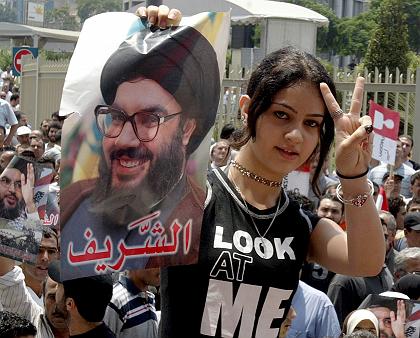
More about this issue in the coming days.


DAY 18
First of all the latest body count:
Until yesterday, according to the Lebanese Ministry of Health, around 600 people were killed by IDF. The Lebanese gov't gave the number of at least 400 killed and the Israeli Military Staff included there 200 killed Hizbullah fighters. At the same time in Israel and Lebanon at least 52 Israelis, mainly soldiers were killed. In Gaza, until today morning, 159 Palestinians, according to Israel mainly militants, were killed in the last 4 weeks.
Yesterday in Berlin a demonstration "For Paece - Against the Terror of Hamas and Hizbullah" took the streets - at least 1,000 people participated. At several places the demonstrators were verbally attacked by Arabs but also German neo-nazis, according to Berliner Zeitung.
Today, according to CNN International(tv), hundreds of demonstrators demanded in Moscow "solidarity for the Palestinian and Lebanese resistance". On the pictures it was clear to see that, beside several so-called "communist" and "socialist" parties and organisations also many members/activists of the National "Bolshevist" Party, in fact a fascist group, jpined the demo.
In about two hours here in Berlin a demonstration will take place, organized by several Palestinian and Arab groups, demanding "Solidarity with the People in Lebanon and Palestine". I'll go there and later I'll report about it(please be patient^^).
Here two very interesting articles about the current situation in Lebanon, especially about Hizbullah's role/resistance:
UNIFIL: Hizbullah undefeatable militarily (Ynet/AP, 7.29)
Top UN peacekeeping official says Israel would flatten whole villages, neighborhoods if Hizbullah continues firing rockets into Israel
A top UN peacekeeping official on Friday said he feared the war in southern Lebanon would continue until late August and voiced fears Israel would flatten Lebanon's southern villages and destroy Tyre "neighborhood by neighborhood" if Hizbullah rockets keep landing in the Jewish state.
At UN peacekeeping headquarters in Naqoura, barely a stone's throw from Israel, political affairs officer Ryszard Morczynski said Tyre would become a target of intense Israeli attacks because Hizbullah was firing rockets from the city's suburbs into Israel's northern port of Haifa.
Hizbullah boasted Friday of a new kind of rocket it called the Khaibar-1 that it fired deeper inside Israel than the hundreds of others
since the outbreak of fighting more than two weeks ago.
"I have no doubt that Israel will flatten Tyre if civilian casualties continue in Haifa. Tyre will be taken off neighborhood by neighborhood," Morczynski said. "I think Israel is contemplating flattening villages, flattening every single house to deny Hizbullah any advantage of urban fighting in the streets."
He estimated that 80 percent of the roughly half-million people who live in southern Lebanon have already fled the embattled area. He also said he feared the civilian death toll in Lebanon was more than 600, well more than the official count of 400-plus.
'Hizbullah still strong'
"Hizbullah are still strong" 17 days into the conflict, peacekeeping chief, Maj. Gen. Alain Pellegrini told The Associated Press. Pellegrini told the Times newspaper that "a military victory will never be possible."
And according to Morczynski's calculation, roughly 800 Hizbullah fighters operate in the southern region on any given day.
"They are mobile, well-prepared, devoted and willing to act," he said. "When there is shelling ... they are not sitting in their bunkers."
The Hizbullah stronghold of Bint Jbeil attests to the group's tenacity.
"In Bint Jbeil it looks like the Israelis have pulled out and are now preparing the ground to come in again," Morczynski said, after Hizbullah fighters had pushed the limited Israeli ground force to the southern edges of the town.
'Hizbullah communication intact'
Also, he said, there was evidence Hizbullah's communications were intact and their fire-and-run tactics were still effective. There was no sign that the guerrillas' supply of rockets was dwindling and Israel has had limited success in targeting their launchers.
Morczynski said the peacekeepers occasionally intercept Hizbullah communications. He recalled a typical such exchange: "Allah is great. My brothers this is number 13 and we are going to operation number 7. We hope that our brothers are safe for the day." Hizbullah uses numbers and letters as codes to identify the fighter and the location.
Hizbullah firepower would seem to be a combination of sophisticated missiles and the older Katyusha rockets, Morczynski said. Some rockets are launched from the back of trucks, while older ones are ferried on motorcycles and fired from portable triangular-shaped launchers.
"They have thousands of them. They are scattered everywhere - in caves, houses, bushes, abandoned buildings. They aren't all in one, two or three depots that you can hit and say now we have wiped them out," he said adding Israel wanted to clear Hizbullah from a two-kilometer strip along its northern border.
"The only way to prevent the launch of rockets is to erase all launching positions of Hizbullah. That is the only solution," Pellegrini said. "But it is difficult."
'Large-scale invasion possible'
Despite the sophistication of the Israeli military machine, the advantage seems still to lay with Hizbullah, Morczynski said. While it takes the Israelis only about two minutes to target the origin of a Hizbullah rocket and retaliate, it hasn't stopped the barrage and it is unclear how many fighters have been hit.
The thrust of the Israeli attack is still with its air force but Morczynski said he anticipated a large-scale invasion if the hostilities continued.
"It is clear that if the pace of the war continues as it is today it will continue until the end of August," Morczynski said.
While Israel is reluctant to wage a ground assault, he said it would be unavoidable in another two weeks because the Israeli Defense Force will need a victory.
"Now the war is going on too long without any big success. Something has to happen soon because they have to show some success to the Israeli public," he said.
http://www.ynetnews.com/articles/0,7340,L-3282947,00.html
As the shells fall around them, Hizbullah men await the Israelis (Guardian, 7.29)
An injured Lebanese boy with his mother after their van was attacked by Israeli
aircraft as they fled their village in Tyre, Lebanon. Photo: Ghaith Abdul-Ahad/Getty
"Patience is our main virtue, we can wait for days, weeks, months before we attack. The Israelis are always impatient in battle and in strategy," says the cleric, Sayed Ali, who claims to be a descendant of the prophet. "I know them very well."...
Please read the entire article here:
http://www.guardian.co.uk/syria/story/0,,1832931,00.html

DAY 16
First of all a summary from the latest developments (by Guardian, GB)
Israeli soldiers hold up a Hizbullah flag as their armoured personnel carrier pushes
across the border into Lebanon. Photograph: David Furst/AP
Hizbullah guerrillas fired at least 150 rockets at Israeli border towns, the highest daily total since the start of fighting, while Israel followed its highest one-day casualty toll in the fighting yesterday with air strikes on suspected Hizbullah positions across Lebanon.
Israel is also to call up three reserve divisions, but a meeting of senior Israeli cabinet ministers decided against expanding the ground offensive in Lebanon. The Israeli prime minister, Ehud Olmert, said the goals of Israel's 17-day offensive were being met, participants said.
The ministers said the call-up of reserves, comprising thousands of soldiers, was intended to refresh troops in Lebanon.
Israeli attacks meanwhile killed three people in the Gaza Strip, Palestinian medical workers said, a day after fighting that left 24 Palestinians dead. Those who died included a 75-year-old woman, whose house was hit by a missile or shell. The identity of the other dead, aged 16 and 23, was not immediately clear.
A senior UN official said he feared an escalation in the fighting and warned there was a high risk the conflict might broaden.
"I do not feel confident that this war between Hizbullah and Israel has peaked yet," Terje Roed-Larsen, Kofi Annan's envoy on Syria-Lebanon issues, said. "There are apparently plans and threats to hit deeper into Israel and that will for sure lead to an escalation of the conflict."
This morning's Israeli air strikes also hit a Lebanese army base, a radio relay station and destroyed several roads. The series of raids in northern, eastern and southern Lebanon killed at least one person and wounded several others.
Ayman al-Zawahiri, al-Qaida's deputy leader, warned in a tape broadcast by al-Jazeera that his group would respond to the violence in Lebanon.
Thousands of civilians are believed to be trapped in villages across the border region in southern Lebanon, according to humanitarian officials who have toured the region. Americans who escaped a village near the focus of the ground fighting said many US citizens were still there.
The Israeli military's radio station in south Lebanon today warned that the army "will totally destroy any village from which missiles are fired toward Israel". The statement, aired on al-Mashriq radio, also told Lebanese not to use the road from Qleileh - which is near the Mediterranean coast - to Houlah in eastern Lebanon, across the border from Israel's Kiryat Shmona.
Israeli warplanes struck a road in Rayak, a few miles from the Lebanese-Syrian border early today, wounding two soldiers and a civilian, Lebanese officials said.
Israeli fighter jets also carried out more than 30 bombing runs in Iqlim al-Tuffah, a highland region where Hizbullah is believed to have offices and bases, officials and witnesses said. The airstrikes, which targeted mostly deserted houses allegedly belonging to Hezbollah activists, and roads linking villages in the region, caused a number of casualties, the officials said.
Ambulances and civil defence crews were unable to reach the targeted areas because of intense bombardment, witnesses said. A Lebanese policeman was killed when an Israeli missile struck his car as he drove in the eastern city of Zahle, security officials said.
At least 423 other people have been killed in Lebanon, including 376 civilians reported dead by the health ministry and security officials. The deaths of the soldiers yesterday brought to 51 the number of Israelis killed in the campaign, according to the military.
Israeli planes also attacked targets near the southern market town of Nabatiyeh, wounding at least three people.
An international conference in Rome yesterday to discuss the crisis ended in disagreement, with demands from 11 countries and the United Nations for an immediate ceasefire resisted by the US and British governments.
The Israeli justice minister, Haim Ramon, who is a close ally of the prime minister, Ehud Olmert, said Israel interprets this as a green light to continue its offensive. "We received yesterday at the Rome conference permission from the world ... to continue the operation, this war, until Hizbullah won't be located in Lebanon and until it is disarmed," he told Israel Army Radio. "Everyone understands that a victory for Hizbullah is a victory for world terror."
Israel yesterday suffered its heaviest casualty toll in a single battle in the 16-day campaign, with at least nine soldiers killed and 25 wounded in house-to-house fighting in Hizbullah strongholds in Lebanon. An Israeli military source said "several dozen" Hizbullah fighters had been killed in the fighting...
http://www.guardian.co.uk/israel/Story/0,,1831570,00.html
Al-Qaida No 2 calls for global war
Israel Decides Not to Expand Offensive
Iranian Envoy, Hezbollah Leader Meet
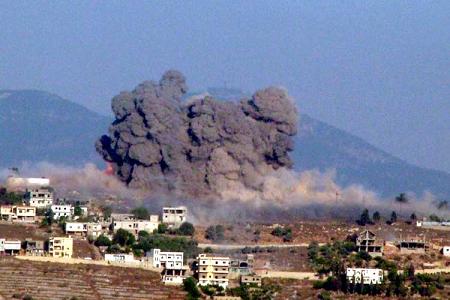
Israel 'can take its time' (Al Jazeera)
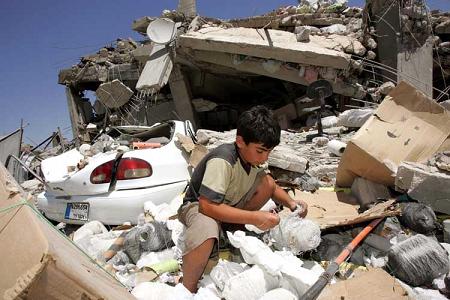
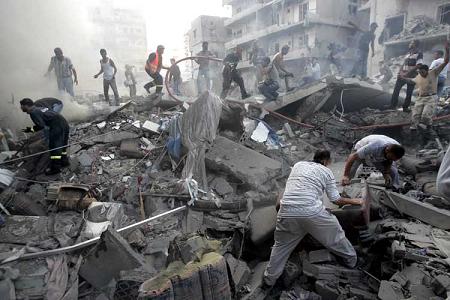
Scores killed in Gaza fighting (Al Jazeera)
Security cabinet okays mass call-up of reservists, but nixes expansion of south Lebanon operation (Haaretz)
The security cabinet, headed by Prime Minister Ehud Olmert, decided Thursday morning against expanding the Israel Defense Forces operation in southern Lebanon, but did okay a further, extensive call-up of reserve troops.
During the meeting, which came a day after nine IDF soldiers were killed in fierce battles with Hezbollah, the ministers decided that while the troops would be called up, they would not be deployed until further notice.
The decision, which was passed by 11 votes to one, takes into account "the need to prepare forces for possible developments," such as an expansion of the operation, but also takes into account the need to calm Syrian concerns that Israel could be preparing for an attack on its interests...
http://www.haaretz.com/hasen/spages/743489.html
Katyushas hit communities across north; seven wounded
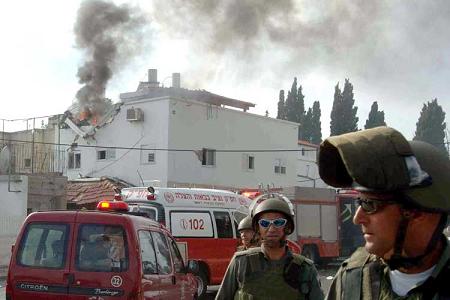
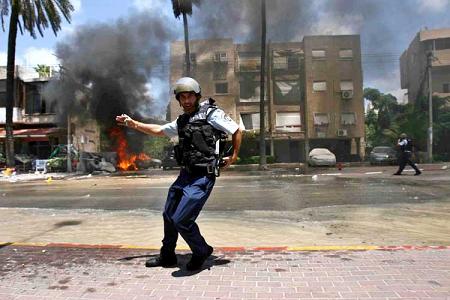
7.26, Nahariya and Haifa once again under Hizbullah attacks..
.......

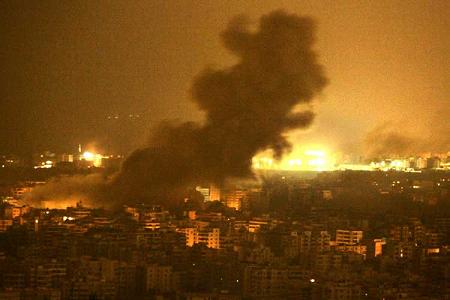
Night life in Beirut. Because IDF is "only" targeting the areas in the city where
Hizbullah have offices and places from where they launch missiles, in the other parts
of the city the life is going as "usual", such as in the northern and eastern parts.

..WHAT A SURPRISE!!
North Korea rules out six-way talks
North Korea said Thursday that it will not join any six-way talks with the United States, South Korea, China, Russia and Japan, unless Washington lifts its financial sanctions against Pyongyang.
Pyongyang's reiteration of its previous position came as its foreign minister, Paek Nam-sun, arrived in Kuala Lumpur to attend a regional security forum.
"There will be no incident (in which) we return to the six-way talks as long as the U.S. continues to impose its financial sanctions," Jung Sung-il, director-general of North Korean Foreign Ministry's international organization bureau, told reporters.
Jung made the comments on behalf of his boss Paek, who was whisked away by a sedan upon his arrival at the airport.(Yonhap, 7.27)
http://english.yna.co.kr/Engnews/20060727/610000000020060727180013E2.html
And it's just the beginning of the ASEAN summit in K.L. Our "beloved friends" from P.Y. may have some more f(unny) surprises for the coming two days!!??

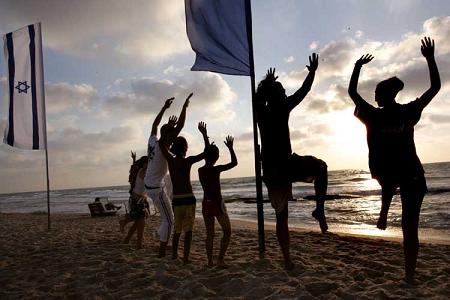
Israeli refugees from the north of the country: "Party, techno-beats and Tai Chi at
a beach refugee resort at the south coast, Netzanim", Der Spiegel(Germany)
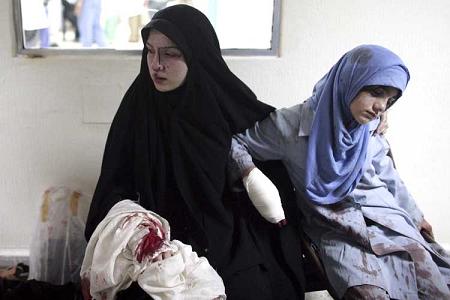
Lebanese refugees from the south of the country after heavy bomb attacks by IDF
LONG LIVE THE EXPLOITATION
AND OPPRESSION OF DPRK's
WORKING CLASS..
..by the S.K. capitalist class and N.K. monarchy!!
When the S.K. capitalists and their gov't are watching, for instance last week's struggle in Pohang, they may dream about the perfect possibilities in the DPRK.. There no-one comes to the idea to go on strike, even he/she is getting paid only $50/50,000 Won(migrant workers in S.K., at least, are getting 500,000 W) per month(some people are calling it "salary"). And if the N.K. workers really would come to the(complete stupid - or better deadly) idea to fight for a normal payment... YODOK, or any other concentration camp, is waiting!! And I'm 100 percent sure that nobody in S.K., especially in the ruling class, would ask about him or her, unless the production/profit-making-machine will get in serious problems..
And not only the "real" ruling class profits from this situation: even, for example the so-called "alternative/left" media is trying to take a piece of the cake. Until some days ago Hankyoreh(the English section) had TWO advertisment clips for the Gaeseong Industrial Complex(GIC) - http://www.kidmac.com - on its main page. Today there is "just" one clip about GIC..
Last week(7.18) IHT/NYT published following article about GIZ:
North Korea's well-isolated capitalism
Just north of the demilitarized zone dividing the Korean Peninsula, in possibly the world's most heavily guarded special economic enclave, 500 managers from the South and 7,000 workers from the North are engaged in a capitalist experiment that is anathema to the United States.
The South Koreans recently gave a tour of the enclave, the Kaesong Industrial Park, to 200 foreign business executives, diplomats and journalists. The hosts expressed optimism that it would bring peace to the peninsula, then they led the visitors through factories churning out goods for markets in the South and elsewhere.
In one of the 15 factories, Taesung Hata, a cosmetics company, about 500 workers wearing dark blue uniforms and white hats operated machines that produced plastic cosmetic containers.
Next door, 1,500 workers sat in rows of desks with sewing machines, below ceiling fans and decorative red flowers, making orthopedic shoes called Stafild that were described as "Shoes for Unification."
To hear the South Korean hosts tell it, when the special economic zone is completed in 2012, it will house 2,000 companies and employ 700,000 North Koreans.
Yet Kaesong's significance is larger still, they say, because it will nudge the North toward embracing economic reforms and opening up to the world, the way Shenzhen did in China two decades ago, and open the path, as the shoes suggest, toward reunification.
(The hosts also said they had considered canceling the June 22 tour, which coincided with rising tensions over North Korean preparations for missile tests, but decided against it.)
Kaesong is South Korea's biggest project in what some call unification by "small steps," or "de facto" unification. The South does not want formal unification for a few more decades, but its strategy is to narrow the yawning gap of half a century of division through various projects, from manufacturing in Kaesong to uniting the two Koreas' different Braille characters for the blind and sign language for the deaf.
"It's de facto unification," said Ko Gyoung Bin, who oversees the 18- month-old Kaesong project at the Ministry of Unification in Seoul. "It's already under way. Unlike the German model, it won't happen suddenly."
The two Koreas agreed on building Kaesong when the former South Korean president, Kim Dae Jung, and the North's leader, Kim Jong Il, met in Pyongyang in June 2000.
Since then, the exchanges have become so routine that sports authorities on both sides are moving toward fielding a unified team for the 2008 Beijing Summer Olympics.
With cultural, academic, business, political or military exchanges going on between the two Koreas nearly every week, 80,000 South Koreans visited the North last year.
That did not include South Korean visitors to Kumgang Mountain, a North Korean resort opened to foreigners eight years ago. Kumgang has been visited by 1.25 million South Koreans.
South Korean regional and local governments, regardless of political leanings, have also undertaken projects with counterparts in the North. More than 60 private organizations now send South Koreans north to assist on agricultural, health and other projects.
"We go to North Korea, where we work with our counterparts to show them how to use certain agricultural machines or how to breed better cattle," said Kang Young Shik, director of the Korean Sharing Movement, a private group that has undertaken the Braille and sign-language projects. "They need help from us, though they also feel the need to compete with us."
Cho Yong Nam, a director general in the Unification Ministry, said South Korea had projects in 27 out of 206 cities and counties in the North. The common theme, he said, is to raise standards in the North so that, in a unified Korea, North Koreans would not constitute "a displaced, misfortunate minority group."
Companies that have come to Kaesong, which is managed by Hyundai Asan, a private company, have received tax breaks and other support from the South Korean government.
A new highway and railroad traverse the demilitarized zone before reaching Kaesong, about 65 kilometers, or 40 miles, northwest of Seoul. Soldiers stand watch on either side of the DMZ, with its barricades, barbed wire fences and land mines.
In working with North Koreans, South Koreans have said, they have encountered the sometimes unexpected effects of their division: North Korean construction workers, for example, were rated only one-third as efficient as their counterparts from the South. Many North Koreans, with little experience handling machines, have required extensive training.
Sometimes, South and North Koreans had trouble communicating because the language spoken on either side of the DMZ has changed significantly. (One project supported by the South is a unified dictionary with new words that have appeared since the division, or words whose meanings have changed.)
Last year, the activity here expanded trade between the two Koreas to more than $1 billion for the first time, though only a few of the companies here are believed to be profitable.
Kaesong has also become an obstacle in negotiations between South Korea and the United States over a free-trade agreement. The South wants products made here to be included in the agreement, arguing, so far in vain, that most of the materials derive from the South.
The Bush administration, which has tried to isolate the North instead of engaging it, recently criticized Kaesong after long withholding judgment. It accused the South of economically propping up the North, as the United States was financially squeezing the North elsewhere.
In a recent opinion article in The Wall Street Journal, Jay Lefkowitz, President George W. Bush's special envoy for human rights in North Korea, said projects like Kaesong strengthened Kim Jong Il by pumping "hundreds of millions of dollars into the North, with more to come."
Lefkowitz also said he had doubts about whether the North Korean workers actually got their wages.
Ko, of the Unification Ministry, rejected such accusations, saying the North Korean workers had to sign their names when they received their wages. The wages average $57 a month, nearly triple the average in the North, he said.
According to Hyundai Asan, employees work 48 hours a week. They were picked by North Korean officials, then approved by South Koreans. About 80 percent are high school graduates.
Visitors were allowed to speak to the North Korean workers, but supervisors and North Korean guides on the tour discouraged anything but innocuous answers.
Peter Beck, who is the Northeast Asia director for the International Crisis Group in Seoul and took part in the tour, said he was impressed by the facilities but that it was still unclear how much of the wages went to the workers.
At Shinwon, a garment manufacturer, 300 North Korean workers were cutting and sewing shirts, dresses and blouses in a large, brightly lighted, air-conditioned factory.
"I've seen factories of this type in Kenya, Bangladesh, India and Papua New Guinea, and the conditions here compare very favorably," said Frank Gamble, a retired banker and an official with the Australia-New Zealand Chamber of Commerce in Seoul, as he toured the Shinwon factory. "What South Korea is trying to do here in Kaesong, we've already seen in China and Vietnam and elsewhere. The United States was against investing in Vietnam, but now they're beating down doors to get there."
A North Korean official accompanying the visitors expressed anger at criticism from Americans.
"I think they're ignorant," he said, refusing to give his name. "They just criticize everybody, including China on human rights. They just want to impose their standards on the world."
http://www.iht.com/articles/2006/07/18/news/pyongyang.php
7.23 이주노동자 문화제
Here reports by MWTV News(in Korean and English):
지난 7월 23일 고려대학교에서는 이주노동자 문화축제 "Migrants Welcome Festival"이 열렸습니다. 이번 축제는 이주노동조합을 비롯하여 네팔, 방글라데시, 필리핀, 인도네시아 공동체, 버마액션, MWTV와 이주노동자 방송국, 오산센터의 공동 주최로 열렸습니다.
이번 행사는 이주노동자들이 중심이되어 만든 첫번째 문화제라는 점에서 의미가 크며, 다양한 나라의 공동체가 서로 힘을 합쳐 행사를 진행하여 흐뭇한 모습을 자아냈습니다.
행사장은 각 공동체의 문화전시와 전통음식, 방송국 소개와 대안무역등 다양한 볼거리들이 주를 이루었으며 오후에 이루어진 문화공연에는 이주노동자들의 연극, 공동체에서 준비한 전통음악과 함께 이주노동자밴드, 국내 가수들의 공연등 다채로운 무대가 펼쳐졌습니다. 공연 중간에는 테러리스트로 오인되어 보호소에 억울하게 갇혀있는 압둘 사쿠르씨와의 전화연결과 함께 강제추방 반대에 대한 의미있는 목소리를 냈습니다. 서로의 문화를 교류하고, 또 이주노동자의 권리를 위해 함께 노력하는 뜻 깊은 자리였습니다.
The migrant worker cultural festival entitled "Migrants Welcome Festival" was held on Sunday July 23rd at Korea University. This festival was sponsored by the Migrant Worker Trade Union in conjunction with Nepalese, Bangladeshi, Filipino and Indonesian community organizations along with Burma Action, MWTV, Migrant Worker network ([other tv station]), and the Osan Center.
Groups representing several different countries teamed up to organize the festival, which was the first such cultural event focusing on migrant workers, organized by migrant workers.
At the festival, booths featured cultural displays along with traditional food, jewelry and clothing from various countries for sale. In the evening, a concert presenting both traditional song and dance performances along with folk and rock musicians from various countries including Indonesia, Bangladesh and Korea closed out the festival.
During the concert, a call was made to Abdul Sakur, the Indonesian migrant worker who was arrested under suspicion of terrorist activity and after being proven innocent, he was then sent to the immigration detention center where he has been held for 2 months now. Abdul Sakur, via live phone call broadcast to the crowd, voiced his thanks for the support he has received so far, and spoke out against forced deportation and false allegations of terrorism.
The festival was a chance to not only share the cultures of migrant communities here in Korea, but to promote the rights of all migrant workers living in Korea.
And another report you can read here(by migrantsinkorea.net):
단결과 투쟁을 위한 이주노동자 문화제 열어
이주노조, 시민사회단체연대회의 등 주최
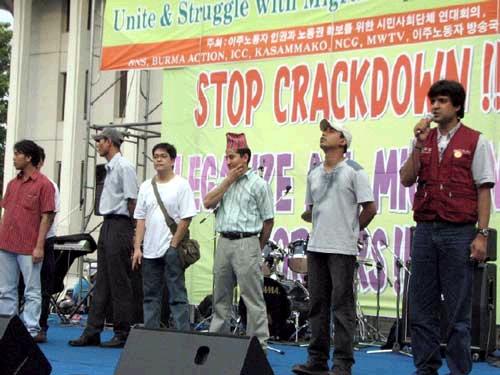
문화제에 참가한 공동체 활동가들과 이주노조 아노아르 위원장이 연대발언을 하고 있다.
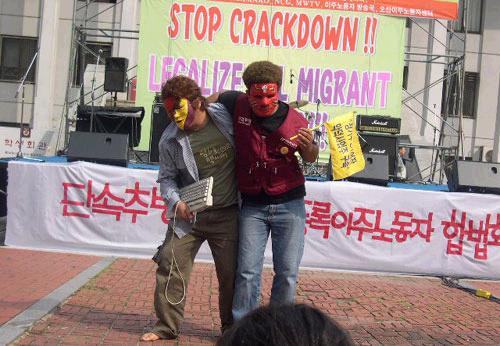
이주노조 활동가들이 참여한 마스크 연기가 펼쳐지고 있다.

이주노동자들과 많은 학생들이 참여한 가운데, 관객들이 행사를 보며 즐거워하고 있다.
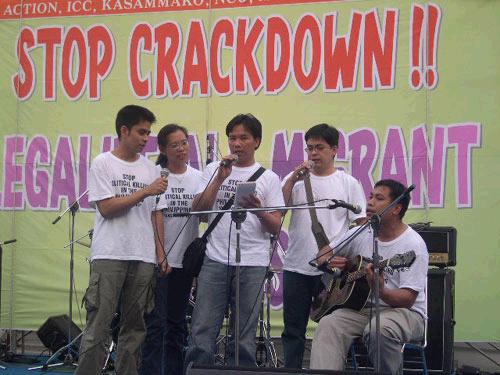
필리핀 공동체의 활동가들이 노래를 하고 있다.

인도네시아 공동체의 워커스 밴드(Workers' Band)가 공연을 하고 있다.
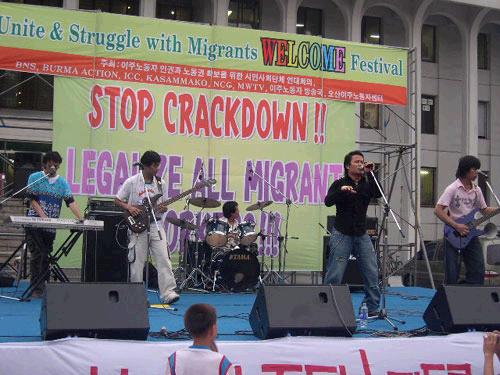
Stop Crackdown Band. 스탑 크렉다운 밴드가 공연하고 있다.
(Source of pics/sub-titles: www.migrantsinkorea.net)
For more pictures please check out MWTV's image archive
http://www.mwtv.or.kr/zeroboard/zboard.php?id=migrant_image
DAY 12
Until now in the latest war in the Middle East at least 370 Lebanese, mainly civilians, were killed by IDF. According to Al-Jazeera more than 100 Palestinians have been killed in the Gaza offensive, the majority of them fighters.
Following some reports, analysis and latest news:
The German magazine Der Spiegel published this report last week(7.21):
BEIRUT IN RUINS
Hezbollah's Dead Neighborhood
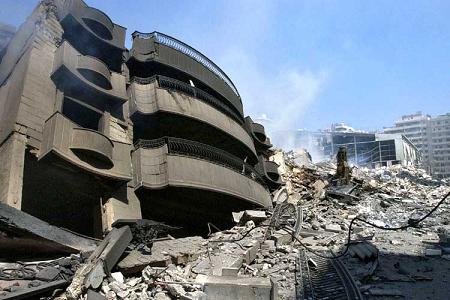
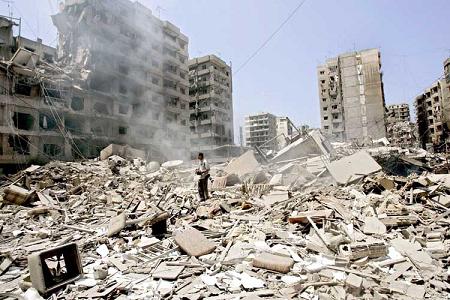
After more than a week of Israeli bombing raids, Lebanon's southern suburb of Haret Hreik has become uninhabitable. Hezbollah is organizing visits for journalists to the devastated neighborhood that was once its stronghold.
There are wars in which one bombed-out building is shown from different angles so many times that most television viewers end up thinking the whole city has been devastated. There is no need for such tricks in Beirut. In Haret Hreik, a cameraman who wants to show the consequences of war just has to keep on filming -- entire streets in the Beirut suburb have ceased to exist.
A drive to the southern suburbs of Beirut is like a nightmare in which everything only gets worse. At first it's only the burnt smell that reminds you that the ruins alongside the street don't date back to the last war. Next come the craters in the asphalt where bombs have hit, then a burnt-down gas station, and then a newly destroyed highway bridge. But it's only on stepping out of the cars marked "TV" and proceeding on foot that you understand the catastrophe that is playing out in Haret Hreik these days. There is more destruction, more rubble around every street corner -- until the sheer quantity of shattered concrete just blocks your path, stops you from moving further into the chaos.
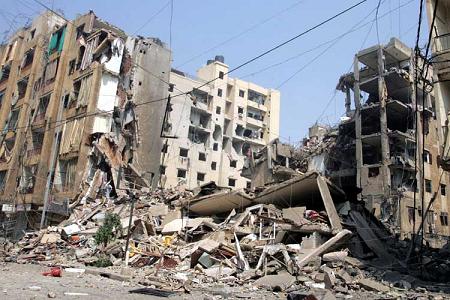
As many as 700,000 people are thought to have lived in the southern suburbs of Beirut. No exact figures exist of how many called Haret Hreik their home. But one thing is clear: the district is now completely deserted. The Shiite-dominated working-class neighborhood, a stronghold of Hezbollah located between the city center and the airport, has been attacked to the point of being uninhabitable. And the bombs keep falling several times a day. The only people who continue to frequent the neighborhood are the ones who have no other choice, and they don't stay any longer than necessary. Cars race through the streets at speeds as high as 100 kph (62 mph) -- streets where you used to be stuck in perennial traffic jams. Pedestrians keep falling into a nervous trot and cast worried glances skyward. As if that will help -- only two seconds of time separate the sound of an approaching Israeli fighter jet and the detonation on the ground, they say. There's no time to take shelter.
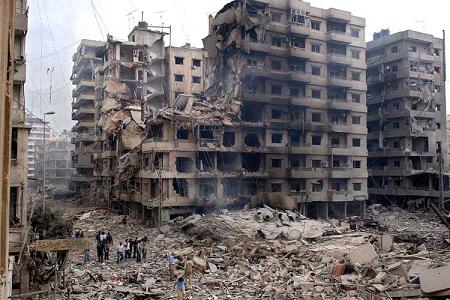
Armed men stand on some street crossings. They're meant to discourage looters and catch Israeli spies. The latter are suspected of being everywhere since war broke out. Some Hezbollah representatives who have agreed to lead a few journalists into Haret Hreik consult with militia members. Is the neighborhood safe? The answer is vague -- move quickly, don't stand around for too long under any circumstances.
The tour leads past bedrooms whose outer wall is missing and stores whose metal blinds have been ripped out by explosions. It leads past a burnt-down store called "Chic-Choc, Bags and Shoes" and an "Oxford Language Center" whose façade lies in pieces on the street. Glass shards from shattered storefronts lie inches-deep on the street and make crunching noises as you walk over them. The stench of trash is in the air. The air tastes dusty from the blasted concrete.
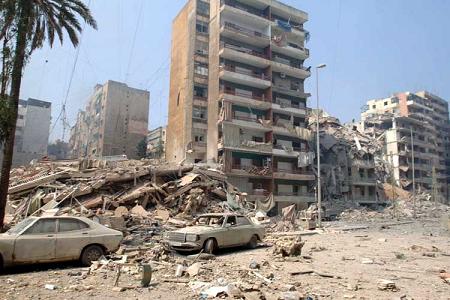
The Hezbollah leaders are nervous. The last attack on these streets happened only a few hours ago, and the next one could be imminent. The men keep in touch with each other by Walkie Talkie -- the signal from a mobile phone could attract Israeli attackers to the group. Drones and spy planes are searching for anything in the neighborhood that's still moving, the men claim. Faint echoes from distant explosions are felt more than they are heard. "That's the airport," one man says. "It's being bombed again."
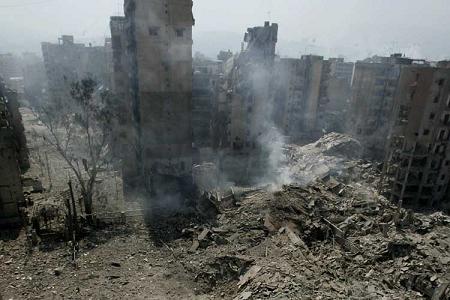
The translator begins to cry as we approach a street where the devastation is particularly bad. "I know this street," she says. "I was often here." She tells us that the burning building down there used to be a children's hospital. The men from Hezbollah are staring down the street too. "If what happened here happened in the USA, in Israel, France or another Arab state, the people would cry, scream and be angry. But it makes us stronger and nourishes our hunger for more fighting," one of the men claims. He says he's glad that fighting on the ground has now begun.
Grim tour with propaganda included
Of course, the quick visit organized by Hezbollah is a propaganda event. According to the men from Hezbollah, everyone who died in the entire area was a civilian. "There were no martyrs -- only civilians died," the leader of the men says. "Why is Israel doing this?" But who can say whether mobile rocket launchers weren't hidden in these densely inhabited residential streets. It's a known fact that Hezbollah -- which is a legally recognized political party in Lebanon, and which is represented in parliament -- had many of its offices and social centers in this neighborhood. It is reasonable to assume that the military section of the militia was also present here.
But even if the Israelis did assume that this neighborhood served as a hideout and base of operations -- the attacks on Haret Hreik are not a matter of "surgical strikes" against military targets alone. UN Human Rights Commissioner Louise Arbour said on Wednesday that war crimes that need to be punished may have been committed during last week's fighting. The ruins of the residential neighborhood could at least serve as corroborative evidence for the charge of "predictable death or injury of civilians."
A man rushes to the porch where our little group is standing, seeking shelter. He's clutching a bundle of plastic bags. "I thought I could use them to take a few things from home with me," says the man, who is in his mid-40s. But his home no longer exists.
The apartment building that Khaled points to is a crushed concrete sandwich -- steel girders, parts of balconies and the remains of furniture jut out from between the massive concrete slabs. In this case, the cliché is accurate: The man's life is in ruins. Just three days ago, he came here from a northern suburb where he had taken refuge with his family. His house was still standing then. "It must have happened the night before last," he says calmly -- as if he still can't understand what has happened to him.
Asia Times(HK/China) published following in the last days:
Bunkered down for a war of attrition
Troops poised for ground offensive
The arms that keep Hezbollah fighting
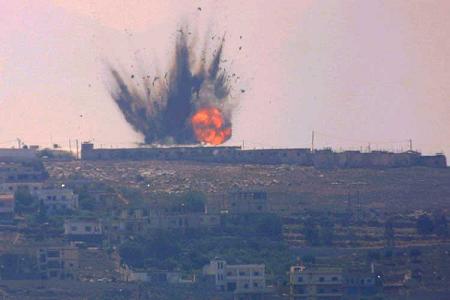
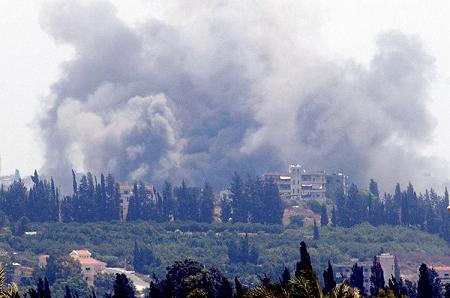
The Observer(GB) in its today's edition:
Scared to flee ... even more scared to stay
P. Beaumont talks to refugees from the south of Lebanon as whole families leave all their possessions behind.
Rites and prayer as rockets rain
Are the Shias on the brink of taking over the Middle East?
Our city is being torn by these two brutal foes
IHT/NYT:
A new era with winds of change in Mideast
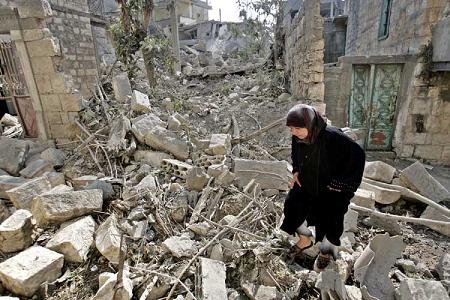
Haaretz(IL):
Israel believes U.S. will grant it a week to end incursion
Lebanese FM: Abducted soldiers in 'good health'
The two Israel Defense Forces soldiers abducted by Hezbollah on July 12 are "in good health," Lebanese Foreign Minister Fawzi Salloukh said Sunday.
On the eve of U.S. Secretary of State Condoleezza Rice's visit to Jerusalem, senior officials believe Israel has received American approval to continue operations against Hezbollah at least until next Sunday.
Rice will first explore ways with Israel's leadership to end the crisis and begin to shape a new order in Lebanon. She will return next Sunday to try to implement a cease-fire...
Please read more here:
http://www.haaretz.com/hasen/spages/741445.html
Rockets hit car in Haifa, carpentry in Haifa suburb
Two killed in Katyusha rocket strikes on Haifa
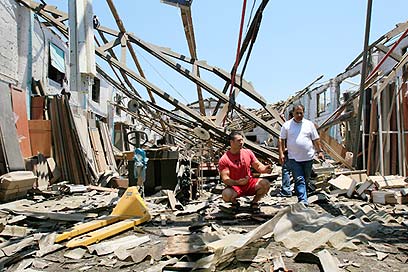
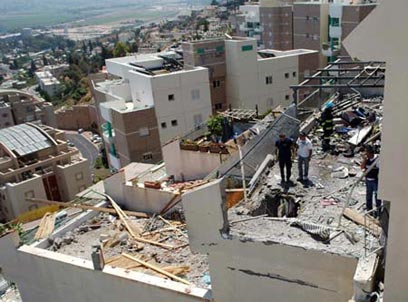
Two people were killed and several others were wounded as ten Katyusha rockets slammed into Haifa and its suburbs Sunday morning.
A man was killed in Haifa when rocket shrapnel hit his vehicle as he was driving along a main road in Haifa. A second person was killed when a rocket hit a carpentry shop in a suburb of Haifa.
The full text:
http://www.haaretz.com/hasen/spages/741722.html
Meanwhile Hamas' Palestinian Information Center wrote last week(7.19) following:
NSB forms first women human bombers
The Nasser Salahuddin Brigades, armed wing of the popular resistance committees, Tuesday declared the formation of the first group of women human bombers in a parade organized in Gaza city.
Shima Al-Quqa, daughter of the martyr Al-Abed Al-Quqa the NSB commander who was martyred two months ago, said that the women contingent would defend the honor of the Ummah at a time the Arab and Muslim men refrained from shouldering their religious and ethical duty towards the Palestinian and Lebanese women and children.
She said that all members of the purely female group had vowed almighty Allah to brandish the weapons alongside the male Mujahideen to confront the Israeli occupation forces.
The spokeswoman asked all Arab rulers to seek shelter underground because "We will remain above the ground defending them and their dignity and the dignity of the Arab and Muslim Ummah".
The group of women carrying Kalashnikovs, RPGs and Al-Yassin projectiles paraded the streets of Gaza city until they arrived at the PLC premises where they burnt the Israeli, American and EU flags after which one of the women drew an X on the Arab League flag then torched it in a clear sign of anger over the AL weak position towards the Israeli crimes against the Lebanese and Palestinian people.
http://www.palestine-info.co.uk/am/publish/article_19235.shtml
And Al-Jazeera reported 7.20:
About 4,000 Palestinians demonstrated in Nablus in support of Hezbollah calling on it's leader, Hassan Nasrallah, to attack Israel - Haifa and even Tel Aviv - with rockets.

덧글 목록
관리 메뉴
본문
so beautiful... rediscovered Seoul!부가 정보