공지사항
-
- '노란봉투'캠페인/국제연대..
- no chr.!
LATEST NEWS
Just few minutes ago CNN/AP reported following:
N. Korea agrees to return to 6-party nuke talks
North Korea agreed Tuesday to rejoin six-nation nuclear disarmament talks in a surprise diplomatic breakthrough three weeks after the communist regime conducted its first known atomic test, the Chinese government said.
Chinese, U.S. and North Korean envoys to the negotiations held a day of unpublicized talks in Beijing during which North Korea agreed to return to the larger six-nation talks on its nuclear programs, the Chinese Foreign Ministry said.
"The three parties agreed to resume the six-party talks at the earliest convenient time," the Chinese statement said.
The agreement is one of the first signs of easing tensions since North Korea conducted the underground detonation on October 9, defying warnings from both the United States and Japan, and its staunchest ally, China.
If the six-party talks resume, it would mark a diplomatic victory for Beijing, which in the wake of the test had argued against punishing North Korea too harshly, in order to leave open a path for diplomacy.
"We hope it's true," White House press secretary Tony Snow told NBC's "Today" show. "It would be very good news."
South Korea welcomed the North Korean agreement.
"The government hopes that the six-party talks will resume at an early date as agreed and that an agreement will be reached on how to implement" a prior accord under which Pyongyang pledged to abandon its nuclear program, South Korean Foreign Ministry spokesman Choo Kyu-ho said.
Seoul also has been trying to strike a delicate balance in punishing the North for its nuclear test; seeking to avoid aggravating its volatile neighbor while imposing sanctions according to an unanimous U.N. Security Council resolution.
The U.N. resolution calls for a ban on the sale of major arms to Pyongyang and inspection of cargo entering and leaving the country. It also calls for the freezing of assets of businesses supplying North Korea's nuclear and ballistic weapons programs, as well as restrictions on sales of luxury goods and travel bans on North Korean officials.
The six-nation arms talks were last held in November 2005, where no progress was made on implementing the September 2005 agreement where the North pledged to abandon its nuclear program in exchange for security guarantees and aid.
Just after that agreement, the North had demanded a nuclear reactor for power -- a request that was quickly rejected by the other sides at the talks.
However, the North then argued that it wouldn't return to the negotiations until the U.S. desisted from a campaign to sever it from the international financial system for Pyongyang's alleged complicity in counterfeiting and money laundering to sell weapons of mass destruction. The North viewed those measures as proof of Washington's "hostile" policy against it and thinly veiled desire for regime change
The U.S. refused and said the issue was unrelated. To try and press its case, the North launched a series of missile in July -- including a long-range model believed capable of reaching parts of the U.S.
A U.N. committee has been determining how to implement the sanctions over the atomic test, measures banning the North's weapons trade.
Washington has been seeking to gather support for the sanctions, and getting the North's top two trading partners -- China and South Korea -- to pressure the regime.
North Korea is believed to have enough radioactive material to make about a half-dozen bombs, but estimates vary due to limited intelligence about its nuclear program.
The apparent North Korean agreement followed a day of typically bellicose rhetoric from Pyongyang.
North Korea claimed that the United States, "scared" by the North's nuclear test, conducted some 200 spy flights over the communist country during October.
"The ... aerial espionage underscores the need for the army and the people of the (North Korea) to bolster the war deterrent for self-defense in every way to foil the U.S. imperialists' moves for a war of aggression," the North's official Korean Central News Agency said.
North Korea also warned South Korea on Tuesday against participating in a U.S.-led international drive to stop and search ships carrying weapons of mass destruction, saying involvement would bring about unspecified "catastrophic consequences."
The warning released by Pyongyang's official news agency came as South Korea is considering whether to fully participate in the U.S.-led Proliferation Security Initiative aimed at interdicting shipments of weapons of mass destruction and other suspected cargo.
Seoul has been reluctant to take full part in the initiative out of concern it may anger North Korea and complicate efforts to resolve the international standoff.
Instead, it has sent observers to drills and attended briefings.
http://edition.cnn.com/2006/WORLD/asiapcf/10/31/nkorea.ap/index.html
中、朝、美六方會談團長在北京舉行非正式會晤 (中華人民共和國外交部)
Just let's wait and see what will
bring the near future!!(*)
* Because, as you know, the "Dear Leader" likes to make strange surprises!!


IHT published yesterday following article:
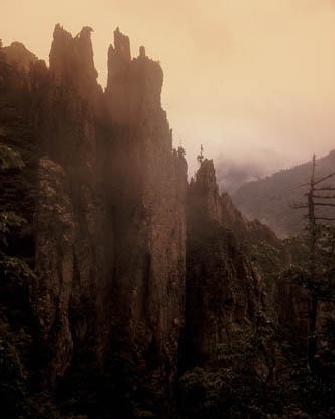
The lure of Korea's magic mountain
Visiting this fabled North Korean mountain was not an easy decision for Kim Chung Soo and his wife, Nam Sang Ja. Twenty-two people from their village in central South Korea had each paid 240,000 won a month in advance to book a day trip last week, but after North Korea conducted a nuclear test on Oct. 9, 14 of the tourists canceled.
"Our children said, 'Father, don't go there. It's dangerous,'" Kim, 66, said with a laugh. Around the couple, a chattering crowd of visitors marveled and digital cameras flashed at the mountain's famed Nine Dragons Waterfall, which an ancient poet described as "10,000 bushels of pearls cascading from the heavens."
"This is not a place you can come everyday," Kim said. "So my wife and I thought, Let's go. Why does a Korean have to be afraid of visiting a Korean mountain?"
Each week, despite tensions over North Korea's nuclear test and U.S. assertions that such tours are channeling precious cash to the communist regime, thousands of South Koreans travel to this tourist resort carved out of the foothills of Mount Kumgang, just beyond the east coast border of the two Koreas.
The 3,280-hectare, or 8,200-acre, zone is the only part of the North that South Koreans can visit freely. The trip is not only a sojourn into a mountain whose waterfalls and autumn foliage have inspired Korean poets and painters for centuries. It offers a peek into a country stuck in a bygone era, where red-and- white slogans everywhere exhort people to "Defend Great General Kim Jong Il, Lodestar of the 21st Century, with our lives," while his hungry people brace themselves for UN sanctions.
For Kim Jong Il, the mountain has proved as precious as its namesake - Kumgang means diamond in Korean - bringing $452 million in tourist fees since the tours began in 1998. His regime also received a lump sum of $450 million from Hyundai, the South Korean conglomerate, for the rights to Mount Kumgang tourism and other inter-Korean economic projects, as well as $400 million invested in hotels, piers and roads in the mountain resort.
Now with Washington determined to cut off all sources of financing for the North's weapons programs, the tour has become a focal point in a U.S.- South Korean dispute over how to change the North's behavior. In Seoul last week, Christopher Hill, the U.S. assistant secretary of state, said the tours were "designed to give money to the North Korean authorities."
Seoul, however, is keeping the tours going. Tourism - and the incentives it provides - is one of the few remaining tools of influence that South Korea maintains over the North. It also is a linchpin in South Korea's painstakingly built policy of encouraging the North to open up to the outside world - the so- called Sunshine Policy.
"We started our tours hoping that we could help build trust and ease tensions between the two Koreas and serve as a catalyst for reunification," said Chang Hwan Bin, senior vice president of Hyundai-Asian, an arm of the Hyundai conglomerate that runs the tour. "But this winter is going to become a very difficult time for us."
Since 1998, Hyundai has attracted 1.36 million visitors. It pays from $30 to $80 to the North for each tourist it brings. After years of losses, the tour business posted its first annual profit last year, at 14 billion won, or $15 million, thanks partly to South Korean government subsidies for students and teachers who take the tour during the winter vacation.
But after the North's launching of missiles in July and its nuclear test, thousands of people canceled their trips. Now the average number of tourists stands at 20,000 a month, half the figure the company had hoped for and barely enough to break even. Then came another blow last week: Under pressure at home and abroad to implement UN sanctions more vigorously, Seoul said it would probably end the subsidies.
There is a growing recognition in South Korea that the Sunshine Policy "has not worked and it's time to recalibrate that policy," said Peter Beck, an analyst with the International Crisis Group in Seoul. But South Korea also fears that terminating the Mount Kumgang project will drive the North deeper into isolation and raise tensions.
"At this rate of 20,000 tourists a month, we pay about $1 million a month to the North in tourist fees," Chang said. "But keeping the door open with the North is worth the money. It took us 50 years to come this far. If we shut the door now, it will be more difficult to open it again."
To get to Mount Kumgang, tourists travel on a Hyundai-built road across the no-man's land that has divided the two Koreas for six decades, and enter a zone sealed off from the rest of North Korea by steel fences and soldiers.
They check into Hyundai-run hotels, bask in a hot spring, watch a North Korean acrobatic show and shop at duty-free Hyundai stores packed with Western liquor and North Korean "Paradise" cigarettes and dried mushrooms.
In the hotel's karaoke bar served by communist women(*), southern capitalists belt out American pop songs and Western whiskey flows.
Improved lifestyles in this part of North Korea highlight how contact with capitalists has already reaped rewards - or at least how much the regime is trying to polish its image for visitors. Villagers' clothes were more colorful than before. Some houses were freshly painted.
A few years ago, when Northern villagers on the road saw a convoy of South Korean tourist buses, they would drop their bags and hide behind trees to avoid contact. Now they go about their lives hardly noticing the buses.
"It would be really regrettable if the South succumbs to U.S. pressure and ends the tour," said Park Myong Nam, a North Korean tourism official.
A highlight of the trip is a hike up the mountain's Nine Dragons Valley. The route is dotted with granite monuments celebrating each spot where Kim Jong Il's late father, President Kim Il Sung, stopped for a rest during his "historic" hike in 1947.
Communist minders - part tour guides, part propagandists - guard the monuments. They are eager to propagate the official line on why North Korea was pursuing a nuclear arsenal, and to gather information from this rare contact with free-speaking South Koreans.
On a visit last week, the minders asked what had resulted from Secretary of State Condoleezza Rice's trip to Asia last week to try to work out how to implement UN sanctions against the North. South Korean tourists gathered to watch them speak.
"We are not afraid of sanctions," said Kim Nam Sook, a minder in her 20s. "We have lived with them for decades and survived them. They are nothing new to us."
Up the valley, Kim Keum Chul, who wore a Mao-style "people's suit," told South Koreans "not to worry about the nuclear test but to thank the North for building a strong deterrent against war on the Korean Peninsula."
http://www.iht.com/articles/2006/10/30/news/mount.php
(*) since when the North Koreans have something to do with COMMUNISM???

최근 덧글 목록