The Revolt
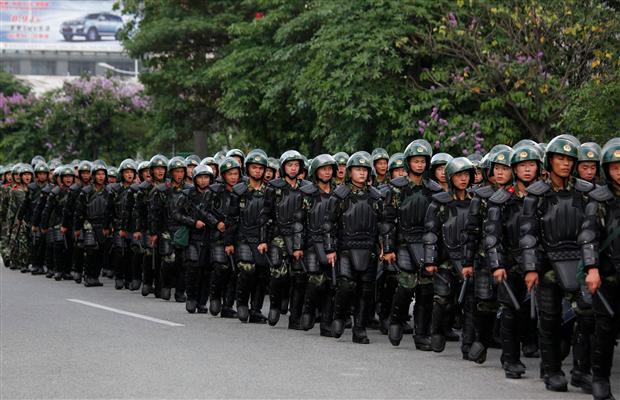
Since March Syria has been the scene of mass murder. More than 1300 people, including young children, are dead (compared with the 800 deaths that were required before the Army’s removal of Mubarak in Egypt) and as we write another 70 died in Hama and other places after another Friday of protest. The response of the “international community” has been noticeable by it feebleness. Syria has for decades been designated a “state sponsor of terrorism” by the United States and is already under a sanctions regime but there has been no US call for the Assad regime to go. Significantly no UN resolution against Syria has been tabled, no attempt to intervene militarily as in Libya and only feeble verbal condemnation by Obama et al.. It is clear that the tragedy for the Syrian demonstrators is that there are no petrodollars or oil supplies at issue. And it is clear that the West or Israel would not necessarily welcome “regime change” in Syria since this would throw the Middle East into even more turmoil than ever. The Assad regime supported by its imperialist allies in Iran [who have sent advisers on how to deal with street unrest — something they have long experience of], and Russia and China, has been allowed a free hand to brutally suppress all the demonstrations since March. This harks back to another episode in recent Syrian history.
In February 1982 the Muslim Brotherhood organised a rising of 5000 armed men against the current Assad’s father, Hafez, in the town of Hama. The result was that the Army surrounded the town, cut off the water, electricity and telecommunication lines and began to bombard it. Not a single person could escape and it is reported that even supporters of the regime were killed by the Army. As many as 20,000 people may have died in that massacre. The message was clear and understood. Any resistance would be dealt with without mercy. Since then, until this March there have only been intellectual voices raised in protest at the corruption of the regime and the stagnation of the economy. The current risings in different places broke out when the regime arrested a dozen children for putting up anti-regime graffiti in Daraa.
However the inspiration for the present “uprisings” obviously comes from the examples of Tunisia and Egypt, and elsewhere in the Arab world. As elsewhere those taking part are largely the young, unemployed or casual workers as well as those elements of the middle class who have received a university education but at least 20% of whom are unemployed. Like their counterparts elsewhere (including the richer capitalist countries) they have no hope of a future. They cannot marry or find meaningful paid work and most live off their parents. The industrial working class as a whole has not yet joined in to a wide degree, nor on class terms, but only as individuals in the demonstrations. Like other revolts of “the Arab Spring” the main demands are for an end to the current ruling caste’s rule and the introduction of “democracy”. They are principally demanding that Article 8 of the Constitution which designates “the Arab Socialist Baath Party” as the leadership of the state, alongside an undefined “nationalist and progressive front” be rescinded and the Assad regime be overthrown. The main slogan in every demonstration has been simply for an end to the Assad regime. The revolt though is not as cohesive as in Tunisia and Egypt and up to now amounts to separate movements in this or that town or village.
A Little on its Origins
At first sight the regime looks to be in a perilous position. After all it is based on uniquely Syrian Muslim minority the Nusayri (1) which took the name Alawites on the insistence of the French colonialists who promoted them after 1919. France was “mandated” to run Syria and Lebanon, also snatched from the Ottomans by the Treaty of Sevres at the end of the First World War. This was supposed to be until the Syrians (who had never existed as a nation) were “able to govern themselves” as it was patronisingly expressed in imperialist circles at the time. The Alawites are a bizarre set of Muslims (no condemnation of alcohol, no observance of many tenets of basic Islamic worship [like not going to the mosque] and honouring Christian saints being the most unorthodox). They are usually mistakenly called Shiites since they also profess allegiance to Ali, the Twelfth Imam revered by all Shia, but in Syria they are a minority of less than 7% (no-one knows exactly since Syrian censuses avoid religious denomination issues) in a country made up of minorities both religious and secular, including Kurds, Druze Muslims and Christians but which has a huge (estimated at 75%) Sunni majority. Under the French, the Alawites, along with other minorities, for the first time enjoyed subsidies, legal rights and lower taxes than their Sunni counterparts and were promoted as counterweights to the pro-Ottoman Sunnis. They particularly thrived in the Army. As the Alawites were mainly rural peasants they found the Army a useful means of social mobility and because after 1946 they could not pay the exemption tax more Alawis were in the Army at every level than their numbers in society would merit. This was something the Sunnis, who once again dominated Syria after the French mandate expired in 1946, overlooked. They weeded the Alawites out of the government, business, the legal profession and civil services but not the armed forces. The Alawites (who are themselves divided into 4 rival clans) found a unifying vehicles in the Ba’ath (Renaissance) Party (founded 1947). With its secular and “Arab socialist” ideology it divided the Sunnis but appealed to most Alawites. It did not end their rivalries but became a vehicle for them to rise to power. After a series of military coups the Ba’ath party was in power by 1963 and in 1970 the bloodless coup of the then Defence Minister Hafez al-Assad (father of current President Bashar al-Assad), not only established Ba’athist power, but also unified the Alawite clans. This has been the rock on which the regime has rested giving favours to other religious minorities, and some carefully selected Sunnis, in order to maintain a wide enough power base.
The regime has faced a number of crises (the murder of Lebanon President Hariri and the subsequent Syrian withdrawal from Lebanon in 2005, the Hama incident described above etc) but the biggest crisis the regime has faced so far has been the death of Hafez al-Assad in 2000. This led to the accession of the trainee eye doctor Bashar al-Assad. Bashar had to give up his chosen career when his elder brother Basil died in 1994. After that he was hastily drafted into the Army achieving rapid promotion to Colonel. When his father finally died the Constitution was changed (he was 34 and previously you had to be 40 to become President) to allow him to slide into office. All this was so that the Ba-athist old guard, the Alawite elite and especially the Assad family could continue to hold things together. Whilst his uncles cousins and younger brother control military intelligence, business is dominated by his mother’s family, the Makhloufs (in fact so dominant are they that the standard ironic reference in Syria is to the country as “Makhloufistan”). Needless to say corruption operates as it did in Egypt and Tunisia at every level of the state and the intelligence services are everywhere.
Jisr al-Sughour
As Syria does not lack international friends (unlike Ghaddafi) the Assad regime is not in such a desperate situation. Its weakness may lie in the fact that thought the elite troops in the Syrian Army are Alawite (amounting to some 200,000) the conscripts are Sunnis (300,000). In the current repression the main perpetrators have been other minority troops (Kurds, Druze etc.) (2) but the situation in Jisr al-Sughour suggests that the first cracks in the military may be appearing. Information is scanty and unverified but with the Government claiming that 120 members of the security forces were killed there the suggestion is that these were in revolt at the actions of the Government. This cannot be confirmed but the next episode in the bloodbath is already being prepared. As we write 30,000 Government troops have surrounded the town and have burned the crops in the fields around it. All those who can have fled, either to Turkey, where the Red Crescent have set up camps (with Turkish troops preventing international press access), or to Syrian coastal towns. Some have suggested that the town is already a ghost town with only those “too poor” to leave left behind. Electricity and water have been cut off in advance of the expected onslaught by Government troops. It smells of Hama in 1982.
So far this is a situation in which a largely unarmed civilian movement demands “democratic rights” whilst the “democratic” world watches on without raising a finger. It not only demonstrates the bestiality of the Assad regime but also the bankruptcy of the decaying social system that is modern capitalism. And the tragedy is that those people, like those in the rest of the Arab world, who are demonstrating and dying for “democracy” will have to learn to their own great hurt and chagrin that the cult of capitalist democracy is the best means for their further vicious exploitation (albeit in more “civilised” garb). No-one and no words can persuade them of anything else. They will have to learn it through their own bitter experience — that is, if they are allowed to …
Jock
(1) After Ibn Nusayri, the sect’s founder in the nineteenth century.
(2) Although reports are contradictory. Since no foreign journalists are allowed in the country many of their factual statements have to be taken as provisional. Some report that most of the repression has been carried out by the 4th Armoured Division headed by the President’s younger brother, Maher.


댓글 목록
관리 메뉴
본문
청년창안대회 - 세상을 바꾸는 아이디어 공모전스티브 잡스가 바꾸지 못한 것,
청년들의 할 일이다.
포스터
http://chuntaeil.org/images/popupimages/pop_link.jpg
청년창안 대회란?
일터와 대학, 그리고 청년의 삶. 더 나은 곳, 더 나은 삶으로 바꿀 수 있는 좋은 생각이 없을까? 청년들 스스로 이를 해결하는 아이디어를 모아보자.
응모기간. 2011년 5월 20일(화) ~ 6월 19일(일)
응모할곳. y_idea@naver.com
응모자격. 만 15세부터 39세까지의 모든 청년들(개인 또는 2~5인으로 이뤄진 팀 참가 가능)
응모분야. 청년의 삶을 변화시킬 수 있는 모든 분야의 아이디어. 예)주거, 취업,등록금, 소셜 네트워크
창안료와 상금.
대상 1편. 100만원과 상패
최우수상 2편. 50만원과 상패
우수상 10편. 10만원과 상패
가작 10편. 도서 2권 증정(전태일 평전, 레알청춘)과 상패
응모방법
- 하나. 아이디어
- 둘. 실행계획 *한글 문서에 작성해서 보내주세요.
심사기준
- 완성도.
- 창의성
- 실현 가능성
심사 일정 및 발표
- 예심 발표. 6월 22일
- 본심 발표와 시상식. 7월 2일
예심 통과자는 10일 간의 대회 준비 시간을 드리고, 대회 당일인 7월 2일 프리젠테이션 발표를 통해 수상자를 결정합니다.
http://2009idea.makehope.org
전태일재단. 02-3672-4138
청년유니온. 02-735-0261
부가 정보