공지사항
-
- '노란봉투'캠페인/국제연대..
- no chr.!
4개의 게시물을 찾았습니다.
The Observer, GB, was writing today..
US confronts brutal culture among its 'finest sons'
In the wake of the Haditha massacre come further allegations of outlaw killings in Iraq. They add to growing unease about US military culture that fails to distinguish civilian from insurgent
American veterans of the war in Iraq have described a culture of casual violence, revenge and prejudice against Iraqi civilians that has made the killing of innocent bystanders a common occurrence.
The US military is now involved in at least three separate investigations into its own soldiers' conduct in Iraq that may illegally have led to the deaths of Iraqi civilians. It is widely expected that more incidents will be uncovered. The most serious is the alleged massacre of 24 civilians in the Sunni town of Haditha by a unit of marines. The victims included women and children who were shot after a roadside bomb hit a convoy and killed a US soldier.
Last week it was revealed that two more incidents have also been under investigation. The first is the death of 11 Iraqis during an American raid near Balad in March. The dead included five children. The second inquiry involves seven US marines and a sailor in the death of an Iraqi civilian near Baghdad in April. It is believed the man was dragged from his home and shot before an AK-47 and a shovel were placed next to his body to make it look like he was an insurgent.
Some American veterans have expressed little surprise at the latest revelations. 'I don't doubt for one moment that these things happened. They are widespread. This is the norm. These are not the exceptions,' said Camilo Mejia, a US infantry veteran who served briefly in the Haditha area in 2003.
American veterans have told The Observer of a military culture that places little practical emphasis on avoiding civilian casualties in the heat of battle, although they also point out the huge problems of urban fighting against a tough enemy that often hides within the civilian Iraqi community.
'In these circumstances you would be surprised at how any normal human being can see their morals degenerate so they can do these things,' said Garrett Reppenhagen, a former US sniper.
Mejia, who has served time in jail for refusing to return to Iraq for a second tour of duty, said there was widespread prejudice against Iraqis in his unit, and that Iraqis were routinely referred to as 'Hajis' in the same way that local people during the Vietnam war were called 'gooks' or 'Charlie'.
'We dehumanise the enemy under these circumstances,' said Mejia. 'They called them gooks in Vietnam and we called them Hajis in Iraq.'
Mejia described an incident in Ramadi when his unit was manning a roadblock near a mosque. When one car refused to stop, US soldiers opened fire on it. Then the American unit came under fire from elsewhere. In the resulting firefight, however, no insurgents were killed while seven Iraqi civilians stuck at the roadblock died. No weapons were found in the car that had refused to stop. 'There was no sense in it. There was no basic humanity. They were all civilians and we didn't kill any insurgents,' Mejia said.
Some have tried to defend the killings by pointing to the stress that US soldiers - many of whom are on their second or third tour of duty - are under. But it is clear that there are other, deeper problems within the US military that point to a widespread failure of command.
At the heart of the issue is a culture of violence against Iraqi civilians that has been present in large measure since the moment US forces crossed the border into Iraq - an inability and unwillingness to distinguish between civilians and combatants that as three years have passed has been transformed, for some, into something more deliberate.
From the shootings of civilians in Nasiriya by marines during the US advance to similar shootings by the Third Infantry Division on the outskirts of Baghdad during the so-called 'Thunder Run' into the city, the same pattern has reasserted itself. Indeed, within weeks of the fall of Saddam's regime it expressed itself in the moment that many now see as the starting point of the insurgency: the firing by US paratroopers of the 82nd Airborne Division into a noisy demonstration in Falluja.
And as the occupation and insurgency have dragged on, the sense of unaccountability has only increased. Last November, during the referendum on the new Iraqi constitution in the dangerous northern city of Mosul, a young sniper in a Stryker fighting vehicle described being hit by two improvised explosive devices in one day and his crew's reaction: 'I just wanted to get out and kill some Iraqis.'
It is a lack of discipline that has been commented on with horror by British officers - representing an army that itself has seen its own soldiers seriously mistreat Iraqi civilians.
In the days since evidence of the Haditha killings emerged, media organisations, including The Observer, have been contacted with details of other incidents that Iraqis have long claimed involved the execution of civilians by US troops.
Among them is an alleged massacre at Makr al-Deeb, near the town of Al-Qaim on the Syrian border, where marines were alleged to have bombed a wedding party and then shot a number of survivors. At the time, Major General James Mattis, commander of the 1st Marine Division, was scathing of those who suggested a wedding party had been hit, claiming his soldiers had attacked a foreign fighters' safe house.
After Haditha, it seems such denials can longer be taken at face value. Iraq's new Prime Minister, Nouri al-Maliki, yesterday rejected the US military's exoneration of its forces over another alleged massacre - this time in the town of Ishaqi on 15 March - when US troops are alleged to have executed five children, four women and two men after tying them up. So far the US military has reacted to the crisis by vowing to investigate any incidents that occur and insisting that they are isolated and carried out by a tiny minority of soldiers.
However, the impact of the scandals is likely to have a damaging impact on American attitudes towards the war. They have emerged in the wake of the prisoner abuse incidents at Abu Ghraib, which greatly damaged US public opinion about events in Iraq and deeply affected troop morale.
But many believe that the new scandals, in particular Haditha, will have a much larger political and military effect than Abu Ghraib. 'It will be bigger than Abu Ghraib. That was torture. At Haditha we are talking about people being killed. It will be a huge blow to US efforts,' said Aidan Delgado, a veteran whose unit served at Abu Ghraib.
The emerging picture of US military behaviour in Iraq is likely to shatter America's image of its soldiers, even in the midst of the 'war on terror', when extreme patriotism has become a growing facet of American public life. 'Americans have a heroic image of their soldiers and they don't want to lose that. They have an impression that US soldiers don't do things like this,' Delgado said.
Delgado now tours American anti-war meetings with a slideshow and lecture about the Abu Ghraib scandal. He believes that all the abuse and killings scandals are part of a widespread pattern. 'Until we recognise this as a pattern, not just a few individuals, then we are not going to the root of the problem,' he said.
He describes his experiences within Abu Ghraib , painting a picture of prisoners being severely beaten for minor disciplinary problems and saying that guards opened fire on rioting inmates, killing them for throwing stones. He also says he saw US prison guards boasting about abusing or killing prisoners.
One of the issues raised by the scandals is whether cover-ups have taken place and how high up the chain of command knowledge of the killings went. At Haditha it appears there was a clear attempt at a cover-up, both by marines on the ground and officers back at base who issued a press release claiming the Iraqis had either died in the initial explosion or had been insurgents.
At the same time, the marines and sailor being investigated in the killing of a civilian in Baghdad also appear to have attempted to cover up the death by planting evidence on the body.
It is a practice that Reppenhagen, who is now a senior member of peace group Iraq Veterans Against the War, said had happened before. 'We have members who can tell you about carrying shovels in their vehicles to throw down next to killed civilians as "proof" that they were planting IEDs [improvised explosive devices],' he said.
Few veterans believe that serious charges will travel very far up the chain of command. After Abu Ghraib, it was only low-level soldiers who stood trial. Many now expect a similar result from the new investigations.
'They make it look like Abu Ghraib, that it was just some bad soldiers who went crazy - they were the bad apples,' said Mejia. Yesterday, however, Pentagon sources suggested that even before the Haditha court martials take place some senior officers may be relieved of their commands.
Mejia believes the problem is a systemic one. He points out that both the Abu Ghraib scandal and the Haditha massacre have only come to light because either locals or US soldiers took photographs of the crimes or their aftermath. If left to the army alone, they would never have been uncovered.
'These things are just the ones we know about. Just think about how much else has gone that we don't know about. Civilians are dying there almost every day,' he said.
http://www.guardian.co.uk/Iraq/Story/0,,1789986,00.html


As he left the soccer field after a club match in the eastern German city of Halle on March 25, the Nigerian forward Adebowale Ogungbure was spat upon, jeered with racial remarks and mocked with monkey noises. In rebuke, he placed two fingers under his nose to simulate a Hitler mustache and gave a Nazi salute.
In April, the American defender Oguchi Onyewu, playing for his professional club team in Belgium, dismissively gestured toward fans who were making simian chants at him. Then, as he went to throw the ball inbounds, Onyewu said a fan of the opposing team reached over a barrier and punched him in the face.
International soccer has been plagued for years by violence among fans, including racial incidents. But FIFA, soccer's world governing body, which is based in Zurich, said there had been a recent surge in discriminatory behavior toward blacks by fans and other players, an escalation that has dovetailed with the signing of more players from Africa and Latin America by elite European clubs.
This "deplorable trend," as FIFA has called it, now threatens to embarrass the sport on its grandest stage, the World Cup, which opens June 9 for a monthlong run in 12 cities around Germany. More than 30 billion cumulative television viewers are expected to watch part of the competition, and Sepp Blatter, FIFA's president, has vowed to crack down on racist behavior during the tournament.
The issue has been included on the agenda at FIFA's biannual congress, scheduled to be held this week in Munich. A campaign against bigotry includes "Say No to Racism" stadium banners and television commercials, and team captains will make pregame speeches during the quarterfinals of the 32-team tournament.
Players, coaches and officials have been threatened with sanctions. But FIFA has said it would not be practical to use the harshest penalties available to punish misbehaving fans - halting matches, holding games in empty stadiums and deducting points that teams receive for victories and ties.
Players and anti-racism experts said they expected offensive behavior during the tournament, including monkey-like chanting; derisive singing; the hanging of banners that reflect racist beliefs; and perhaps the tossing of bananas or banana peels, all familiar occurrences during matches in Spain, Italy, Eastern Germany and Eastern Europe.
"For us it's quite clear this is a reflection of underlying tensions that exist in European societies," said Piara Powar, director of Kick It Out, an organization against racism in soccer based in London. He said of Eastern Europe: "Poverty, unemployment, is a problem. Indigenous people are looking for easy answers to blame. Often newcomers bear the brunt of the blame."
Yet experts and players also said they believed the racist behavior would be constrained at the World Cup because of increased security, the international makeup of the crowds, higher ticket prices and the prestige of the event.
"Racism is a feature of many football leagues inside and outside Europe," said Kurt Wachter, project coordinator for the Football Against Racism in Europe, an international network of organizations. He said he expected most problems to occur outside stadiums, where crowds are less controlled. "We're sure we will see some things we're used to seeing. It won't stop because of the World Cup."
Germany has one of the world's lowest rates of violent crime. Still, an immigrant group called the Africa Council said it would publish a "No Go" guide for nonwhites during the World Cup, particularly for some areas of eastern Berlin and for surrounding towns in the state of Brandenburg.
Chancellor Angela Merkel has warned that "anybody who threatens, attacks or, worse, kills anybody because of the color of his skin or because he comes from another country will face the full force of the law."
The Bundesliga in Germany is one of the world's top professional soccer leagues and has not experienced widespread racism. Incidents involving racial abuse of black players are more prevalent in semiprofessional and amateur leagues in Eastern Germany.
After making a Nazi salute, which is illegal in Germany, Ogungbure of Nigeria was investigated by the authorities. But a charge of unconstitutional behavior against him was soon dropped because his gesture had been meant to renounce extremist activity.
"I regret what I did," Ogungbure said in an interview by telephone from Leipzig. "I should have walked away. I'm a professional, but I'm a human, too. They don't spit on dogs. Why should they spit on me? I felt like a nobody."
Gerald Asamoah, a forward on Germany's World Cup team and a native of Ghana, has been recounting an incident in the late 1990s when he was pelted with bananas before a club match in Cottbus. "I'll never forget that," Asamoah said during a television interview. "It's like we're not people." He has expressed anger and sadness over a banner distributed by a rightist group that admonished, "No Gerald, You Are Not Germany."
Cory Gibbs, an American defender who formerly played professionally in Germany, said there were restaurants and nightclubs in Eastern Germany - and even around Hamburg in the West - where he was told, "You're not welcome," because he was black.
"I think racism is everywhere," said Gibbs, who will miss the World Cup because of a knee injury. "But I feel in Germany racism is a lot more direct."
Racist behavior at soccer matches is primarily displayed by men and is fueled by several factors, according to experts: alcohol; the perceived "us versus them" threat of multiculturalism in societies that were once more ethnically homogeneous; the difficult economic transition of East European countries since the fall of the Berlin Wall; and crude attempts to unnerve opposing players during bitter, consuming rivalries.
Other observers say the soccer stadium in Europe has become a communal soapbox, one of the few remaining public spaces where spectators can be outrageous and where political correctness does not exist and is even discouraged.
"Nowhere else other than football do people meet someplace and have a stage for shouting things as an anonymous mass," said Gerd Dembowski, director of an anti-racist organization called Floodlight, based in Berlin. "You can shout things you would never say in your normal life, let out your frustrations."
Not all the misbehavior can be traced to fans or to Europe. Players and coaches have also been transgressors.
Luis Aragonés, Spain's World Cup coach, was fined in 2004 after making racial remarks about the French star Thierry Henry. In March, in the Brazilian league, the defender Antonio Carlos was suspended for 120 days, and four additional matches, after an incident in which he shouted "monkey" at an opposing player who is black.
But it was an incident in Spain on Feb. 25 that galvanized anti-racist sentiment and prodded FIFA into taking a tougher stand against bigoted behavior. That match, in Zaragoza, was temporarily halted in the 77th minute by the referee, who threatened to cancel the remaining 13 minutes after Samuel Eto'o, the star forward for Barcelona, was subjected to a chorus of racial taunts. Eto'o threatened to leave the field, but his coach and teammates persuaded him to continue, and last month Barcelona won the European Champions Cup.
Eto'o, who was voted European player of the year this spring, has become one of the sport's most outspoken players on the subject of racism.
"I'll continue to play," Eto'o, whose national team, Cameroon, did not qualify for the World Cup, said last week through his agent. "I'm not going to give up and hide and put my head down. I'll score goals against the teams whose fans are making rude noises."
Under pressure to curb what it acknowledged was an increase in racist incidents, FIFA announced in late March a stricter set of penalties that would apply for club and national team matches. The sanctions would include suspensions of five matches for players and officials who make discriminatory gestures, fines of $16,600 to $25,000 for each offense and two-year stadium bans for offending spectators. It also said teams, which receive three points in the standings for a victory, would have three points deducted on a first offense by misbehaving players, officials or fans.
Blatter, the FIFA president, told reporters that the three-point deduction for abhorrent fan behavior would apply during the World Cup, then backed away from his comments in April. Blatter declined to comment for this article. And it remains unclear exactly what penalties will be levied against World Cup teams for offensive behavior by fans, coaches and players.
Nicolas Maingot, a FIFA spokesman, said World Cup sanctions would be made public later. But in an e-mail response to questions, he said: "Only racist abuses in the field of play will be punished. For fans, it will be impossible, due to the multinationality of the audience.
"In other words, it would be impossible to identify from which side would potential racist abusers come."
Critics counter that spectators are supposed to have their names on their tickets, so identifying offending fans should be relatively easy.
Onyewu, the American defender who was punched by an opposing fan in Belgium, said the man was identified through an anonymous tip and was barred from attending matches for two years. Onyewu said he did not retaliate, because he believed that racist behavior reflected acts of a minority of fans.
"I'm anticipating a more professional environment in Germany because it's the World Cup," Onyewu said. Even so, he said, although anti-racist efforts could restrict public behavior, "that's only helping the exterior."
He added, "The interior mind thinking, you can't really change that."
http://www.iht.com/articles/2006/06/04/sports/racism.php
But how the World Cup, as a extreme expression of capitalism, can fight against racism?? Racism is just an integral component of the (German) capitalist society!!
Tomorrow I'll write more about this issue(World Cup and capitalism..)... perhaps
Drei Tage lang sind 1000de von Protestierenden beim Widerstand gegen die Ausweitung einer U.S. Basis mit der Polizei und Soldaten aneinandergeraten. Die Ausweitung des Camp Humphreys (K-6) ist Teil der US amerikanischen globalen Heerschau, dass der Vorgabe des neuen amerikanischen Zeitalters entspricht(PNAC), und von der Bush Regierung durchgesetzt wird, um die militärische Hegemonie in Nordostasien zu festigen.

Das nationale Verteidigungsministerium Koreas (MND) hat das Dorf Daechuri und die Umgebungsgebiete als militärisch geschützte Zone benannt, um einen Versuch zu machen, das Land als Eigentum der US Armee zu definieren. Bei einem Versuch, das eskalierende Chaos zu kontrollieren schickte das MND Truppen und Riot-Cops, um BewohnerInnen und politische AktivistInnen zu räumen, Häuser zu durchsuchen und Menschen im Vorbeigehen zu verhaften. Straßenblockaden aus Sandsäcken und Polizeibusse sind aufgestellt worden, um jede/n daran zu hindern, das Dorf zu betreten oder zu verlassen. Mindestens 400 Menschen sind seit Donnerstag verletzt und 524 verhaftet. Die drei Tage Gewalt haben Kritik der Polizeikräfte an der Räumung hervorgerufen. MenschenrechtsaktivistInnen beschrieben gegenüber der nationalen Polizei die Szenen als ein "Blutbad", und als "beschämende Momente" für die nationale Regierung.
Internationale Unterstützung wird dringend gebraucht | www.saveptfarmers.org | Neuigkeiten hier
Hintergründe: die Auseinandersetzung um Daechuri | Geschichte der US Militärbasen in Korea |1000de beteiligen sich am Widerstand gegen US Militärbasiserweiterung in Korea | Autonomieerklärung in Daechuri, Süd Korea | autonomes Dorf unter Belagerung von koreanischen Truppen | Neuigkeiten von der Belagerung
Fotos:: 1 | 2 | 3 | 4 | Videos here
On May 4th, the MND made its fourth attempt to occupy the villages of Daechuri and Doduri and crush the resistance to U.S. military base expansion. At 5am riot police poured into the village from the adjacent army base. Some 100 protestors attempted to block their advance, but were beaten and pushed towards the school. Around 13,000 riot police, 1,500 hired 'workers' (notorious ex-military strikebreakers) and 2,000 Korean soldiers invaded the village and overran the fields. While the protesters were barricaded inside the school grounds, troops erected some 30 kilometers of triple strand 'Concertina wire' around the rice fields and set up military tents, toilet facilities and sandbag road blocks around the village. The riot police charged the school grounds, forcing protesters into the primary school. Shooting water cannons, throwing stones, and beating people with shields and batons, they swarmed across the lines of defense and into the school. After a massive battle for the first floor, protestors moved to the second floor, sitting with arms linked. Others occupied the roof of the school to prevent helicopters from deploying troops onto the roof. The riot police slowly made their way to the second floor and began removing and arresting the protestors, one by one. 
Having cleared the primary school, the MND demolished the school and the playground. By nightfall, the primary school, the headquarters for organizing and the symbol of Daechuri's resistance, was a pile of smoldering rubble. The children's playground equipment lay mangled and blackened on the ground and surrounding trees were flattened. Over 400 people were arrested that day and hundreds injured.
On May 5th, several dozen elderly farmers and a handful of supporters gathered in a quiet vigil. Around one-hundred riot police marched through the village to arrest the remaining villagers. Their advance was halted by a few village women and some supporters who stood in front of the riot police shields, refusing to let them pass. After a tense standoff, the police relented. 
Between 1,000 to 1,500 supporters marched across the fields, over the barbed wire fences and through the police roadblocks into the village. Gathering in the ruins of the primary school, they demonstrated through the village and upon reaching the fields, suddenly charged the barbed wire. Soldiers who were guarding the wire were taken by surprise and overwhelmed. Some people dismantled the fences, others tore apart the military tents and tossed the contents into the muddy fields. Riot police were sent to the scene and began arresting people. A several hour standoff ensued. As night fell, the protesters fled to seek shelter in the woods, abandoned homes, and farm sheds. Police began making door to door searches, and arrested anyone who they found on the streets. A military enforced curfew was declared for Daechuri and the surrounding areas. Anyone leaving their homes was subject to arrest. No one was allowed to enter or leave the village. Outrage at the actions of the police has sparked solidarity rallies in the capitol, Seoul. Over a thousand people demonstrated in solidarity on March 6th. International support is urgently needed.
Besides community displacement, other concerns of base expansion are the detrimental environmental impact of U.S. bases, the violent crimes committed by US troops stationed here, the massive issue of human trafficking and forced prostitution which surrounds the bases, the U.S.'s arrogant and aggressive foreign policy that threatens to derail Korean reunification and destabilize Northeast Asia, the undermining of local economies through Free Trade Agreements, and a variety of other issues of national sovereignty. 
Daechuri is only one of many communities jeopardized by upcoming military realignment. Besides the expansion of Osan Airforce base and Camp Humphreys, Korean government and business investors have planned a massive development project that connect the two U.S. bases and supplement the influx of people. Named in various contexts an "International Peace City" and an "International Business City", this relatively unknown project will create even more displacement than the military base expansions.
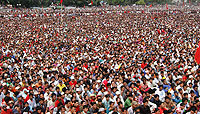
According to BBC World, 6.2, between at least 200,000 and 500,000 people joined the mass rally in Kathmandu, organized by the CPN-M, held on Friday.. Their demands.. from a democratic republic to the continuing struggle for a classless society, aka the Communism..
IHT, NYT published yesterday following article..
Nepal's Maoists come out of the jungle, into the mainstream
Ten years after waging war from their jungle redoubts in the hills, Nepal's Maoists are tiptoeing out onto mainstream political turf, raising hopes for an end to the deadly conflict but also clouds of uncertainty about the country's future.
Maoist cadres are openly organizing meetings in town squares and trolling for what they call "donations" for their party coffers.
Senior leaders who have spent most of the 10 years underground are holding news conferences. A series of rallies across the country culminated with a giant gathering Friday in the capital, Katmandu.
For Nepal, the challenge of reintegrating the rebels could not be more important. The country stands on the brink of historic change and the rebels, in large measure, hold the key to whether it treads the path of war or peace.
The rebels have already scored important victories. In late April, after three weeks of nationwide protests, King Gyanendra ceded control of the state to an interim government. Bowing to a central Maoist demand, a newly reinstated Parliament abolished the king's control over the army. The interim prime minister, Girija Prasad Koirala, says the government will also hold elections to draft a new constitution, another major rebel demand.
The government and the guerrillas held a first round of peace talks. But the challenge now is to see if the rebels can be brought into the fold of Nepal's politics, military and society.
For the time being, the rebels live in limbo, and so does Nepal.
Take the rebels' preparations for the rally Friday. A former guerrilla spent a hot afternoon last weekend emblazoning the walls of this ancient city on the edge of Katmandu with pictures of his commander, nicknamed Prachanda, "the fierce one." He had exchanged his fatigues for a jersey and jeans. His weapon was a paint roller and a bucket of glue. No longer did he have to paint revolutionary graffiti under the cover of dark, as he had only months ago, or dodge the police. Already, he had spent a year in jail.
But asked for his name, the young man was unsure whether to give his real name (Rakesh Bati) or the one he had adopted during his four years underground (Comrade Rahul Shrestha). Either way, the erstwhile Comrade Rahul crisscrossed the narrow lanes of Bhaktapur, slapping up rally posters.
A fellow party worker, Ram Rajkhal, doled out leaflets and collected contributions. Elsewhere, he could be mistaken for a schoolboy selling raffle tickets.
"In the past, they destroyed telephone towers and electricity lines," Bidur Giri, a worker at the timber yard, said quietly from the sidelines. "Now they are saying they'll do something good. I don't know."
A baker studied a poster that had been pasted next to his shop.
"After 10 years of war, there's hope for peace," Bhimsen Sapkota volunteered. "I want to hear what they say. I've never heard them speak." He said he would attend the rally.
The rebels refuse to disarm before elections, out of distrust of the military. But they have said they will sequester their troops under international supervision so long as the military agrees to do the same. Second, the rebels insist that their troops should be integrated into a new national army, a move about which the government is still reticent. Third, they demand that Parliament be dissolved and oppose the restoration of local government institutions in the countryside, much of which they effectively control.
On Thursday, the Maoist spokesman, Krishna Bahadur Mahara, threatened to pull out of peace talks if the last two conditions were unmet.
Both sides want the United Nations to monitor the cease-fire accord and possibly broker talks.
"I'm a confused optimist," said Kanak Mani Dixit, editor of Himal Southasian, a news magazine, and among Nepal's most prominent journalists. "Confused because we need to decide on so many matters now. How to bring the Maoists in, that's the immediate problem - but also how to restructure the state."
In the twilight between war and peace, Nepal remains on edge.
Demonstrations break out in a flash. One day in May, the death of a patient at a hospital in Katmandu prompted a band of protesters to rough up hospital workers and try to set the hospital on fire. The same day, transportation workers erupted in a strike.
The daily disorder is a measure of what is arguably the government's most pressing challenge: to restore stability and assure a restless, still enraged citizenry that the state security forces remain loyal to the state. The army and the police are still widely viewed in this country as having violently repressed the pro-democracy protests in April.
The government suspended three senior commanders of the security forces last month. "The government is looking at security forces with suspicion, the security forces are looking at the government with resentment," said one foreign diplomat in Katmandu, who asked not to be identified to avoid being perceived as meddling in Nepal's internal affairs. "The most essential thing for the political parties now is to realize that things may very, very quickly break down."
The Maoists, meanwhile, have not exactly abandoned their old ways.
Although the number of killings and abductions has plummeted, reports of Maoist violence continue to pour in from the countryside.
In the southern town of Chitwan, the rebels abducted and killed a man they accused of claiming to collect money in the name of the Maoists, according to the independent human rights group Advocacy Forum; his body was dumped in a field.
In the western district of Surkhet, six schoolteachers accused of rape were abducted; one of the kidnapped men escaped, only to be hounded for cash, also according to Advocacy Forum.
Young members of the People's Liberation Army, interviewed during a public rally in the southern village, said they remained prepared for war. "How can you say it's safe or unsafe? There's still uncertainty," said a hotelier, Pratap Tulachan, in the southern town of Butwal. "People are still scared of those days."
Maoist operations have certainly become less furtive. On a Friday afternoon in late May, in the picturesque hillside town of Palpa, a veteran party leader, Pampa Bhusal, sipped tea with comrades and made preparations for a rally to be held the next morning in the main town park.
Bhusal, a central committee member of the Communist Party of Nepal (Maoist), was a lawyer in the capital and a fiery student leader before slipping underground over a decade ago to join the rebellion.
On this day, she could hardly contain her delight at the prospect of returning to Katmandu. Only once in her years underground had she gone home to the city. "One month ago, I worked only underground," she said. "Now I work underground and over ground also."
http://www.iht.com/articles/2006/06/02/news/nepal.php
The Nepalese bourgeois eKantipur reported following..
Tens of thousands attend Maoist mass meet in capital
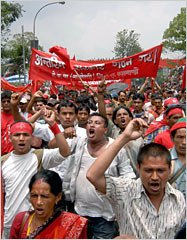
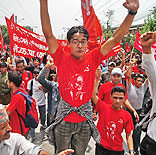
Tens of thousands of people assembled at the Khulla Manch in Kathmandu to attend the mass-meet of the Communist Party of Nepal- Maoist (CPN-M) on Friday.
The entire Tundikhel, Bhotahity, Ratna Park areas and the areas in front of Bir Hospital were jam-packed with people.
People from within and outside the capital assembled to attend the much-publicized mass meet, on a public holiday in the Kathmandu valley to mark the religious festival of Bhote Jatra.
Coordinator of the Maoist team for the government-Maoist talks, Krishna Bahadur Mahara, other members of the rebel team Dinanath Sharma, Dev Gurung, central member Pampha Bhusal, deputy commander of the Maoists' Peoples' Liberation Army (PLA), Prabhakar, and leaders Agni Sapkota , Lekh Nath Neupane and Pawan Kumar Shrestha addressed the gathering.
Addressing the mass-meet, the Maoist leaders said the people's movement would continue until the "ultimate goal" was achieved.
Terming the reinstatement of the House of Representatives (HoR) as a "betrayal,” the rebel leaders repeated their stand on the HoR not being able to meet the "esteemed goals" of the historic people's movement.
Maoist spokesperson Mahara blamed the seven-party government for sticking to its “old agenda” after the reinstatement of the House of Representatives.
“Our party had objected to the move to reinstate the old House which has no relevance in the present context, as it doesn’t represent the aspirations of the popular mass movement,” said Mahara, adding, “The seven parties are trying to move ahead with their own agenda, which is unacceptable to us.”
Mahara, who is also the head of the rebel negotiating team, said that his party is still appealing to the seven parties to “withdraw their stance and join the talks to translate the people’s wishes.”
He also claimed that the people have accepted the Maoists to take up the leadership in the political mainstream.
The mass broke into fervent clapping whenever the speakers expressed their commitment to peace or spoke against the erstwhile royal regime.
Another leader Dinanath Sharma said that his party Chairman Prachanda should lead Nepali politics in the coming days. “We cannot say that our chairman comrade Prachanda will lead Nepali politics for the time being, but we want to assure you that the day has come for him to take up the responsibility for the sake of the nation,” Sharma said.
Maoist women’s leader Pampha Bhusal said that “the government to be formed next should give emphasis on women’s empowerment and bring about a revolution in guaranteeing women’s rights.”

June 4th, 2006 International Day of Solidarity with the Daechuri Villagers
savePTfarmers.org 25.May.2006 12:03
June 4th, 2006 International Day of Solidarity with the Daechuri Villagers
Sunday, June 4th, 2006
In Korea, there will be demonstrations held in solidarity with the villagers of Daechuri and Doduri, who are being evicted to make way for the expansion of US military base, Camp Humphreys.
We are working to organize solidarity vigils around the world on this day.
If you can organize a vigil or demonstration against war and stand in solidarity with the villagers of Daechuri and Doduri on June 4th, please hold one in your area. Rally at the local Korean or US embassy or in front of a local news media outlet. Let them hear your voice!
E-mail us at savePTfarmers[at]yahoo.com and let us know how the vigil went in your area.
Thank you for your support.
http://www.indymedia.org/de/2006/05/839351.shtml