공지사항
-
- '노란봉투'캠페인/국제연대..
- no chr.!
30 YEARS AGO: THE BEGINNING OF THE END OF APHARTEID
The long march to freedom
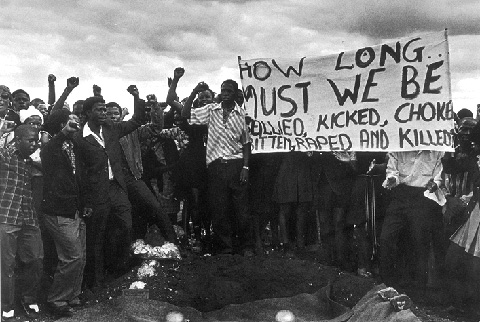
On the morning of June 16 1976, a crowd of 10,000 black students gathered in the South African township of Soweto. They were demonstrating against a decree from the apartheid government that all pupils must learn Afrikaans in school. The protest was peaceful, but police opened fire, and at least 566 people were killed in the events that followed. The massacre brought the brutality of the racist regime to the attention of the world - and, some say, marked the beginning of the end for apartheid. Thirty years on, award-winning photographer Gideon Mendel travelled to Soweto to find out how life is now
Antoinette Sithole, 46
Sister of the murdered Hector Peterson, now a guide at the museum dedicated to her brother
We were told there was going to be change at our school, that we would do maths and geography in Afrikaans. We were surprised, and the teachers weren't pleased about it. That winter in 1976 we thought, let's see what the first term is like. We did the first term tests, and they were disastrous.
The African National Congress and Pan- Africanist Congress were banned at the time but sometimes we would discuss the issue together and eventually they told us there would be a demonstration on June 16. Obviously everyone was thrilled.
The night before, we were so anxious, trying to come up with some banners that would have a big impact. We didn't have many, though "to hell with Afrikaans" was one example. We didn't want to tell our parents.
The day itself started normally, there was no sign of anything. Every day there would be an assembly, and we would be there singing and praying. While we were praying I saw students from Morris Isaacson high school.
I was excited but because we were praying I had to restrain myself. They were singing and chanting, they put us in the mood. Soon we threw our books down and got out our placards. Everyone was waving and singing in the streets of Soweto.
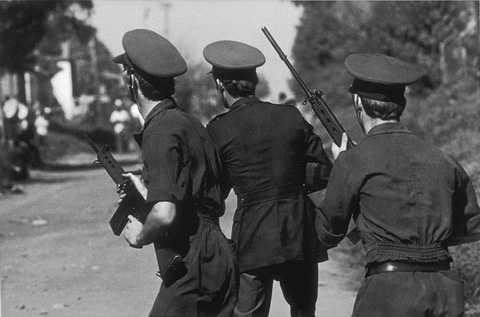
Our leader told us that the police were around the school and emphasised that we weren't to provoke them, otherwise the mission would not be fulfilled. As I was having a discussion with my friends, "bang", there was a shot. We had never thought there would be violence and we ran amok in confusion, hiding ourselves in nearby houses. Later on, when it was calm, we sneaked out again. It was like hide and seek - as soon as we heard shots, we'd hide and then when it calmed down, we came out.
I told my brother to stay next to me while I figured out how we could get home. While I was talking to him there was another shot. We ran back into hiding. When I emerged, Hector wasn't there. I said to myself maybe, because he is young, he is still hiding. The best thing to do, I thought, was to wait there, where I was talking to him, so that when he emerges, he will find me. Meanwhile, students were gathering at a scene. I wanted to go and see but couldn't because I was still waiting for Hector. But when I looked closer, I saw him there with the crowd, as if he was fetching something from them, because he was very tall. I was anxious. I could see the body frame and then I saw blood coming from his mouth. I tried to let them know that this was my brother: I have been waiting for him, can't you see he is hurt? We ran to the clinic, but we could see he was finished.
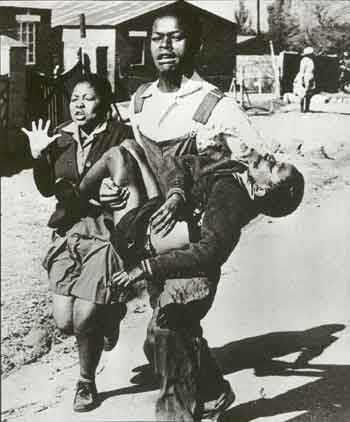
There and then I understood he was dead.
I tell myself now that I have forgiven but I won't forget. It's a part of me I cannot run away from, but I want to move forward in life. I always say those who died did not die in vain. Obviously there are going to be a few hiccups before we get there, but we are now in a process and I am hoping for the best. If we come together as we did in 1976, singing one song, South Africa will be the best country.
Trevor Ngwane, 47
Organiser of the Soweto Electricity Crisis Committee
On June 16 1976, I was still in school in KwaZulu Natal and the protest was a big thing. There was no television at that time, but we heard about it from newspapers. It was frontpage news, and it influenced our own school because a few months later we had some strikes. We had certain grievances as students; we got expelled, went home, had to reapply, so it touched us, it touched me.
Some of the things that the children of 1976 died for and made sacrifices for have not been fulfilled. For example, our education system still leaves a lot to be desired. We have a two-tier education system - private schools and public schools - which is in a bad state.
So you find parents spending money, bussing children into town to get a better education. Universities and colleges are also expensive. Those issues that inspired the students to fight have not been addressed.
In my opinion, anything is better than apartheid. But in socio-economic terms, the situation for the majority of people has worsened. Unemployment, for example, has risen above 40%, which is very high. At the height of apartheid there was almost full employment! Also, when we got our independence in 1994, we had a housing backlog of about a million houses. We had to build a million units. Today our backlog is 3.5 million, which means more people are short of a place to sleep. Ordinary people say, although perhaps to offend the government, that it was better under apartheid. Of course it couldn't have been, but if you compare what we are fighting for, our ideals, and what we are receiving, then certainly we are getting a very raw deal.
In socio-economic terms to compare the black population now and in 1976 - are they worse off? What proportion is better/worse off? I think that is the real issue, as there is a lot of inequality now. Ten per cent are professionals who are OK, maybe another 20% have jobs perhaps in the retail sector, but according to government statistics, 30% of families don't have any kind of income. Research about five years ago showed that the average family income in Soweto is about 1,250 rand (£100), which is pathetic. What's happening is what's occurring in broader South African society; a few are getting the benefits and a few are optimistic, a few see opportunities and can make use of the new openings, but the majority are stuck, even paralysed - they don't know how to find a way out. That's the real problem.
I believe this is a period we have to go through in South Africa. I am certainly optimistic. People don't only learn from books or political speeches and church sermons, they also learn from their own experiences. Slowly but surely people are realising they have to stand up and organise themselves for things to get better. But this isn't an automatic response. People can become xenophobic, blaming Mozambicans, but from what I've seen and from the campaigns that we've fought, I am optimistic
.
Andrew Lekalakala, 51
Teacher at Morris Isaacson school, where pupils gathered on June 16
On June 16, I was in the fifth form. We had meetings at night with other schools talking about how to protest. We met here at this school. Since the arrests of the ANC leaders, the atmosphere wasn't quite normal and we were afraid of being arrested. I wasn't one of the leaders, I was just told what to do.
We decided to march to the police station, to complain about Afrikaans. Then we would march to Pretoria. Morris Isaacson was the meeting place. Many schools met there; our aim was to march to Orlando Stadium.
We were going to show these white people that we could also fight. We went to meet our leaders at Morris Isaacson - they were advising us on what moves to make. They used the term "black power" very strongly, and we sang the slogan. We sang songs insulting the then prime minister (John Vorster): "Vorster's wife doesn't bear children, when she bears children, she bears mice. When Mandela's wife bears children, she bears comrades."
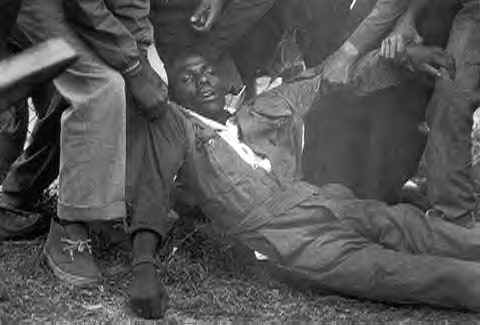
Unfortunately, when we arrived at Orlando, the police stopped us. I think someone told the police we were marching to Orlando Stadium, and when we arrived they were already there. They blocked us there, and that was where Hector Peterson was shot. We saw many bodies.
We ran from Orlando back to Mufulo with police behind us. There was tear gas everywhere. From that day, there was no peace in Soweto. The next day, we burnt everything that belonged to the apartheid government and we didn't attend school all year. This spread from Soweto up to Cape Town, all over South Africa.
We wanted to leave the country but some of our parents refused. We all wanted to join MK (Umkhonto we Sizwe - the armed wing of the ANC) and fight back. Most of our friends crossed, but some - like me - remained here. We struggled, we never stopped until 1994. We even stopped women going to clinics to get contraceptives because we wanted them to bear more children, we wanted more soldiers, no more abortions. We wanted to replace those that were being killed.
In 1979 when Morris Isaacson re-opened, I started to teach there. We had a different calendar from the whites, but we were told when the whites opened, we would open and when they closed we would close. Usually we'd close before June 16, and when we were supposed to open we were told to wait for the whites, so their holidays were longer.
Many pupils now don't take the anniversary seriously, they can't believe something like this happened. Only a few ask questions about it. Most don't care about it, they just go to the festival. Because our students now get everything free, they don't really utilise the opportunities they are given by the government. Under apartheid we were given two opportunities, either become a teacher or a policeman - no other professions.
If you look at our library, it is empty. The government is slow to provide funds but there has been a little bit of change. We are still not up to the standards of the whites. There are children who live in Soweto yet go to white schools and they do so because of resources. It's not because they teach better than us - they have computers, televisions, everything. We want the government to see that our schools are the same as the whites'. I give it five years for everything. (The Guardian, 6.16)
Please read more here:
Inequality still burdens South Africa 30 years after landmark revolt
About the background of the uprising(Wikipedia)
http://en.wikipedia.org/wiki/Soweto_Riots
The following pics were made by the S. African photographer Peter Magubane at the day of the uprising:
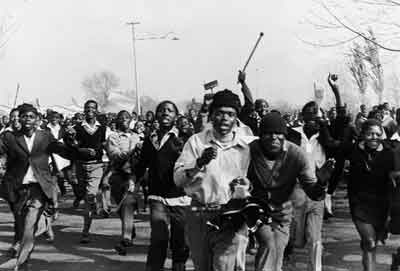
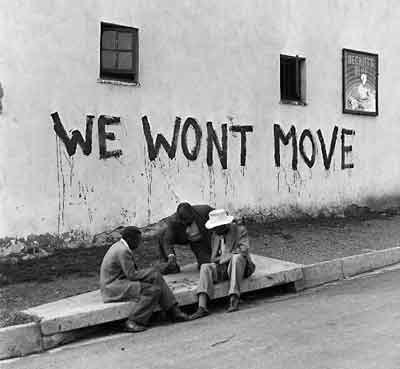

In my opinion the Soweto Uprising have(perhaps) a similar value like Gwangju in
S. Korea..(??)


First of all the latest news by BBC World(6.16, 4:30pm, CET):
"The parliament is to dissolved. A interim parliament is planned, including CPN-M(Communist Party of Nepal-Maoist, the bourgeois media just call them 'Maoists')."
Maoists poised to join Nepali government
(Guardian, 6.16)
The leader of Maoist rebels in Nepal was meeting the country's prime minister on Friday for historic talks that could see the Maoists joining the government and the two sides deciding to hold elections later this year.
In a highly significant political development which could formally end a bloody decade-long internal war, Maoist leader Pushpa Kamal Dahal, better known by his nom de guerre Prachanda (Fierce One) met the prime minister, Girija Prasad Koirala, this morning amid heavy security at his official residence.
They were joined by their negotiating teams, and a source in Kathmandu maintained that the two sides had taken ground-breaking decisions affecting the political future of the nation.
It is expected that the Maoists will join the government and elections will be called for the Constituent Assembly which will adopt a new constitution and decide whether or not to retain what has now been virtually reduced to a ceremonial monarchy.
A solution may be imminent also for the tricky issue of what to do with the arms possessed by the insurgents in the period leading up to the elections.
The Maoists have been demanding that they should be treated on par with the Royal Nepalese Army, with whom they have engaged in bloody battles for more than four years. But the Maoist rebels may agree to surrender their arms under UN supervision providing the international body also monitors all army activity during the elections.
One external stumbling block for this proposal could be objections from India, which has always been opposed to any UN intervention in its neighbourhood. But New Delhi is said now to have agreed to make an exception in Nepal's case, since the political instability in the Himalayan nation has wider ramifications in the region.
Nepal had been trapped in an extended political crisis until April this year, when King Gyanendra reluctantly agreed to reconvene the country's sacked parliament, appoint a new, seven-party government and surrender his powers.
But the vexed question of bringing the armed Maoists into the political mainstream and ending the insurgency still remains unresolved, with the rebels pushing hard for a new constitution and an end to the monarchy.
"A lot of groundwork has been done before today's meeting between GP [Koirala] and Prachanda, and the two leaders appear to have an excellent rapport," said the source from Mr Koirala's ruling Nepali Congress party. "There's broad agreement on major issues, and some solution will also be found to break the deadlock on the monarchy question."
Some of these decisions were taken at the second round of talks between government and Maoist negotiators held in the capital on Thursday. In an effort to boost the peace process, it was decided to adjourn parliament for 18 days, meeting halfway Prachanda's demand for its dissolution.
Thursday's talks at a hotel in Kathmandu, when the Koirala-Prachanda 'summit' was also announced, had apparently been preceded by several secret meetings. The two sides appear to be following a shrewd strategy, thrashing out differences in secret and appearing in the media glare for formal "talks" only when they have something concrete to announce.
The Koirala-Prachanda meeting appears to have been similarly planned. Even though the media believes this is the first-ever "historic" meeting between the two leaders, they are said to have quietly met at least once earlier, and got along well enough to be able to trust each other. As a result, even the sharp differences over the future of the monarchy between the two leaders may find a resolution.
"In any case, though GP believes Nepal needs a ceremonial monarchy, he is ready to accept whatever decision the Constituent Assembly takes on this issue," said the party source.
http://www.guardian.co.uk/international/story/0,,1799362,00.html
eKantipur reported this today afternoon:
Govt-Maoist summit talks conclude with an eight point agreement
The Summit talks between the Seven-Party Alliance (SPA) government and top Maoist leaders held in the Prime Minister's Residence at Baluwatar has concluded with an eight point agreement.
Addressing the press conference after the talks, Home Minister and chief government negotiator Sitaula said that the two sides have reached a historic eight point agreement.
"I hope this agreement will be helpful in resolving the poblems the country is facing," Sitaula said.
Maoist leaders Prachanda, Dr. Baburam Bhattarai, members of the Maoist talks team are present with Home Krishna Prasad Sitaula in the conference.
Civil society leaders Dr. Devendra Raj Pandey, Damannath Dhungana and Padmaratna Tuladhar and top SPA leaders are among others present in the conference.
Please read the full article here:
Nepal PM and rebel leaders meet
(Washington Post/Reuters, 6.16)
Nepal's Maoist rebel chief Prachanda began talks with Prime Minister Girija Prasad Koirala on Friday in a bid to iron out differences before holding landmark elections and drafting a new constitution. The talks in Kathmandu between Koirala, who heads a multi-party, interim administration, and Prachanda was the first known high-level meeting between the rebels and the government since the revolt began 10 years ago.
"The main agenda for the meeting is to discuss early elections for the constituent assembly and solve the political hurdles for this," rebel spokesman Krishna Bahadur Mahara said.
Prachanda, whose assumed name means Awesome, has led a bloody war against the monarchy in the impoverished Himalayan nation in which more than 13,000 people have been killed.
Speaking to Reuters in a rare interview in western Nepal on Thursday, he said peace talks with the government which started in May were largely back on track after initial troubles.
But differences remained over a Maoist demand for the dissolution of the reinstated parliament before elections for a special assembly to draft a new constitution that would decide the future of monarchy, he said.
On Friday, Prachanda flew into Kathmandu in a private helicopter and drove straight to Koirala's high-security official residence in the heart of the capital.
He was accompanied by his second-in-command, Baburam Bhattarai, and Home Minister Krishna Prasad Sitaula as they arrived at Koirala's house.
Soldiers behind sandbag bunkers kept vigil while dozens of Maoist guerrillas in plainclothes, and apparently unarmed, prevented media cameramen from taking pictures.
The government and the rebels are observing a ceasefire for more than a month after weeks of street protests in April forced King Gyanendra to end his absolute rule and hand power back to political parties.
http://www.washingtonpost.com/wp-dyn/content/article/2006/06/16/AR2006061600104_pf.html
Nepalese leader and rebel chief meet for talks
(IHT/AP, 6.16)
The elusive leader of communist rebels in Nepal flew to the capital Friday and held an unprecedented meeting with the prime minister aimed at resolving the country's decade-old insurgency, an official said.
The rebel leader, Prachanda, and a deputy were escorted into the residence of Prime Minster Girija Prasad Koirala in Katmandu under heavy security, a Koirala aide said on condition of anonymity.
It was the first meeting between Prachanda, whose real name is Pushpa Kamal Dahal, and the country's top leader since the insurgency began in 1996.
Reporters and photographers who were camped outside Koirala's house were not allowed near the cars transporting the rebels. It was not clear how long the meeting would last.
"The meeting between the prime minister and Prachanda will center on settling major political issues," Tourism Minister Pradeep Gyawali, who is also member of the government peace talks team, had said before the meeting.
Government and Maoist rebel negotiators had met Thursday for a second round of peace talks.
"We have decided that there will soon be a meeting between top Maoist leaders and leaders of the seven-party ruling alliance," Home Minister Krishna Sitaula said after Thursday's meeting. "They will decide on the major issues."
Prachanda used to be rarely seen, and only then in the remote villages controlled by the rebels.
At the two-hour peace talks Thursday in the capital, rebel and government representatives agreed to form a monitoring committee comprising peace activists and human rights workers, with help from the United Nations.
The first round of talks to end the conflict took place last month when the two sides agreed on a code of conduct and said they would meet for talks again.
The new government in Nepal took office after King Gyanendra agreed to relinquish control in April following weeks of anti-monarchy protests and a general strike.
The unrest was organized largely by the politicians now in power and backed by the rebels - a bond that smoothed the way for the peace dialogue.
The new government has released hundreds of rebels from jail, dropped terrorism charges against them, and agreed to a cease-fire. It also has agreed to rewrite the constitution, a key rebel demand that crippled peace talks in 2001 and 2003.
The rebels, who claim to be inspired by the Chinese revolutionary Mao Zedong, began fighting to replace the constitutional monarchy with a communist state in 1996.
http://www.iht.com/articles/2006/06/16/news/web.0616nepal.php
Meanwhile just three days ago..
..Nepal scraps anti-terror laws
(CNN/AP, 6.13)
Hundreds of communist rebels to be freed from jails
Nepal's government has scrapped anti-terrorism laws and withdrawn cases against hundreds of jailed communist rebels after rebel leaders met with a government minister, officials said.
Several Maoist rebels had been freed since the government and the rebels declared a cease-fire and began peace talks in the past few weeks. However, hundreds had remained in jail charged under the anti-terrorism laws.
The Cabinet met and decided anyone arrested or imprisoned under a tough anti-terrorism law imposed by the previous royal government would be freed, Information Minister Dilendra Badu said told reporters Monday after the meeting.
Rebel spokesman Krishna Mahara confirmed that the government had pledged to free 350 of their jailed members and supporters starting Monday.
The Cabinet decision followed a meeting between Home Minister Krishna Sitaula, and rebel leader Prachanda and his deputy Baburam Bhattarai at a remote mountain village on Sunday.
"The meeting has cleared all doubts and confusion that appeared to have obstructed the peace talks," Mahara told reporters Monday in the capital, Kathmandu.
He said the two sides had been at odds since the first round of peace talks between the government and rebel negotiators last month -- the first since they declared a cease-fire.
Prachanda, whose real name is Pushpa Kamal Dahal, has accused the government and ruling seven-party alliance of focusing on minor issues rather than key elements of the peace process, such as creating a more inclusive interim government.
The anti-terrorism laws were enforced by the previous government of King Gyanendra to hunt down and prosecute rebels.
Many rebels had been charged with murder, kidnappings and crimes against the state under the anti-terrorism laws.
Weeks of street protests by the alliance of seven major political parties forced Gyanendra to give up powers, reinstate Parliament and appoint Girija Prasad Koirala as prime minister in April.
Since then, the new government and the rebels have declared a cease-fire and have been holding peace negotiations to end the conflict that has killed more than 13,000 people.
http://edition.cnn.com/2006/WORLD/asiapcf/06/12/nepal.terror.laws.ap/index.html
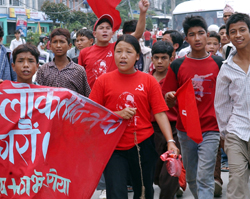
A BBC portrait for CPN-M chairman Prachanda(independent stuff about him is not to find until now..):

최근 덧글 목록