사이드바 영역으로 건너뛰기

게시물에서 찾기2006/06/22

3개의 게시물을 찾았습니다.

  1. 2006/06/22
    北 미사일.. #2
    no chr.!
  2. 2006/06/22
    네팔뉴스 #40..(인터뷰)
    no chr.!
  3. 2006/06/22
    北 미사일.. #1
    no chr.!

北 미사일.. #2


Now, not even 24 hours after my last contribution about this issue, the US administration made it clear that they don't want even to think about bilateral talks with the DPRK(actually it was clear from the beginning that they will reject this kind of "offer"..). ``You don't initiate talks by threatening to launch an ICBM(inter-continantal ballistic missile),'' Bolton, the U.S. envoy to the U.N. said.


And finally some US ex-politicians are calling now for military strikes against DPRK's missile sites(please see the last two articles).


Just a short while ago AP reported following:


China Concerned Over N. Korea Missile Test


China issued its strongest statement of concern yet Thursday over a possible North Korean long-range missile launch, while Pyongyang warned of possible clashes in the skies as it accused U.S. spy planes of repeated illegal intrusions.

Beijing is the North's last major ally and key benefactor, and Washington has urged China to press the North to back down on its potential missile test.

``We are very concerned about the current situation,'' Jiang Yu, a Chinese Foreign Ministry official, said at a regular briefing in Beijing. ``We hope all parties can do more in the interest of regional peace and stability.''

Jiang said China would ``continue to make constructive efforts.''

President Bush praised China on Wednesday for ``taking responsibility in dealing with North Korea.''

Worries over a potential North Korean launch have grown in recent weeks following reports of activity at the North's launch site on its northeastern coast, where U.S. officials say a Taepodong-2 missile - believed capable of reaching the United States - is possibly being fueled.


Read the full article here:

http://www.guardian.co.uk/worldlatest/story/0,,-5903911,00.html


And the semi-official S.K. newsagency Yonhap published this:


N. Korea's next step draws keen attention


As the United States turned town North Korea's repeated appeals for direct talks over a possible missile test, Pyongyang's next move remains unpredictable, analysts here say.

They say North Korea appears to be in dilemma over whether to go ahead with the missile launch in the face of strong warnings from the U.S. and Japan.

U.S. officials have stuck to a firm stance against any bilateral talks with North Korea outside of the Beijing-based six-nation talks on Pyongyang's nuclear program.

Speaking to Yonhap News Agency earlier this week, Han Song-ryol, deputy head of the North's mission to the United Nations, said his country has a right to own a ballistic missile and test it.

"We are aware of the U.S. concerns about our missile test-launch. So our position is that we should resolve the issue through negotiations," he said. It was the highest-profile response from North Korea on the recent reports of its preparations for the launch of the so-called Taepodong-2, which is said to be able to fly as far as the western United States.


Read the entire stuff here:

http://english.yna.co.kr/Engnews/20060622/610000000020060622161806E5.html


IHT/AP:

Japan makes moves to monitor North Korea


Washington Post published today following article:


Former Defense Officials Urge U.S. Strike on North Korean Missile Site


Former defense secretary William J. Perry has called on President Bush to launch a preemptive strike against the long-range ballistic missile that U.S. intelligence analysts say North Korea is preparing to launch.


In an opinion article(*) that appears in today's Washington Post, Perry and former assistant defense secretary Ashton B. Carter argue that if North Korea continues launch preparations, Bush should immediately declare that the United States will destroy the missile before it can be fired.


Perry and Carter suggest using a cruise missile launched from a submarine and carrying a high-explosive warhead. "The effect on the Taepodong would be devastating," they write, using the name of the Korean missile. "The multi-story, thin-skinned missile filled with high-energy fuel is itself explosive -- the U.S. airstrike would puncture the missile and probably cause it to explode. The carefully engineered test bed for North Korea's nascent nuclear missile force would be destroyed."


As President Bill Clinton's defense secretary, Perry oversaw preparation for airstrikes on North Korean nuclear facilities in 1994, an attack that was never carried out. He has remained deeply involved in Korean policy issues and is widely respected in national-security circles, especially among senior military officers. He has been a critic of the Bush administration's approach to North Korea.


"We believe diplomacy might have precluded the current situation," Perry and Carter said. "But diplomacy has failed, and we cannot sit by and let this deadly threat mature."

Perry and Carter say that such a strike "undoubtedly carries risk" but that there would be no damage to North Korea beyond the missile galley. They argue that the unproven U.S. missile-defense system might not be able to shoot down a missile.


Meanwhile, there were some signs that South Korea, where officials have expressed skepticism over U.S. intelligence regarding an imminent missile launch, might be willing to step up pressure on the North. Yesterday, Kim Dae Jung, the former South Korean president, postponed a much-lauded visit next week to the North Korean capital, Pyongyang, because of the rising tensions.


"Because of the unforeseen situation, it has become difficult" for Kim to visit North Korea, Jeong Se Hyun, a former top aide to Kim, told reporters.


In addition, South Korea's unification minister, Lee Jong-Seok, was widely quoted in the country's press as suggesting that continued investment and humanitarian aid to North Korea might be curbed if Pyongyang conducts a missile test. In a meeting with opposition leaders from South Korea's Grand National Party, which has criticized the administration of President Roh Moo Hyun for being soft on North Korea, Lee was quoted by the Korea Times as saying Seoul "will not pretend as if nothing has happened in the event of North Korea test-firing a missile."


Also yesterday, the U.S. ambassador to Japan reiterated that "all options are on the table" with regard to North Korea.


Asked whether the United States would attempt to shoot down the North Korean missile if launched, J. Thomas Schieffer warned in an interview that "we have greater technical means of tracking it than we had in the past, and we have options that we have not had in the past."

http://www.washingtonpost.com/wp-dyn/content/article/2006/06/21/AR2006062101838.html


* If Necessary, Strike and Destroy
North Korea Cannot Be Allowed to Test This Missile


By Ashton B. Carter and William J. Perry


North Korean technicians are reportedly in the final stages of fueling a long-range ballistic missile that some experts estimate can deliver a deadly payload to the United States. The last time North Korea tested such a missile, in 1998, it sent a shock wave around the world, but especially to the United States and Japan, both of which North Korea regards as archenemies. They recognized immediately that a missile of this type makes no sense as a weapon unless it is intended for delivery of a nuclear warhead.


A year later North Korea agreed to a moratorium on further launches, which it upheld -- until now. But there is a critical difference between now and 1998. Today North Korea openly boasts of its nuclear deterrent, has obtained six to eight bombs' worth of plutonium since 2003 and is plunging ahead to make more in its Yongbyon reactor. The six-party talks aimed at containing North Korea's weapons of mass destruction have collapsed.

Should the United States allow a country openly hostile to it and armed with nuclear weapons to perfect an intercontinental ballistic missile capable of delivering nuclear weapons to U.S. soil? We believe not. The Bush administration has unwisely ballyhooed the doctrine of "preemption," which all previous presidents have sustained as an option rather than a dogma. It has applied the doctrine to Iraq, where the intelligence pointed to a threat from weapons of mass destruction that was much smaller than the risk North Korea poses. (The actual threat from Saddam Hussein was, we now know, even smaller than believed at the time of the invasion.) But intervening before mortal threats to U.S. security can develop is surely a prudent policy.


Therefore, if North Korea persists in its launch preparations, the United States should immediately make clear its intention to strike and destroy the North Korean Taepodong missile before it can be launched. This could be accomplished, for example, by a cruise missile launched from a submarine carrying a high-explosive warhead. The blast would be similar to the one that killed terrorist leader Abu Musab al-Zarqawi in Iraq. But the effect on the Taepodong would be devastating. The multi-story, thin-skinned missile filled with high-energy fuel is itself explosive -- the U.S. airstrike would puncture the missile and probably cause it to explode. The carefully engineered test bed for North Korea's nascent nuclear missile force would be destroyed, and its attempt to retrogress to Cold War threats thwarted. There would be no damage to North Korea outside the immediate vicinity of the missile gantry.


The U.S. military has announced that it has placed some of the new missile defense interceptors deployed in Alaska and California on alert. In theory, the antiballistic missile system might succeed in smashing into the Taepodong payload as it hurtled through space after the missile booster burned out. But waiting until North Korea's ICBM is launched to interdict it is risky. First, by the time the payload was intercepted, North Korean engineers would already have obtained much of the precious flight test data they are seeking, which they could use to make a whole arsenal of missiles, hiding and protecting them from more U.S. strikes in the maze of tunnels they have dug throughout their mountainous country. Second, the U.S. defensive interceptor could reach the target only if it was flying on a test trajectory that took it into the range of the U.S. defense. Third, the U.S. system is unproven against North Korean missiles and has had an uneven record in its flight tests. A failed attempt at interception could undermine whatever deterrent value our missile defense may have.


We should not conceal our determination to strike the Taepodong if North Korea refuses to drain the fuel out and take it back to the warehouse. When they learn of it, our South Korean allies will surely not support this ultimatum -- indeed they will vigorously oppose it. The United States should accordingly make clear to the North that the South will play no role in the attack, which can be carried out entirely with U.S. forces and without use of South Korean territory. South Korea has worked hard to counter North Korea's 50-year menacing of its own country, through both military defense and negotiations, and the United States has stood with the South throughout. South Koreans should understand that U.S. territory is now also being threatened, and we must respond. Japan is likely to welcome the action but will also not lend open support or assistance. China and Russia will be shocked that North Korea's recklessness and the failure of the six-party talks have brought things to such a pass, but they will not defend North Korea.


In addition to warning our allies and partners of our determination to take out the Taepodong before it can be launched, we should warn the North Koreans. There is nothing they could do with such warning to defend the bulky, vulnerable missile on its launch pad, but they could evacuate personnel who might otherwise be harmed. The United States should emphasize that the strike, if mounted, would not be an attack on the entire country, or even its military, but only on the missile that North Korea pledged not to launch -- one designed to carry nuclear weapons. We should sharply warn North Korea against further escalation.


North Korea could respond to U.S. resolve by taking the drastic step of threatening all-out war on the Korean Peninsula. But it is unlikely to act on that threat. Why attack South Korea, which has been working to improve North-South relations (sometimes at odds with the United States) and which was openly opposing the U.S. action? An invasion of South Korea would bring about the certain end of Kim Jong Il's regime within a few bloody weeks of war, as surely he knows. Though war is unlikely, it would be prudent for the United States to enhance deterrence by introducing U.S. air and naval forces into the region at the same time it made its threat to strike the Taepodong. If North Korea opted for such a suicidal course, these extra forces would make its defeat swifter and less costly in lives -- American, South Korean and North Korean.


This is a hard measure for President Bush to take. It undoubtedly carries risk. But the risk of continuing inaction in the face of North Korea's race to threaten this country would be greater. Creative diplomacy might have avoided the need to choose between these two unattractive alternatives. Indeed, in earlier years the two of us were directly involved in negotiations with North Korea, coupled with military planning, to prevent just such an outcome. We believe diplomacy might have precluded the current situation. But diplomacy has failed, and we cannot sit by and let this deadly threat mature. A successful Taepodong launch, unopposed by the United States, its intended victim, would only embolden North Korea even further. The result would be more nuclear warheads atop more and more missiles.


Ashton B. Carter was assistant secretary of defense under President Bill Clinton and William J. Perry was secretary of defense. The writers, who conducted the North Korea policy review while in government, are now professors at Harvard and Stanford, respectively.

http://www.washingtonpost.com/wp-dyn/content/article/2006/06/21/AR2006062101518.html


진보블로그 공감 버튼트위터로 리트윗하기페이스북에 공유하기딜리셔스에 북마크

네팔뉴스 #40..(인터뷰)

INTERVIEW WITH PRACHANDA (by Kishor Nepal, 6.20)


Excerpts of a recent interview with Chairman of the Communist Party of Nepal (Maoist), Prachanda alias Pushpa Kamal Dahal:
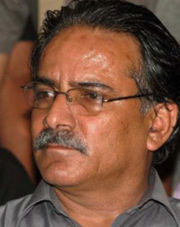


Q. Which name do you prefer to be addressed by- Chairman, Prachanda or Puspa Kamal Dahal?
 
Prachanda: I prefer Chairman and Prachanda. The name Puspa Kamal Dahal represents a certain culture while the name Prachanda represents a feeling and ideology that intends to take the whole country forward independently. Therefore, I want that all of my friends and the Nepali people recognise me with the name Prachanda.
 
Q. Your name has caused a big shake-up in the political sector. You remained underground for 25 years. Now you have abandoned the underground life and entered public life. How do you feel?
 
Prachanda: I had a different life before I went underground. I used to teach Science in High School. I was involved in politics as well. I was a member of the Party. We boycotted the Panchayat elections of 2038 BS(*). Then I became totally underground. My situation after the 1990 popular movement was almost like it is today. I was open to the media and was not completely underground. A totally new process began after the start of the People's War (in 1996). Now the situation is somewhat similar to 1990.
 
Q. You have suddenly landed on the liberal political ground from a violent political base, especially after the 12-point understanding with the seven parties. What were the reasons behind the understanding?
 
Prachanda: Our political base was not that rigid. Ours is a party which had to wage a People's War for just rights despite entering Parliament. We were the third largest party in Parliament.... We lawfully tried to raise some issues- issues related to nationality, people's daily requirements and democracy- even back then. We are not rigid. What we said even after starting the People's War is that we are not communists of the traditional type. Even after the start of the People's War, we have always been ready to accept the people's verdict. We had told the government during the very first peace talks let's hold constituent assembly elections; that the solution to our problem lay there. We were never into rigid politics. We were very much wide and flexible.
 
Q. You took up arms for political change. Isn't that rigid?
 
Prachanda: To take up weapons is just a form of politics. I don't think you become rigid once you take up arms. Taking up weapons is also a form of flexibility.
 
Q. While talking about dialogue and sustainable peace, you once said, in a different context though, that even the king was acceptable?
 
Prachanda: I didn't say this in that sense. What I had said is we are ready to accept what the people decide through constituent assembly elections. We are ready to accept if the people's verdict is in favour of the king or monarchy...The situation was different when Birendra was the king. In our understanding, the relevance of king and monarchy ended after the royal palace massacre.
 
Q. You said the relevance is over. But you twice held talks with the governments of the same irrelevant king. What was the compulsion?
 
Prachanda: The relevance is over indeed. Right after the royal palace massacre, we said the institutional development of republicanism was necessary in Nepal. We are still firm and clear on this stand. As regards to the issue of talks; a war was on between two forces. The initiatives for talks had been taken to avoid further bloodshed between the two sides. It didn't mean we accepted the relevance of monarchy.... When the UML and Deuba were in power last time, we said we would hold talks with the master not with the servants. Because we thought talks would mean something only if we knew who had the real power. Enough talking was done with the parties. But nothing happened.
 
Q. Who first saw the need for the 12-point understanding after the king began his direct rule- you or the parties?
 
Prachanda: On our part, we had seen the historic importance of the unity between our party and the parliamentary parties right after the royal palace massacre. But the seven parties didn't listen to us. We had said also in the Siliguri (India) meeting that a working unity was needed between the parties and us. On their part, the seven parties, too, couldn't do much for the people in the democratic period. The parliamentary parties were so much indulged in their power games that they could not grasp what we were trying to say, or let's say we could not make them understand properly. Their situation was totally different after February 1, 2005. Then the seven parties came and we signed the 12-point understanding.
 
Q. Had any international power pushed you or the seven parties towards each other?
 
Prachanda: It's both. If you talk negatively, Gyanendra pushed us towards each other. His negative actions pushed us towards each other. I doubt if this change would have come, hadn't some international powers, mainly India, urged us (Maoists and parties) to "do something" jointly. Had the seven parties somebody who could think independently, the country would have been different right after the royal palace massacre. The country would not have suffered this much, had there been leaders who could think for themselves. This time, India helped the 12-point understanding in a positive way.
 
Q. To the seven parties?                                     
 
Prachanda: Let's not say seven parties; mainly the UML and the Nepali Congress.
 
Q. But no understanding seems to be building between you and the UML?
 
Prachanda: It is building as per the need. They, too, are in the seven-party alliance, apparently. Let's say it's building. But they might be thinking that they would lose their ground if we enter peaceful politics. In our opinion, it's a narrow-minded thought. Let me tell you one thing, our talks team was in Kathmandu during the first round of talks. We were raising the issue of constituent assembly. There was a wave of encouragement among the people. The then Prime Minister Deuba was not in a position to do anything on the issue of constituent assembly. After we realised that the peace talks were going nowhere, we planned to attack Dang. After the attacks in Dang, the UML leaders became happy. May be they thought that it would be a great loss to the UML if we entered peaceful politics. But this was not on our mind. We were concerned about giving an outlet to the crisis and taking the country forward. They thought "Thank God! You saved us" when we attacked Dang.
 
Q. A huge shakeup took place after the 12-point understanding. The House of Representatives was restored and it took a lot of decisions. You have come out in public and look very calm and relaxed. It seems as if you are eagerly enjoying the talks. What is the truth?
 
Prachanda: This is not the truth. Though it looks that way, it's not like that. The 12-point understanding was reached after a lot of hard work. This is something our party had been thinking about for the past four years. Our Indian friends had contacted and talked with us before the king's coup. We were in Rolpa then. But the right environment for it was created only after Gyanendra took over on February 1. There isn't that much brainwork done by the seven parties behind the 12-point understanding. It would have been great had this understanding been built on their (seven parties') own vision. The understanding lacks depth as it was formed amidst the negative moves of Gyanendra and India's advice (to the seven parties and Maoists) to move ahead positively. We had told the seven parties when they put forward the House restoration issue that this will provide the king and monarchy a back door. Even among the seven parties, six were not in favour of House restoration. But the Nepali Congress could not give up this slogan. Girijababu could not abandon it. We knew that a design was hidden in this (House restoration) slogan...We knew this a year before the 12-point understanding was reached. We went ahead with the understanding despite knowing this. We had no other alternative to agitate the Nepali people to a new level of awareness.
 
Q. Dialogue with India was on while you were still in Rolpa, before the King's coup?
 
Prachanda: We were in direct contact. Indian friends were there. They said the House should be restored. We said House restoration had no relevance. It is our conclusion that the people have stood up now in this fashion because of the 10-year long People's War and the 12-point understanding. The people stood up under the cover of the 12-point understanding because a direct confrontation through the People's War would lead to much bloodshed. House restoration was not the people's demand. This was not even on their mind. We have taken it (House restoration) as a recurrence of what happened in 1951. Therefore the people still need to be alert.
 
Q. But the mass movement has stopped?
 
Prachanda: Rather than saying the movement stopped, let's say it was time to change its form. There was no situation for the movement to go on the way it was going. It was slightly divided as well. There was a change in the political situation.
 
Q. How can the talks move forward in such an artificial environment?
 
Prachanda: This thing is very important. We will stick to the dialogue process till the end. It is our objective that a peaceful outlet is found. But the seven-party leaders are creating an artificial environment. They are doing the opposite. Not respecting the people's feelings. We want to keep the pressure on from the ground... If the talks fail, there will definitely be an October Revolution of its own kind in Nepal. We are ready to lead that revolution.
 
Q. This means you are ready to wait till October?
 
Prachanda: What I mean, in clear words, is that if the seven parties do not understand by October, then the situation will move towards an October Revolution.
 
Q. How optimistic are you? Do you doubt Girija Prasad Koirala's honesty?
 
Prachanda: Rather than Koirala's honesty, how he will run the politics is the major thing. In my first meeting with him three years back, I had told him "You accept a republic, we will accept multiparty. Then the country will become new. Let's make a new Nepal." He had replied immediately, "Congress cannot go for a republic right now." He is still where he was three years back. He mentioned ceremonial king only yesterday. But this ceremonial thing doesn't work in Nepal. This proves how much rigid he is. This concept of a ceremonial king will not work- one, because of the army, and two, because of the king's own character.
 
Q. Do you personally feel that the talks will be successful?
 
Prachanda: I don't think the seven-party leaders are in favour of making the talks successful. And I don't think the international power centres, too, are in favour of giving Nepal and Nepalis a forward-looking exit from the current crisis by making the talks successful. To tell you directly, I haven't seen the signs for the talks to be successful. But again, the Nepali people want the talks to be successful and our party, too, wants the same. It depends on how much the people's and our party's initiatives can be taken forward. The talks will be successful if the pressure can be increased.
 
Q. What kind of republicanism is it that you have been talking about?
 
Prachanda: There shouldn't be the parliamentary republicanism, which is in practice in other countries, in Nepal. That doesn't solve the problem. There's no question of an autocracy. We need a republicanism of our own kind.
 
Q. You have envisioned a people's republic, no?
 
Prachanda: Mao Zedong's People's Republic cannot fulfill the needs of today's world. It cannot address today's political awareness appropriately. Mao said cooperative party theory; we called it competitive party theory. We have said let's move ahead from the conventional People's Republic and develop it as per the specialties of the 21st century. 
 
Q. You do not follow the old concept of communism?
 
Prachanda: Definitely not. What happened without competition? In the USSR, Stalin gave no place to competition and went ahead in a monolithic way. What was the result?
 
Q. Let's talk about the economy. The 21st century world is a free-market world. How do you see the open market economic policy?
 
Prachanda: The economy should not be given a free rein in the name of a free market. We should take the middle way. Words like libralisation and globalisation are being much touted these days. But if you look at it closely, the very supporters of these theories have not implemented it in their own countries. The most powerful countries and America themselves have not implemented it. They have referred it to the poorest countries. Competition has been referred to undeveloped countries. We are against that policy. It's not right.
 
Q. The country's resources haven't increased. The number of mouths to feed has. In such a situation, do you think the country's development is as easy as you are saying?
 
Prachanda: I think development is not that difficult a thing. The main thing is what policies and plans the state adopts and what kind of programmes it brings forward for the millions of people. This is the main thing. One hundred years back, we were very much self-dependent. We were not economically weaker than others. If you compare us with many countries of the world, you will know that we are not weak. Others kept progressing and we kept going downhill. We have serious problems in the policies adopted by the state. What I think is if the state has the right programmes and vision, then there are only 200 million mouths but 400 hands. If the 400 million hands are put to work in the right way, imagine where this could take the country in 10 years.
 
However, we have to cut down certain things to save money. I have been saying that we do not need this 90 thousand-strong army. We can cut it down by 80 thousand. 10 thousand is enough. And then see how much capital we will have. It's not out of any personal grudge that we want to abolish the monarchy. They have amassed hundreds of billions of rupees. Imagine the kind of capital we will have if that is nationalised. Won't miracles happen if we then mobilise the 400 million hands? We can earn millions from our herbs. We have so much Yarchagumba(**). Let's open processing factories where it is found. Thousands will get jobs and we can earn hundreds of millions of rupees. Money will start growing there.
 
Q. You just mentioned about decommissioning the army. What will happen to your army?
 
Prachanda: The same for the Liberation Army. I have also been training them now. There is no use of increasing the number of our army, either. We don't have the status to beat the Indian or the Chinese army even with our 30 thousand and the 90 thousand-strong royal army. We don't have the status to beat anyone. You go through history; the only thing the Nepali Army has done after the Sugauli Treaty is to kill the people. We can ensure security by forming the people into a militia. If all citizens are made to undergo a five-year military training, there will be 250 million soldiers ready. Once that army is ready, even if India or China attacks, we can save the country. But even if we make a 500 thousand-strong army and keep it in barracks, it cannot fight anyone. What's the use of it?
 
Q. That means the management of arms and armies will not be a stumbling block on the way to a constituent assembly?
 
Prachanda: In my opinion, it will not and should not. If the seven-party leaders are really serious about the country, peace and development, this problem will not come. It will not come from our side. We are going to put forward this proposal. I have already talked about it. Let's cut down the armies of both sides. Let's train the people into a militia. The militia will maintain law and order. Let's keep the army only to train the people.
 
Q. Business people, industrialists and entrepreneurs are a little concerned about you. Their fear is if you can give them so many problems as a powerful party, you will squeeze them once in power.
 
Prachanda: We encourage those who want to develop industries in the country, create jobs, make profits and invest the profits in the country. We are organising a national meet of the capitalists. There, we will invite even those who disagree with us. We want that Nepal's capital does not go outside. We are clear that there will be no development in Nepal unless the capitalists can make some profit. But let that profit not be through exploitation and let it also not go abroad. We are also going to propose to the capitalists to invest where the most profit can be made. We should introduce a strict law to stop those who earn here and deposit the money in America or India.


*   1982
**  Yarchagumba = "a rare species of plant widely used both in clinical medicine and as a household remedy. It is also considered potent at strengthening lung and kidneys, increasing energy and vitality, stopping hemorrhage, decreasing phlegm, and as an overall tonic."


Well, in my opinion this interview is a very important statement and we should "study" it very well and check out what comes as next.. More about it, I'll write in the next days(btw, I have some problems with it..).


 
Background informations about Prachanda(主席同志^^) you can read here:


진보블로그 공감 버튼트위터로 리트윗하기페이스북에 공유하기딜리셔스에 북마크

北 미사일.. #1


Latest news, comments and analysis

about the missile "madness"
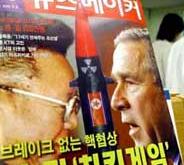


First of all: the f.. missile is still in its hole!

But of course - no wonder - KJ Kim's trip to P.Y. is cancelled as one of the first(foreseeable) results of the latest developments.

Meanwhile - of course it was also pedictable - the S.K. govt is threatening the DPRK with the stop of("additional") economic and humanitarian help(Yonhap, Korea Times).

And the US administration's position: "All options are still on the table", a.k.a. everything can be happen, incl. a military option(just watch CNN's stuff쟯n the end of my contribution..).

And finally, of course also foreseeable: the DPRK is offering the US administration bilateral negotiations to solve the "missile problem"(on the other side the DPRK said that it has all rights to launch a satellite..).


IHT published in the last two days following articles:

North Korea's very bad idea (NYT)

South Korea's ex-leader won't visit North

U.S. Readies System For Missile Detection? (Washington Post)
Use Against N. Korean Launch Discounted

The U.S. military yesterday moved ships into position off the coast of North Korea to detect the launch of any long-range ballistic missiles and prepared its new, unproven missile-interception system to attempt a response if necessary.

Please read the full article here:

http://www.washingtonpost.com/wp-dyn/content/article/2006/06/20/AR2006062001446.html


The latest comment published y'day in Asia Times(HK/China) you can read here:

Pyongyang will shoot itself in the foot(harrharr, finally a kind of surprising..)

Before y'day the same magazine published following analysis:

There's method in the missile madness

..and some backgrounds about the DPRK's missile development program and export:

Pyongyang's global reach

And finally here you can watch the latest contribution in CNN Intl. TV program(6.21):


North Korea's plan to launch a long-range missile prompts U.S. concern

http://edition.cnn.com/video/player/player.html?url=/video/world/2006/06/20/starr.north.korea.missle.launch.dod 


And last but not least the S.K. "left-liberal" daily Hangyeore wrote this y'day:

Expert says N.K. missile could carry nuclear payload 12,000 km
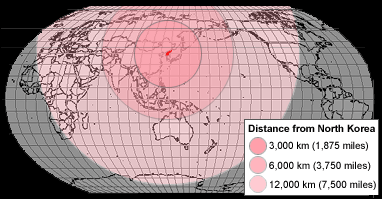


(..oops, what a great idea!!)


진보블로그 공감 버튼트위터로 리트윗하기페이스북에 공유하기딜리셔스에 북마크

  • 제목
    CINA
  • 이미지
    블로그 이미지
  • 설명
    자본주의 박살내자!
  • 소유자
    no chr.!

저자 목록

달력

«   2006/06   »
        1 2 3
4 5 6 7 8 9 10
11 12 13 14 15 16 17
18 19 20 21 22 23 24
25 26 27 28 29 30  

기간별 글 묶음

찾아보기

태그 구름

방문객 통계

  • 전체
    2397962
  • 오늘
    525
  • 어제
    974
