공지사항
-
- '노란봉투'캠페인/국제연대..
- no chr.!
39개의 게시물을 찾았습니다.
8.13 MTU RALLY AND DEMONSTRATION
Source of the docu: 이주노동자방송국
Yesterday once again a MTU(Migrant Workers Trade Union) rally and demonstration took the streets of Seoul to express their oppositon against the EPS, the daily policy of crackdown and for the struggle for legalization of migrant workers in S. Korea. Among migrant workers, activists from KCTU, Democratic Labour Party, their youth organization "All Together", activists from the people who are defending their homes(against the government and construction mafia/
A report in Korean you can read here:
'단속추방중단,노동권 쟁취,전면합법화' 이주노동자대회
이주노조와 시민사회단체연대회의 등 참여, 고용허가제 실시 2년을 규탄해
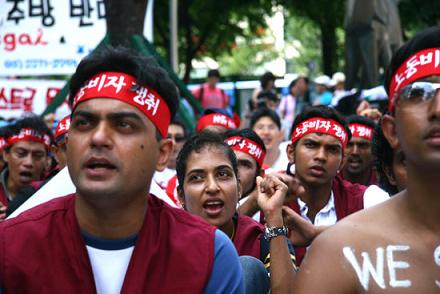
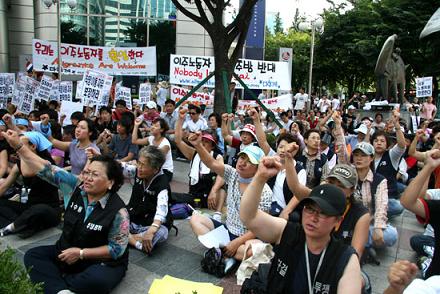
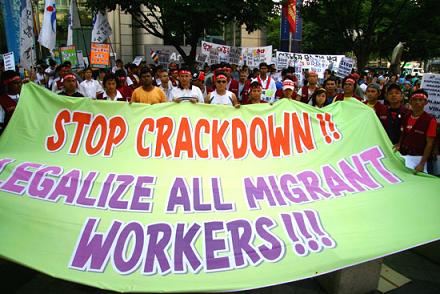
Source of the pics: 다함께
More pictures you can see here:
http://migrantsinkorea.net/webbs/view.php?board=migphoto&id=102&page=1
and here:
[8.13]'고용허가제 2년', 단속추방 중단·노동권 쟁취·전면합법화를 위한 이주노동자 대회
("All Together"/다함께)
A kind of picture story about the event you can see here.


Get our fields back, that is peace
빼앗긴 들녘을 되찾는 것, 그것이 평화
The documentary I found today on:

Source of the pic:
http://blog.jinbo.net/didi/?pid=27
Israeli activist shot in Bil'in(West Bank/Palestine)
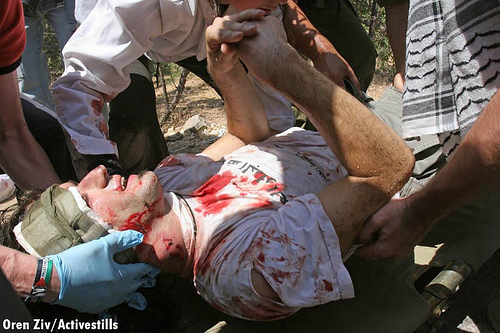
Last Friday an Israeli activist got shot in the head by a rubber bullet during a non-violent protest against the Israeli occupation and the wall around the West Bank territories. He will suffer serious lasting brain injury from his wounds. At this moment he's in an hospital in Tel Aviv for brainsurgery. Here follows a report on the demonstration.

The Israeli "left-liberal" daily Haaretz wrote following report:
Activist shot in head with rubber bullet at Bil'in
A Border Police soldier shot a rubber-tipped bullet at an Israeli demonstrator Friday at a protest in Bil'in against the separation fence. In violation of military regulations, the gun was fired at close range, from between ten and 20 meters, wounding attorney Lymor Goldstein in the head. The Israel Defense Forces prevented Goldstein's evacuation for more than an hour. He later underwent surgery to remove the bullet from his brain.
The shooting occurred during the weekly Friday afternoon anti-fence protest at Bil'in. On Friday the IDF Spokesman's Office said that Border Police forces threw stun grenades and fired rubber bullets after protesters threw rocks at them, but video footage of the incident clearly shows the Border Police commander instructing his soldiers to shoot rubber bullets with no warning and before any rocks were thrown at his forces.
The footage shows soldiers aiming their weapons at shoulder height and firing at the protesters. At one point a soldier can be seen pointing his gun at two protesters searching for cover and then firing at the head of one of them. IDF regulations permit the firing of rubber-tipped bullets only at a distance of at least 40 meters, and only at the legs of the target. What are called "rubber bullets" are actually plastic-coated lead bullets, and they can be deadly when fired at certain areas of the body.
"After they started shooting we tried to find cover," related the demonstrator who was next to Goldstein when he was hit. "I was standing with my back to them and then I saw Lymor fall. I'm trained as a medic so I tried to stop the bleeding from his head. I shouted at the soldiers that someone had a head wound but they kept going and paid no attention. One of them cursed us."
The video shows the soldiers walking past Goldstein without stopping. When demonstrators asked the commander to evacuate Goldstein, he responded, "I don't have an ambulance." One soldier said the injury was "unimportant." It took 15 minutes for a medic to arrive.
The demonstrator, who asked not to be identified, said that even after the medic arrived Goldstein's care was delayed and it took a long time before he was evacuated by an army truck. "Another medic, who went with him, told me she had to hold Lymor's head with her hands because of the rough ride. The IDF medic hadn't stabilized his head. The driver went really fast even though she begged him to slow down."
Goldstein was eventually evacuated to Sheba Medical Center, Tel Hashomer. According to hospital officials he arrived at 3:30 P.M., almost two hours after he was shot. He was operated on Friday night. Yesterday Goldstein was awake and alert, but he may have sustained permanent damage to his vision or other faculties.
Jonathan Pollak of Anarchists Against the Wall says he is convinced that the decision to use rubber bullets Friday was aimed at taking advantage of the situation in Lebanon to silence the West Bank protests using force.
PS.:
When I was the last time in Palestine, 1988 during the Intifada(some are calling this the "1st Intifada") I visited also hospitals where many palestinans were treated for injuries they got during demonstrations against the occupation. There I was able to see not few children with the so-called rubber bullets in their heads/brains. I saw also x-ray pictures/radiographs from some of this children with partially three or more of this bullets in their brains.
This so-called rubber bullets are metal bullets - with a diameter from around 1 centimeter - with a very thin rubber skin. Actually this so-called rubber bullets are metal bullets and especially for children and younger people potentially deadly projectiles.

Oops.. instead of three hours I needed THREE DAYS.. but here, finally it comes ^^:
Already nearly 5 years ago, during and short after PIFF 2001(this was my 1st time in S.K.), I heard first time about Jeongdongjin Independent Film&Video Festival(jiff). At that time a jiff activist indeed adored about the next festival in the coming year(2002) and because of this, especially because of her(the activist’s) impressive and beautiful ideas for the event, I decided that I really MUST participate at this event.
So when I came the third time to S.K. – during the second time, I was staying about three month there, I got no possibility to contact the jiff activist – I decided to go alone to the coming jiff. But just coincidentally at that time the activist contacted me and we went together to jiff.
Actually - haha, like every year – jiff 2002 (http://jiff.co.kr/2005/page34.php) was held during the typhoon season. And the typhoon season at the East Sea, where Jeongdongjin is located, is really f.. strange. So when we arrived at the place where jiff should be held(a middle school in the small town of Jeongdongjin) the school yard was complete under water, just like a swamp.
And the activists already were on the way to prepare the open air screening, planned for two days later.
And here started the crazy, but very impressive story. For the air screen there must be a stabilization and it must be filled with water. So the organizers called the Jeongdongjin fire brigade to bring water. Harr, and because also S.K. is a service society the fire brigade came with a big truck with water. But the school yard, as I said before, was already a huge swamp. And the truck... sunk at least a half meter in the ground of the school yard. At next the organizers had to call a construction company to bring a crane to pull out the fire brigade truck. After the truck was out we had to order thousands of Kilogramm of new sand to fill out the huge holes, the fire brigade truck left over..
So finally we had many hours of really hard work for to prepare the air screen. And the next afternoon, after all damages were repaired, the air screen got holes, or whatever, and losed the air. Harrharr... many hours of f.. hard work and finally...
Anyway at that night, during the late afternoon guests(mainly movie freaks/directors/activists/ organizers..) especially from Seoul arrived, we’d a great opening party.. (with at least two hundred bottles of soju for about max. 40 people..)
The film festvival itself I could join, because of some "personal problems" I was forced to go back at the next day to Seoul.
But anyway.. this was one of my most impressive experiences I had until that time. Actually I’ll never forget this and many times I thought that it would be really great to make a (short) movie about this weekend in Jeongdongjin... (possibly a "tragic comedy"^^)
Well, I made, when I remember well, a lot of photos about this "two days of struggle with nature and technology" and somewhere in Seoul they must be still exist..??!!
Aeh~~ its just MY memory...

DAY 31
Yesterday after exactly 30 days of the new war in the Middle East(M.E.,Lebanon/Israel/Palestine) the issue nearly complete disappeared from the headlines of the news agencies, tv stations and daily papers. It seems - even in the M.E. still many people are dying(until yesterday alone in Lebanon about 1,000 people were killed by IDF attacks) - that the "UK Terror Plot"(BBC World) is better to sell. For example yesterday's CNN news program at 1 pm(CET) not even one word were spoken about the M.E. war. Usually at least 20 Minutes or so are occupied with the issue. In today's German daily Berliner Zeitung the issue disappeared from the front page(yesterday) to page number 6.
Here the latest from the battle field:
According to BBC World "at least 11 civilians were killed in Lebanon on Friday".
Russia suggested a 72-hour truce for humanitarian actions in Lebanon, but Israel rejected it. At the same time IDF is massing about more than 20,000 troops on the border to Lebanon in preparing for a broader ground operation/invasion in the coming days. It meens Israel is preparing for a all-out war now, if there will be no diplomatic solution until tomorrow or so.
Meanwhile Hizbullah since today morning(CET) is again attacking northern towns and villages in Israel with massive rocket and missile barrage.
Before yesterday Nasrallah called all Arab residents of the northern Israeli city of Haifa to leave immediately the city(perhaps Hizbullah is planning a massacre there under the non-Arab residents?!). But, according to Israeli news papers, they refused to leave, because, so a Arab resident: "Never someone can devide us again from our Jewish neighbours".
(Haifa's Arabs: We won't leave city )
And "of course" IDF's activities in Gaza are still continuing. Until now at least 120 Palestinians were killed there.
Here the latest by M.E. and int'l news papers/agencies:
Israel pounds Beirut as truce rejected (Al Jazeera, 8.11)
Israel Delays Northern Push in Lebanon (AP/Guardian)
Rockets fall on north (ynet)
Truce draft doesn't call for disarming of Hezbollah Military chiefs strongly oppose cease-fire terms (Haaretz)
IDF wants to 'move, fight and attack' (Yedioth Ahronoth)
Here the very latest news:
IDF ordered to move up to Litani (ynet, 11.08, 6 pm/CET)
Prime Minister Ehud Olmert and Defense Minister Amir Peretz give green light to army to capture southern Lebanon territory stretching up to Litani River as US-French truce deal said 'very, very close'
Prime Minister Ehud Olmert and Defense Minister Amir Peretz on Friday gave the Israel Defense Forces the green light to widen operations in southern Lebanon and capture the territory situated south of the Litani River.
The decision comes members of the United Nations Security Council were said to be close to reaching an agreement on a truce deal brokered by France and the United States.
US Ambassador to the UN John Bolton said, "We are very close to an agreement."
Military officials said it is in Israel's interest to push forward with its military operation in order to achieve more military and strategic gains ahead of a ceasefire that could open the way for the deployment of an international force in southern Lebanon.
The defense establishment criticized Olmert and Peretz for delaying the operation for two weeks, an operation officers say will significantly weaken Hizbullah.
http://www.ynetnews.com/articles/0,7340,L-3289808,00.html
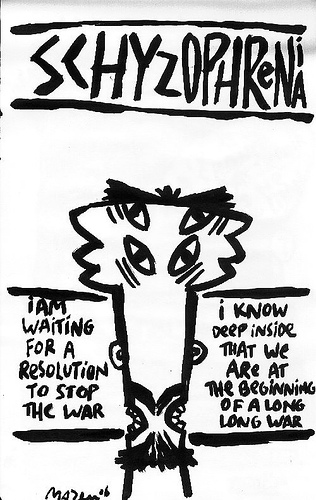
Following report, from the same battle field in Lebanon, but from a "complete other world", was published three days ago in the German magazine Der Spiegel:
Drowning out the Bombs
Nightlife and Rattled Nerves in Beirut
By Ulrike Putz in Beirut
Beirut is famous for its cosmopolitan inhabitants and roaring nightlife. But even the city's modern youth can't escape the current conflict. Whereas they used to go out to amuse themselves, they now spend their nights in clubs and bars where the loud music drowns out bombs exploding nearby.
The war for Fanny and Ernesto disappears each day for four hours. Late each morning, the power company cuts electricity in their building and the television, with its constant broadcast of images of destruction, goes dark. It's then that Ernesto gets up to make brunch consisting of an omelet, grapefruit juice and bread.
For four hours the couple from Beirut will be shielded from the fighting that has come to Lebanon. But eventually the power will come back and they won't be able to escape the scenes of chaos and violence that they can't keep themselves from watching.
Until war struck, Fanny and Ernesto were the kind of people who represented the new face of their country to the world. They belong to the segment of Lebanese society -- young, modern and cosmopolitan -- that helped lead the so-called "Cedar Revolution" after the assassination of Rafik Hariri in February 2005.
Both Fanny and Ernesto were there every Monday as thousands of Lebanese demonstrated against Syrian influence in their country. Like countless others, they thought that the summer of 2006 would go down as one of the best in the history of Lebanon. The Syrians pulled out their troops amid international pressure and an unprecedented number of visiting, cash-rich Gulf Arabs were coming to fill hotels and holiday villas. But then came July 12 -- the day the Islamic extremist group Hezbollah kidnapped two Israeli soldiers and the bubble of well-being popped.
"The war is the ransom for democracy," says Ernesto. "Lebanon was becoming more open and more liberal. Syria and Iran could no longer stand by and watch that."
Such views are becoming more widespread among Lebanese youth these days. The fighting has less to do with Hezbollah and Israel and more with totalitarian Islamic regimes hoping to see a tolerant and cosmopolitan Lebanon go down in flames.
As the fighting began, Fanny and Ernesto reacted the only way they knew how. Ernesto stocked up on a month's worth of Cuban cigars -- a natural response for a man whose devout communist parents named him after Fidel Castro's companion in arms, Ernesto "Che" Guevara. Fanny stocked up on spaghetti at the supermarket and painted her fingernails red to brighten things up a bit as the days became dark.
War and unpaid holiday
Fanny is a 29-year-old architect in a small and exclusive Beirut office. Her mother is French and her father a doctor. She makes around $1,200 a month. Ernesto is a 25-year-old cineaste and philosophy student, who before the current conflict used to make $1,000 a month with DJ sets in the city's hippest clubs and bars. Both are from Christian Lebanese families, but religion doesn't play a dominant role in their lives. Ernesto's last ex-girlfriend was a Shiite.
They might be an exceptional pair, but they represent what many in Lebanon are now going through. They are experiencing war from the second row: fortunately none of their friends or family have been killed and they've been able to stay in their apartment. Fanny also has the luxury of holding a European Union passport, which means she can still get out of the country if worse comes to worst. For Lebanese living in the capital, the biggest problem right now is money. How long will their savings last and what comes next?
Both Fanny and Ernesto know that the few thousands they have in the bank won't last forever. Like the majority of Lebanese, they have been forced to take unpaid holiday. As the bombing started they worked a few days as interpreters for international news organizations for $150 a day. But now the TV teams have moved south and they are left to while away their time at home and in cafes. As more time passes they lose hope of a quick resolution to the crisis and their faith in the West.
"What frustrates me the most is our complete failure of ethics and morals," says Fanny. With "our" she means Europe, to which many of Beirut's young elite feel strong ties. "We Europeans always hold up human rights so high, the Geneva Convention, the laws and rules of what is allowed in war and not. But this war shows clearly that we're prepared to forget all that when it's in our interest to do so. It's all bullshit." She's angry that no one will hold Israel responsible for what its military has done after the conflict is over. Not for the dead Lebanese civilians, nor for the fact that the country has been bombed back 20 years. "That can be done to Slobodan Milosevic, but not with Israel. It's untouchable."
Ernesto gets agitated when asked how things will continue after the fighting stops: "Why do you think that this is the end?" Lebanon has dealt with war for 30 years almost on a daily basis and the country will continue to limp along in the future. "My concern is university. I just need one more course, but if the refugees continue to live in the campus buildings I won't be able to finish my studies," he says. But his self-serving optimism isn't totally convincing. Fanny and Ernesto continue to discuss if they should go to France, Germany or Canada. But they'd have to marry since only Fanny has a European passport. So far Ernesto says he isn't interested in tying the knot.
"I wonder whether I really want to live in this country," says Fanny. She studied in Paris and consciously chose to come back to Beirut. "I love this city, but it's impossible to plan a life here." Like much of the younger generation that missed much of the worst of Lebanon's vicious civil war, they didn't believe their elders when they warned that peace wouldn't last. "I only realize now that they were right. This land is made for war," Fanny sighs and lights another cigarette. "So I can't live here; I want a future."
Life in Limbo
Their lives now are in a bizarre limbo. When the pair step into an elevator so they can take a walk outside, Fanny suddenly remembers the danger of a power outage. "If the power goes out, we're going to be stuck here for four hours," she says. "Well, that's plenty of time to try out a few Kama Sutra positions," Ernesto comments, dryly. Grinning, Fanny says the only good thing about the war is that it has enabled the couple to move in together. In Lebanon live-in relationships out of wedlock are strictly frowned upon. "But hey, this is war, and our neighbors have better things to do than to get upset about that."
Even in a town where it's easy to drop $300 or $400 a night in chic clubs and bars, the youth of Beirut refuse to save money at the expense of going out. Last night Fanny and Ernesto were in their favorite bar Torino until 4:30 a.m. -- it's the only place that hasn't closed its doors for a single day since the fighting began. "Why should we sit alone at home and moan," asks Fanny? "Everything is easier after a few drinks, even war." The fact that they stayed out so late is no coincidence. The really loud Israeli bombardments usually hit southern Beirut around 4 a.m. "So we sit in Torino and the music drowns out the detonations."
Then comes morning. During the day, people living in the parts of the city that have been spared the worst of the Israeli campaign against Hezbollah try to maintain their gentile façade -- some are even showing a sense of humor. Souvernir shops once stocked with hand carvings and the country's national symbol, cedar wood, now carry t-shirts with slogans like "Don't Shoot, Press" or "Hot Vacation in Beirut 2006." But the cracks are showing. As the sun sets on the Beirut's famous beachside promenade, people jog and families gather near the seaside. However, as the first explosions are heard in the distance, those remaining in the city race to their cars and speed away -- even to places that aren't any safer than where they were. People's nerves are raw.
"The war is inside us," says Fanny, back in Torino to drink a cappuccino. She and Ernesto are planning to head out of the capital to a resort along the coast. "Come along, a few cocktails poolside make the whole world look a lot friendlier!" But in the following night, Israeli jets bombard the coastal road leading northward out of Beirut. With the last major route out of Lebanon cut the way to Syria is blocked. And so to is the way to Fanny's poolside resort.
"Now we're trapped in Beirut," she writes in a text message. "What will come next?"
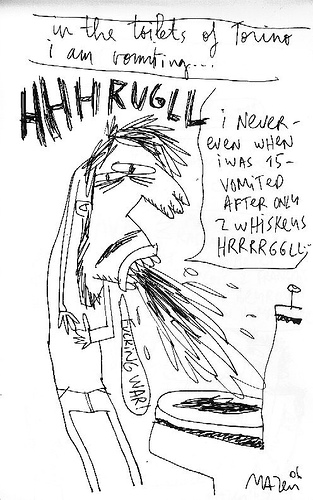
Drawings by Mazen Kerbaj, Beirut, Lebanon
http://mazenkerblog.blogspot.com
harrrrr~~~ it seems that I'm some days to late^^
More about it a short while(about three hours) later..
Thanx for your patience!^^
VICTORY!! ...but for whom??
8.08 in the morning(CET) the Israeli online news magazine ynet reported, related to the Lebanese cease fire proposal, following: "At the press conference... Olmert stated that there were some 'interesting points' in the Lebanese prime minister's proposal for a ceasefire, and added he knew full well Hizbullah was interested in a cessation of the fighting, mainly because the group was no longer able to continue its resistance to the Israeli army.
And only few hours the Israeli news agencies were forced to report that again IDF soldiers were killed and injured in "fierce clashes with Hizbullah units" in south Lebanon.
Since noon Israel's northern villages and towns were/are once again under massive attacks by Hizbullah's Katyusha rockets.
And a short while ago(pm 7:30, CET) this was written by Israeli media:
Minister Ezra: Hizbullah is breaking down (^^)
http://www.ynetnews.com/articles/0,7340,L-3288371,00.html
Also yesterday the Israeli rightwing daily Jerusalem Post published following:
Analysis: Hizbullah still strong
Operation Change of Direction was launched last month with the declared goal of weakening Hizbullah to the point where it would be possible to create a new political reality in south Lebanon. On Monday, almost four weeks into the fighting, a high-ranking Military Intelligence officer said the IDF was still far from reaching its goal.
While Israel waited for a United Nations Security Council resolution on a cease-fire, not now expected to come up for a vote until at least Thursday, the next stage will be a second resolution - one that calls for the deployment of a multinational force to replace the IDF in southern Lebanon and to prevent Hizbullah from reestablishing itself there.
Israeli officials, including Prime Minister Ehud Olmert and Defense Minister Amir Peretz, have spoken with enthusiasm about a multinational force, but the high-ranking officer said Monday that Hizbullah had not been damaged enough and still retained enough "diplomatic power" to thwart the deployment of such a force.
"Hizbullah has not been sufficiently weakened," the officer said. "And there may be no choice but to expand the ground operation in the direction of the Litani River to achieve that goal."
According to intelligence information, the Hizbullah command-and-control array is still functioning even after nearly four weeks of fighting. So are the logistical command centers - still operating and succeeding in directing the smuggling of weapons into Lebanon from Syria.
The officer said that Hizbullah still had the ability to fire short-range rockets, of which the guerrilla group has already fired 2,500 since the beginning of the war.
The only way to stop the short-range rockets, he said, was for the IDF to deepen its incursion north to the Litani and to sweep through cities like Tyre, estimated to be the hiding place for most of the short-range 122mm Katyusha rockets.
But despite the concern that the Hizbullah could succeed in thwarting a diplomatic effort to deploy an international force in Lebanon, the IDF can still pat itself on the back. Over 400 guerrillas have been killed in IDF operations, most of the long-range rocket arrays have been destroyed and the organization's stronghold in Beirut - Dahiya - has been almost completely demolished in IAF air strikes.
Senior IDF officers said Monday that they needed more time to continue striking at the guerrilla group to really weaken Hizbullah. The big question now is whether Prime Minister Ehud Olmert will give the green light for an IDF incursion up to the Litani, a move that could save Israel face and provide it with the the victory it has been seeking since the outset of a conflict that has proven to be far more difficult than initially expected.
At the moment, the IDF is holding onto positions in a security zone eight kilometers deep into Lebanon and is waiting to see if it will be ordered to push northwards to the Litani. Senior officials in the Northern Command said Monday that the chances the the IDF would reach that far in the coming days were slim, since with fighting still going on in villages like Bint Jbail - where three soldiers were killed Monday - within the IDF-created security zone, the military could not move on.
"We need to first finish clearing out the security zone and only then can we move north," a high-ranking officer in the Northern Command explained.
http://www.jpost.com/servlet/Satellite?cid=1154525826349&pagename=JPost%2FJPArticle%2FShowFull
*****
The German daily die tageszeitung wrote yesterday(8.08) that, according to the Near East Consulting Institute, the predominant majority of the Palestinians in Gaza and the W. Bank are supporting the "struggle of Hizbullah against Israel" - 97 percent of the entire population. And even 95 percent of the Christian minority are supporting Hizbullah, so the German daily.
"ANOTHER WORLD IS POSSIBLE"..
..but it seems that there are a lot of obstacles
on the way to there!
Nepal peace talks close to collapse, rebel chief warns (Guardian, 8.08)
The peace process in the Himalayan state of Nepal between Maoist guerrillas and Nepalese politicians is on the verge of collapse over the future of the monarchy and disarmament, a senior communist leader said yesterday.
The comments, by deputy rebel chief Baburam Bhattarai, were the first signs of a split in the alliance between the seven political parties and the Maoists that effectively removed the king from power in April. "The talks are very close to collapse," Mr Bhattarai told business leaders in Kathmandu. "The dialogue process is stuck at a very sensitive stage. The government is trying to force us to war again."
More than 13,000 have been killed during a decade of Maoist revolt, but the rebel leader ruled out an immediate return to battle, saying that if the talks failed the Maoists would "launch a new peaceful, popular movement in the cities, and not go back to the jungles".
Despite previous Maoist statements that they would accept a ceremonial monarchy if the people wanted one, Mr Bhattarai criticised the interim prime minister's recent statement in favour of a ceremonial monarchy. "We caution and warn the prime minister that we may have to leave him if he continues to protect the monarchy - and that protest will not only finish the king, it will also finish all those who are siding with the monarchy," Mr Bhattarai said.
The Maoists and the government agreed a ceasefire in May after Nepal's King Gyanendra was forced from power by weeks of street protests. He ceded power to a multi-party administration that does not include any rebel members. Since then, the two sides have been inching towards an agreement for a future elected constituent assembly that could write a new constitution for the country.
The negotiations appear to have stalled because the Maoists are unwilling to give up their guns unless the Nepalese army is disarmed. The UN had proposed that armouries could be built in barracks for the rebels where weapons could be kept under two sets of locks. One set of keys would be held by the Maoists, the other by the UN. However, the Maoists would not accept the plan unless the country's military was similarly constrained.
"What was being proposed was dissolving the [Maoist] People's Liberation army. It is not acceptable to us," Maoist chief negotiator, Krishna Bahadur Mahara told the Guardian. "We are not for the status quo. How can we accept demilitarisation only for us, and not for them?"
Analysts say that the Maoists were attempting to strengthen their hand in the negotiations by talking tough. "The international community has been quite firm. India, the US, the EU have all told the Maoists they cannot join the interim government with guns in hand," said Kanak Mani Dixit of Himal magazine.
"What they need is a face-saving measure (for the Maoists), because Nepal does not want to return to war."
http://www.guardian.co.uk/international/story/0,,1839248,00.html
Dr Bhattarai warns of another struggle if peace talks breached (eKantipur, 8.06)
Maoist leader Dr Baburam Bhattarai said on Monday that Prime Minister Girija P Koirala's comments a day earlier on giving space to the king would hamper the ongoing peace talks.
Dr Bhattarai made the comments at a programme organised by Nepal's commerce and industrial fraternity in the capital on the occasion of the 40th Annual General Meeting (AGM) of the Federation of Nepalese Chambers of Commerce and Industry (FNCCI).
Prime Minister Koirala had, on Sunday, made his opinion public regarding the monarch saying that even he should be given some room in a democracy.
Warning of a third people's movement in the country, Dr Bhattarai said that if the government and the parties kept on “humming the same monotonous tune” calling for the Maoists to lay down their weapons without even trying to enter the preliminary stages of peace talks, then it would be inevitable for the peace process to take a backseat.
"All of you present here (industrialists and businessmen) have wished for a lasting peace in the country. My statements don't mean that if the peace talks don't succeed, the country would again head towards war. You don't need to have any confusion about that," he explained adding, "Our chairman Prachanda too has pledged time and again that we would not go back to the jungle again. Even if we have to carry on our struggle, we will do that here in the capital and cities. We will struggle peacefully."
Maoist supremo Prachanda was earlier scheduled to address the second and concluding day of the FNCCI's AGM but instead the number two in the Maoists' chain-of-command, Dr Baburam Bhattarai addressed the meeting.
Dr Bhattarai said, "If they (government and the parties) breach the peace talks, if they stick to the old notion of preserving the "royal army" and the king, we will detach ourselves from the peace talks and continue our struggle right here in the city but peacefully."
Warning of another “big” movement if things didn’t go as per the agreements, Dr Bhattarai said, "We will form another "front" -- "republican front" -- comprising the people of Nepal that would bring another enormous change which would not only sweep monarchy but also all forces who support monarchy."
Reiterating that there would not be another conflict again, he also made clear that it should not spread the message that the Maoists have lost their will and power. "We are not tired, we have not lost," said Bhattarai adding, "The people of Nepal (from rural areas) have already made sacrifices for the betterment of the country. Now it's your turn (people from urban and city areas, including the capital) to show the same spirit to bring a massive and positive change in the country."
http://www.kantipuronline.com/kolnews.php?&nid=82036
THE STRUGGLE OF
CONSTRUCTION WORKERS IN POHANG
IS STILL CONTINUING!!

Workers' rallies in southern city reach breaking point (Hankyoreh, 8.07)
Rallies in Pohang increasing in number and violence
Although a union workers' occupation of POSCO headquarters in Pohang, North Gyeongsang province, has come to an end, the crisis at the large steel manufacturer continues. Police and unionists clashed at a mass rally on August 4 organized by the construction labor union and Korean Confederation of Trade Unions (KCTU), the country's second-largest umbrella labor group. About 100 were injured. The union plans to hold another large-scale rally on Wednesday(*). Pohang is in a full state of crisis.
Construction workers in Pohang expressed hopelessness and rage at the situation when talked to by the Hankyoreh. Lee, 47, who has worked for 13 years at POSCO construction sites, became furious when someone mentioned Ha Jung-geun, who died after being hit on the head by shields wielded by riot police. "There is only a person who was beaten to death; there was 'no one' who hit him," Lee said, referring to the fact that no blame has been placed so far in the incident. "I want to turn over the government and POSCO" to be prosecuted, said Lee.
It has been 37 days since construction workers in Pohang went on strike. But there is not any sign of an impending solution. The workers were asking for raise and improvement in labor conditions, but now new issues have emerged, such as worker's compensation disputes and how arrested unionists will be dealt with. Added to this is dispute over Ha's death.
POSCO construction projects at the Hyeongsan River have been stopped for about 20 days. After the workers' occupation of the POSCO main office ended, the strike was expected to wane. The number of participants in the strike, however, is still at over 3,500.
Oh Hi-taek, an official of the Korean Federation of Construction Industry Trade Unions (KFCITU), said that "negotiations with subcontractors are likely to be made, but POSCO, which has the key to the solution, has refused to budge an inch. Unless POSCO moves, there cannot be any improvement in negotiations."
Some experts suggested the hard-line approach: to make POSCO move, another clash between the union and authorities is unavoidable. Park, 52, a civil engineering worker, said, "Many unionists think that we should stage a sit-down demonstration."
According to industry experts, the problem stems from all sides. The government, labor, management and all citizens should practice self-examination and make an effort to solve the conflict, the experts said.
http://english.hani.co.kr/arti/english_edition/e_national/147406.html
Here a report by Voice of People about last Friday's demonstration and clashes in Pohang:
Laborers' Rally against Riot Police's Violence
* 하중근열사 정신계승! 살인경찰폭력 규탄! 전국노동자대회
시간: 2006-08-09 오후 3:00
장소: 포항 동국대병원 앞 (**)
KCTU published 6 days ago(8.02) following:
KCTU/KFCITU Action Alert : Union Member dies due to severe beating by riot police
"포항 전투!!"
자본가, 지배계급의 노동자착취 구조
강화하고 있는 노무현 정권의 오만한 무력진압에 맞선 투쟁
(8월 4일 포항 상황)
Documentary by 숲속홍길동同志
For more informations, but "only" in Korean, please check out
KFCITU's(전국건설사무노동조합) home page: http://www.kfcitu.org
****
** PS(8.09):
Here you can read(in Korean) the first report about today's demonstration in Pohang:
하중근 살인 경찰폭력규탄 전국노동자대회 개최 (Voice of People)

VICTORY!! ...but for whom??
Well, before I'll publish here my own "opinion" I'll collect and upload several different voices(Israeli, Arab..) about this issue. I'll TRY to continue this daily until I'm ready to write my own stuff(..its a little difficult for me to find the right words without to confuse you/my readers completely^^).
Here, at first, some Israeli voices but from different point of fews. And these are just opinions - without to be the "only, real truth"...(and in some points this voices are failing to explain the - likely - "real" reason of Israel's defeat ..in my opinion).
Israel is losing World War III (Haaretz, 8.07)
There has never before been a war like this.
That is why we are losing it.
We don't know how to fight it. Not yet, at least.
From the start, the whole world has been watching this war, and for good reason:
This is the next great battle of World War III. And, as in Iraq, the war is not going well for the West.
There are parallels to the last world war, of course, beyond the newspaper cartoonists' and worldwide Israel-haters' first reflex of calling the Jews Nazis.
There is the danger that we are seeing a tipping point, in Iraq as well as in Lebanon, which will embolden radical Islam, and Iran in particular, to extend the battlefield of jihad indefinitely.
At its outset, the Second World War went staggeringly well for the Axis. German and Japanese tacticians were legions ahead of their Allied adversaries. Smarter, more creative, more innovative, more motivated, much more deadly.
The blitzkrieg caught all of Europe unawares and, within weeks, reeling. Pearl Harbor, the Twin Towers of its era, struck at an isolationist United States that was profoundly unprepared for war.
Allied military defeats followed in series for years, until endurance, faith, and appropriate fighting methods turned the tide.
Certainly there are those in Israel and the Jewish world who are perversely pleased by the way things have gone wrong for us. There is the Told You So brigade on the far right, which misses no chance to declare that withdrawal is the cause of this war, and is a mortal error that must never be repeated, no matter what, ever.
There is the supremely self-satisfied Not In My Name battalion on the far left, which suggests in its knee-jerk protests and pride at being called traitors, that Israel may have a right to defend itself, but should never really exercise it.
Why are we losing? It is because, in our haste to confront Hezbollah before Iran went nuclear, we went to war before we had the ways and means to win.
Give us the tools, the British said at the outset of WW II, and we'll finish the job. We now know that we went to this war without the tools.
After years of Military Intelligence warnings of Hezbollah's missile arsenal and vaguely comforting news items about the mystery-shrouded Nautilus Katyusha-killer, we now know that we knew next to nothing.
We are losing it because our prime minister, defense minister, and army chief, who are new at their jobs and have proven it at every opportunity, made outlandish, grandiose, and boastful claims at the outset of the campaign, speaking of disarming Hezbollah, creating a new order in Lebanon, creating a reality in which the Lebanese people themselves would turn on the terrorists and diminish their influence.
Even before we ran aground in the north, the words had a perversely familiar ring. They are the sound track of debacle. They are as dated and as current as a 16 mm version of Apocalypse Now screened in IDF forts in Lebanon in the '80s.
We've gone after infrastructure, and in so doing, caused immeasurable suffering to as many as a million Lebanese, a thousand of them dead, thousands of them maimed, hundreds of thousands of them displaced.
And there are still those, and they are many, who argue for More of the Same. Much more. For a start, "Erasing villages where Hezbollah operates."
But more of them same is likely to yield only more of the same failure.
With thousands of thousands of soldiers already in Lebanon, seven brigades and counting, after 4,600 IAF bombing runs , 150 of them Sunday night alone, 80 to 90 percent of Hezbolah's 2,500 fighters are alive and shooting. They are still capable of firing 200 rockets a day into Israel.
We are losing the war, in part, because our actions have only gained sympathy for Hezbollah.
Polls are now showing that nearly 90 percent of Lebanese ? including many who had serious doubts about Hezbollah in the past, now support the organization's war with Israel.
The war has so elevated Hezbollah in the eyes of the world, that terrorism authority Prof. Robert A. Pape, writing in The New York Times, could without flinching compare the group to "the multidimensional American civil-rights movement of the 1960s."
Oddly, one of the lessons of the war is that the government, fearing a backlash over the deaths of soldiers, has directed an offensive which has relied on remote control warfare, effectively causing the needless deaths of hundreds of civilians in Lebanon, and, in the process, putting a million Israelis in range of Katyushas and Fajrs.
It's true, this is World War III. And we are losing.
Cabinet minister Avi Dichter, head of the Shin Bet for much of the Intifada, suggested Monday that the government is heading for a change in direction in Lebanon, and not a moment too soon.
"Curtailing to the point of halting the rockets is the quintessential mission of the IDF. The IDF will need to find the formula to carry out this mission, whether from the air or by other means.
"The fact that this hasn't happened as yet, doesn't mean that this will not happen."
We have to fight smarter. We have to use diplomacy with more skill. But we don't have the option of rolling over and playing righteous. In a world war, you have to choose a side.
Our job now is to survive.
If the Second World War taught the Jews anything, it is this: History is not, fundamentally, written by its victors. History is written, and made, by its survivors. Hezbollah knows this. All they have to do to declare victory, is to survive.
The survival of the Jews is our victory as well. But we're going to have be a whole lot smarter than we have been, to come out of this.
http://www.haaretz.com/hasen/spages/747340.html
When Moshe Dayan flew to Vietnam… (Yedioth Ahronoth, 8.06)
Perhaps solution to Middle East crises lies in creating a single American address that would exert international pressure on Lebanese government. Perhaps, then, this bruised and battered government would bring salvation
In the middle of the 60's Moshe Dayan, the man and the legend, flew to Vietnam to cover the war. On ending his visit to the war trenches, the former chief-of-staff was summoned for a talk with the commanding officer of the American forces, General William Westmoreland. "Nu," his host urged him, "what were your impressions from there?" "You have already lost this war," Dayan said, "but you don't know it yet…"
"Over what and why?" responded General Westmoreland. His guest fixed his one eye on him and said: "The Vietcong has gone underground, and you are flying at an altitude of 37,000 feet. From such an altitude you can't see the trenches, tunnels and sewers where they are hiding out." The Americans, as we know, lost the war.
Similar assumptions shouldn't be applied to our situation at this stage of the war against the Hizbullah. This story relayed to me by Gad Yaacobi, however, should be told at the beginning of the military inquest the day after the war.
What's next?
The fourth week of the war is likely to be critical for the future of Israel in the coming years. So much so, that the efforts to reach a ceasefire are accelerating, and the sand in the military hourglass is running out. Another two or three days, then what? A victory campaign? An endless trauma? Will Iran set its borders (God forbid, its military as well) next to Rosh Hanikra, at the gates of Metullah? Will Hizbullah cease to exist?
While these words were being written Saturday night, visions of the end of the war were still fuzzy. Some people, such as Major General Giora Eilland, believe that the army is fighting in the wrong place: that the infantry is carrying out its offensive 8-7 kilometers from the border, that the air force is spitting fire far into Lebanese territory and into Beirut, and that the Katyusha rockets are being fired from exactly this range, where no offensive is taking place.
Two scenarios
Katyusha rockets are being fired into Israel 10 kilometer from the border. We are, therefore, likely to face two difficult and perhaps unbearable scenarios:
On the one hand, in the event that there is no ceasefire and the IDF reaches the waters of the Litani River, but the Katyusha rockets continue to be fired at the Galil and Haifa from a point beyond the Litani, the army will not go that far, sparking off a war of attrition: Here a Katyusha, there a Katyusha, the situation will be frozen, time will freeze, and the world will become apathetic. Let them kill each other over there. After all, it's only Jews killing Arabs and vise versa.
On the other hand, if there is a ceasefire, it will take a long time until an effective multi-national force with a clear mandate is assembled. The Hizbullah will most likely demand that the IDF first redeploy to its borders. The IDF, and rightfully so, will not accede to redeploy its forces before the multi-national force takes control of the south of Lebanon.
In this situation, the IDF will remain put. Where? In the security zone it left six years ago. And now as then, every two or three days a roadside bomb will go off, Hizbulla ambushes will be set up and soldiers will fall. We shall do everything in our power to prevent violating the ceasefire, and if a decision is made to respond after all, the Katyushas will be back.
The situation, to say the least, is highly complex. Perhaps, the solution lies in creating a single American address that would exert international pressure on the Lebanese government. Perhaps, then this bruised and battered government will bring the salvation.
http://www.ynetnews.com/articles/0,7340,L-3287009,00.html
Defeat and victory (ynet, 8.05)
We lost because of euphoria and bragging, but we shall ultimately win because we have learned Israeli society is stronger, smarter than its political, military leadership
We lost because on the first day of the war the prime minister said that "we shall win."
We lost because on that same day the defense minister said, "Nasrallah will not forget the name Amir Peretz."
We lost because of the euphoria and the bragging, the aggressiveness and the vindictiveness.
We lost because instead of launching an immediate offensive against Hizbullah posts, we destroyed half of Beirut.
We lost because the IDF has become accustomed to operating in modes of policing, oppression, arrest and conquest.
We lost because we praised the home front's resilience without really assisting it. We lost because we didn't win. How simple...
http://www.ynetnews.com/articles/0,7340,L-3286706,00.html

최근 덧글 목록