공지사항
-
- '노란봉투'캠페인/국제연대..
- no chr.!
39개의 게시물을 찾았습니다.
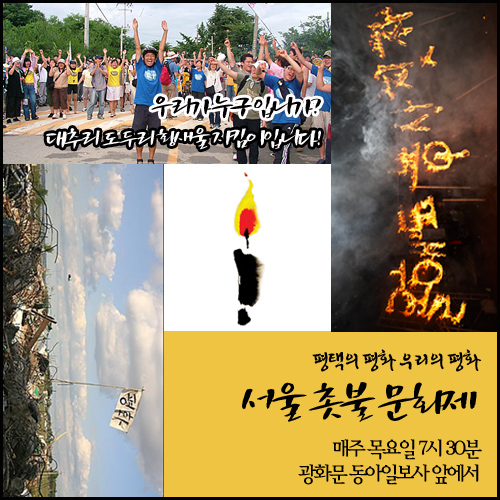
And on all the other days(aeh~ better said evenings) during the week(at the same time) candle light rallies to support the stuggle of the irregular construction workers in Pohang are taking place there:
매일 저녁 7시 30분 촛불문화제로 모입시다
포항지역건설노동자들의 파업이 두달째 전개되고 있습니다.
하중근 열사 사망 사건에 대해 경찰과 검찰은 파렴치한
작태로 자신들의 잘못 보다는 불법시위, 폭력시위라는 낙인찍기에
혈안이 되어 있습니다.
포스코는 여전히 기만적인 협상자세를 보이고 있고
언론은 포항시 관제대모를 포항시민들의 여론인양
건설노동자들의 파업 파괴공작을 일삼고 있습니다.
이제 투쟁의 중심은 포항에서 서울로 올라와야 합니다.
수도 서울에서 '하중근열사 진상규명, 책임자 처벌과 포항지역건설노동자
파업투쟁' 승리를 위한 치열한 사투가 전개되어야 합니다.
오늘부터 포항지역건설노조에서 약 40여분의 조합원들이 올라와서
광화문 열린마당을 거점으로 매일 집회와 시위, 선전전을 전개할 예정입니다.
또한 매일 저녁 7시 30분 광화문 동아일보앞에서
'열사정신계승, 파업투쟁 승리 촛불문화제'가 있습니다.
각 단위에서는 촛불문화제에 적극적인 참여를 조직하여 주십시오.
열마디 말보다 한번의 연대, 실천이 중요한 시기입니다.
투쟁의 현장에서 만납시다.. 투쟁!
'하중근 열사정신계승, 파업투쟁 승리를 위한 촛불문화제'
일시: 평일 오후 7시 30분
(주말 개최여부는 추후 판단.)
장소: 동아일보사 앞


VICTORY!! ...but for whom??
While Hezbullah is claiming victory over IDF and predicting the "beginning of the end of the Zionist entity(a.k.a. Israel)" and the "entire Arab/Muslim world is praising Hezbullah's victory"(CNN Int'l), in Israel the discussion about the last Lebanon war and its results is still continuing.. and escalating.
Today the Israeli bourgeois daily Yedioth Ahronot published following contribution by R. Ben-Yishai:
Hizbullah was better
Hizbullah fighters fought more effectively than IDF soldiers
The balance sheet of the second Lebanon War certainly does not point to an IDF victory. Even in points, it's closer to a loss than to an achievement, when taking into account the home front's extended suffering.
Indeed, in light of the relative UN good Security Council resolution we received, and possible positive future developments in Lebanon itself, we were not defeated. However, what happened to us is very similar to the defeat suffered by the American military in Vietnam and Iraq, and to the one suffered by the Soviet Union in Afghanistan and the Russians in Chechnya.
I covered some of those wars. I saw from up close how guerilla fighters overcame the most powerful, modern armies in the world because they knew how to fully utilize their intimate familiarity with the war zone and the local population's support.
Yet this isn't the only reason. The guerillas won also because they received unlimited material, planning, and moral support from a patron country or countries.
Another reason: Guerilla fighters consistently avoided a head-on clash with overwhelming air and ground forces and were not embarrassed to run away and hide when needed.
Finally, the guerilla fighters were more highly motivated than their opponents and willing to sacrifice their lives.
Israeli arrogance
Regular armies stood helpless in the face of guerillas because they failed to formulate an effective combat tactic that would neutralize the "hit and run" advantages of the Vietcong and Mujahideen, and because military units on the ground lacked real-team tactical intelligence that would allow them to take advantage of their superior fire power.
The final straw that led to the militaries' defeat was the heavy losses they suffered without being able to reach a phase where the end of fighting could be seen on the horizon. This is almost precisely what happened to us in Lebanon.
There's plenty of arrogance in the common perception around here that the failure in meeting the ground offensive's objectives was entirely the result of the failures of the political echelon and senior commanders to properly utilize the army.
This argument underestimates the enemy's capabilities and advantages and assumes that had we taken determined decisions and the logistical operation had worked smoothly, we would have won.
This is not the case, however. In my estimate, the ceasefire prevented an even greater ground offensive fiasco. Even if it's unpleasant, we must admit the fact that the IDF did not achieve victory not so much because of the failed conduct of its leaders, but rather, because Hizbullah was more effective and determined.
Hizbullah's intelligence better
The Shiite organization developed and implemented a combat method that takes maximal advantage of its natural advantages as a popular militia that operates within its natural habitat. Hizbullah also designed its future battlefield through an intimate understanding of IDF vulnerabilities.
The group prepared in a manner that allowed small cells to take cover and than appear at the time of their choosing equipped with anti-tank missiles, which enabled them to hit tanks and homes used by IDF infantrymen as cover.
More significant even was the tactical intelligence information gathered by Hizbullah members before, and particularly through, the fighting.
Their information was of better quality than that possessed by the IDF simply because Hizbullah's information gathering was undertaken through the use of eyes and binoculars on the ground in proximity to our forces, and not through pilotless drones and other sophisticated means, which failed to identify, in real-time, rocket launchers and small Hizbullah cells moving from one bunker to the next.
Hizbullah made sure each cell of fighters was able to gather intelligence independently, both for the purpose of accurate rocket attacks (by watching Israeli television reports) as well as for the purpose of fighting IDF troops inside villages (by using observers.)
IDF troops, on the other hand, walked around the villages as if they were blind, because the tactical information gathered before the war was not shared. Moreover, while in the villages, intelligence forces did not gather information methodically.
Frustration can lead to reform
We should also acknowledge the following reality: Hizbullah commanders and fighters were willing to sacrifice their lives in order to complete missions, while IDF commanders and cabinet ministers were virtually panicking every time they received casualty reports and attempted to prevent human losses as if this was the military objective.
A large part of the contradictory, changing orders relayed to troops resulted from this syndrome. At the end, because of the desire to avoid casualties, we suffered even more losses.
We must be merciless in admitting that Hizbullah succeed because it fought more effectively than the IDF in a mountainous area and through a total willingness for sacrifice. When facing those factors, the IDF has no proper combat tactic, just like the Americans and Russians, which would allow it to successfully respond to a super-guerilla featuring the characteristics and equipment of a modern army.
However, failures are also an opportunity. Deep frustration gives rise to an authentic, powerful demand for fundamental reforms. There's no point in fixing minor flaws here and there.
What we need is the total enlistment of the State of Israel , both in terms of finances and thought process, so that the IDF quickly develops and implements operation combat methods, unique combat means, and effective tactical intelligence that ensures different results in the next round.
http://www.ynetnews.com/articles/0,7340,L-3294340,00.html
To be continued soon..
BTW: This discussions are taking place not in the basements of Israeli "dissidents" or deep in the political underground... It takes place in the open public, even in the f.. bourgeois media. Please keep this in mind(more about it, I'll write later)!!
Following article was published 8.18 in the German(bourgeois) magazine Der Spiegel:
Hezbollah's Leader
War Turns Nasrallah Into a Cult Figure
The military conflict in Lebanon has ended with a cease-fire. No proper peace treaty has been signed. Still, Hezbollah is celebrating the ceasefire as a victory over Israel. Hezbollah leader Sheikh Hassan Nasrallah has achieved cult status among the Middle East's Islamic radicals -- and he's become more dangerous than ever.
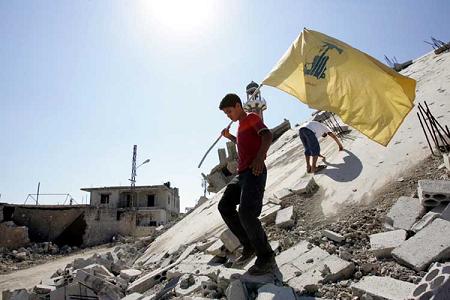
One of Hezbollah's public relations teams has attached a poster saluting non-Arab speakers by the highway leading to Beirut airport. It's not one of the usual improvised yellow-and-green posters or banners, the ones that show Hezbollah leader Sheikh Hassan Nasrallah smiling mildly. It's a perfectly normal ad -- large and properly paid for. The message is clear: The poster celebrates "the divine victory."
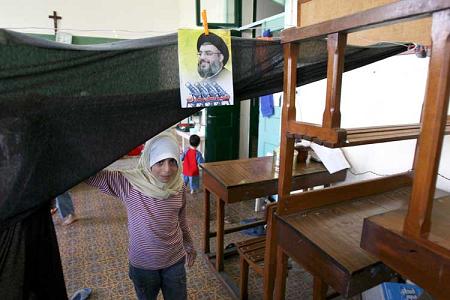
Nasrallah and Hezbollah's Katyushas(in a Christian school in Beirut)
Similar images have been shown on Hezbollah's TV channel Al-Manar for the last two days. Computer-animated hands reach up from the rubble of southern Lebanon to make victory symbols. Then a band begins to play. Men dance among the devastated houses of southern Beirut. The lyrics are flowery and don't make much sense -- but the word "victory" is mentioned over and over.
Nasrallah -- the militia leader, the spiritual authority, the face of resistance -- is omnipresent. Freshly printed posters featuring his likeness and images of Katyusha rockets have been plastered up all over the country. As Lebanese soldiers preparing to patrol southern Lebanon assemble by the banks of the Litani River, entire caravans of buses draped with Hezbollah flags rush by. The windshields display pictures of Nasrallah, and loud battle songs -- Hezbollah's new victory hymns -- can be heard from inside.
Everything's prepared for the Hezbollah militants when they return to their hometowns -- the militia's PR teams have done an amazing job. Almost every bombed-out building sports a Hezbollah flag, and large banners hang across the streets to help villagers form an opinion of what happened during the last few weeks. The banners say the massive destruction isn't Hezbollah's fault, and that Hezbollah has won the war by giving its all to battle Lebanon's enemy.
"Made in the USA"
Others are to blame for the devastation, the Hezbollah propaganda insists. "Made in the USA" is an especially popular motto along the approaches to some heavily bombed villages. Posters hanging above mountains of rubble ask a rhetorical question: Is this what comes with the democracy everyone talks about in Israel? Other slogans celebrate "victory over the murderers" or simply "the Sheikh's victory." This is Hassan Nasrallah's sweet revenge.
It's tempting to see the post-ceasefire victory celebrations as propaganda. But Islamic radicals in the Middle East agree that this cease-fire marks a cesura in their history, even if it's temporary. Nasrallah ordered rockets to continue to be fired at Israel until the very end, and he still controls southern Lebanon. Israel didn't achieve its goal of destroying his militia. Even an internationally renowned magazine like The Economist featured the headline: "Nasrallah Wins The War."

Nasrallah in the bus(Tehran)..
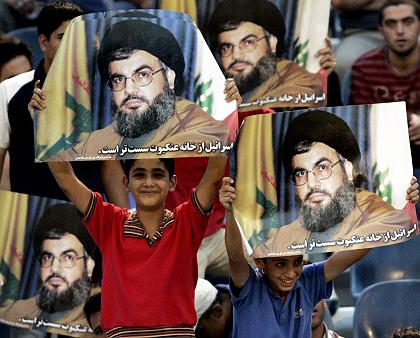
..and in the stadium(during a qualifacation game for the Asia Cup, Iran)
The Israelis never got near Nasrallah himself, either. He managed to make public statements several times on TV, and observers expect him to make a staged appearance before throngs in a Lebanese street during the coming days. The Israelis can't kill him now that the cease-fire has started. So no matter what direction the peace process takes, Nasrallah is alive and will lead his militia. His place in history books -- somewhere between the Ayatollah Ruhollah Khomeini, Saddam Hussein and Syrian President Bashar Assad -- is secure.
Avenging the Palestinians?
Respect for Nasrallah was also evident in speeches given by the presidents of Syria and Iran. Both praised his "struggle." The critics of Hezbollah's assaults on Israel, such as Jordan's King Abdullah, were silent. Abdullah as all too familiar with the mood in his country, where Nasrallah is suddenly being celebrated as the avenger of the Palestinians. It's not wise to criticize a new cult figure like Nasrallah -- who knows what might become of him?
Nasrallah's rise to glory is the climax of an unusual career. He was born in the slums of Beirut in 1960. His parents saved the little money they had so he could attend a private school, where he was known as a devout Muslim. When civil war broke out in 1975, Nasrallah was 15. He was quick to escape to Iraq, where he attended an Islamic seminary in Najaf. Not much later, he moved to Qom in Iran. He was considered charismatic there and attracted considerable attention.
Nasrallah, who is addressed as "Prime Minister Nasrallah" by his followers, is not a religious fanatic. He never moved far up in the clerical hierarchies of Islam because he wasn't all that interested in the Koran. His former schoolmates describe him as hard-working but not particularly talented. Nasrallah is, however, an experienced politician: He regularly visited Lebanese Prime Minister Rafik Hariri for tea before the latter was assassinated. It was always possible to reach an agreement with the Shiite leader, Hariri once said.
Nasrallah has been an important political factor in Lebanon for years now. He's even met United Nations Secretary General Kofi Annan, once, as the leader of Hezbollah. Timur Gocksel, who was for many years the leader of the UN forces stationed in southern Lebanon, describes Nasrallah as a pure pragmatist. "He was hungry for knowledge," Gocksel recalls. "He had always read the paper. Of course he was interested in Israel and military matters, but he read about many other things too."
A policy based on hatred for Israel
The struggle against Israel became Nasrallah's life work. He adopted the religious and ideological positions of the Iranian elite under Ayatollah Khomeini and the present Iranian spiritual leader Ali Khamenei, and he's long been seen as someone who represents Iran in Lebanon. Just after he took control of Hezbollah, the first Katyusha rockets began flying into Israel.
He likes to provoke: None of his speeches would be complete without a rant against Israel. His 18-year-old son died fighting the Israeli army in 1997. Nasrallah spent days negotiating the return of the corpse. But he also created a propaganda legend: Hadi hadn't been dead for 24 hours when his father turned up at a Hezbollah celebration. "We win honor for ourselves when we send our sons into battle," he cried out. "And we stand upright when they die."
At the peak of his power, the leader of the Shiite militia isn't likely to go soft anytime soon. He'll probably become more dangerous than ever, both in Lebanon and beyond. Whatever he says will be taken up by Islamic radicals. Whatever he writes will be read by hundreds of thousands of people. Without meaning to, Israel has created an enemy that may be larger than Hezbollah.
Israeli intelligence agents are already concerned that radical groups such as Hamas might learn the keys to success from Hezbollah. The very structure of the group -- half militia and half social movement -- worries Mossad members. Most of all, other groups could learn from Hezbollah how to avoid infiltration by intelligence agents and develop strict discipline.
The flowery speeches from politicians in Lebanon during the last few days give an idea of Nasrallah's importance. No matter which political party the speakers belong to, they all make an effort to please him, directly or indirectly. They're out to win his support -- or at least prevent him and Hezbollah from doing anything extreme for the time being. This means that his power is already greater than the two Hezbollah ministers in the Lebanese cabinet suggest. Nasrallah will be sure to use this influence.
Given this situation, the international community will have to consider how it deals with the sheikh. So far he hasn't shown any inclination to give up the weapons held by his troops or allow them to be disarmed. If such a measure were forced on him, he would no doubt start a new confrontation in southern Lebanon -- which means the man from the slums of Beirut has the leverage, even in a United Nations-sponsored peace.
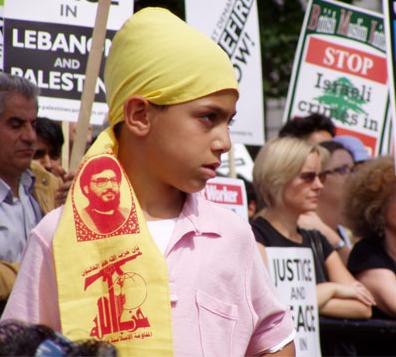
Hezbollah/Nasrallah propaganda in Europe("anti-war" rally in London)
It seems that all two years S.Korea is facing a real, or at least potentially increasing confrontation between unionized hospital/medical workers and their employers (better you call them exploiters!!). And no wonder that the conflict continuously is increasing, sometimes escalating: continuously the employers are refusing to meet the main demands of the workers(aeh~ actually like usually..).
At least since 2002 hospital/medical workers are demanding better work conditions, 5-days working week and real work contracts for irregular workers.
Already in later summer 2002 I joined some demonstrations and rallies during the first nationwide strike of S.K. hospital workers. At that time the government and the employers sent thousands of riot cops to smash the strike. KCTU wrote this, among many other articles, leaflets.. about the strike:
5,000 Hospital Workers Strike in Solidarity

Hundreds of strikers and their supporters were arrested(including my ^^friend..) during the struggle.
Hospital Workers' Sit-in at the Myongdong Cathedral
Some of the activists called this struggle "Our 9.11"!!
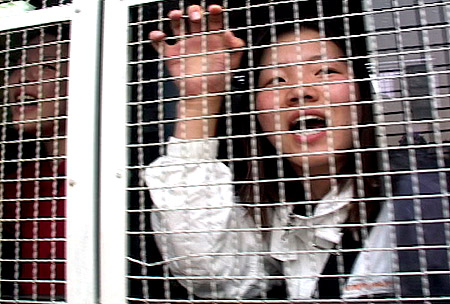
About this struggle at that time I wrote short reports for Base21:
http://base21.jinbo.net/show/show.php?p_cd=205&p_dv=0&p_docnbr=22528
http://base21.jinbo.net/show/show.php?p_cd=205&p_dv=0&p_docnbr=22627
Two years ago, in June 2004, we, migrant workers, at that time in sit-in strike in Myeong-dong, joined the strike of hospital workers. ETU-MB wrote also about it at that time:
6.09/10 struggle report (hospital workers general strike)
Now two years later S.K. press is reporting that in this week a new round of struggle for the nearly same demands hospital workers were/are struggling since 2002 will begin:
S. Korean hospital workers to go on strike this week
Tens of thousands of hospital workers will go on strike as planned this week to press their demand for higher salaries and better working conditions, their union said Sunday.
The Korean Health and Medical Workers' Union said it has decided to launch the walkout on Thursday after 73.6 percent of its 26,630 members voted for the strike.. (Yonhap, 8.21)
Health Workers Opt for Strike (K. Times, 8.20)
The Korea Health and Medical Worker’s Union, with workers at 113 hospitals nationwide, voted to launch a general strike this week, after failing to resolve a dispute with management representatives over wages and working conditions.
Announcing the results of a three-day vote Saturday, the union said its walkout will start next Thursday, after nearly 74 percent of those voting approved the industrial action. More than 26,600 of the union’s 32,000 members participated in the vote.
The union is calling for a 9.3 percent rise in salary, permanent employment of temporary workers, and the implementation of a five-day workweek.
The union said if the management refuses to alter its position, there will be strikes starting from 7 a.m. Thursday, taking place in each hospital lobby. Both the management and union were close to an agreement, but still differ over three issues. The management has refused to accept the union’s demand for a salary hike, citing a lack of money.
There are 113 union branches, with workers at hospitals such as the Korea University Medical Center, Ewha Womans University Medical Center and Hanyang University Medical Center. In 2004, the union went on a general strike for three days causing inconvenience to patients through long queues.
However, the government said while the event will bring some discomfort, there will not be as much ``chaos’’ as there was two years ago..
http://times.hankooki.com/lpage/nation/200608/kt2006082017522611970.htm
..CHUN-HUA DONGJI ^^
In the beginning of last year Chun-hua, a Chinese female migrant worker from Harbin was working together with us in MWTV.
In March 2005 I made with her reports about two anti-war rallies and demonstrations in Seoul. Actually the cooperation with her was very funny, because she didn't speak not even one word English and understood nearly nothing what I said in English. I wasn't able to speak Korean(only a kind of gibberish..^^), I only understood a little from her, even her Korean was excellent, like her Chinese... Harrharr, but my Chinese.. ^^
But we had also to make several interviews with Korean demonstrators/audience.. And, except only one Korean activist, nobody else understood my English.. So you can imagine that to make interviews, I prepared questions before to start the work, was a "little difficult". But finally we made it.. and in my opinion - it was our first TV report - the result wasn't soo bad(??).
You can watch our contribution here (3.19/20 反戰 報告/anti-war demo report, you can see it at the end of the first third of the show).
PS: I remember very well this evening when we made this recording.. we hade to practice to use the camera and to make/record an announcement.. And it was getting dark but still it was f.. noisy(traffic..)^^
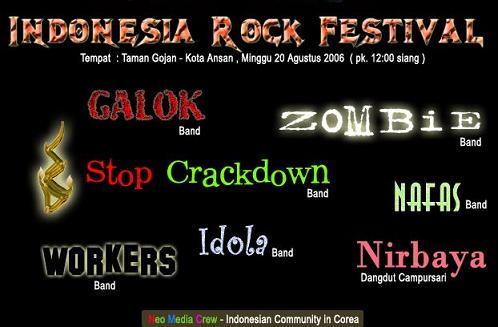
Sunday, 8.20
4 pm
in Ansan, Gojan Park
According to MWTV the event is beginning at 4 pm, but according to the poster: 12 am.
STATE RACISM IN THE EU
When the European Union(EU) isn't able to repel potential immigrants from the so-called "Third World" to reach its soil (every year THOUSANDS of potential immigrants are dying in the Mediterranean Sea and the Atlantic on their way to flee poverty, civil war, any kind of discrimination.., just for to reach the coasts of the EU - the "empire of freedom and prosperity") the rulers in the EU search for other ways to "solve the problem of migration by the poor". For example to lock up immigrants in Ghettos..
Here is one of the latest examples for the inhumanity of EU's "immigration" policy:
Ring of steel locks in immigrants (Times, 8.11)
A city famed for its beauty has turned to an ugly answer to drugs and violence
PADUA in Italy is renowned for its ancient university and medieval frescoes by Giotto. Yesterday, however, it acquired a less attractive claim to fame: a steel wall, 84m long and 3m high, blocking off a run-down housing estate with a high immigrant population and a reputation for drugs, violence and prostitution.
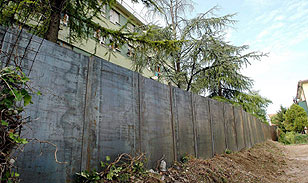
The wall was erected overnight by the local council around a cluster of run-down apartment blocks housing 1,500 people that is known as the Padua Bronx. A police checkpoint has been set up to control access to and from the estate. The council said that the wall had cost €80,000.
Some reports said, however, that the operation — including the installation of CCTV — costs as much as €270,000. Italian newspapers said that “a new Berlin Wall has gone up — this time in the heart of Italy”.
Il Giornale compared the Padua wall to the fence dividing Israel from the West Bank. La Repubblica ran the headline: “Padua is divided in two.”
Police said that the flats — on what is officially the Serenissima (Most Serene) estate — had once been occupied by students, but over the past decade had been taken over by immigrants from Africa, including the Maghreb, Asia and Eastern Europe. “Many of them are illegal immigrants,” a police spokesman said. “There is a serious drugs problem .”
Police raided several flats at dawn yesterday, arresting ten clandestini (illegal immigrants) and seizing hundreds of grammes of cocaine. Last month police used teargas to quell street fighting between nearly 200 Nigerians and Moroccans, and confiscated weapons including machetes and meat cleavers.
The wall was condemned by Giancarlo Galan, the centre-right President of the Veneto Region, as a “policy of despair”. He said that it amounted to an admission of failure by Padua’s centre-left council.
Signor Zanonato said that he preferred “enclosure” to wall. “People are comparing us to Berlin, or even Beirut,” he said. “But there are 20,000 immigrants in Padua. My task is to do what is possible to integrate them. But this enclosure was requested by residents near the estate, to stop drug dealing.”
An Italian voice about this case you can read here:
PADUA: A 3M "WALL" AROUND VIA ANELL
(Agenzia Giornalistica Italia, 8.09)
Four millimetre thick steel panels are being used to construct a 80m long "wall" three metres high to fence off the entire Serenissima complex on Via Anelli in order to deny people wishing to buy or sell drugs access to the "Paduan Bronx". Even though the aim is different, a "wall" is being built in Padua just like post-war Berlin. This time, however, it is the locals who are supporting the project, hoping for greater peace. Access to the complex will be restricted to its residents and a police checkpoint will be installed at the entrance. In the last few weeks, fighting was taking place at the complex for the control of the drug racket, but was thwarted by the Police and the Carabinieri. The wall will have new security video cameras installed for surveillance and should stop the easy escape of the criminals that are putting life in the entire neighbourhood at risk. In the meantime, police operations continue. At dawn, some houses were searched and over 40 people were registered, about ten of whom are being subject to expatriation procedures by the Police. The operation has also confiscated hundreds of grammes of cocaine.
Residents there, according to a report of the German state broadcasting station ZDF, called it "the Guantanamo of Italy... a prison for immigrants".
****
But actually this kind of state policy isn't so new in Europe, not really.
Of course everyone knows about the ghettos for Jews in the (by the Germans) occupied territories during WWII!?
After the collapse of the East Block in cities of the Czech Republic, for example, like in Usti nad Laben(in the north, near the German border) the municipalities ordered to build walls around residential quarters of local Roma communities(a.k.a. Gypsies, a national minority in the most of the east European countries).
****
BTW.. it's very interesting that only a few bourgeois European media were reporting about the case of the Padua Wall.
Hezbollah's Reconstruction Role - From Combat Troops to Charity Battalions
Armed Militants Helping Lebanon Rebuild
From rockets to reconstruction: the Islamic militant group Hezbollah has quickly switched its priorities from fighting Israeli troops to helping with reconstruction efforts in southern Lebanon. Hardworking, well organized and not about to disarm or retreat, they are impressing local residents.
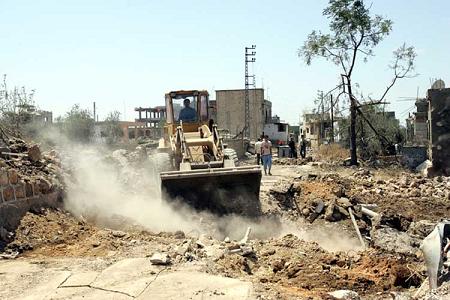
The orders from Hezbollah leader Hassan Nasrallah were very clear, but militia commander Suliman couldn't carry them out this time. The head of the Shiite extremist group told his fighters by radio on Saturday that as part of the cease-fire agreement starting this week they were to switch from military camouflage to civilian clothing. Suliman would have gladly obeyed, but there was just one problem.
"Unfortunately I only have one pair of trousers," says the Hezbollah veteran while grinning embarrassedly. "What can I do?"
So even though the guns have fallen silent, Suliman still thoroughly looks the part of militant fighter. He has a pistol stuck into his camouflage pants, a crackling radio peeks out of his pocket and he says he's rarely managed to take off his combat boots in recent days. The gray-bearded man is surrounded by his younger fighters, all of whom are still heavily armed. Normally forbidden to talk to journalists, they appear uncertain. But the 46-year-old commander has given his approval.
Suliman eagerly tells of how his troop fought Israeli forces until the last moments before the cease-fire. "I gave the order before we brought down the helicopter on Saturday," he says pointing to a spot somewhere in the mountainous region near the border. "It was an uplifting feeling." The Hezbollah commander even claims there are still plenty of dead Israeli soldiers in the hills. "They're afraid to recover them."
Of course, it's far from certain whether Suliman's 40-man unit actually shot down an Israeli chopper. However, all of Israel's heavy ordinance couldn't dislodge them from the village of Beit Lif, only three kilometers from the border. If Suliman is to be believed, he didn't lose a single man to the bombardment. "Up till the end we fired dozens of rockets in Israel's direction," he says. "We still have a few in the depots."
But today Suliman has different orders. Together with ten of his fighters he is gathering dead cows scattered around the 2,500-person village with a backhoe. Another four men are using a bulldozer to remove rubble from the streets. "We still have a lot to do," he says while looking at his watch. "We want to start with the rebuilding soon."
Beit Lif suffered considerable damage in the month-long conflict and Hassan is happy to show a destroyed farm as part of a tour of the village. The 34-year-old is a teacher from Beirut, but he's also part of what could be considered Hezbollah's militia reserves. Bragging about his fighting skills and how many Israelis he killed in a rocket attack on a Kibbutz in the nearby hills, he says he will now help with the reconstruction efforts before returning to the Lebanese capital to teach children English.
Hezbollah's reconstruction helpers are everywhere in southern Lebanon right now. Those men fighting in the port town of Tyre only days ago are now the ones clearing the streets, raising electricity masts and offering aid to local residents. The quick reorganization from combat to relief help made it possible for many refugees to return to their homes. Nasrallah even claims Hezbollah will rebuild the country on its own.
More than a fighting force
The militant group has always supplemented its fighting and terrorist operations with humanitarian efforts including supporting clinics and schools -- partly explaining its broad appeal with many in Lebanon. But now Hezbollah is hoping to gain popularity by rebuilding after a conflict that many blame the militants for starting in the first place. But in the bombed out town Qana, it's clear who's to blame. "We Will Rebuild What the Murdering Jews Have Destroyed," reads one banner.
The group certainly won't have a problem coming up with money for aiding reconstruction. Since the latest conflict broke out, Hezbollah's charitable foundations have been swamped with donations from throughout the Arab world. The images of destruction caused by Israeli air strikes have made heroes out of Nasrallah's outgunned men. And now they will show they care about the Lebanese people's plight as much as they hate Israel.
Along with money, Hezbollah seems to have everything else it needs for large-scale relief efforts: heavy construction equipment, building supplies and plenty of manpower. Until international aid arrives, Hezbollah will have finished much of the most pressing work. The extremists' own TV station, Al-Manar reported that hundreds of pre-fabricated houses were already being delivered around Tyre.
Even those unsympathetic to the Islamists are willing to accept their help right now. Fatma, a 34-year-old woman who is six months pregnant, has returned to the almost completely leveled town of Siddik to stand before her destroyed home. Two bombs turned the house her husband built for $150,000 into a large crater. She is angry at Hezbollah for sparking the fighting by kidnapping two Israeli soldiers.
"They've destroyed our lives with their nonsense," Fatma says while looking around to make sure there aren't any bearded militia members driving bulldozers nearby. "Everyone knew that Israel would attack."
But when asked who will help Lebanon pick up the pieces now that the fighting was over she falls silent at first. "The first help will come from Hezbollah," she says. "Then hopefully Europe will help." But her opinions are not widely shared in a region laid to waste buy hundreds of bombs. And Hezbollah's speedy response is likely to only strengthen the group's roots in the local population.
And that could make the mission of the Lebanese army and a United Nations peacekeeping mission to southern Lebanon more difficult. Suliman and his fighters certainly have no intention of laying down their weapons and demobilizing. "If Hezbollah left, the region would be completely empty," says Suliman grinning. "That can hardly be the goal of the UN, right?"
(Der Spiegel, Germany, 8.16)
Hizbullah set to rebuild Lebanon (Guardian, UK, 8.17)
JEWS AGAINST THE STATE OF ISRAEL
..haehae~ it's not a joke!!!
When I was living in Palestine - in Silwan/East Jerusalem - daily I met/saw hundreds of orthodox Jews. Many of them were dressed in clothes which were used in the 17th and 18th century by Jews in east Europe(Poland, Russia..). The males wear long beards, temple curls and fur caps.
Later, from my Palestinian comrades I learned that many of them are members of the Jewish sect Neturei Karta (N.K. www.nkusa.org). I was learning that they are, because of their religious believe complete enemies of the State of Israel.
They were/are calling themselves "Jewish Palestinians". As I know they're living in the region(especially in Jerusalem and Safed) since the 17th century. They don't speak Hebrew(only in the synagoge or for praying, in the public and privat they speak Jiddish), they don't join the IDF and they usually refuse to use the Israeli ID card. Since the 70th of the last century they are supporting - some of them actively were/are joining - the PLO. They have their own department in this organisation.
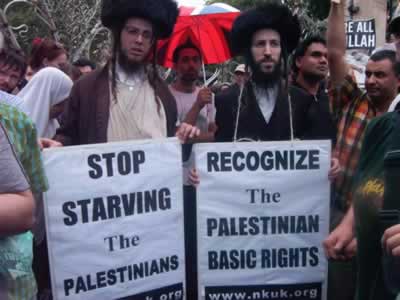
Actually I complete reject any religion but in this case I said that its ok, if they use this only for their privat life and don't try to make trouble for their non-jewish(Arab) neighbours. (Of course their kind of Jewish religion is very strange, or better said reactionary, but if they use this just for their privacy... it's their own problem..).
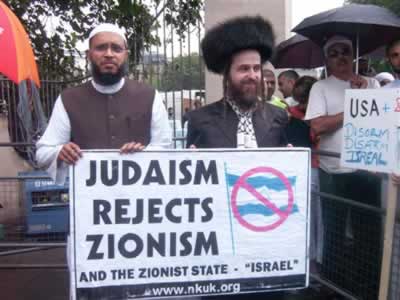
Beside N.K.'s opposition against any kind occupation of Gaza, West Bank and the Golan Hights they were strong opponents of the war in Lebanon.
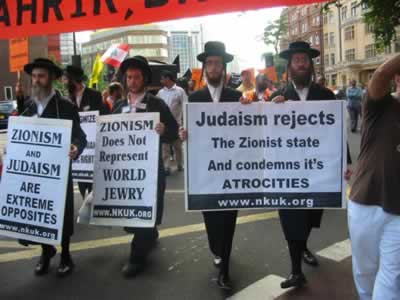
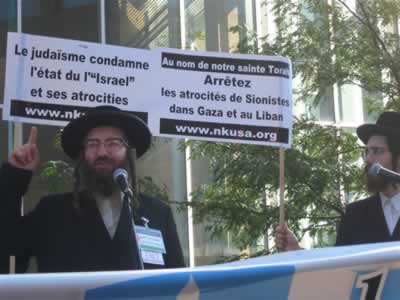
But now I doubt about their "mental health"(well, to much praying, definetely, makes SICK!!, aeh, it's just MY opinion..)..
Please, just check out following article by Yedioth Ahronoth:
Neturei Karta rabbi to Iran newspaper: Israel will cease to exist
Rabbi David Weiss says: Israel was established in the name of Judaism but is impure and Godless
In an interview with official Iranian newspaper, IRNA, Rabbi David Weiss, of the Neturei Karta movement, said "Israel was established in the name of Judaism but is impure and Godless. We are sure that it will cease to exist."
Neturei Karta is a small group of Ultra-Orthodox Jews who reject all forms of Zionism and oppose the existence of that state of Israel. This stems from their belief that Israel can only truly be reestablished with the coming of the Messiah and, subsequently, that any state of Israel prior to this exists in violation of divine will.
Anti-Zionist Rabbis
In an interview with an IRNA journalist, in New York, Rabbi Weiss stated that "We don't know how much blood will be shed until the state of Israel will cease to exist, but we pray to the Creator that it will happen with the minimum amount of loss and bloodshed."
According to Weiss, "The creation of the state of Israel does not conform to Jewish law and, actually, is contrary to it. Jewish rabbis around the world fear to express their opinions because of the intimidating atmosphere creating by the Zionists."
Weiss addressed UN Security Council resolution 1701 and said: "I oppose this decision because it does not touch upon the demands of the Lebanese or Palestinian people."
"We believe that the day is close at hand when Israel will lose its strength. The Torah says that whatever exists in opposition to divine will cannot continue. As I understand it, things are changing every day and we are sure that Israel will cease to exist."
'Problem today is Zionism'
Weiss discussed Israel's weakening hand in the war on terror and said: "In 1967, if you would have said anything about giving away part of the Gaza Strip to Palestinians, people would have killed you. Now we see that, after more than fifty years, Israel is trying to defeat Palestinian resistance, but is not succeeding."
Regarding the demographic problem, he said that "The Muslim population in Israel is growing rapidly and, in the upcoming years, most of the state will be Muslim."
"As long as Olmert and his government are weakening, so much the better, but we would prefer a general revolution in Israel. Olmert expected a miracle but Lebanon showed him the opposite. In the Torah it says that an illegal government of Jews is considered a revolt against God and, therefore, God will not help them," he continued.
Weiss was asked what solution he suggests to Muslims, Christians and Jews in order to live in peace and security, side by side. In response, he answered: "We and the Muslims lived side by side for hundreds of years with no problem. At that time, there was no UN and no human rights. The problem today is not religion, but rather Zionism. Zionism takes advantage of religion and sees all of its opponents as anti-Semitic."
"The solution is for Muslims to invest primarily in global PR. Muslims must show the world that, in the past, Muslims and Jews lived side by side with no problem."
http://www.ynetnews.com/articles/0,7340,L-3291956,00.html
BTW.. even N.K. strongly supports a Palestinian state in the entire territory of Israel, Gaza and the West Bank Palestinian "resistance fighters" had no problems to commit - at least one - suicide attack in Jerusalem's Mea Shearim residential quarter, where the majority of the N.K. people are living.(harrharr..)
THE LAST DAYS OF THE LAST(??) WAR..
..seen by two (still alive) Lebanese citizens
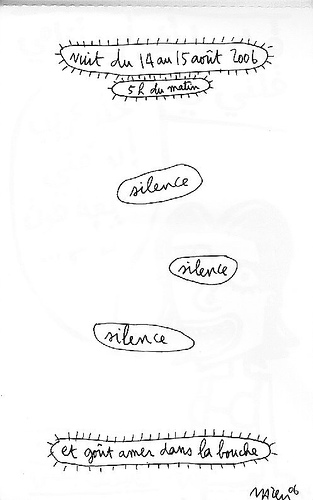
night to 8.15.. and a bitter taste in the mouth.

...
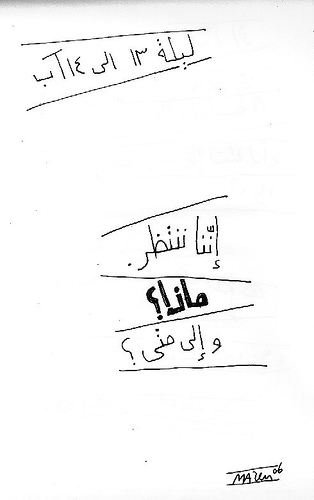
we are waiting. WHAT? and until when?
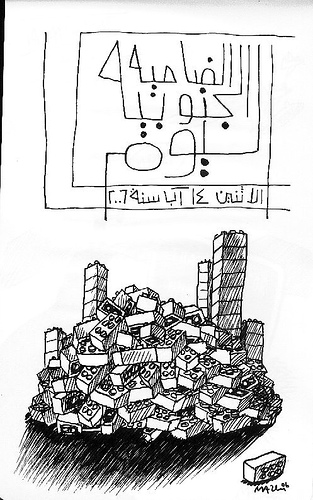
de-construction games, 8.13
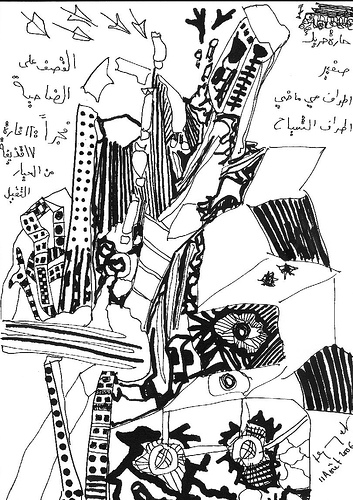
8.11
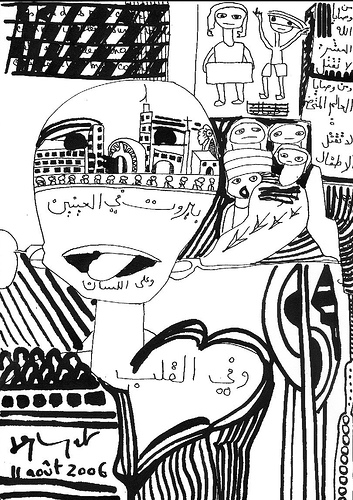
8.11
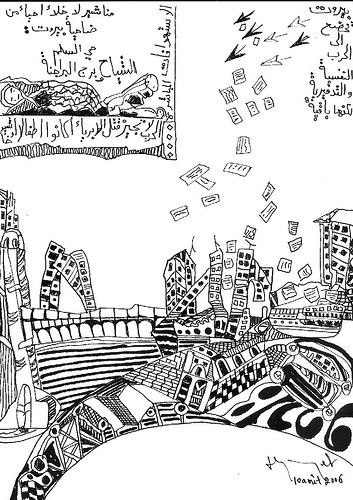
2006.8.10
For more impressions from Lebanon please check out(for example):
http://www.laureghorayeb.blogspot.com (Laure Ghorayeb)
http://mazenkerblog.blogspot.com (Mazen Kerbaj)
"Sky Pilot" by E. Burdon & The Animals (1968)

덧글 목록
관리 메뉴
본문
Unluckly the ghettos are by far more ancient than German WWII occupation. The word comes from the name of the place where jews were required to live in 16th century Venice. Look at http://en.wikipedia.org/wiki/GhettoAnyhow this wall is a perfect example of the behaviour of our (I'm italian) center-left administration, expecially at the local level. In italy there's this strange thing: upper class and poors both vote Berlusconi's center-right coalition (for different reasons) and the main center-left electors pool is in the wealthy educated middle-class, which is the more interested into keeping immigrants away from their homes and lives. Our politician really acts doing the 'good' of their electoral base (and their own too, of course), it's the electoral base which doesn't have anymore a political coscience.
The state of the left in italy is really dramatic.
부가 정보