공지사항
-
- '노란봉투'캠페인/국제연대..
- no chr.!
39개의 게시물을 찾았습니다.
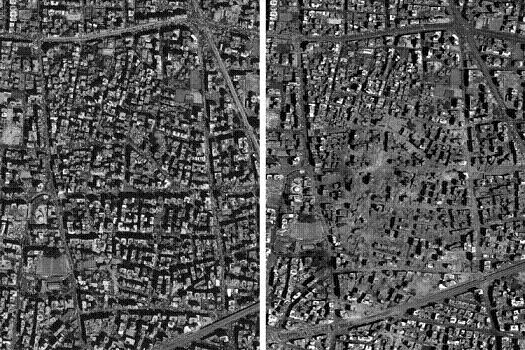
A residential area in the southern part of Beirut. Left: 7.12, the day when the new Lebanon war started. Right: only twenty days later(8.01) after several heavy bomb attacks by IAF.


..Fighting for Peace and
Against Capitalism..



found on manic's blog
http://blog.jinbo.net/manic/?pid=167
Here the - interesting, but possibly controversially - opinion of one(a kind of famous) German-Jewish writer about the war in Lebanon and the position of the Germans in this case(published some days ago in the German magazine Der Spiegel):
The Harmless Children of Hezbollah?
By Henryk M. Broder
Germans are squabbling about whether Israel's military strikes against Lebanon are justified. But how else can Israel defend itself against Hezbollah rockets? By staging sit-down protests along the Israeli-Lebanese border, perhaps?
Should Israel quit defending itself?
It was more than 20 years after the end of the Second World War, during the 1960s, when Germans realized that the Nazis had murdered a large number of Jews as part of their proposed "final solution of the Jewish question." The Frankfurt Auschwitz trial, which continued for two years (1963-1965) and involved 183 court sessions, resulted in an extensive documentation of what had occurred in the concentration camp near the Polish city of Oswiecim. The German public was shocked, horrified -- and most of all, surprised.
Apparently no one had ever read Hitler's "Mein Kampf," heard Hitler's speeches, subscribed to the Nazi newspaper Stürmer or even noticed that their Jewish neighbors had "moved out" without taking the furniture.
More than a decade later, in 1978, German television aired the four-part TV series "Holocaust." Once again the Germans reacted with horror, shock, and endless surprise. The fate of the Jewish family portrayed in the film brought tears to German eyes. They asked questions for which there were no answers. "How was that possible?" And: "Why did the Jews allows themselves to be led like lambs to the slaughter? Why hadn't they defended themselves?"
This question dominated debates on the Holocaust for almost 20 years, until Daniel Goldhagen published his book "Hitler's Willing Executioners: Ordinary Germans and the Holocaust" in 1996. The book caused another wave of shock and horror. But this time the upheaval was not over what the book described, but about its author, who spoke of "eliminatory anti-Semitism" and claimed that the "final solution" was the logical endpoint of a development implicit in German identity.
Ever since Goldhagen's book, the debate is no longer about what the Jews experienced and didn't survive, but about what the Germans knew or didn't know -- about how many of them were more or less willing accomplices in the Holocaust. The focus of the discussions has shifted from the victims to the perpetrators, and the perpetrators are trying to present historical proof that they too were victims, at least in the end, when Dresden was bombed -- an event the political chief of the neo-Nazi NPD party has likened to the Holocaust -- and when the Gustloff, a converted cruise ship filled with German refugees, was sunk by a Soviet submarine.
Shifting the blame
By this point in the public conversation, Berlin-based political scientist named Ekkehard Krippendorf had already contributed an original thought. He claimed that if the Jews hadn't allowed themselves to be deported -- if they had practiced passive resistance and organized sit-down strikes -- the Germans would have rallied to their cause, the Third Reich would have been shaken to the core and the worst catastrophes would have been avoided.
So historical blame was re-distributed. In Krippendorf's analysis, the Jews were not only to blame for anti-Semitism -- there wouldn't be any anti-Semitism if there weren't any Jews -- but for the Third Reich as well. They had the power to destabilize the system and missed out on that unique opportunity.
Today the debate has advanced by a few rounds. Every day you read and hear people saying the Israelis have done to the Palestinians what the Nazis did to the Jews. Meanwhile the Germans -- or rather the "non-Jewish Germans," as the new expression goes -- take it to be their historical duty to ensure that the Jews learn from their own history and behave decently. Sociologist Wolfgang Pohrt's remark on the perpetrators who turn into probation assistants and make sure their victims don't relapse was never more topical and accurate than today.
The old question "Why didn't the Jews defend themselves?" is no longer fashionable. Today the Jews are accused of defending themselves. They're blamed for concluding from the last-attempted "final solution" that it's better to defend yourself early than to let yourself be pitied afterwards. As nice as the Holocaust Memorial in Berlin may be -- it's a place "one likes to visit," according to former German Chancellor Gerhard Schröder -- a day on the beach in Tel Aviv or in Nahariya beats it hands down.
Now Germany -- where even a convicted cannibal can successfully sue for violation of his constitutional rights -- is witnessing a lively debate over the means by which Israelis should be allowed to defend their basic right to lie on the beaches of Nahariya or Tel Aviv. Politicians such as Heidemarie Wieczorek-Zeul from the Social Democrat party SPD, researchers such as Udo Steinbach from the Orient Institute and journalists such as Heribert Prantl from the center-left daily Süddeutsche Zeitung are among those who argue that Israel's reaction to the rocket attacks from Lebanon is exaggerated and "disproportionate." "No one is denying Israel the right to defend its borders. But rockets fired across the border don't threaten the existence of a state," writes Claudia Kühner in the Swiss daily Zürcher Tages-Anzeiger, for example.
Stop shooting and start shopping?
But if rockets designed to fly across borders don't threaten a state's existence, then who or what does? Excessive payroll fringe costs? Excessively low taxes? Too many unemployed people? Too few children? And how would the Swiss react if one of their border regions were attacked with rockets? Would they retaliate by firing "Luxemburgerli" pastries from their famous confectioner? Or would they airdrop coupons issued by the Migros grocery chain and urge their attackers to "Stop shooting and start shopping"?
Of course the question of a "proportionate response" is entirely justified -- and it's justified when asked about Israel or any other state. And: Those who ask the question have to be ready for an unexpected answer. It's a sign of reasonableness and moral maturity that Germans like to solve problems by sitting down at a round table to talk. The approach has worked for workplace conflicts and squabbles within clubs and associations, but it turned out to be ineffective in Northern Ireland and Kosovo. And it amounts to committing suicide for fear of dying when you're dealing with an enemy that loves death more than life.
The late King of Jordan had no qualms about using his might to put down a Palestinian uprising during "Black September" in 1970. He ordered refugee camps to be bombed. Between 3,000 and 5,000 people died. The PLO then moved its headquarters to Lebanon. Arafat moved to Cairo and later to Tunis.
Former Syrian President Hafis al-Assad, the father of Syria's present ruler, pulled no punches in fighting insurgent members of the Muslim Brotherhood. He devastated the city of Hama in February 1982, killing between 10,000 and 30,000 civilians. No one accused him of "genocide" -- and if someone had, al-Assad would have asked his critics not to meddle in the domestic affairs of his country.
When one considers what Israel is doing one has to admit that it is behaving quite moderately -- notwithstanding the bloodbath in Qana, in which dozens were killed including children. What happened in Qana just shows that the precision of high-tech wars can lead to catastrophic results. The war isn't between two regular armies, but one between an army and a guerrilla group that doesn't hesitate to use civilians as a human shield. At least the Israeli army warns the civilian population of imminent bombings by dropping leaflets, whereas Hezbollah fires Katyusha rockets without warning, in order to terrorize a civilian population.
"It'll work out somehow."
The most powerful army in the Middle East is fighting with one hand tied behind its back -- and paying for the mistakes of politicians. Everyone in Israel who had something to do with defense knew Hezbollah wasn't building holiday camps for Palestinian orphans in southern Lebanon -- it was preparing for military action. Instead of sounding the alarm because UN Resolution 1559, which calls for Hezbollah to disarm, wasn't being implemented, the choice was made to ignore the danger. The Israelis were glad to have turned their backs on the Lebanese quagmire. You could once again go shopping in Kiryat Shmona and swim in Lake Genezareth without having to hear the sounds of combat.
Of course it would have been better to disarm Hezbollah when it was still possible to do so relatively easily. But such a decision would have been difficult to justify within Israel -- and it would have caused the world to brand Israel as an aggressor. And so UN Resolution 1559 vanished into the mists of history, and the Israelis -- who can only think and plan in the short term -- said to themselves: "Ichije tov" -- "It'll work out somehow."
And since they didn't commit the necessary atrocities straight away, they're now paying twice the cost. They're fighting an enemy they underestimated and they're being pilloried as aggressors. It's not just on the nationalist and radical-left fringes of German civil society where people agree that Israel is the "new center of genocide" -- similar noises can be heard from the political center. Israel should negotiate with Hezbollah instead of shooting innocents, some commentators say.
You'd think Hezbollah was a group of children who had been playing with matches in the barn -- and that the Israelis insanely stoked the fire until the whole farm burned down. That kind of view is widespread in Germany. This is a nation where people will seriously debate whether a civilian airplane hijacked by terrorists should be pre-emptively shot down. But Israel is supposed to wait for Hezbollah to fire its rockets and then go complain to Kofi Annan.
Common roots
So the Germans' "becoming-good-again" -- predicted by essayist Elke Geisel 20 years ago -- enters its final stage. The "Holocaust" has been outsourced; now it's taking place in the Middle East. What started with the question "Why didn't you defend yourselves?" ends with the cool observation that the Jews have learned nothing from history, and that they are doing to the Palestinians what the Nazis did to them. And it's apparently the task of Germans to admonish and educate them. Ahmadinejad's willing executioners only want the best for Israel.
Theologian and itinerant preacher Jürgen Fliege reminds Israel of the "common cultural and religious roots" that "our ancestors laid down in the Torah." The principle of "an eye for an eye, a tooth for a tooth" is "no call for abandoning restraint in an emergency situation and swearing revenge, come hell or high water," writes Fliege. According to him, what the principle really means is: "Only one soldier for one kidnapped soldier" -- everything else would be going too far. In a ludicrous reversal of cause and effect, action and reaction, perpetrator and victim, Fliege calls on the Israelis to act moderately. But why doesn't he direct his appeal at Hezbollah's leader Hassan Nasrallah? Perhaps because in Hezbollah's case the "common cultural and religious roots" are still so fresh they should be given time to develop.
Even though Germany's former Foreign Minister Joschka Fischer has now relaized that the conflict with Hezbollah and Hamas is not about "occupied territories" but about Israel's existence, Middle East expert Michael Lüders finds it lamentable that "the Israeli settlements in the Palestinian territories" west of the border "are not perceived as a problem," unlike the "terror" that threatens Israel's existence. And he really does place "terror" in quotation marks -- suggesting it doesn't exist outside the subjective perception of Israelis. Western policy "in the region," he writes, creates "its own counterpowers, especially in the form of Islamic fundamentalism." With those words, Lüders justifies everything that Islamic fundamentalists do.
But what logical conclusion would have to be drawn from this insight that Lüders is still hesitant to utter? In order to eliminate the fuel of Islamic fundamentalism, the West would have to abandon Israel. The message is clearly there between the lines, and it's only a question of time before it's raised explicitly. For now, Lüders contents himself with Schadenfreude. "Even if Israel were to succeed in defeating Hezbollah and Hamas tomorrow -- the day after tomorrow there would be new groups with different names, ready to continue the struggle against the omnipotence of the Washington-Jerusalem axis."
Unlike the word "terror," Lüders doesn't place "the omnipotence of the Washington-Jerusalem axis" in quotation marks -- to him, that phenomenon is perfectly real. It used to be referred to as the "Jewish-American claim to world dominance." Today, it's not just Iranian President Ahmadinejad who is wishing for "a world without Zionism" in order to preserve world peace.
The situation is getting uncomfortable for the Israelis. They're beginning to suspect that they can't win this war, because they're dealing with an international public that demands a "proportionate" reaction even in an "asymmetrical conflict." And the appeals to respect international law and the rules of the game are always directed at Israel, never at those who believe that all means are justified in the struggle against Israel.
If the Israelis don't succeed in defeating Hamas and Hezbollah, they will have to come up with other forms of resistance. How about sit-in strikes along the Israeli-Lebanese border?
638 ways to kill Castro (Guardian, 8.03)
The CIA's outlandish plots to bump off the Cuban dictator would put 007 to shame ... poison pills, toxic cigars and exploding molluscs. Once he even offered to shoot himself..
For nearly half a century, the CIA and Cuban exiles have been trying to devise ways to assassinate Fidel Castro, who is currently laid low in Cuba following an operation for intestinal bleeding. None of the plots, of course, succeeded, but, then, many of them would probably be rejected as too fanciful for a James Bond novel.
Fabian Escalante, who, for a time, had the job of keeping El Commandante alive, has calculated that there have been a total of 638 attempts on Castro's life. That may sound like a staggeringly high figure, but then the CIA were pretty keen on killing him. As Wayne Smith, former head of the US interests section in Havana, pointed out recently, Cuba had the effect on the US that a full moon has on a werewolf. It seems highly likely that if the CIA had had access to a werewolf, it would have tried smuggling it into the Sierra Maestra at some point over the past 40-odd years.
The most spectacular of the plots against Castro will be examined in a Channel 4 documentary entitled 638 Ways to Kill Castro, as well as in a companion book of the same name written by the now-retired Escalante - a man who, while in his post as head of the Cuban secret service, played a personal part in heading off a number of the plots. While the exploding cigar that was intended to blow up in Castro's face is perhaps the best-known of the attempts on his life, others have been equally bizarre.
Knowing his fascination for scuba-diving off the coast of Cuba, the CIA at one time invested in a large volume of Caribbean molluscs. The idea was to find a shell big enough to contain a lethal quantity of explosives, which would then be painted in colours lurid and bright enough to attract Castro's attention when he was underwater. Documents released under the Clinton administration confirm that this plan was considered but, like many others, did not make it far from the drawing-board. Another aborted plot related to Castro's underwater activities was for a diving-suit to be prepared for him that would be infected with a fungus that would cause a chronic and debilitating skin disease.
One of the reasons there have been so many attempts on his life is that he has been in power for so long. Attempts to kill Castro began almost immediately after the 1959 revolution, which brought him to power. In 1961, when Cuban exiles with the backing of the US government tried to overthrow him in the Bay of Pigs fiasco, the aim was to assassinate Fidel and Raul Castro and Che Guevara. Two years later, on the day that President Kennedy was assassinated, an agent who had been given a pen-syringe in Paris was sent to kill Castro, but failed.
On one occasion, a former lover was recruited to kill him, according to Peter Moore, producer of the new film. The woman was given poison pills by the CIA, and she hid them in her cold cream jar. But the pills melted and she decided that, all things considered, putting cold cream in Castro's mouth while he slept was a bad idea. According to this woman, Castro had already guessed that she was aiming to kill him and he duly offered her his own pistol. "I can't do it, Fidel," she told him.
No one apparently could. This former lover is far from the only person to have failed to poison Castro: at one point the CIA prepared bacterial poisons to be placed in Castro's hand-kerchief or in his tea and coffee, but nothing came of it. A CIA poison pill had to be abandoned when it failed to disintegrate in water during tests.
The most recent serious assassination attempt that we know of came in 2000 when Castro was due to visit Panama. A plot was hatched to put 200lb (90kg) of high explosives under the podium where he was due to speak. That time, Castro's personal security team carried out their own checks on the scene, and helped to abort the plot. Four men, including Luis Posada, a veteran Cuban exile and former CIA operative, were jailed as a result, but they were later given a pardon and released from jail.
As it happens, Posada is the most dedicated of those who have tried and failed to get rid of the Cuban president. He is currently in jail in El Paso, Texas, in connection with extradition attempts by Venezuela and Cuba to get him to stand trial for allegedly blowing up a Cuban airliner in 1976. His case is due to come back before the courts later this month but few imagine that he will be sent to stand trial, and he appears confident that he will be allowed to resume his retirement in Florida, a place where many of the unsuccessful would-be assassins have made their homes.
Not all the attempts on Castro's life have been fancifully complicated: many have been far simpler and owe more to the methods of the mafia who used to hang out in the casinos and hotels of Havana in the 40s and 50s, than they do to James Bond. At one time the CIA even approached underworld figures to try to carry out the killing. One of Castro's old classmates planned to shoot him dead in the street in broad daylight much in the manner of a mafia hit. One would-be sniper at the University of Havana was caught by security men. But the shooters were no more successful than the poisoners and bombers.
Officially, the US has abandoned its attempt to kill its arch-enemy, but Cuban security are not taking any chances. Any gifts sent to the ailing leader as he lies ill this week will be carefully scrutinised, just as they were when those famous exploding cigars were being constructed by the CIA's technical services department in the early 60s. (They never got to him, by the way, those cigars contaminated with botulinum toxin, but they are understood to have been made using his favourite brand. Castro gave up smoking in 1985.)
All these plots inevitably changed the way Castro lived his life. While in his early years in office, he often walked alone in the street, but that practice had to change. Since then doubles have been used, and over the decades Castro has moved between around 20 different addresses in Cuba to make it harder for any potential hitmen to reach him.
Meanwhile, jokes about Castro's apparent indestructibility have become commonplace in Cuba. One, recounted in the New Yorker this week, tells of him being given a present of a Galapagos turtle. Castro declines it after he learns that it is likely to live only 100 years. "That's the problem with pets," he says. "You get attached to them and then they die on you".
http://www.guardian.co.uk/cuba/story/0,,1835930,00.html

More articles/reports about Cuba and the current situation you can read here:
Propaganda war grips a land crippled by shortages (Guardian)
U.S. Prepares for Showdown in Cuba (AP/Guardian)
The White House and Congress, caught unaware by Fidel Castro's illness, prepared Wednesday for a possible showdown in Cuba as lawmakers drafted legislation that would give millions of dollars to dissidents who fight for democratic change.
``The message will be, `The United States stands with you,''' Sen. Bill Nelson, D-Fla., one of the bill's authors, said in an interview. ``Be ready to assert your independence.''
There was no sign of upheaval in Cuba on Wednesday, two days after Castro stunned U.S. officials and many of his own countrymen with the news that he had temporarily ceded power to his brother, Raul, in order to undergo surgery.
The handover was a surprise to the White House and Congress, one senator said...
Please read the full article here:
http://www.guardian.co.uk/worldlatest/story/0,,-5991159,00.html
What now for Cuba? A guessing game over Castro (IHT/NYT, 8.02)
And now, even the "serious" bourgeois madia, such as the German magazine Der Spiegel are starting with extreme agitating against Cuba.. They are all waiting for REGIME CHANGE, "hopefully very soon"... F*** them all!!
VICTORY!! ...but for whom??
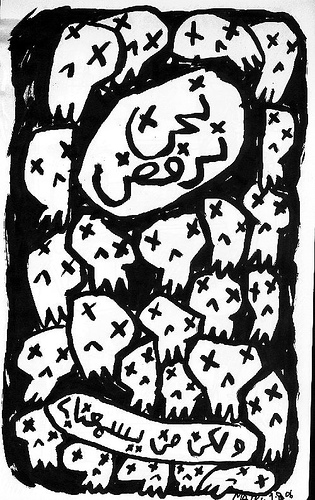
Especially after the Qana massacre it seems that Israel is losing the war. The "rulers" all over the world - except the US, GB and Germany - are calling for a immediate cease fire in Lebanon. (BTW.. after the 1996 Qana massacre by IDF israel was also forced by the "world's public opinion" to stop all its military actions there..).
Well, the Israeli PM Olmert said yesterday(local time) that there will be no cease fire NOW and also not in the NEAR FUTURE and today he said "Israel will keep fighting Hizbullah until multinational force deploys in south Lebanon"(and the "intl. community" said they will only deploy troops there when the fighting will be stopped..). But so or so, sooner or later the Isreali govt. will be forced to agree for a cease fire.
And what Israel was achieving with the war?
The first aim, beside to free the two kidnapped soldiers, was the "complete destruction of Hizbullah", so the Israeli media in the first days of the war. After some days of massive bomb attacks against assumed bases of Hizbullah, causing hundreds of civil losses, the new aim was to push Hizbullah back and to destroy their missile/rocket launchers.
Instead to achieve this goals by air attacks IDF ground forces got more and more involved in the battle, with heavy losses on its side.
Now the aim is "just" to push Hizbullah's forces behind the Litani River(about 20 to 40 KM north of the Israeli/Lebanese border). And this goal the IDF must achieve in the next days or coming two weeks. Actually, especially after the experiences in the last fierce battles in some few small border villages - it is impossible!!
Actually, except hundreds of killed Lebanese (mainly) civilians, 700,000 displaced people and a humanitarian desaster.. Israel achieved nothing! The soldiers are still in the hand of Hizbullah, daily Katyushas and other missiles launched by Hizbullah are raining on Isreali villages and towns(only yesterday 210 rockets, according to Israeli media)... And day by day Hizbullah is becoming more and more an "organization of hereos", the "only real resistance" for "the Arab nation and dignity", so a Jordanian bourgeois newspaper.
Finally at the present point Israel got exactly the opposite what they wanted to achieve. Instead of a weak, isolated Hizbullah they have now a strong, in the entire Lebanon, but also the surronding Arab world respected Hizbullah. For example even Israeli Arabs/Palestinians, attacked by Hizbullah missiles, like a short while ago in An-Nasirah/Nazareth, feel not like victims. They just see it as a kind of "friendly fire", so a report on CNN(8.02).
After Hizbullah's first missile, hitting yesterday the West Bank(near Jenin) a "Fatah member related that local residents cheered when they heard the rocket fall and saw the resulting flames. 'Even if it were to fall on our heads, it wouldn’t have spoiled our joy. All of us here are praying for Hizbullah’s success and victory,'" said(ynet, 8.02).
And what will be the result of this developments?
About these - in my opinion - very unattractively consequences I, possibly, will write tomorrow.
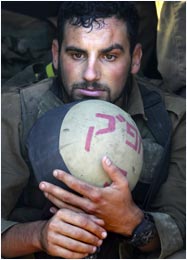
IDF paratrooper.
Not happy anymore, not really..
To get an idea of the current situation, please check out following articles:
How Israel's bombing turned Hizbollah leader into a symbol of Muslim pride
(The Independent, GB, 8.02)
A new face to Hezbollah's resistance
(Asia Times, HK/China)
Senior Fatah members: Nasrallah, bomb Tel Aviv (ynet, 8.01)
Palestinian protesters in Ramallah urge Hizbullah to fire missiles on central Israel; former Palestinian interior minister calls on Fatah fighters to go on high alert ahead of possibility of escalation in fighting
http://www.ynetnews.com/articles/0,7340,L-3284779,00.html

DAY 22
Today in the morning the 48 hours of arial "cease fire", after the Qana massacre(BTW... today nobody in the "West", for example in the German media, is talking/writing anymore about it..) - in fact the IAF was continuing their activities(just on a lower level) - ended. And now everything is starting again, but on a much more extreme level.
IDF is preparing for a massive ground offensive - already 20,000 soldiers are now operating in the southern border area in Lebanon. And, according to several intl. news agencies, thousands of IDF troops are ready to enter the Lebanese territory soon(likely in the coming night).
On the other side Hizbullah is attacking Israel since the morning with Katyushas and even long-range missiles. According to Hizbullah 300 missiles were fired... according to Israeli sources around 100 were hitting targets mainly in north Israel.
And IDF troops and HIzbullah fighters are involved in heavy and fierce ground battles. Already yesterday three IDF soldiers were killed in house-to-house fights in villages near the southern Lebanese border.
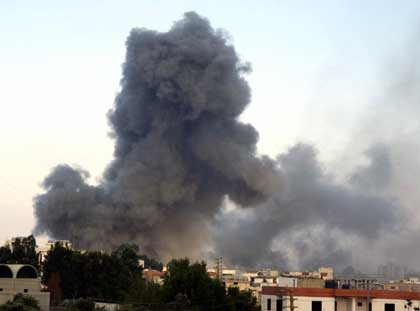
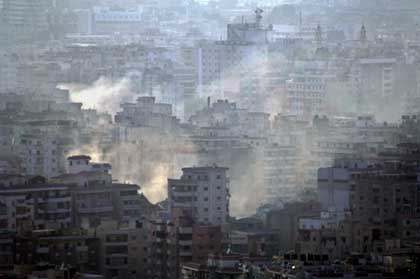
Here the latest by ME and intl. news agencies, news papers:
Israel raid 'captures Hezbollah fighters' (Al Jazeera)
IDF commandos complete Baalbek raid, reportedly capture five Hezbollah militants (Haaretz)
19 killed as Israel raids hospital (Guardian)
Israel strikes deep in Lebanon (IHT/NYT)
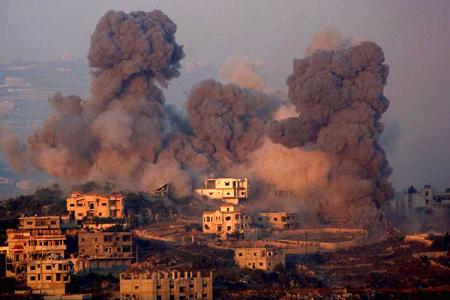

Exchanges of fire rage in Lebanon (ynet)
150 Hizbullah rockets hit Israel (Guardian)
..and so on, and so on.....
Later(likely in the coming 2 or 3 hours) i'll write some of my thoughts about it.. And perhaps not everyone will like it^^

최근 덧글 목록