공지사항
-
- '노란봉투'캠페인/국제연대..
- no chr.!
53개의 게시물을 찾았습니다.
ISRAEL IS ARMING ITS ENEMIES..^^
Two days ago WorldNetDaily published following unbelievably story:
"Israel's weapons
used against Jews
Terrorist tells WND rifles given to Abbas
for 'security' employed in shooting attacks
Weapons transferred last week by Israel to Force 17, the presidential guard units of Palestinian Authority Chairman Mahmoud Abbas, will be utilized for attacks against Jews, a senior member of Force 17 told WorldNetDaily in an exclusive interview today.
The militant, Abu Yousuf, hinted the weapons already were used in two shooting attacks the past few days that killed one Israeli civilian and wounded another.
Prime Minister Ehud Olmert announced earlier this week he had approved a shipment of weapons and ammunition, which reportedly include over 370 assault rifles and were destined for Force 17. The shipment reportedly originated in Jordan and needed Israel's approval for transport.
Olmert said the shipment was meant to bolster security forces loyal to Abbas amid an increasingly violent power struggle between the PA chairman's Fatah party and Hamas, which won recent Palestinian parliamentary elections.
"I did this because we are running out of time and we need to help Abu Mazen," Olmert told reporters Tuesday.
The weapons reportedly were escorted by Israel to Ramallah and to the Gaza border where they were received by Force 17 members.
Abu Yousuf said the weapons will be fired at Israelis.
"These weapons will not be used in an internal war but against Israelis," he said. "Force 17 is proud that we were the first to lead the Palestinian people during tough times such as resistance operations [against the Israeli army during large-scale operations in northern Samaria in 2002]. We will also be the first to lead the Palestinians in the current struggle against Israeli occupation."
Several Force 17 members, including Yousuf, also are members of the Al Aqsa Martyrs Brigades, a terror group linked to Abbas' Fatah party responsible for scores of suicide bombings and shooting attacks.
Yousuf himself previously participated in anti-Israel terrorism, including recent shootings, attacks last month against Israeli forces operating in Ramallah and a shooting attack in northern Samaria in December 2000 that killed Benyamin Kahane, leader of the ultranationalist Kahane Chai organization.
After the Kahane murder, Yousuf was extended refuge by Yasser Arafat to live in the late PLO leader's Ramallah compound, widely known as the Muqata. Yousuf still lives in the compound.
Abbas earlier this week appointed Mahmoud Damra to head Force 17. Damra, who is on Israel's most wanted list of terrorists, was offered shelter in Arafat's compound in Ramallah in 2002 after Israel accused him of masterminding a string of terrorist attacks.
Israeli security officials say that since September 2000, Damra has led a terror cell based in Ramallah that has carried out deadly attacks, including shootings at Israeli vehicles, attacks against Jewish communities in Judea and Samaria and the planting of roadside bombs.
Yousuf told WorldNetDaily Israel transferred the weapons to his Force 17 unit "for its own political purposes. We are not concerned with the reasons. The weapons will not be used against our brothers, only [against] Israelis."
Sources close to the Al Aqsa Brigades told WND assault rifles transferred by Israel to Force 17 already were used in two separate anti-Israel shooting attacks in recent days. One attack killed a 35-year-old Israeli Arab on a major West Bank highway on the outskirts of Jerusalem this past Sunday. Israeli security officials say the shooters likely mistook the victim for a Jew. The second attack, which occurred Tuesday on the same highway, lightly wounded an Israeli.
Yousuf refused to confirm whether Israeli weapons were used in the recent spate of highway shootings, but he hinted the information was accurate. He told WND members of Al Aqsa Brigades live with him in the Muqata and that "resistance tools" are shared regularly."
http://www.worldnetdaily.com/news/article.asp?ARTICLE_ID=50664
Well, I know, it's sounding really unbelievably, but it's nothing new for Isreal to support its enemies.
Already in the end of the 80's, especially in the first months of the Intifada(some are calling this the 1st Intifada..), Israel was supporting - at least tolerated - Hamas and its activities. Despide Hamas', for Shin Beth wellknown(extreme anti-Israeli/Jewish) charta, Isreal's 'security' and military forces wanted to build up an "alternative institution" to undermine the influence/position of the secular - and here mainly the(allegedly) left wing - Palestinian resistance organisations, such as PFLP, DFLP.. and the increasingly growing Peoples Committees. Of course also against the influence of the PLO.
But finally, at least after the collapse of the block of the so-called "real socialist" states, especially the Palestinian left organisations and parties became strong allies with Hamas. And their now combined forces were directed soon only against the "Zionist enemy"!
Actually its a little similar with the 'tactic' of the USA: supporting the Taliban, Al Qaeda.. against the USSR(the "Reich of the Evil"/the 'communism') ...the final result is wellknown!!^^
And now it seems that the Isreali "security"(^^) and military forces are making the same mistake.


30 YEARS AGO: THE BEGINNING OF THE END OF APHARTEID
The long march to freedom
On the morning of June 16 1976, a crowd of 10,000 black students gathered in the South African township of Soweto. They were demonstrating against a decree from the apartheid government that all pupils must learn Afrikaans in school. The protest was peaceful, but police opened fire, and at least 566 people were killed in the events that followed. The massacre brought the brutality of the racist regime to the attention of the world - and, some say, marked the beginning of the end for apartheid. Thirty years on, award-winning photographer Gideon Mendel travelled to Soweto to find out how life is now
Antoinette Sithole, 46
Sister of the murdered Hector Peterson, now a guide at the museum dedicated to her brother
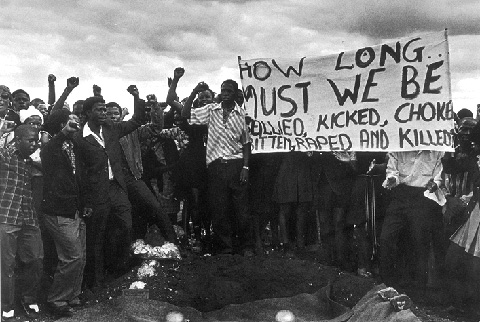
We were told there was going to be change at our school, that we would do maths and geography in Afrikaans. We were surprised, and the teachers weren't pleased about it. That winter in 1976 we thought, let's see what the first term is like. We did the first term tests, and they were disastrous.
The African National Congress and Pan- Africanist Congress were banned at the time but sometimes we would discuss the issue together and eventually they told us there would be a demonstration on June 16. Obviously everyone was thrilled.
The night before, we were so anxious, trying to come up with some banners that would have a big impact. We didn't have many, though "to hell with Afrikaans" was one example. We didn't want to tell our parents.
The day itself started normally, there was no sign of anything. Every day there would be an assembly, and we would be there singing and praying. While we were praying I saw students from Morris Isaacson high school.
I was excited but because we were praying I had to restrain myself. They were singing and chanting, they put us in the mood. Soon we threw our books down and got out our placards. Everyone was waving and singing in the streets of Soweto.
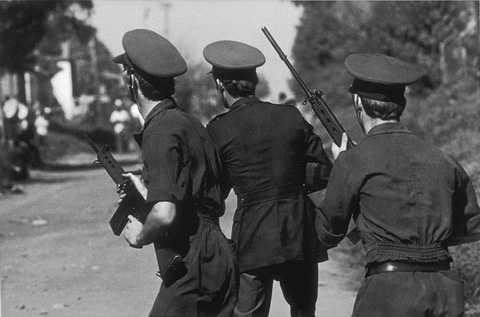
Our leader told us that the police were around the school and emphasised that we weren't to provoke them, otherwise the mission would not be fulfilled. As I was having a discussion with my friends, "bang", there was a shot. We had never thought there would be violence and we ran amok in confusion, hiding ourselves in nearby houses. Later on, when it was calm, we sneaked out again. It was like hide and seek - as soon as we heard shots, we'd hide and then when it calmed down, we came out.
I told my brother to stay next to me while I figured out how we could get home. While I was talking to him there was another shot. We ran back into hiding. When I emerged, Hector wasn't there. I said to myself maybe, because he is young, he is still hiding. The best thing to do, I thought, was to wait there, where I was talking to him, so that when he emerges, he will find me. Meanwhile, students were gathering at a scene. I wanted to go and see but couldn't because I was still waiting for Hector. But when I looked closer, I saw him there with the crowd, as if he was fetching something from them, because he was very tall. I was anxious. I could see the body frame and then I saw blood coming from his mouth. I tried to let them know that this was my brother: I have been waiting for him, can't you see he is hurt? We ran to the clinic, but we could see he was finished.
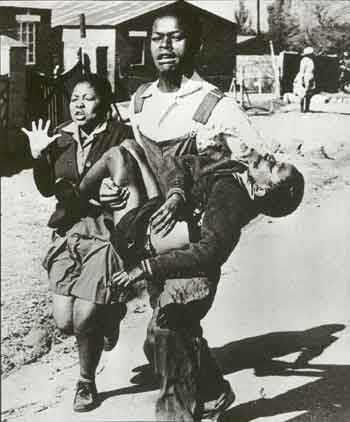
There and then I understood he was dead.
I tell myself now that I have forgiven but I won't forget. It's a part of me I cannot run away from, but I want to move forward in life. I always say those who died did not die in vain. Obviously there are going to be a few hiccups before we get there, but we are now in a process and I am hoping for the best. If we come together as we did in 1976, singing one song, South Africa will be the best country.
Trevor Ngwane, 47
Organiser of the Soweto Electricity Crisis Committee
On June 16 1976, I was still in school in KwaZulu Natal and the protest was a big thing. There was no television at that time, but we heard about it from newspapers. It was frontpage news, and it influenced our own school because a few months later we had some strikes. We had certain grievances as students; we got expelled, went home, had to reapply, so it touched us, it touched me.
Some of the things that the children of 1976 died for and made sacrifices for have not been fulfilled. For example, our education system still leaves a lot to be desired. We have a two-tier education system - private schools and public schools - which is in a bad state.
So you find parents spending money, bussing children into town to get a better education. Universities and colleges are also expensive. Those issues that inspired the students to fight have not been addressed.
In my opinion, anything is better than apartheid. But in socio-economic terms, the situation for the majority of people has worsened. Unemployment, for example, has risen above 40%, which is very high. At the height of apartheid there was almost full employment! Also, when we got our independence in 1994, we had a housing backlog of about a million houses. We had to build a million units. Today our backlog is 3.5 million, which means more people are short of a place to sleep. Ordinary people say, although perhaps to offend the government, that it was better under apartheid. Of course it couldn't have been, but if you compare what we are fighting for, our ideals, and what we are receiving, then certainly we are getting a very raw deal.
In socio-economic terms to compare the black population now and in 1976 - are they worse off? What proportion is better/worse off? I think that is the real issue, as there is a lot of inequality now. Ten per cent are professionals who are OK, maybe another 20% have jobs perhaps in the retail sector, but according to government statistics, 30% of families don't have any kind of income. Research about five years ago showed that the average family income in Soweto is about 1,250 rand (£100), which is pathetic. What's happening is what's occurring in broader South African society; a few are getting the benefits and a few are optimistic, a few see opportunities and can make use of the new openings, but the majority are stuck, even paralysed - they don't know how to find a way out. That's the real problem.
I believe this is a period we have to go through in South Africa. I am certainly optimistic. People don't only learn from books or political speeches and church sermons, they also learn from their own experiences. Slowly but surely people are realising they have to stand up and organise themselves for things to get better. But this isn't an automatic response. People can become xenophobic, blaming Mozambicans, but from what I've seen and from the campaigns that we've fought, I am optimistic
.
Andrew Lekalakala, 51
Teacher at Morris Isaacson school, where pupils gathered on June 16
On June 16, I was in the fifth form. We had meetings at night with other schools talking about how to protest. We met here at this school. Since the arrests of the ANC leaders, the atmosphere wasn't quite normal and we were afraid of being arrested. I wasn't one of the leaders, I was just told what to do.
We decided to march to the police station, to complain about Afrikaans. Then we would march to Pretoria. Morris Isaacson was the meeting place. Many schools met there; our aim was to march to Orlando Stadium.
We were going to show these white people that we could also fight. We went to meet our leaders at Morris Isaacson - they were advising us on what moves to make. They used the term "black power" very strongly, and we sang the slogan. We sang songs insulting the then prime minister (John Vorster): "Vorster's wife doesn't bear children, when she bears children, she bears mice. When Mandela's wife bears children, she bears comrades."
Unfortunately, when we arrived at Orlando, the police stopped us. I think someone told the police we were marching to Orlando Stadium, and when we arrived they were already there. They blocked us there, and that was where Hector Peterson was shot. We saw many bodies.
We ran from Orlando back to Mufulo with police behind us. There was tear gas everywhere. From that day, there was no peace in Soweto. The next day, we burnt everything that belonged to the apartheid government and we didn't attend school all year. This spread from Soweto up to Cape Town, all over South Africa.
We wanted to leave the country but some of our parents refused. We all wanted to join MK (Umkhonto we Sizwe - the armed wing of the ANC) and fight back. Most of our friends crossed, but some - like me - remained here. We struggled, we never stopped until 1994. We even stopped women going to clinics to get contraceptives because we wanted them to bear more children, we wanted more soldiers, no more abortions. We wanted to replace those that were being killed.
In 1979 when Morris Isaacson re-opened, I started to teach there. We had a different calendar from the whites, but we were told when the whites opened, we would open and when they closed we would close. Usually we'd close before June 16, and when we were supposed to open we were told to wait for the whites, so their holidays were longer.
Many pupils now don't take the anniversary seriously, they can't believe something like this happened. Only a few ask questions about it. Most don't care about it, they just go to the festival. Because our students now get everything free, they don't really utilise the opportunities they are given by the government. Under apartheid we were given two opportunities, either become a teacher or a policeman - no other professions.
If you look at our library, it is empty. The government is slow to provide funds but there has been a little bit of change. We are still not up to the standards of the whites. There are children who live in Soweto yet go to white schools and they do so because of resources. It's not because they teach better than us - they have computers, televisions, everything. We want the government to see that our schools are the same as the whites'. I give it five years for everything. (The Guardian, 6.16)
Please read more here:
Inequality still burdens South Africa 30 years after landmark revolt
About the background of the uprising(Wikipedia)
http://en.wikipedia.org/wiki/Soweto_Riots
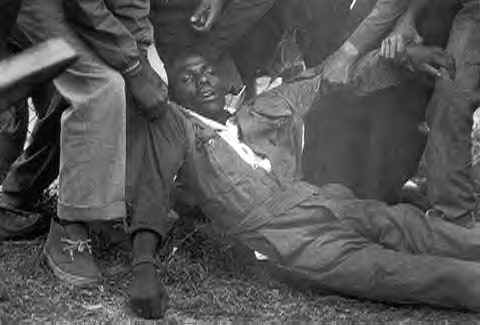
The following pics were made by the S. African photographer Peter Magubane at the day of the uprising:
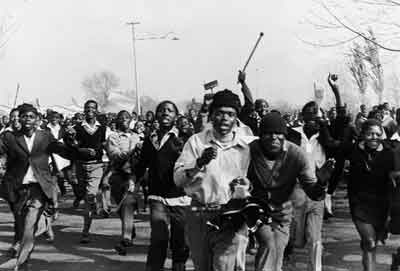
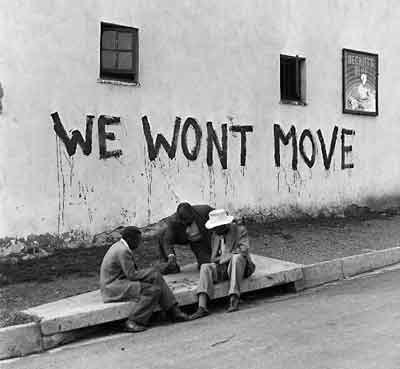

In my opinion the Soweto Uprising have(perhaps) a similar value like Gwangju in
S. Korea..(??)
First of all the latest news by BBC World(6.16, 4:30pm, CET):
"The parliament is to dissolved. A interim parliament is planned, including CPN-M(Communist Party of Nepal-Maoist, the bourgeois media just call them 'Maoists')."
Maoists poised to join Nepali government
(Guardian, 6.16)
The leader of Maoist rebels in Nepal was meeting the country's prime minister on Friday for historic talks that could see the Maoists joining the government and the two sides deciding to hold elections later this year.
In a highly significant political development which could formally end a bloody decade-long internal war, Maoist leader Pushpa Kamal Dahal, better known by his nom de guerre Prachanda (Fierce One) met the prime minister, Girija Prasad Koirala, this morning amid heavy security at his official residence.
They were joined by their negotiating teams, and a source in Kathmandu maintained that the two sides had taken ground-breaking decisions affecting the political future of the nation.
It is expected that the Maoists will join the government and elections will be called for the Constituent Assembly which will adopt a new constitution and decide whether or not to retain what has now been virtually reduced to a ceremonial monarchy.
A solution may be imminent also for the tricky issue of what to do with the arms possessed by the insurgents in the period leading up to the elections.
The Maoists have been demanding that they should be treated on par with the Royal Nepalese Army, with whom they have engaged in bloody battles for more than four years. But the Maoist rebels may agree to surrender their arms under UN supervision providing the international body also monitors all army activity during the elections.
One external stumbling block for this proposal could be objections from India, which has always been opposed to any UN intervention in its neighbourhood. But New Delhi is said now to have agreed to make an exception in Nepal's case, since the political instability in the Himalayan nation has wider ramifications in the region.
Nepal had been trapped in an extended political crisis until April this year, when King Gyanendra reluctantly agreed to reconvene the country's sacked parliament, appoint a new, seven-party government and surrender his powers.
But the vexed question of bringing the armed Maoists into the political mainstream and ending the insurgency still remains unresolved, with the rebels pushing hard for a new constitution and an end to the monarchy.
"A lot of groundwork has been done before today's meeting between GP [Koirala] and Prachanda, and the two leaders appear to have an excellent rapport," said the source from Mr Koirala's ruling Nepali Congress party. "There's broad agreement on major issues, and some solution will also be found to break the deadlock on the monarchy question."
Some of these decisions were taken at the second round of talks between government and Maoist negotiators held in the capital on Thursday. In an effort to boost the peace process, it was decided to adjourn parliament for 18 days, meeting halfway Prachanda's demand for its dissolution.
Thursday's talks at a hotel in Kathmandu, when the Koirala-Prachanda 'summit' was also announced, had apparently been preceded by several secret meetings. The two sides appear to be following a shrewd strategy, thrashing out differences in secret and appearing in the media glare for formal "talks" only when they have something concrete to announce.
The Koirala-Prachanda meeting appears to have been similarly planned. Even though the media believes this is the first-ever "historic" meeting between the two leaders, they are said to have quietly met at least once earlier, and got along well enough to be able to trust each other. As a result, even the sharp differences over the future of the monarchy between the two leaders may find a resolution.
"In any case, though GP believes Nepal needs a ceremonial monarchy, he is ready to accept whatever decision the Constituent Assembly takes on this issue," said the party source.
http://www.guardian.co.uk/international/story/0,,1799362,00.html
eKantipur reported this today afternoon:
Govt-Maoist summit talks conclude with an eight point agreement
The Summit talks between the Seven-Party Alliance (SPA) government and top Maoist leaders held in the Prime Minister's Residence at Baluwatar has concluded with an eight point agreement.
Addressing the press conference after the talks, Home Minister and chief government negotiator Sitaula said that the two sides have reached a historic eight point agreement.
"I hope this agreement will be helpful in resolving the poblems the country is facing," Sitaula said.
Maoist leaders Prachanda, Dr. Baburam Bhattarai, members of the Maoist talks team are present with Home Krishna Prasad Sitaula in the conference.
Civil society leaders Dr. Devendra Raj Pandey, Damannath Dhungana and Padmaratna Tuladhar and top SPA leaders are among others present in the conference.
Please read the full article here:
Nepal PM and rebel leaders meet
(Washington Post/Reuters, 6.16)
Nepal's Maoist rebel chief Prachanda began talks with Prime Minister Girija Prasad Koirala on Friday in a bid to iron out differences before holding landmark elections and drafting a new constitution. The talks in Kathmandu between Koirala, who heads a multi-party, interim administration, and Prachanda was the first known high-level meeting between the rebels and the government since the revolt began 10 years ago.
"The main agenda for the meeting is to discuss early elections for the constituent assembly and solve the political hurdles for this," rebel spokesman Krishna Bahadur Mahara said.
Prachanda, whose assumed name means Awesome, has led a bloody war against the monarchy in the impoverished Himalayan nation in which more than 13,000 people have been killed.
Speaking to Reuters in a rare interview in western Nepal on Thursday, he said peace talks with the government which started in May were largely back on track after initial troubles.
But differences remained over a Maoist demand for the dissolution of the reinstated parliament before elections for a special assembly to draft a new constitution that would decide the future of monarchy, he said.
On Friday, Prachanda flew into Kathmandu in a private helicopter and drove straight to Koirala's high-security official residence in the heart of the capital.
He was accompanied by his second-in-command, Baburam Bhattarai, and Home Minister Krishna Prasad Sitaula as they arrived at Koirala's house.
Soldiers behind sandbag bunkers kept vigil while dozens of Maoist guerrillas in plainclothes, and apparently unarmed, prevented media cameramen from taking pictures.
The government and the rebels are observing a ceasefire for more than a month after weeks of street protests in April forced King Gyanendra to end his absolute rule and hand power back to political parties.
http://www.washingtonpost.com/wp-dyn/content/article/2006/06/16/AR2006061600104_pf.html
Nepalese leader and rebel chief meet for talks
(IHT/AP, 6.16)
The elusive leader of communist rebels in Nepal flew to the capital Friday and held an unprecedented meeting with the prime minister aimed at resolving the country's decade-old insurgency, an official said.
The rebel leader, Prachanda, and a deputy were escorted into the residence of Prime Minster Girija Prasad Koirala in Katmandu under heavy security, a Koirala aide said on condition of anonymity.
It was the first meeting between Prachanda, whose real name is Pushpa Kamal Dahal, and the country's top leader since the insurgency began in 1996.
Reporters and photographers who were camped outside Koirala's house were not allowed near the cars transporting the rebels. It was not clear how long the meeting would last.
"The meeting between the prime minister and Prachanda will center on settling major political issues," Tourism Minister Pradeep Gyawali, who is also member of the government peace talks team, had said before the meeting.
Government and Maoist rebel negotiators had met Thursday for a second round of peace talks.
"We have decided that there will soon be a meeting between top Maoist leaders and leaders of the seven-party ruling alliance," Home Minister Krishna Sitaula said after Thursday's meeting. "They will decide on the major issues."
Prachanda used to be rarely seen, and only then in the remote villages controlled by the rebels.
At the two-hour peace talks Thursday in the capital, rebel and government representatives agreed to form a monitoring committee comprising peace activists and human rights workers, with help from the United Nations.
The first round of talks to end the conflict took place last month when the two sides agreed on a code of conduct and said they would meet for talks again.
The new government in Nepal took office after King Gyanendra agreed to relinquish control in April following weeks of anti-monarchy protests and a general strike.
The unrest was organized largely by the politicians now in power and backed by the rebels - a bond that smoothed the way for the peace dialogue.
The new government has released hundreds of rebels from jail, dropped terrorism charges against them, and agreed to a cease-fire. It also has agreed to rewrite the constitution, a key rebel demand that crippled peace talks in 2001 and 2003.
The rebels, who claim to be inspired by the Chinese revolutionary Mao Zedong, began fighting to replace the constitutional monarchy with a communist state in 1996.
http://www.iht.com/articles/2006/06/16/news/web.0616nepal.php
Meanwhile just three days ago..
..Nepal scraps anti-terror laws
(CNN/AP, 6.13)
Hundreds of communist rebels to be freed from jails
Nepal's government has scrapped anti-terrorism laws and withdrawn cases against hundreds of jailed communist rebels after rebel leaders met with a government minister, officials said.
Several Maoist rebels had been freed since the government and the rebels declared a cease-fire and began peace talks in the past few weeks. However, hundreds had remained in jail charged under the anti-terrorism laws.
The Cabinet met and decided anyone arrested or imprisoned under a tough anti-terrorism law imposed by the previous royal government would be freed, Information Minister Dilendra Badu said told reporters Monday after the meeting.
Rebel spokesman Krishna Mahara confirmed that the government had pledged to free 350 of their jailed members and supporters starting Monday.
The Cabinet decision followed a meeting between Home Minister Krishna Sitaula, and rebel leader Prachanda and his deputy Baburam Bhattarai at a remote mountain village on Sunday.
"The meeting has cleared all doubts and confusion that appeared to have obstructed the peace talks," Mahara told reporters Monday in the capital, Kathmandu.
He said the two sides had been at odds since the first round of peace talks between the government and rebel negotiators last month -- the first since they declared a cease-fire.
Prachanda, whose real name is Pushpa Kamal Dahal, has accused the government and ruling seven-party alliance of focusing on minor issues rather than key elements of the peace process, such as creating a more inclusive interim government.
The anti-terrorism laws were enforced by the previous government of King Gyanendra to hunt down and prosecute rebels.
Many rebels had been charged with murder, kidnappings and crimes against the state under the anti-terrorism laws.
Weeks of street protests by the alliance of seven major political parties forced Gyanendra to give up powers, reinstate Parliament and appoint Girija Prasad Koirala as prime minister in April.
Since then, the new government and the rebels have declared a cease-fire and have been holding peace negotiations to end the conflict that has killed more than 13,000 people.
http://edition.cnn.com/2006/WORLD/asiapcf/06/12/nepal.terror.laws.ap/index.html
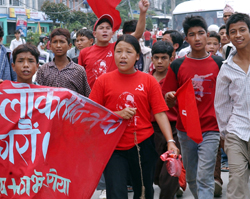
A BBC portrait for CPN-M chairman Prachanda(independent stuff about him is not to find until now..):
Self-made "entertainment" by US Marines in Iraq
On 6.12 the Council of American-Islamic Relations, Washington D.C., published following:
'MARINES' CHEER SONG ABOUT KILLING IRAQI CIVILIANS
Song's lyrics: 'I blew those little f**kers to eternity'
The Council on American-Islamic Relations (CAIR) today called on the Pentagon and Congress to investigate a music video posted on the Internet that seems to show U.S. Marines cheering a song that glorifies the killing of Iraqi civilians.
CAIR said the four-minute video, called "hadji girl," purports to be a "marine in iraq singing a song about hadji." (A "Hajji" is a person who has made the Islamic pilgrimage to Mecca, but the term has often been used as a pejorative by U.S. troops in Iraq.) The song, posted online in March, tells of a U.S. Marine's encounter with an Iraqi woman. It has been viewed by almost 50,000 people.
The song's lyrics include: "I grabbed her little sister and put her in front of me. As the bullets began to fly, the blood sprayed from between her eyes, and then I laughed maniacally. . .I blew those little f**kers to eternity . . .They should have known they were f**king with the Marines." Members of the audience, not shown in the video, laughed and cheered wildly for these lyrics.
http://www.cair.com/default.asp?Page=articleView&id=2184&theType=NR
Here the shit is coming:
Here the entire "lyrics":
I was out in the sands of Iraq
And we were under attack
And I, well I didn't know where to go
Then the first thing that I could see
Was everybody's favorite Burger King
So I threw open the door and I hit the floor
Then suddenly to my surprise
I looked up and I saw her eyes
And I knew it was love at first sight
And she said 'Dirka dirka Mohammed jihad, sherpa sherpa.. blabla..'
Haji girl, I can't understand what you're saying
And she said 'Dirka dirka Mohammed jihad, sherpa sherpa.. blabla..'
Haji girl, I love you anyway
Then she said she wanted me to see
Wanted me to go meet her family
But I, well, I couldn't figure out how to say no
Cuz I don't speak Arabic, so..
She took me down an old dirt trail
And she pulled up to a sod shanty
She threw open the door and I hit the floor
Cuz her brother and her father shouted:
'Dirka dirka Mohammed jihad, sherpa sherpa.. blabla..'
They pulled out their AK's so I could see
And they said
'Dirka dirka Mohammed jihad, sherpa sherpa.. blabla..'
So I grabbed her little sister
And I put her in front of me
As the bullets began to fly
The blood sprayed from between her eyes
And then I laughed maniacally
Then I hid behind the tv
And I locked and loaded my M-16
I blew those little fuckers to eternity
And I said:
'Dirka dirka Mohammed jihad, sherpa sherpa.. blabla..'
They shoulda known they were fuckin' with a Marine
("dirka, dirka mohammed jihad" that phrase came from Trey Parker's and Matt Stone's puppet movie "Team America: World Police")
You should follow the text very seriously, especially after 'So I grabbed her little sister ..' and combine it with the reaction of the "audience".
Finally - I think - there's no further comment necessary!?
PS.(6.16):
Meanwhile in the last 24 hours or so the 'ruling forces' are trying to downplay or just excuse the issue. Of course the Ministry of War in the USA, but also the 'leading' press.. Like the German magazine Der Spiegel: they wrote today that the song was just 'funny meant', 'marine strnge humor' and especially the last parts were just 'misunderstandings'. Spiegel justified this bullsh.. with the sentences: "..the marine(soldier) accompanied the girl home. But there the young woman was shot cold-bloodedly by her father and brother: 'And she threw open the door / And I hit the floor... / Cuz her brother and her father shot her.'"
http://www.spiegel.de/politik/ausland/0,1518,421649,00.html
But this 'interpretation' is complete f.. sh.. because - as I wrote before - when you listen the 'song' and read the 'lyrics' seriously, without any problems, you are able to follow this shit and you can check out what's correct or not...
No matter if it is the US govt or in the Geman press - they try everything to protect the(allied) mass murders in Iraq(and of course everywhere)!
WOW, THE BEST - OR BETTER - THE ONLY ONE DEMOCRACY, IN THE WORLD..^^
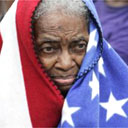
"Fraudsters steal $1bn of Katrina funds
(Guardian, GB, 6.14)
About $1bn in relief meant for victims of Hurricane Katrina was lost to fraud, with bogus claimants spending the money on Hawaiian holidays, football tickets, diamond jewellery and Girls Gone Wild porn videos, the US Congress was told on Wednesday.
The fraud, exposed through an audit by the Government Accountability Office, found a staggering amount of abuse of the housing assistance and debit cards given out by the beleaguered Federal Emergency Management Agency as a way of granting relief to those who lost their homes to Katrina.
Testimony presented to the house committee on Homeland Security yesterday revealed that Fema paid housing assistance to people who had never lived in a hurricane-damaged property - including at least 1,000 prison inmates - and made payments to people who were living in free hotel rooms. In one instance it paid out on a property damage claim from a cemetery in New Orleans - to a person who had never lived in the city. In another it paid compensation for a vacant lot.
"Fema paid over $20,000 to an inmate who used a post office box as his damaged property," Gregory Kutz, the GAO's director of audits, told the committee.
The extent of the fraud was uncovered the day after the first tropical storm of this year's hurricane season landed near Tallahassee, Florida. Concerns remain that despite the torrent of criticism and soul searching after Hurricane Katrina, the agency remains ill-equipped to deal with coming storms.
Predictions that this year will bring another season of severe storms has raised tensions along the Gulf coast, where, nearly one year after Katrina, tens of thousands of people continue to live in Fema trailers, their homes still in ruins. "It is key that Fema address weaknesses in its registration process so that it can substantially reduce the risk for fraudulent and improper payments before the next hurricane season arrives," the GAO report said.
The audacity of the fraud exposed shocked the congressional committee yesterday. As much as 16% of the relief distributed by the agency was lost to fraud, the auditors said. They also said it was likely they were underestimating the scope of the fraud.
"We expected it, but we didn't expect it on this magnitude," Michael McCaul, the Republican chairman of the house homeland security investigations panel, told reporters. "It's an assault on the American taxpayer."
During the audit investigators filed their own bogus claims and used other undercover methods to discover that most of the improper payments occurred because Fema failed to verify the identity of those making claims, or to confirm their addresses.
In the largest instance of abuse by an individual, Fema made 26 payments to someone who submitted claims for damaged property at 13 different addresses in Louisiana, Mississippi, and Alabama, using 13 different social security numbers. Only one of the social security numbers was valid, and a search of property records revealed that the individual had never lived at any of the 13 addresses. In addition, only eight of the addresses actually existed.
Fema also paid rental assistance to people who were already enjoying luxurious hotel accommodation - footing an $8,000 hotel bill in Hawaii for someone who simultaneously received $2,358 in rental assistance.
Fema debit cards also turned out to be an easy mark for those bent on fraud. Among some of the charges the GAO found unnecessary to satisfy legitimate disaster needs were $3,700 on a diamond watch, earrings and ring, a one-week all inclusive holiday in the Dominican Republic, $200 of Dom Perignon champagne, fireworks, $1,000 for a Houston divorce lawyer, and a considerable amount for adult erotica.
Fema recovered some of the mis-spent funds. However, the agency remains unable to account for 381 debit cards worth about $760,000."
http://www.guardian.co.uk/katrina/story/0,,1797513,00.html
THE UGLY SIDE OF GERMANY
(uhuu.. is there any non-ugly side in G..??)
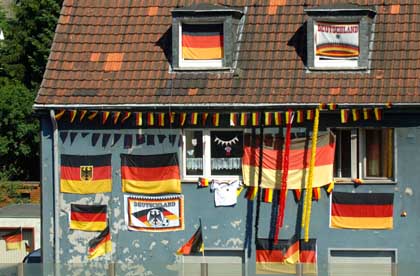




"Mr. President: 'Give Flag Freedom.. The Right to Carry Our (the German) Flag!'
Berlin Police is Demanding in BZ" [BZ, 6.14 (BZ is the main, yellow press, newspaper
in Berlin)]

국가주의(애국심) 박살내자!!
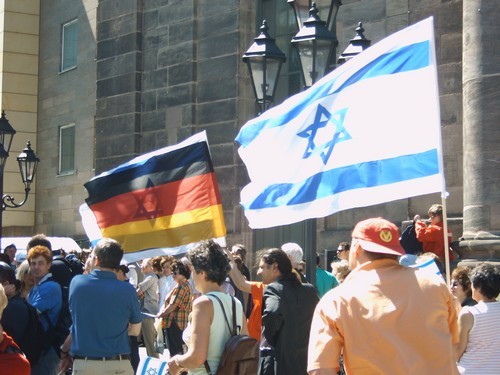
harrharr, it goes much better..
German "anti-german communists"(with Israeli flags) were protesting with
German patriots(nationalists) against the participation of representatives
of the Islamic "Republic" Iran during the World Cup
(Nuernberg, 6.11, I wrote about it already here:
http://blog.jinbo.net/CINA/?cid=4&pid=729)
In only a short while the game between Poland and Germany is beginning..
Already since the beginning of the WC Germans(even "ordinary" people) are running around with t-shirts "1939 we defeated Poland in 36 days - 2006 in 90 minutes".
(Sept. 1, 1939, with the attack against Poland, the Germans began the WWII with the final result, in 1945, of at least 50 million slaughtered people in Europe.. 6 million Jewish.. millions of people from the Soviet Union, Poland, Yugoslavia, Greece, France, Belgium...)
HUNGER STRIKE AGAINST USFK AND THEIR ACCOMPLICES/COLLABORATORS(THE S.K. GOVT)..
16 Activists Join Hunger Strikes for Release of Kim Ji-Tae
Mun Jeong-heon(a Christian activist against war), one of the leaders of the KCPT, the umbrella organization working in solidarity with the communities of Daechuri and Doduri to resist the expansion of USFK Bases, continues to hunger strike in front of the Blue House (Cheongwadae, the residence of the S.K. president), now with the support of 2 free activists, and 15 activists who remain in police custody from actions on March 15th, April 7th, May 4th and May 5th. Father Mun stated, "The reason why I started [this] hunger strike is to follow our chairperson [to give support in his suffering] and to ask our government to be honest."
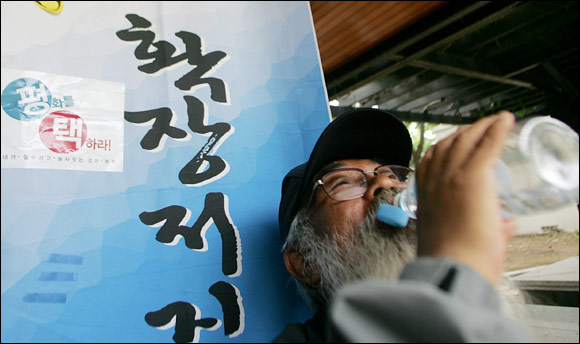
All began their hunger strikes to demand the release of Daechuri villiage main representative Kim Ji-tae. Kim Ji-tae surrendered himself as a condition for resumed talks between the residents of Daechuri and Doduri and the S. Korean government. The activists thought and believed that he would not be arrested or held, only interrogated. However, on June 6th, it was announced that Kim Ji-tae would not be released. Residents withdrew from talks with the government and held a protest at the Pyeongtaek police station. Solidarity vigils are held throughout S. Korea and in Gwanghwamun in central Seoul nightly at 7pm.
After being denied bail at a review hearing on June 7th, Kim Ji-tae continues to be held in prision while awaiting trial on alleged illegal protest activities.
어제부터 내린비로 기온이 상당히 많이 떨어졌습니다. 단식이 일주일이 되어가면서 신부님의 체력이 급격히 떨어지셔서 큰 걱정입니다. 그래도 대추리에서 주민들이 찾아오셔서 힘을 내어보십니다.

▲문정현신부님 단식 6일째 대추리 주민들이 방문하셨다. 김지태이장님의 어머니 황필순 할머니는 신부님을 보자마자 울음을 터트리셨다.
For more about the latest news(in Korean) please read this:
6/11 문정현신부 단식6일째 청와대 농성
http://www.antiwar.or.kr/maybbs/view.php?db=antipabyeong&code=board&n=7352&page=208
..and
(Voice of People/민중의소리)
For more informations(in English) please check out:
http://saveptfarmers.org/blog/
http://www.antigizi.or.kr/zboard/zboard.php?id=english_news http://www.saveptfarmers.org/
Just few minutes ago intl. news agencies reported another deadly attack by the Israely military against "resistance fighters" but, once again, also against civilians in Gaza.
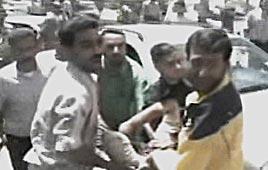
source: Isreali tv
Here the latest by Ynet
Gaza: IAF missiles hits car, 9 killed
At least nine Palestinians killed, among them two children, and 20 others were wounded as IDF chopper fires at least two missiles at vehicle carrying Islamic Jihad members. IDF: Passengers were on their way to fire Qassams at Israel..
Palestinian sources said that in the initial incident a chopper fired a missile at a vehicle, killing three Islamic Jihad members. According the sources, another missile was fired as people were approaching the scene to assist the casualties, injuring many more Palestinians, among them children. (Wow, really a nice idea to fire missiles when people try to help!!)
Now, 15:35 local time, the text is different - updated. Like that:
Gaza: IAF missiles hit car, 11 killed
At least 11 Palestinians killed, among them two children, many others wounded as IDF chopper fires at least two missiles at vehicle carrying Islamic Jihad members. IDF: Passengers were on their way to fire Qassams at Israel..
..Palestinian sources said that shortly after 12 p.m. a chopper fired a missile at a vehicle, killing three Islamic Jihad members. According the sources, another missile was fired as people were approaching the scene to assist the casualties, injuring and killing more Palestinians, among them children...
read the full text here:
http://www.ynetnews.com/articles/0,7340,L-3262326,00.html
(Now there you can also watch a short video docu..)
You should read the "talkbacks", because it shows a lot about the way of "thinking" there..
Ynet also reported that paramedic and ambulance drivers among the death..
Al Jazeera:
Israeli missile strike kills bystanders
Haaretz:
9 Palestinians die in IAF strike on
Islamic Jihad rocket crew
Nine Palestinians, including two schoolchildren, were killed Tuesday when Israel Air Force aircraft fired two missiles in Gaza City at the vehicle of an Islamic Jihad crew heading to fire rockets at Israel.
The rockets found in the vehicle were Katyusha rockets, which have a longer range than the homemade Qassam rockets usually fired from Gaza.
Several civilians were also among the dead, along with at least two Islamic Jihad activists.
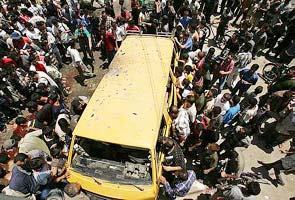
AP reported following:
Hospital: 9 Dead in Israeli Air Strike
A failed Israeli airstrike Tuesday against a car carrying militants along a main road in Gaza City killed nine Palestinians, including two schoolchildren, Palestinian hospital officials said.
The Israeli military said the militants were on a mission to launch rockets at southern Israel. Palestinian witnesses said two missiles were fired, but they missed the car. The second missile came two minutes after the first, when a crowd had begun to gather around the scene of the attack, witnesses said.
Israel-Palestinian violence has escalated since an explosion on a Gaza beach Friday killed eight civilians. Palestinians have blamed the deaths on an Israeli artillery round. Israeli military officials said Tuesday the military's investigation shows the deaths likely were caused by a mine planted by militants from the Palestinians' ruling Hamas party.
Seven of those killed Tuesday in Gaza City were civilians, hospital officials said, and Islamic Jihad said the other two belonged to the ranks of its militant group.
Seventeen Palestinians were injured in the strike, three of them seriously. Gaza's Shifa hospital was overwhelmed by the large number of casualties, and some were being treated on the bloodied floor.
At the hospital's morgue, where the bodies were brought, angry women shouted, ``Death to Israel, Death to the occupation!''
An explosion was heard minutes after the Gaza City strike in the nearby town of Jebaliya. Palestinians said Israel had carried out another airstrike, but the Israeli army said it did not operate there, and no casualties were immediately reported. http://www.guardian.co.uk/worldlatest/story/0,,-5882940,00.html 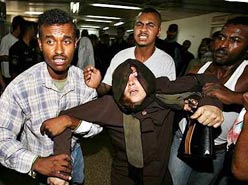
Gazans supporting the relative of Palestinian
killed in an IAF missile strike in Gaza City on
Monday, in which seven civilians were killed.
(Reuters)
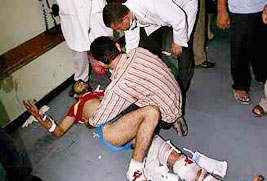
Palestinian doctors treating a youth wounded
in an IAF missile strike in Gaza City today.
(Reuters)
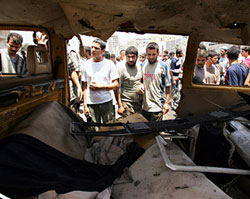
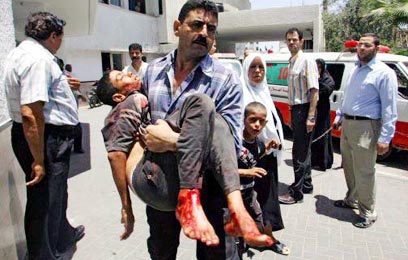
After the attack..
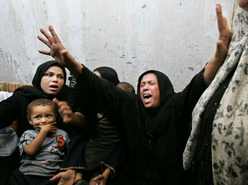
They, the Palestinian organisations of so-called "resistance" - such as FATAH, HAMAS, PFLP, DFLP.. - are demanding(..screaming, yelling, fighting) for "national unity"..
And the final result, once again, is this:
Fatah Gunmen Attack Palestinian Parliament (Guardian)
Hundreds Palestinian security forces loyal to President Mahmoud Abbas went on a violent rampage against the Hamas-led government Monday night, riddling the parliament and Cabinet buildings with bullets to protest an attack against their comrades in the Gaza Strip by Hamas gunmen.
The security men shot out the windows of the parliament before storming the two-building Cabinet complex, where they smashed furniture, destroyed computers and scattered documents. No casualties were reported. But the mob set fire to one of the Cabinet buildings, causing heavy damage as flames quickly spread.
``Every time they touch one of ours in Gaza, we will get ten of theirs in the West Bank,'' said one member of the Preventive Security force, which is loyal to Abbas' Fatah movement. Dozens of gunmen from the Al Aqsa Martyrs' Brigades, a pro-Fatah militia, joined the security men.
The rampage followed an attack in Gaza early Monday by Hamas gunmen on a Preventive Security installation. The attack set off daylong clashes that left two people dead and 14 wounded.
Abbas has been locked in a bitter power struggle with Hamas since the Islamic group beat Fatah in legislative elections. Hamas now controls the parliament and Cabinet.
The power struggle has revolved around control of security forces. With most forces loyal to Abbas, Hamas has deployed its own private militia in the Gaza Strip, raising tensions between the sides.
Abbas was in Gaza at the time of the rampage, where he has been holding negotiations with Hamas in hopes of ending the political deadlock.
http://www.guardian.co.uk/worldlatest/story/0,,-5881297,00.html
| Abbas issues high-alert warning after deadly clashes kill 2 militants (Haaretz) | ||
 | ||
|
Palestinian Authority Chairman Mahmoud Abbas warned all Palestinian security personnel to go on high alert Monday night, after two Palestinians were killed and another 15 wounded in deadly clashes between rival militant groups in the Gaza Strip town of Rafah.
| ||
Fatah gunmen set fire to Cabinet buildings in Ramallah
(Jerusalem Post)
Hundreds Palestinian security forces loyal to President Mahmoud Abbas went on a violent rampage against the Hamas-led government Monday night, riddling the parliament and Cabinet buildings with bullets to protest an attack against their comrades in the Gaza Strip by Hamas gunmen.
The security men shot out the windows of the parliament before storming the two-building Cabinet complex, where they smashed furniture, destroyed computers and scattered documents. No casualties were reported. But the mob set fire to one of the Cabinet buildings, causing heavy damage as flames quickly spread.
"Every time they touch one of ours in Gaza, we will get ten of theirs in the West Bank," said one member of the Preventive Security force, which is loyal to Abbas' Fatah movement. Dozens of gunmen from the Al Aqsa Martyrs' Brigades, a pro-Fatah militia, joined the security men.
At least two people were killed earlier on Monday when a fierce gun battle erupted in Rafah and Khan Yunis between Hamas militiamen and members of the Preventative Security Service.
Meanwhile, the power struggle between Hamas and Fatah moved to the chamber of the Palestinian Legislative Council, which held a stormy session on Monday to discuss Palestinian Authority Chairman Mahmoud Abbas's decision to hold a referendum over a document drafted by some Palestinian prisoners in Israeli jails.
The Hamas-led Palestinian parliament eventually put off the vote on the referendum plan until June 20. Hamas leaders said the move was aimed at giving ongoing negotiations with Abbas a chance to succeed.
Questioning Abbas's right to call a referendum, Hamas called for the PLC to hold an emergency meeting to determine whether the move was in accordance with the law. The PA's Basic Law does not make any mention of a referendum - a fact
that is being used by Hamas to justify its opposition to Abbas's initiative. Fatah, on the other hand, argues that the referendum is legal since there is nothing in the Basic Law that prohibits it.
Many of the Fatah legislators questioned the PLC's right to debate the referendum and called for canceling the session. "This is a black day for Palestinian democracy," said Fatah's Saeb Erekat. "All the Palestinian factions have
the right to resort to resort to various political methods to reject or support the referendum," he added. "But that has to be done within the frame of the law."
Erekat insisted that Abbas had the power to call a
referendum and that the PLC did not have the right to vote against it. "Anyone who opposes this move is entitled to challenge it in court," he said. "We are here to discuss a political issue, not a legal matter."
Erekat begged the speaker of the PLC, Aziz Dweik, to call off the session to avoid internal strife. He reminded Dweik that "75% of the Caliphs [Prophet Muhammed's successors] were killed at the hands of Muslims. Therefore, we must pay
allegiance to one Caliph to prevent dissension."
Fatah legislator Issa Karaki, also invoked Islamic history to justify the referendum. "The Koran and the sharia [Islamic religious law] mention the referendum and shura [consultation of the people in the management of religious and worldly affairs]," he said. "President Abbas's decision to hold a referendum is legal and is aimed at strengthening the status of the people."
Another Fatah legislator, Ibrahim al Masdar, said he saw no reason why the Hamas government should be afraid of a referendum. "The referendum won't affect the work of the government," he said. "In the absence of alternatives, the president has the right to call a referendum on the prisoners' document."
http://www.jpost.com/servlet/Satellite?cid=1150035836391&pagename=JPost/JPArticle/ShowFull
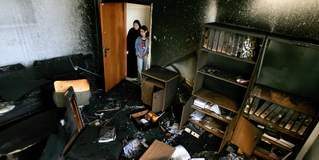
PLC employees surveying the damage Tuesday of a
rampage by Fatah supporters in Ramallah
AFP was reporting just few minutes ago following:
Palestinian parliament, cabinet offices torched
Palestinian factional rivalry erupted into unprecedented violence as followers of president Mahmud Abbas set fire to the parliament and West Bank cabinet offices while supporters of the Hamas government tried to storm a security compound in Gaza.
Militants loyal to Abbas's Fatah faction set fire to the ground floor of the parliament building in Ramallah where the flames quickly leapt through the rest of the complex.
Gunmen from the same Al-Aqsa Martyrs Brigades also torched the cabinet building in Ramallah after hundreds of security officers, staffed largely by Fatah followers, forced their way into the premises and opened fire.
Black smoke spewed into the night sky out of the fourth floor of the five-storey cabinet building as fire engines rushed to the scene but were prevented by militants from trying to extinguish the flames.
Protesting against deadly violence between Fatah faithful and loyalists of the ruling Hamas movement, which today controls government after beating Abbas's party at a January election, Fatah gunmen and security officers smashed windows, destroyed computers and tore up files.
In a bid to contain the situation, Abbas issued an edict placing the Palestinian security forces on a maximum state of alert.
Outside the burning cabinet offices, a masked Al-Aqsa leader who refused to give his name called the protests a "normal response to Hamas aggressions against Palestinian Authority institutions and security service premises".
"We demand president Abbas sacks the government and appoints an emergency cabinet. We blame Hamas for this rift which risks provoking civil war," he told reporters.
In another sign of the anarchy blighting the Palestinian territories, two people were killed and at least 17 wounded in Rafah, in southern Gaza, where Hamas gunmen tried to storm the preventive security service headquarters.
Hundreds of security reinforcements were dispatched to Rafah after Hamas militants managed to smash their way through a wall surrounding the headquarters by firing rocket-propelled grenades.
Shortly afterwards, a Hamas official was briefly kidnapped and then released in the neighbouring city of Khan Yunis by gunmen.
The clashes at the compound took place shortly after a Hamas supporter was killed in fighting that flared after a funeral for another Hamas follower who died from wounds suffered during a previous bout of infighting 10 days ago.
An AFP correspondent at the scene said the three-storey building in central Rafah was riddled with bullets and many of the windows had been shot to pieces.
Cars parked within the compound had also been shot up by the Hamas followers, their windscreens shattered and tyres slashed.
Yussef Siam, head of preventive security in Rafah, said around 20 of his men were in the compound when more than 100 Hamas followers launched their attack.
In the gunbattle that ensued, a 34-year-old deaf civilian, Suleiman Zanoun, was killed after being caught up in the crossfire.
Although the Hamas gunmen were not wearing the uniform of a recently formed paramilitary force, Siam said they were members of the unit.
"This is a force that acts beyond the realms of the law. If they start targeting the government institutions, this will be the end of the Palestinian Authority," he told AFP amid a mass of broken glass, rubble and bloodstains.
Witnesses said the clashes only broke up after hundreds of civilians massed at the scene and started chanting "Unity, Unity" as a sign of their disgust at the bloodshed.
The Hamas paramilitary force was deployed on the streets of Gaza last month despite having been explicitly vetoed by Abbas, who is responsible for security under the terms of the Palestinian basic law.
Although the force is meant to have been withdrawn from view in a bid to ease tensions between the two sides, Abbas's announcement over the weekend of a referendum on coexistence with Israel has reignited the situation.
Fatah gunmen torch Haniyeh's Ramallah office (Ynet/Yedioth Ahronoth)
Fatah activists storm government, parliament buildings in Ramallah and set fire to office of Prime Minister and Hamas leader Ismail Haniyeh
Fatah activists on Monday set ablaze the Ramallah office of Prime Minister and Hamas leader Ismail Haniyeh, witnesses said.
Earlier a Hamas activist and a civilian were killed in exchanges of fire between rival Hamas and Fatah gunmen in the Gaza Strip. PA Clashes
Hamas gunmen open fire at convoy of Fatah’s Preventive Security force chief as he attends funeral of fellow officer. Abu Shbak rushed from scene unharmed, but two others injured
Gunmen opened fire at a building complex housing the Palestinian Legislative Council and government offices in protest at a series of attacks on Fatah officials in Gaza, which have been largely blamed on Hamas.
Under a travel ban imposed by Israel prime minister Haniyeh has no access to his West Bank office and is permanently located in Gaza.
Hamas on Monday blamed Fatah gunmen for the killing of one of its members during the funeral of a gunman killed in clashes on Sunday.
Fatah refuted Hamas claims that a sniper positioned on the roof of the headquarters had opened fire at Hamed Abu Jazer, a Hamas activist.
During Monday's clashes Hamas gunmen fired rockets at the Preventive Security Forces building in Rafah, near the border with Egypt.
Gunmen ignored orders by the Interior Minister to evacuate the streets of Rafah and clashes lasted few hours. A Palestinian civilian was killed in night clashes between the rival factions.
Palestinian security officials said Hamas gunmen tried to set on fire the Rafah headquarters of the Preventive Security Forces.
The latest escalations come a day after the failure of talks between President Mahmoud Abbas and premier Haniyeh in Gaza on Sunday.
Hamas refuses to accept a plan for peace with Israel which Abbas threatened to put up for a referendum.
Rantisi's brother kidnapped
In a sign of further escalation, Fatah gunmen in Khan Younis kidnapped Dr. Salah Rantisi, the brother of Hamas leader Aziz Rantisi, killed in an Israeli air strike.
The kidnapping was to avenge the kidnapping of a senior Fatah official by Hamas gunmen.
.................................................
And the Israeli govt., I"D"F, Shin Beth... are sitting, (perhaps) relaxing and watching the next developments...^^ (of course it is not funny, but what we can do..?)
One of the most important developments on the way to democratization of the Nepalese society was decided by the pariament/govt. last week:
Nepal ends king's veto powers (Al Jazeera, 6.11)
Nepal's parliament has voted to remove King Gyanendra’s right to reject laws.
Saturday's decision to end the king's right of veto is the latest measure to reduce his authority after he was forced to end his absolute rule.
"This regulation has eliminated any and all authority the king had in parliament. From now on the parliament is independent to draft new laws and enforce them," said Subash Nemwang, the speaker for Nepal's parliament.
Members of parliament welcomed the decision.
"The concept of king in parliament has been abolished through law," said Ram Baran Yadav, a legislator of the Nepali Congress, the country's largest party.
"We are now free to criticize the king and the royal family members in Parliament," said Laxmi Shakya, an MP from the Communist Party of Nepal.
As well as losing his legislative veto, the king no longer has control of the 90,000 strong Nepal Army and cannot choose an heir to the throne.
King Gyanendra was forced to reinstate parliament in April after weeks of protests, organised by the political parties and Maoist rebels, against his absolute rule.
The political parties and Maoists have since observed a ceasefire and the government has met the Maoists' demand for elections to an assembly that will redraft Nepal's constitution.
The rebels want the government to move faster, including dissolving parliament and forming a new interim government that includes them.
http://english.aljazeera.net/NR/exeres/CC6C64DB-EE98-457F-8CAD-4E1CC935C897.htm
......................................
About another positive development the Nepalese daily eKantipur reported y'day:
Govt to release over 350 Maoists
In a bid to make environment conducive for the ongoing talks with the Maoist rebels, the government on Monday assured the Maoists of releasing their comrades detained at various prisons and detention centres across the country.
"The government has assured us that it will release more than 350 Maoists detained at various prisons," Maoist Spokesman Krishna Bahadur Mahara, who also heads the rebel talks team said.
Earlier today, the meeting of the Council of Ministers decided to withdraw the cases filed under the Ordinance on controlling Terrorist and Destructive Acts and on not to move forward further investigation.
"Today's meeting has decided to withdraw cases under the TADO and all charges put on the rebels," State Minister for Information and Communications, Dilendra Prasad Badu told journalists after a cabinet meeting held at PM's residence at Baluwatar this morning.
The controversial ordinance, introduced by the erstwhile royal regime allowed the government to detain persons accused of terrorism for a year without any trial.
The government move follows a meeting between Home Minister and chief government negotiator Krishna Prasad Sitaula and Maoist chairman Prachanda in a village in Kaski district Sunday afternoon.
Mahara, who is also the coordinator of the rebel talks team said that Minister Sitaula and the Maoist chairman held informal talks for nearly two hours in which they discussed the recent political developments and the ways to move towards the constituent assembly elections.
"Our Chairman Prachanda is positive about the ongoing peace process between us and the government," said Mahara, adding, "He (Prachanda) hopes that the high-level peace talks (supposed to be held between Prachanda and PM Girija Prasad Koirala) would be held soon."
Mahara also said that unlike in the past, they are ready to show maximum flexibility during the talks. "We expect that the government, too, will remain flexible to sort out serious problems by ignoring petty differences."
He also said that the next round of peace talks would be held within a few days. "I am hopeful that talks will be held within 3-4 days not exceeding a week."
Meanwhile, the government also decided to form a Recommendation Task Force in connection with constituting a High-Level Media Commission.
The task force formed under the convenorship of MP Radheshyam Adhikari has chiefs of the Federation of Nepalese Journalists (FNJ), The Nepal Press Union (NPU), The Press Chautari Nepal, Sancharika Samuha and Save the Independent Radio Campaign, Central Struggle Committee as well as Chief of the Department of Information as members.
http://www.kantipuronline.com/kolnews.php?&nid=76388
.......................................................
Here you can see a interview with the chairperson of the CPN-M:
KTV interview with Maoist Chairman Prachanda (Video)
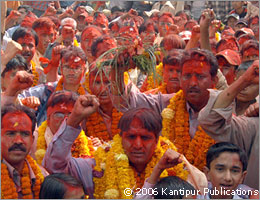
Maoist cadres released from Nakkhu Jail in Lalitpur on
Tuesday chant slogans outside the prison. The
government has pledged to release all the Maoists
from across the country dropping various charges
against them.

최근 덧글 목록