공지사항
-
- '노란봉투'캠페인/국제연대..
- no chr.!
eKanthipur wrote this yesterday, 6.1..
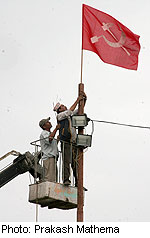
Maoists promise biggest ever mass meet Friday
Claiming that the government is engaged in its own roadmap rather than with the ongoing peace process, Maoist rebels on Thursday warned the government to be sincere towards the talks.
Speaking at a press conference organized on the eve of Friday’s mass gathering, expected to be the largest one since the rebels declared a ceasefire and announced to join the peace process, head of the rebel negotiating team and Maoist Spokesman, Krishna Bahadur Mahara today said that the government, by sticking to its “old agendas” is reluctant to resolve the political crisis.
“The government by going against the spirit of the 12-point understanding is attempting to move ahead alone after the reinstatement of the old House of Representatives,” said Mahara, “This House doesn’t represent the aspirations of the pro-democracy movement.”
He also accused the army of spreading misinformation about Maoist extortions and abductions.
“The anti-democratic forces are engaged in spreading rumours accusing us of forcing people to pay donations,” he said. "We have totally stopped asking for donations after reaching the 25-point Code of Conduct with the government," he added.
Mahara also said that the Maoists in the next round of talks with the government would take up the political agenda.
“We hold that a broad national political conference should be organized and the present government, Constitution and House of Representatives, be dissolved to form an interim government and constitution,” the head of the Maoists’ negotiating team said.
The Maoists also expressed their unease over the deployment of the Nepal Army in the capital in the last few days.
“The government has to stop this before the second round of talks begins,” Mahara said, adding, “It’s against the Code of Conduct reached recently.”
The Maoists have said their Friday mass meeting will be the largest one ever.
The rebels have been organizing similar programmes outside the capital for the last few weeks after the government reciprocated their three-month-long truce and entered the peace process.
“I cannot say as to how many people will attend the gathering but appeal to all the people to participate in it,” said Mahara.
Dozens of vehicles ferrying in Maoist cadres from various parts of the country have already entered the valley.
Traffic management
The government has restricted traffic flow around the programme venue to maintain security.
In a public notice today, the Kathmandu Valley Traffic Office said vehicles in and around the Khulla Manch, where the Maoists are set to hold the gathering, have been prohibited for the programme period.
Parking for those who will be attending the programme has been arranged at the playground in front of Sahid Gate, in the compound of National Trading Limited and vacant areas of Bhrikuti Mandap, the statement said.
Meanwhile, talking to eKantipur over the phone, the Maoists' Central Incharge, Ananta said that they are taking out rallies from six separate parts of the capital.
"Rallies will be taken out from Chabahil, Naya Baneshwor, Balkhu, Lagankhel, Balaju and Gongabu before converging into a gathering at Khulla Manch at 12:30 p.m.," Ananta said.
http://www.kantipuronline.com/kolnews.php?&nid=75384


The Guardian, GB, published yesterday following..
Analysis: Haditha Echoes Earlier Stains
Some words are synonymous with military disgrace. Abu Ghraib. My Lai. And now, perhaps Haditha - the Iraqi town where two dozen unarmed Iraqi civilians allegedly were murdered by U.S. Marines.
Still under investigation, the episode could firm rising American opposition to the U.S. presence in Iraq, just as the 1968 My Lai killings helped turn the tide of public opinion against the Vietnam War.
President Bush promised Wednesday that, if an investigation turns up evidence of wrongdoing, ``those who violated the law, if they did, will be punished.''
The case just added to the administration's many Iraq woes. Just when things seem like they can't get any worse, they do.
``When something like Haditha happens, it gives the impression that Americans can't be trusted to provide security, which is the most important thing to Iraqis on a day-to-day level,'' said Anthony Cordesman, an Iraq expert at the Center for Strategic and International Studies.
``It tends to confirm all of the worst interpretations of the United States, and not simply in Iraq, but also in Afghanistan and in the region,'' Cordesman said.
The disclosure of the allegedly unprovoked killings of civilians in the Iraqi town comes with the war looming large in this year's congressional elections, and with the administration still struggling to explain the American treatment of prisoners at Abu Ghraib in Iraq and at Guantanamo Bay, Cuba.
Haditha is an insurgent stronghold 150 mUnited States and from officials of the new Iraqi government.
``Our troops overreacted because of the pressure on them, and they killed innocent civilians in cold blood,'' said Rep. John Murtha, D-Pa., even though the case is still under investigation and no charges have been filed.
Military investigators have evidence that points toward unprovoked murders by Marines, a senior defense official said last week.
Lt. Gen. Peter Chiarelli, commander of Multinational Corps Iraq, on Thursday ordered American commanders to conduct core values training with all troops on moral and ethical standards on the battlefield.
``This is just a reminder - for troops in Iraq or throughout our military - that there are high standards expected of them and that there are strong rules of engagement,'' Bush said Thursday.
Many analysts have compared the Haditha incident to the March 16, 1968, My Lai massacre, although the Vietnam killings were on a far larger scale. Then, hundreds of unarmed civilians were shot to death by a U.S. unit led by former Army Lt. William Calley Jr. The village was thought to be a Viet Cong stronghold.
The Vietnamese government set the death toll at more than 500. Calley was convicted in a 1971 court-martial and sentenced to life imprisonment, but President Nixon reduced his sentence and he served three years of house arrest.
Michael O'Hanlon, a foreign policy analyst at the Brookings Institution, compared Haditha to My Lai ``on a smaller scale.''
``My Lai symbolized the wanton reckless use of force that was associated with B-52 bombings, and the use of napalm, and the screaming children with their clothes burned off their skin by American incendiaries,'' O'Hanlon said.
And, while U.S. use of force in Iraq is on a far lower order of magnitude, ``these sort of things do reverberate,'' he said. ``And, yes, Iraqis do pay attention to the media, and they watch TV. Their overall impression of the U.S. is not very favorable, and this will make it a little worse.''
First reported by Time magazine, the Marines allegedly went on a killing spree after one of the men driving a Humvee was killed by a roadside bomb. ``If the allegations turn out to be valid, then of course there will be charges,'' vowed Gen. Peter Pace, chairman of the Joint Chiefs of Staff.
Army Brig. Gen. Carter Ham acknowledged the allegations could further tarnish the U.S. image. ``Allegations such as this, regardless of how they are borne out by the facts, can have an effect on the ability of U.S. forces to continue to operate,'' Ham, a former commander of U.S. forces in northern Iraq, told reporters Wednesday.
In the 1950 No Gun Ri killings, American soldiers from the 7th U.S. Cavalry Regiment killed dozens of South Korean refugees over a three-day period, although the number slain varies according to the witnesses. U.S. soldiers' estimates ranged from under 100 to ``hundreds'' dead; Korean survivors say about 400, mostly women and children, were killed at the village 100 miles southeast of Seoul.
The No Gun Ri killings were documented in a Pulitzer Prize-winning story by The Associated Press in 1999, which prompted a 16-month Pentagon inquiry. The Pentagon concluded that the No Gun Ri shootings were ``an unfortunate tragedy'' but ``not a deliberate killing.''
The Haditha killings, if confirmed, show vividly that ``war is very dangerous and dehumanizing,'' said Stephen Wayne a Georgetown University political science professor. ``It can take good people, like these Marines, and it can turn them into something that goes against the human rights and the liberty and all the things we're fighting for.'' http://www.guardian.co.uk/worldlatest/story/0,,-5859432,00.html More about this issue I will write in the coming days..
The HK based magazine Asia Times published following story 5.26..
North Korea's creepy-crawly capitalism
VLADIVOSTOK, Russia and BANGKOK, Thailand - North Korean capitalism is thriving - just not inside North Korea. Pyongyang has steadily established a string of legitimate and less legitimate front companies across East and Southeast Asia, aimed at earning the cash-strapped government badly needed hard currency. And, by all indications, business is booming.
Consider, for instance, Cafe Pyongyang, one of Vladivostok's most popular eateries. It is so popular, in fact, that there are plans to build a new restaurant in the shape of a North Korean peasant's hut, similar to the one where the late leader Kim Il-sung was born in 1912. Here, gracefully clothed North Korean women serve up traditional Korean fare, while patrons sing popular Korean tunes.
Similarly themed restaurants have popped up in Beijing and Shanghai in China, and Phnom Penh and Siem Reap in Cambodia. But this by no means represents a North Korean business diaspora similar to the ethnic-Chinese community that now controls a large swath of Southeast Asia's economy. Rather, the Pyongyang government owns and operates all of the eateries - and their regional interests reach far beyond restaurants.
North Koreans are becoming skilled capitalists outside their own strict centrally controlled country. For instance, they own a 15-story, 160-room hotel, complete with a nightclub and a sauna, in the northeastern Chinese city of Shenyang. There, government entrepreneurs also run a North Korean-owned computer software company and an Internet service provider. Even more imaginatively, a company in Dandong, a Chinese city just across the Yalu River from North Korea, acquired the exclusive rights to sell North Korean medicines on the international market - including a brand called Cheongchun No 1, a home-made version of Viagra.
Angry enemies, profiting allies
While China is welcoming, North Korean companies have gotten a rise out of Japan and the United States, which contend that Pyongyang uses these concerns sometimes to procure raw materials and dual-use technologies clandestinely to support its missile and nuclear-weapons programs.
Until recently, North Korea was able to acquire sensitive industrial components and chemicals through companies in Japan, which were affiliated with the pro-Pyongyang General Association of Korean Residents, or Chosen Soren. But when the Japanese authorities began to crack down on this trade a few years ago, the North Koreans began buying more goods from Thailand.
In November 2002, a Tokyo-based, Chosen Soren-affiliated company called Meishin - or Myongshin in Korean - attempted to export three power-control devices to North Korea. But when the company informed customs of the planned shipment, Japan's Ministry of Economy, Trade and Industry responded that Meishin required special permission under regulations governing the export of dual-purpose equipment that can be used in, or converted for use in, the production of weapons of mass destruction. The power-control devices could, for instance, be used to stabilize the heavy flow of electric current to uranium-enrichment centrifuges.
Meishin (Myongshin) failed to procure the appropriate documents, but on April 4, 2003, it shipped those same devices to a Thai telecommunications company, Loxley Pacific, which in turn planned to ship them to North Korea's Daesong General Trading Co. But customs in Hong Kong, where the ship stopped on its way to Bangkok, acted on a tip-off from the Japanese, seized the devices and returned them to Japan.
Loxley Pacific has major commercial interests in North Korea, including the operation of a mobile-telephone network, and was a perfect conduit for the stabilizers to North Korea. A Loxley spokesman at the time insisted that the devices were not destined for North Korea's nuclear program.
"The electricity situation is poor in North Korea ... They need stabilizers to avoid hurting their household appliances," he said in a press interview at the time. It is possible, though not altogether likely, that Loxley was unaware of what the dual-use stabilizers were actually intended for.
Thailand, which has cultivated close commercial ties with Pyongyang, recently replaced Japan as North Korea's third-largest trading partner. Two-way trade with Thailand was US$165 million in 2002, rose to $265 million in 2003, and jumped again to $332 million in 2004. In 2005, North Korea imported $207 million worth of goods from Thailand, and exports reached $134 million, or a total two-way trade of $341 million, according to statistics from the Thai Customs Department.
Thailand exports rice, fish, fuel oil, textiles, chemicals and pharmaceuticals to North Korea, while it imports fertilizer, optical equipment, and some iron and steel - at least according to official records. It may seem odd that Thailand, with a well-developed fertilizer industry and as a net fuel importer, would import fertilizer and export fuel oil.
But it seems to indicate off-balance-sheet barter deals, which are famously favored by the North Koreans. In exchange for oil, they give fertilizer to their Thai partners, who, in turn, repackage it using locally produced chemicals of questionable quality, or fertilizers received as aid from South Korea, and sell it at a favorable price to countries such as Laos, Cambodia or Myanmar.
Opaque trade flows
It's exactly that lack of transparency that has North Korea's critics in Washington and Tokyo fuming. North Korea's embassy in Bangkok is its biggest in Southeast Asia, and it operates in conjunction with two locally registered companies, both of which have North Korean citizens listed as directors and allegedly deal in electronics components, ceramics and consumer goods.
The first, Kosun Import Export, was set up in 1991 and operates out of a small apartment block not far from the North Korean Embassy. The other was set up in 1995 and was first called Kotha Supply Import Export, but is now registered as Star Bravo. The company is reported to be a subsidiary of the Daesong Group, which is North Korea's main state-owned trading corporation and the overt arm of Bureau 39, the clandestine foreign-exchange-earning branch of the ruling Korean Workers' Party.
Daesong operates openly under that name in Hong Kong, but no longer in Singapore, where in 2001 it changed its registered name to the more innocuous-sounding Laurich International. In Macau, Daesong was known as Zokwang Trading. But the North Koreans fled the former Portuguese territory last September after the US Treasury Department identified a local bank, Banco Delta Asia, as a "financial institution of primary money-laundering concern". The bank, the US authorities asserted, "has provided services for over 20 years to North Korean government agencies and associated front companies".
The Treasury Department accused "North Korean entities" of being engaged in criminal activities, including the counterfeiting of US currency. The naming of Delta Asia in particular caused depositors to rush the bank and withdraw their holdings. The Macau government had to step in to prevent the bank from collapsing, and Delta Asia finally agreed to dissolve its North Korean links. Subsequently, Zokwang - the first North Korean trading company in the region and active in Macau since the mid-1970s - evacuated its office in the territory and moved its operations to the Zhuhai Special Economic Zone just across the border in mainland China.
The Delta Asia affair has had a snowball effect on everyone doing business with Pyongyang, veritably criminalizing dealing with the regime. Nigel Cowie, the British general manager of the Pyongyang-based Daedong Credit Bank, stated in a speech at an informal meeting hosted by the European Business Association of Pyongyang in the US on May 4: "The result of these actions against banks doing business with the DPRK [Democratic People's Republic of Korea] is that criminal activities go underground and are harder to trace, and legitimate businesses either give up or end up appearing suspicious by being forced to use clandestine methods."
Foreign customers conducting legitimate businesses in Pyongyang, he said, "have been told by their bankers overseas to stop receiving remittances from the DPRK, otherwise their accounts will be closed". Now, vast amounts of cash are being carried physically to banks overseas, which would indeed appear suspicious in the eyes of international law-enforcement agencies.
The US action raised important questions about the nature of North Korean capitalism, and underscored the dilemma the world faces from a cash-starved, nuclear-armed Pyongyang. Washington, no doubt, realizes that more international trade and economic development is essential for Pyongyang to move forward and evolve into a responsible regional player. Some North Korea-watchers contend that Washington's recent intervention in Macau will only discourage what was a slow but sure effort by Pyongyang to integrate with the global trading economy and promote an experimental measure of free enterprise, similar to what the Chinese communists did in the late 1970s before implementing their capitalist reforms.
South Korea, in particular, has long advocated economic engagement with North Korea, arguing that unless the North is urged and helped to develop and strengthen its economy, both the South and the North would likely collapse upon reunification. For this reason, Seoul has openly fallen out with its US ally on this score.
Others argue that the flow of more hard currency into Pyongyang's coffers only serves to delay the inevitable collapse of one of the world's most atavistic regimes, thus prolonging the extreme suffering of the North Korean people. There is little or nothing to suggest that the money that the North Korean front companies are earning in the region is being employed for social development at home or spent on basic necessities, such as putting food on the tables of the country's starving people.
Whatever the case, North Korea is likely to find new ways to continue its commercial drive across the region - albeit more cautiously. Perhaps that's where far-flung places like Vladivostok will come into play. At one of the tables at Cafe Pyongyang, two North Korean officials recently talked business with a Russian entrepreneur. They offered North Korean workers in exchange for timber from Siberia's vast forests, where North Koreans have for years toiled as lumberjacks.
The US may try to tighten the screws on North Korea's expanding global businesses, but there are always others - Russia, China and Thailand - who are more than willing to do business with an enterprising Pyongyang.
http://www.atimes.com/atimes/Korea/HE26Dg02.html

최근 덧글 목록