
공지사항
-
- '노란봉투'캠페인/국제연대..
- no chr.!
39개의 게시물을 찾았습니다.

축하!!
According to int'l news agencies: The Korean Peninsula still exists(fortunately). Congratulation!!
The int'l media, here for example AP/CNN, is explaining the "real" reason why..:
North Korea may drop nuclear test
North Korea informed China it may drop its plan to test its first atomic bomb if the United States holds bilateral talks with the communist country, a former South Korean lawmaker said Sunday.
The North also denied speculation that its nuclear test was imminent and said the regime has not raised the alert level of the country's military, said Jang Sung-min, citing a telephone conversation with an unidentified Chinese diplomatic official.
North Korea warned the Chinese official, however, that it would accelerate its preparations for a nuclear test if the United States moves toward imposing sanctions or launching a military attack, Jang said, citing his contact.
The Chinese official was informed of North Korea's stance by North Korean officials Sunday afternoon, Jang said.
The official then telephoned Jang in South Korea with the news.
Jang is a former lawmaker of the then-ruling Millennium Democratic Party...
http://edition.cnn.com/2006/WORLD/asiapcf/10/08/nkorea.tests.ap/index.html
But actually I'm sure that Kim Jong-il was simply to drunken(after yesterday's f.. long party) to get up today(and to direct the nuclear test or anything else^^)..
To be continued(of course!!)...
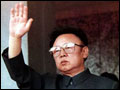


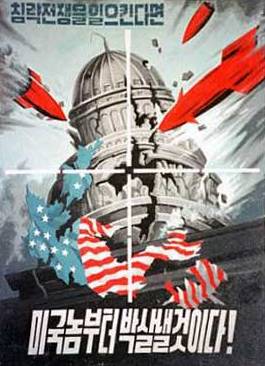
"North Korea can have a future or it can have such (nuclear) weapons. But it cannot have both." (Chr. Hill, CNN Int'l, 10.7)
Int'l news agencies/-papers are expecting for the coming days - many are saying TOMORROW - a test of a nuclear bomb by/in the D.P.R.K.
(Of course especially) the S.K. "left" is downplaying this threat. For example the "left-liberal" newspaper Hankyoreh wrote before y'day: "Despite the North’s recent announcement that it would go ahead with a nuclear test, there are no signs that North Korea is preparing for one. Indeed, experts believe a test is not imminent..." although even Chinese government related officials said that "The dicision for the test is alraedy made"(Li Dunqiu, Research Center of the State Council, 10.4).
I'm really worrying that, even after NK accomplished the test, nobody in SK will really care about it..
Tomorrow I'll write more about my opinion about this issue(aeh~ I mean if it's necessary - if you're still alive..).
U.S. readies options on North Korea (IHT/NYT, 10.6)
Amid signs Friday that North Korea was gearing up for a nuclear test, the Bush administration was developing an extensive list of possible new sanctions against Pyongyang, senior officials said.
The measures under consideration include renewing efforts that have been unsuccessful in the past - persuading South Korea and China to cut off energy supplies and trade - and potentially confrontational steps that include intercepting and inspecting sea shipments into and out of the country.
Many of the sanctions have been considered before, as part of a long- running argument within the Bush administration over the best way to deal with North Korea. After a series of emergency meetings, including one on Tuesday at the White House, officials on each side of that debate said a nuclear test would end the argument about whether the United States should emphasize rewards or penalties.
"If the test happens, all the arguments are over," said one senior official in the midst of the debate. "We'll end up going to full-scale sanctions; the only debate is what 'full-scale' means."
On Wednesday night, Christopher Hill, the assistant secretary of state for East Asia and a leading proponent of new creative diplomatic offers to North Korea, announced that "we are not going to live with a nuclear North Korea."
Bush administration officials concede that the United States has been living with a nuclear North Korea for years. But the fact that North Korea has not yet tested its weapons has created enough diplomatic ambiguity so that President George W. Bush has not had to confront how he would enforce his own declaration in 2003 that he would never tolerate a nuclear-armed North Korea.
U.S. intelligence agencies have long declared that North Korea has produced the fuel for nuclear weapons, but in recent days, their briefings have also included an assessment based on the expectation that North Korea is likely to make good on its threat to conduct an underground test.
The briefings include the important caveat that such assessments are based more on an evaluation of the political environment and North Korean strategy than on physical evidence that a test is imminent. The briefings were described by several government officials, who said they did not forecast a specific timetable for a test.
The question of sanctions is an enormously sensitive one, administration officials said, and they would not describe the options publicly because no decisions had been made. The officials who did discuss them, however, came from both camps in the administration, and they appeared unified in their effort to send a warning to North Korea that a test would galvanize Washington into actions that some administration hawks have been proposing for years.
Bush, several officials said, planned to call President Hu Jintao of China in coming days to urge him to send an emissary to North Korea to deliver a sharp warning about the consequences of a test.
Frederick Jones, a National Security Council spokesman, would say only: "Our objective is to try to use our influence, and the influence of others, to convince the North Koreans that they should not test a nuclear device."
But U.S. officials are clearly concerned that the appeal to Beijing will not prove sufficient.
"The last time the Chinese did this, after the missile tests" that North Korea conducted in early July, "their delegation was left cooling their heels for days," one senior official said. Others cautioned that China had always shied away from the ultimate sanction, cutting off oil to North Korea, for fear that it could trigger an economic or political collapse that would result in chaos along the long Chinese-North Korean border.
The threatened test comes as the administration is already trying to persuade the UN Security Council to make good on its threat to impose sanctions against Iran for defying a call for it to suspend uranium enrichment.
Some U.S. officials are concerned that adding North Korea to the list of countries the United States wants punished could complicate those efforts and fracture a fragile coalition.
The potential sanctions against North Korea are described in a series of classified options papers that have been circulating among senior administration officials.
The proposed sanctions, which are graduated, begin with a significant tightening on economic transactions - a process that began last year with action against a small bank in Macao that is believed to have handled transactions for Kim Jong Il and other North Korean leaders, and that U.S. investigators say was involved in money laundering.
A more escalated measure would involve inspection of all shipping, using a provision of a council resolution passed after the missile tests in July that allows nations to block missile or missile-related transactions.
Such interceptions have been practiced under the administration's Proliferation Security Initiative, a program begun to persuade scores of nations to cooperate in stopping illicit weapons shipments.
But the reality is that North Korea receives most of its goods over the Chinese and Russian borders. Kurt Campbell, a former Defense Department official who specializes in Asia, said, "Without leveraging the Chinese to put firm pressure on, very little can be accomplished by the U.S. through sanctions."
http://www.iht.com/articles/2006/10/06/news/nuke.php

Following article was published yesterday in the German (bourgeois) magazine Der Spiegel:
HOLIDAY WITH THE FAR RIGHT
German Neo-Nazis in Paradise
Germany's far-right NPD party is expanding its influence even in holiday retreats like the Baltic Sea resort Usedom. Some locals are concerned that this could mean the end of a tourism boom for the idyllic coastal region. But no one likes to talk openly about the problem or its causes, and a climate of fear has seized the residents.
Jutta Arnold gets nervous every time she thinks of the coming season. She should have a dream job: She's Usedom's hotel director and regional head of the German Hotel and Gastronomy Association. Business is good. With its renovated Wilhelminian luxury hotels, gorgeous promenades and long white beaches, the Baltic Sea island lures more and more tourists every year to Germany's remote northeastern corner. At least until now.
After regional elections almost three weeks ago, Germany's far-right National Democratic Party (NPD) celebrated a fresh success on this island. The NPD won 7.3 percent of the vote across the state of Mecklenburg-Western Pomerania, but in most villages on Usedom it won just over 10 percent; and now the island's tourism industry fears tourists may decide to go elsewhere next summer.
"To be perfectly honest, the election results will only harm tourism," says Arnold. "That's why I don't understand how people here could vote for the extreme right. We're shooting ourselves in the foot."
Meanwhile, the NPD has learned to deal with the accusation that it scares off tourists. "Tourists welcome, asylum-swindlers out!" say posters still attached to street lights after the election. Arnold knows from experience that those are hollow words. A dark-skinned visitor was recently accosted, she says -- at least one particular tourist was not welcome. "Either I've misunderstood something here," Arnold says about the NPD slogan, "or the NPD has." She candidly admits, "We can only protect our guests on the hotel premises."
What makes Jutta Arnold special is that she'll talk about the danger from the right. Granted, it's part of her job description as a tourism functionary. But an open-mouthed policy on neo-Nazis is nevertheless not typical on the island of Usedom.
The NPD taboo
Many passers-by here would simply rather not discuss it. Some do, then ask not to be named. Others speak fairly openly, give their names, then send pleading e-mails days later: For God's sake, please don't quote me!
What's going on? How great must the fear in Usedom be for so many to fall silent?
Those who speak anonymously about the far right don't admit to voting NPD. No one does: That's the first realization. The second is that almost everybody has some sympathy for NPD voters. They're going against the "established parties," people say. The third is that one often hears the claim that the right-wingers aren't causing problems. "They're always well-dressed, they greet you, and they behave themselves."
In Usedom, such well-bred right-wing extremists made the headlines when they assaulted a group of school kids on a camping trip. Six years ago, a homeless man was beaten to death in Ahlbeck. Today, seniors sitting on a park bench in Ahlbeck let the turbulent holiday life pass them by as they say-again, anonymously-that the incident was the work of hooligans, who can be found anywhere and not just in Ahlbeck. The NPD is a different story, though; they are a legitimate political party.
Ahlbeck, Bansin and Heringsdorf are Western Pomerania's three bath resorts from Germany's imperial era, built as majestic summer retreats. Tourists lounge around here in the white sand, eat ice cream, buy amber souvenirs, and enjoy the idyll of beach life on the Baltic Sea. It is here of all places that these tourists now have to grapple with how the NPD has become so popular right in the middle of mainstream society. An East German couple from Bernau near Berlin tries to explain it this way: "One can understand that the people here would vote out of protest." The two tourists do not get any more specific, saying only that people in Western Pomerania have ample reason to complain, despite the fact that "it's much worse with the foreigners" in West Germany.
Bleak winters in the village
A more complete answer to the question of the NPD's rise in popularity can be found beyond the city's promenades, where the holiday paradise ends and a very different region starts. Life here grows especially gray during the winter, when seasonal workers are unemployed. The hinterlands of Usedom can be very bleak, to say nothing of the mainland.
So bleak, in fact, that the NPD could count on a measure of success with its massive and expensive ad campaign. Western Pomerania is among Germany's least-developed states. It's marked by high unemployment and a rural population that "has always been kinda simple," as one man here put it (again, anonymously). Ideal conditions for a party whose most prominent members come from the west in order to win power using equally simple phrases.
"Preserve local schools. Rap the knuckles of fat cats!" an NPD placard demands. This is not really objectionable in and of itself, says Lars Bergemann, the party whip for the left-wing Party of Democratic Socialism (PDS): "The NPD is not stupid. It reads people's lips and has understood how to skillfully address their needs. They have been successful, and we are left with hindsight."
The politician heads the district commission for youth welfare services and has a seat on the council against right-wing extremism. He's willing speak openly about the NPD, as he tries to explain the climate of fear that has spread throughout the region. "It's a big taboo. People don't trust each other," he says. Even obvious NPD supporters don't want to talk about their motives and the party. And since the extremists remain incognito, not even those who want to "work against this democratically" have the courage to come out of hiding. "To some extent this fear is justified, not so much because of the violence, but because it's easy to make a person's life hell in a village."
Bergemann assumes the NPD has a loyal following here. The election result "wasn't just out of protest. All you have to do is ask around." The NPD has taken hold "because the long-established parties have failed." It's not just Bergemann who says this out of a will to criticize; people say the same thing on the street. The NPD won because the other parties have done nothing.
A youth club here, a bonfire there -- little achievements earn the NPD credit. In Zirchow, near the middle of the island, a muscle-packed young man with a bald head claims that "over the past 15 years," people have tried every party. None did enough. "So they voted for the NPD, who doesn't do any less than the others." He voted for the Greens. "The fact that I am bald is purely a coincidence."
Another native who prefers to remain anonymous says that "half of the people stayed home because they were frustrated. The other half went to the polls for the exact same reason." Unmet expectations, palpable neglect -- these are the issues in Western Pomerania. "It's no solution that our youth has to go to Norway or Bavaria to find work," complains a Lassan woman. In this small village, the conservatives got 158 votes, the social democrats got 138, and the NPD got 129. "Someone has to take care of us."
The first NPD mayors?
Indeed, many people leave the region, above all the well-educated, the young, and the women. What remains are the old "and the young men with relatively meager educations. This is an ideal breeding ground for the NPD," the PDS politician Bergemann says.
Western Pomerania's problems are difficult to solve. On the one hand, there's uncertainty about the future and the social decline of the older generation, who lost their jobs after German reunification. On the other is the lack of prospects for a young generation of Germans who listen to right-wing identity-branding -- with words like 'pride' and 'honor' -- and whose self-esteem swells when large parts of society become afraid of them. The same principles are at work in urban street gangs -- but in the case of gangs, an organized party can't make political capital out of the kids.
Bergemann looks skeptically at the years ahead. The next election is scheduled for 2009. Mayoral and district executive positions will be at stake, and Bergemann fears that the NPD's current grassroots work will pay off. "In some villages, the NPD today already has 30 percent of the vote. It is possible that they will soon gain a foothold with mayoral positions," he says. "I am afraid of that."
Hotel director Jutta Arnold puts it this way: "If nothing happens, things will get bad for us. And as far as I can see, nothing is going to happen."
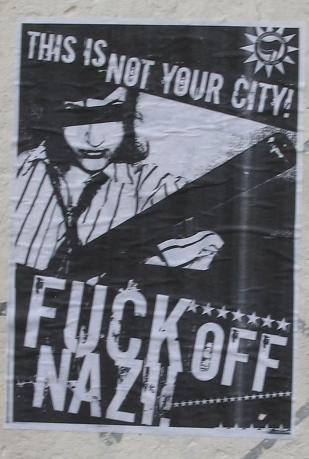
Propagandistic powerlessness
Anti-nazi poster in Erfurt(south-east Germany)
Following f.. crazy story I found few days ago on (the notoriously) DailyNK:
Soccer Ball Rescue Mission
In North Korea, receiving gifts from Kim Il Sung or Kim Jong Il is the most honorable event...
Kim Jong Il often gives presents during field inspection or on holidays to the people. Each individual or organization that received a gift from Kim is supposed to be ‘very grateful’ and solemnly swears an oath of loyalty...
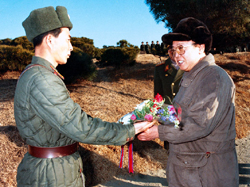
However, 18 years ago, four young soldiers died because of a soccer ball, a gift by Kim Jong Il.
It was a fine spring day in 1988, in a coastguard regiment under the Korean People’s Army’s Fourth Corps in South Hwanghae Province. As a Kim Il Sung’s birthday commemorative gift, Kim Jong Il sent various gifts to the troops stationed near DMZ (demilitarized zone). Soccer balls were included.
Several soldiers, relaxing after a coastal patrol mission, played soccer with the ball given to them by Kim Jong Il...
During the soccer game, somebody who could not control his power kicked the ball into the sea. There were angry waves smashing the coast.
Someone shouted “Save the ball.” A platoon leader dived into the sea. The lieutenant, however, failed to get the ball and was almost drowned.
Other platoon members jumped into the sea to save the lieutenant. 3 others and the platoon leader were swept away by the waves.
A rescue team from the company headquarters arrived, but it was too late. The part of sea was an estuary, where a river joined with the sea and created a powerful whirlpool. Four soldiers were swept too fast.
Dear leader Comrade Kim Jong Il’s present must be saved regardless of the situation.
The coastguards knew danger of diving into such waters. However, they sacrificed their lives to save a soccer ball because the ball was a Kim Jong Il’s gift. Dear leader Comrade Kim Jong Il’s present must be saved regardless of the situation.
After a few days, South Korean army notified the KPA through Panmunjom, a North-South Korean negotiation post along the DMZ, to accept four bodies of North Korean soldiers.
The bodies were buried in a mountain near the platoon they served in. It was reported to Kim Jong Il and Kim ordered to award the soldiers medals and other honors posthumously. The four were recorded as killed in action.
http://www.dailynk.com/english/read.php?cataId=nk00100&num=1151

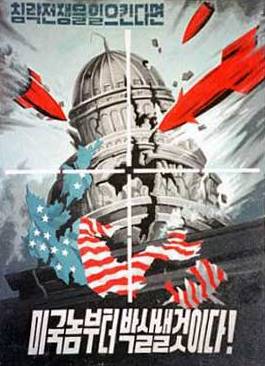
"Today the Korean Nation is standing at the crossroad between life and death" (KCNA, 10.03)(*)
It seems that the DPRK is preparing for a special Chuseok present.
Today, while I was checking thge news about Palestine I saw on Yedioth Ahronoth(Israeli daily) following news: "Any North Korean nuclear test would be 'unacceptable' and the international community would respond 'harshly', Japanese Prime Minister Shinzo Abe said on Tuesday, after Pyongyang said it would conduct a test in the future.". And I said to myselfe: "Oops.. is Kim Jong-il preparing for a special Chuseok gift??!!" Later I found out that nearly everywhere - in Europe(**), Asia(aeh~ perhaps in S. Korea nobody is alarmed and scared..), the US,even in the Middle East(for example on Al Jazeera it's today's top story!)... - everyone is alarmed about NK's annoncement to test a nuclear bomb soon.
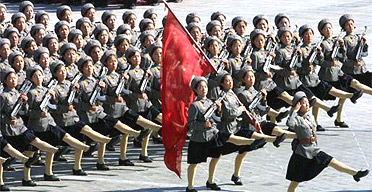
North Korea vows to test a nuclear weapon (IHT, 10.03)
North Korea said Tuesday that it would test a nuclear weapon despite U.S. warnings that such a move would provoke harsher sanctions and perhaps even military action.
The announcement by the North Korean Foreign Ministry marked the first time the regime had declared its intention to conduct a nuclear test and raised the stakes dramatically in negotiations on how to deal with North Korea's nuclear weapons programs.
The statement gave no indication when a test might occur. Last month, Kim Seung Kyu, director of the National Intelligence Service, told the South Korean Parliament that North Korea was capable of conducting an underground nuclear test at any time.
Although Pyongyang declared in February 2005 that it possessed nuclear weapons, it has never conducted a known test on its territory to prove its claim. A successful test would confirm North Korea as the eighth declared nuclear power, following the steps of the United States, Russia, Britain, France, China, India and Pakistan. Israel is an undeclared nuclear power.
Confirmation that North Korea has nuclear weapons, experts said, would disrupt the arms balance in Northeast Asia and possibly compel Japan, which lies within the range of North Korean missiles, to amass its own arsenal. That in turn would encourage South Korea to pursue its own nuclear arms program.
In Tokyo, Foreign Minister Taro Aso said: "It is a threat to peace. We would never be able to forgive such a move."..
"The DPRK will in the future conduct a nuclear test under the condition where safety is firmly guaranteed," the North Korean Foreign Ministry said in a statement..
North Korea's statement, carried by its official press agency, KCNA, said the "U.S. extreme threat of a nuclear war and sanctions and pressure compel the DPRK to conduct a nuclear test, an essential process for bolstering nuclear deterrent."...
North Korea's statement came just days before planned visits by Prime Minister Shinzo Abe to Beijing and Seoul, Nam noted. Abe, a hawk on North Korea, was expected to discuss North Korea as a top agenda item in his meetings with Chinese and South Korean leaders...
Robert Joseph, the U.S. under secretary of state for arms control and international security, said last week that Washington was prepared to seek a UN Security Council resolution that would invoke Chapter 7 of the UN Charter, which allows for military force. The use of Chapter 7 has been vehemently opposed by China and South Korea.
In the recent weeks, there have been news reports in Washington, Tokyo and Seoul that North Korea may be preparing for an underground nuclear test. The reports cited activities around facilities near the border with China or on the North's remote northeast coast.
http://www.iht.com/articles/2006/10/03/news/nuke.php
* Please keep in mind that there is only ONE Korean nation(N+S.K.)!!
** The German TV news Tagesschau was talking about "the communist military dictatorship in North Korea.." - haehae~
Anyway:
I WISH EVERYONE BEAUTIFUL
CHUSEOK HOLIDAYS!!^^
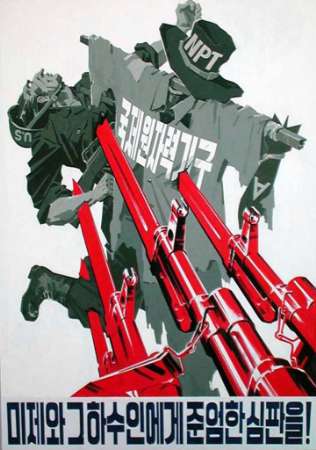
For the latest news/articles about the issue please check out following:
N Korea threatens nuclear test (Guardian, 10.04)
Pyongyang defiant on nuclear test
Asian allies warn on nuclear test by N. Korea (IHT)
N Korea rejects nuclear test criticism (Al Jazeera)
North Korea calls the shots (Asia Times)
S. Korea warns N. Korea not to test nuclear weapons (Yonhap)
And last but not least here you can read the full text of 10.3 announcement by NK's "news" agency KCNA:
DPRK Foreign Ministry Clarifies Stand on New Measure to Bolster War Deterrent

Korea Times'/한국일보 logo

No logo - just German reality
Today 16 years ago Germany was reunited.
Since that date in Germany, mainly in the eastern part, at least 135 people were killed because of racial or "ideological" - mainly people who were looking like "leftists"(for example punks or young men with long hair..) but also homeless or disabled people - motives by neo-nazis/fascists. Just four days after the re-unification the first men, a visitor from Poland, was killed near Berlin.
Already in the first days(end of 1989) of the demonstrations which led to the collapse of the East German/GDR(German Democratic Republic) regime neo-nazis started to hunt mainly young leftists/anti-fascists. About one of the most infamous mass attacks by German neo-nazis, but also "ordinary" people, against migrants I already wrote nearly four years ago here: http://base21.jinbo.net/christian/020913.html
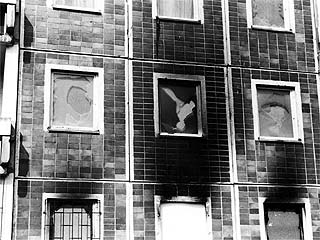
Rostock 1992, migrants' house after neo-nazi attacks
Following story about one of the victims of racial violence in the reunited Germany was published some days ago in the German(bourgeois) magazine Der Spiegel:
NOEL MARTIN'S FINAL STRUGGLE
Neo-Nazi Victim Battling to the Death
Noel Martin plans to take his own life in less than a year. Just over 10 years ago, a neo-Nazi attack left him paralyzed from the neck down. He plans to fight right-wing extremists to the very end.
Noel Martin has already chosen July 23, 2007 to be the day he dies. On that evening, his pulse will gradually slow down until it stops completely. He has decided to die as a result of a lethal blend of drugs -- administered in Switzerland by Dignitas, an organization that offers its clients medically assisted suicide.
Martin publicly announced his decision in June, 10 years after the attack that left him paralyzed and destroyed his will to live. He plans to celebrate his last birthday -- he'll be 48 -- and then drink the cocktail that will put him out of his misery.
He has 297 days left.
The attack occurred on June 16, 1996 in Mahlow, a town in the former East German state of Brandenburg where the dark-skinned, Jamaican-born Briton was employed as a construction worker. A stone crashed through the windshield of his car and Martin's car veered off the road. He remembers seeing a tree careening towards him and jerking the steering wheel.
And then, a thud. Darkness.
When Martin woke up, he was lying on his back. He heard a voice. "Can you feel my hand on your leg?" it asked him. "But you're not touching my leg," Martin replied.
"I am not a part of life. I just exist"
Two young Germans, Sandro R. and Mario P., had thrown a lump of concrete at Martin's car. They were 17 and 24 years old at the time and their motive was "explicit xenophobia," as a court later determined. They were sentenced to five and eight years in prison. Noel Martin never got an apology, but by now he doesn't care any more. "It would be a waste of time. God will take care of them," he says, "life will take care of them." Both of his attackers are now free. But Martin is still imprisoned -- in his own body.
The attack left Noel Martin paralyzed from the neck down. "I am not a part of life," he says, 10 years and three months later, "I just exist." At home in Birmingham, he leans his heavy head against the headrest of his giant wheelchair. He fixes his weary eyes on his interviewer. "Everything has to be figured out by your head. It's torture, mental torture," he sighs. Martin will never be able to move his arms or legs again and he'll never be able to feel what his fingertips touch. He'll never have sex again, never go to the toilet by himself. Nor will he ever feel his own heartbeat.
Martin feels comparatively happy this afternoon. He was up at 8:00 and it only took until noon for him to be washed, massaged, and dressed.
Mornings aren't always this easy. Sometimes his ulcers bleed and bleed, until his dark face goes ashen and his eyes fall shut from sheer exhaustion. Sometimes his nurses slap his face to wake him up again. They have to slap his face -- that's the only part of his body that Noel Martin can still feel.
Losing control of your body hurts
On this particular afternoon, the idea of death seems absurd. Warm rays of sun shine through the garden window, casting patterns of light on the living room carpet. He looks around at the gilt moulding between the high ceiling and the green walls, at the heavy wooden furniture, the red leather couch and his television. There's a little fire place built into one wall. His huge old desk is covered with photo albums and sheets of paper. Dozens of birthday cards line the cornice along the wall. The room is full of life. This is Martin's kingdom. This is where he spends almost every day.
His wheelchair is in the middle of the room. His nurses have dressed him in black trousers and a casual black sweater. His roundish paunch protrudes underneath the sweater. "I used to be fit," Martin says. "I used to run in the mornings. Then I would do sit-ups. I did kung-fu and boxing too." Today he's plagued by chills and hot flashes. His broad shoulders have gone slack. He still has some control over his right shoulder -- which allows him to operate his wheelchair with a joystick and use his phone. Apart from that, Martin needs the assistance of his eight nurses for everything else.
They keep an eye on him 24 hours a day. Even now, a small woman with a blonde ponytail is standing in the doorway. "Cath, give me some wine please," Martin says. The nurse reaches him a glass of chilled white wine. He drinks it through a straw. "Good. Give me a cigarette please," he says. Cathy puts one in his mouth and lights it. Martin takes a drag. Then Cathy removes the cigarette from his mouth -- until he wants to take another drag.
This constant dependence on other people is agony for Martin. "I can never be alone." The self-confident man suffers from his loss of control. Suddenly he twists his face into a grimace -- he can't stand it anymore. "Cath, scratch please." The nurse wipes his face with a towel. This will happen about 10 times before the afternoon is over.
"You can't suffer every day of your life"
Jacqueline, his strong-willed wife, used to take care of him. She died of cancer six years ago. Two days before she passed away, they married at Jacqueline's sickbed -- after having lived together for 18 years. Martin says he spent 36 hours with her after their marriage before she fell into a coma. "I miss her every day," he says. His voice, which normally sounds so resolute, cracks. He can see her grave outside in the garden.
After the attack, he promised Jacqueline to try and hold on for eight years. On the evening of July 23, 2007, 11 years will have passed since the event that changed his life forever.
Martin's announcement that he plans to commit suicide has caused an uproar. The phone rang constantly for days. "The only one who didn't call was God," he jokes. Countless journalists asked him for an interview and outraged Christians urged him not to commit such a sin. But Martin says he doesn't need their advice. "Cath, cigarette please." He takes a deep drag and says that "99 percent of them" would already have "ended it all" years ago, in his situation. What does he think about other handicapped people who want to "end it all"? "Suffering is individual," he replies. "And you can't suffer every day." No, he says, he's not afraid to die. "No one escapes death anyway." He seems relaxed now -- almost cheerful. These are thoughts he has often thought.
Neo-Nazis are already celebrating the imminent death of the man they despise in their Internet forums. After all, the attack gave rise to an unprecedented campaign against xenophobia. Citizens in Mahlow spontaneously started up a local project called "Tolerant Mahlow." Martin returned to the city in 2001 and he called on its citizens to continue to stand up for the rights of others. He also established a charitable foundation against xenophobia.
Right-wing extremists, for their part, see it as a provocation that he is still alive. One of their Internet forums features a post by a neo-Nazi urging Martin to burn himself alive on a market square, noting that this would save money. The author of the post adds that he would be "happy to donate the gasoline." What does Martin think about the neo-Nazis? "Foolish people who know nothing about life. They love white skin, but they lie down in the sun to get a tan." He says to let them talk -- after all, there is such a thing as freedom of speech. "I wasn't afraid of them then, and I'm not afraid of them now," he says.
Noel Martin hasn't yet turned his back on life
Black people still aren't safe in Brandenburg today, 10 years after the attack on Noel Martin. "The government should make sure everyone can go wherever they want and be safe," he says. Martin knows how far-reaching the problem is. The first time he heard the word "nigger" was decades ago, back home, in the British industrial town of Birmingham.
And so Martin wants to make the most of the time that's left before the evening of July 23, 2007. His nurses, Cathy and Charity, spread out sheets of paper on the carpet. Martin discusses his appointments with the two nurses and makes a few phone calls. He hasn't turned his back on life yet. He's working on his book and in October he has a meeting with Brandenburg's governor, Matthias Platzeck in London. Later, he wants to return to Mahlow another time.
"I want to tell people they should stop apologizing for their past. They should just teach their children the value of life," he says. He's sure to receive public attention now -- and Martin is using it to support his foundation and other projects.
The right-wing extremists may well celebrate his death as a late triumph, but Noel Martin takes a very different view. "I have some bad news for those people," Martin says. He raises his head and his voice as if he were preparing to give a speech: "Of the 6 billion people in the world, 5 billion are people of color. Sooner or later they'll all mix." He grins. "Who knows? Maybe the children of these Nazis will marry a black man or a black woman one day?"
He likes the idea. The Nazis are running out of time -- with or without Noel Martin.
FREE PALESTINE!
LONG LIVE THE PALESTINIAN STRUGGLE FOR LIBERATION!(**)
Yesterday, the entire day, you were able to read such news about Palestine like: "Violent demonstrations took the streets of Gaza", "Rioters attacked Palestinian government buildings", "Demonstrators, security forces killed during demonstrations", "Parliament building set on fire", "PA officers kidnapped", and so on, and so on..
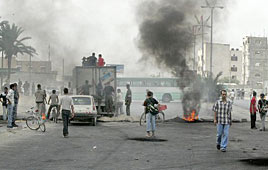
It seems that the Palestinians, especially in the Gaza Strip, know how to make really good parties(or better: know to destroy their own society completely)!
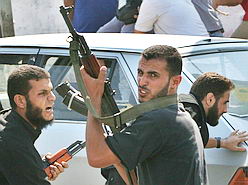
Today's Guardian(UK) reported following about yesterday's "events" in the PA territories:
Eight Palestinians die as Fatah and Hamas fight on streets of Gaza City
· Rivals trade gunfire after protest by unpaid officials
· West Bank cabinet offices aflame as violence spreads
Eight Palestinians were killed and dozens injured yesterday in an increasingly violent struggle for power between rival factions in the Gaza Strip.
Hours after the clashes, gunmen loyal to the Fatah movement set fire to rooms in the Palestinian cabinet building in the West Bank town of Ramallah. It was the most serious outbreak of fighting in the Palestinian territories for some months, and a sign of rising tensions between the Hamas-led government and the more secular Fatah, which lost power in elections at the start of the year.
Among the dead was a boy aged 15. More than 50 people were injured, including three children and a television cameraman. The fighting broke out during a protest in Gaza City led by government employees and security officials, none of whom had received salaries since the government was formed in March.
Most of the security employees were Fatah members, and the Palestinian president, Mahmoud Abbas, who leads the movement, had told them not to go out on the demonstration. Mr Abbas said last night that the "bloody confrontations" were unacceptable and he promised to prosecute those involved in the violence.
On Saturday, Hamas began deploying its own, rival militia - the well-armed Executive Force, who dress in camouflage trousers and black shirts - and yesterday they moved in to break up the protests. Gunmen from both sides then began trading fire with rifles and rocket-propelled grenades. Cars were set alight and plumes of thick, black smoke rose over the city.
Later, in apparent retaliation for the shootings, a crowd of Fatah supporters marched through Ramallah and attacked the cabinet building, setting fire to several rooms. Smoke poured from the windows.
A Fatah spokesman, Tawfik Abu Khoussa, blamed the Hamas government. "Nothing can justify this violence," he said. Ghazi Hamad, the main Hamas spokesman, blamed the protesters, accusing them of being driven more by political than economic motives. "The protest today was beyond acceptable legal norms and turned truly into lawlessness," he said.
Even before yesterday's clashes, there had been attacks between the factions, symptomatic of a broader struggle for power and heightening fears of a slide into civil war. Ten days ago, gunmen in Gaza shot dead Jad Tayah, a senior Fatah intelligence official, and five of his colleagues. Several people pointed the finger of blame at Hamas. A few days earlier, gunmen hijacked a car belonging to Nabil Shaath, a senior Palestinian politician and close adviser to Mr Abbas. Security is now becoming a more immediate concern than the economic crisis.
As soon as Hamas came to power, the international community froze its aid payments to the Palestinian government and Israel suspended its customs transfers, which together amount to hundreds of millions of dollars a year. Both insisted that the hardline Islamist movement publicly recognise the state of Israel, renounce violence and sign up to past agreements between the Palestinians and Israel.
Hamas has not agreed, and efforts to form a coalition government with Fatah that might go some way towards meeting those demands have fallen through in recent days. With the salaries of 160,000 government employees unpaid, the economic situation in the territories has worsened severely, particularly in Gaza, where Israeli closures of crossing points have severely hit farmers and businessmen.
Yesterday's violence suggests that a coalition government - which at one point was almost agreed - may now be beyond reach.
In addition to the internal Palestinian rivalry, there has been a series of Israeli military operations in Gaza since the capture in June of a soldier, Corporal Gilad Shalit, by Palestinian militants. Israel says it is acting to get its soldier back and halt the firing of crude Qassam rockets into nearby Israeli towns, such as Sderot. More than 200 Palestinians have died in the operations, most of them civilians.
Yesterday, Israel's chief of staff said a much larger military operation in Gaza was being considered. "We will have to find a military means to reduce the rocket fire on Sderot," Major-General Dan Halutz told Israel Radio. "For example, a more continued and deeper ground action ... We are holding consultations about this."
http://www.guardian.co.uk/israel/Story/0,,1885324,00.html
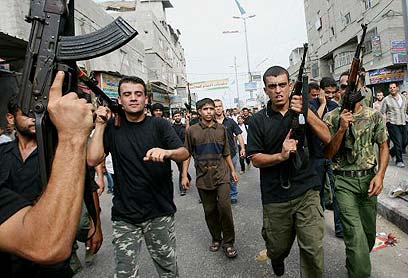
The Israeli "left-liberal" daily Haaretz wrote this:
Hamas-Fatah battles flare despite appeals for calm
Hamas militiamen withdrew from the streets of the Gaza Strip on Monday and returned to their normal posts after the worst day of internal violence since Hamas took control of the Palestinian government in March.
In the West Bank city of Ramallah, Palestinian Authority Chairman Mahmoud Abbas' Fatah Party enforced a general strike, closing shops and private schools in a show of force against Hamas. For its part, the Hamas-led government ordered all ministries closed to protest Fatah attacks on government buildings.
Fatah militants also released Samir Birawi, a Hamas official in the Finance Ministry they had briefly kidnapped, telling him his abduction was intended to send Hamas a message to end the Gaza violence, Hamas officials said. The Fatah men also burned Birawi's car.
Gaza, the center of the violence that killed eight people on Sunday, remained tense Monday, and many shops were closed out of fears of renewed attacks.
Despite appeals for calm from Abbas and Palestinian Prime Minister Ismail Haniyeh of Hamas, militants in Gaza torched the Agricultural Ministry early Monday, and a group of young students in the northern Gaza town of Beit Hanun stoned the house of Hamas minister until his bodyguards chased them away by firing in the air.
Appeals for calm
Abbas on Sunday appealed for calm after gun battles between a Hamas militia and members of the security forces loyal to his Fatah movement left eight dead.
Abbas also said Sunday he was ready renew stalled negotiations with Hamas over a unity government.
"These confrontations have crossed the red line, which we have avoided crossing for four decades," he said in a speech broadcast on Palestine TV.
Abbas condemned the violence "in the strongest terms," and ordered an official investigation into the fighting.
In an interview to the Qatar-based Al Jazeera television station broadcast earlier Sunday, Abbas said was ready to negotiate a unity government with Hamas to avoid crossing the "red line" into Palestinian civil war.
"Personally I believe that a civil war is a red line and I will not allow it under any circumstances," Abbas told Al Jazeera.
"I as a president have the right to form or dissolve the government at any time, but I say that we should exert every effort to form a unity government."
Haniyeh also urged Palestinians on Sunday to end the internal violence.
Following calls from both Abbas and Haniyeh to stop the violence, The Palestinian Interior Ministry ordered its Hamas-led security force to pull back from some positions in Gaza where they had been deployed to stop the policemen from protesting.
"The force was deployed based on Palestinian security needs," Interior Ministry spokesman Khaled Abu Hilal told reporters.
"But since the president [Abbas] has made a decision calling for the withdrawal of all forces," Abu Hilal added, "the Interior Ministry has to respond and comply with the decision of the president."
"I appeal to all citizens to be responsible and to abandon their differences, especially in the time we are facing an escalation by the occupation forces, who threaten to enlarge their scale of aggression," Haniyeh told reporters.
Haniyeh was referring to earlier comments made by Israel Defense Forces Chief of Staff Lieutenant-General Dan Halutz, who said Israel could step up military action in the Gaza Strip to halt rocket fire against its southern towns.
Fatah and Hamas have been holding talks on forming a unity government in an effort to end Western sanctions imposed in the wake of Hamas' election victory in January. Hamas has refused calls to recognize Israel, renounce violence and abide by previously signed interim peace accords.
"Let us be frank here, the United Stated has imposed a political, economic and social siege on us after Hamas' win," said Abbas.
Haniyeh spoke with Abbas by telephone late Sunday evening and called for joint action to end the violence between their respective parties, as well as the need to return to national unity government talks, Haniyeh's office said in a statement.
"We [Abbas and I] have agreed all parties must abide by the law and that they should not get involved in any kind of behaviour that may lead to the spread of chaos," Haniyeh told reporters in Gaza.
First spark in Khan Yunis
The gun battles broke out in Gaza between militants from Hamas party and security personnel loyal to Abbas, hospital officials said.
The fighting started in the southern Gaza town of Khan Yunis, where dozens of police gathered outside the Bank of Palestine on Sunday morning to demand payment of salaries they have not recieved since Hamas took power in January, protesters said.
Abbas, who was in Jordan on Sunday, has been trying to end the crisis by persuading Hamas to form a coalition government and to accept international demands to renounce violence and recognize Israel. Hamas has resisted compromising its radical ideology.
In recent weeks, civil servants - including members of the security forces, many of them Fatah loyalists - held expanding protests against the Hamas-led government to demand their back wages. Hamas has been unable to pay the salaries due to the suspension of aid.
On Saturday, the Hamas-led government sent its 3,500-member militia into Gaza's streets to quash the protests.
Hamas set up its militia - which answers to the interior minister - after losing a power struggle with Abbas for control of Palestinian security forces. Since then, violence has sporadically broken out between Hamas' militia and the official police force, but it has never been as widespread as it was Sunday.
The Hamas militiamen attempted to stop demonstrations staged by the unpaid civil servants and security officials. They ordered the protesters to disperse and then opened fire at them, and they in turn responded by shooting in the air, protesters said.
Fighting then broke out in northern Gaza, where a late morning gun battle erupted between militia members and security officials.
The violence then spread to the parliament building in Gaza City, where security officers and civil servants were protesting. The protesters threw stones at nearby Hamas militiamen, who responded by hitting them with sticks and then by firing guns and anti-tank rockets and lobbing grenades at the protesters, according to an Associated Press journalist at the scene.
Militiamen and security personnel - including members of Abbas' elite bodyguard unit - began trading fire on two major streets nearby, and gunmen from both sides took positions on rooftops.
The clashes later spilled over to an area near the president's residence. Hamas militiamen scrambled up to the rooftop of the nearby Agriculture Ministry and began firing rocket-propelled grenades and rifles at the presidential guard.
"We are going to beat with iron fists all those elements who are trying to sabotage the election process of our people, those who are trying to destroy our public properties and close the streets," said Islam Shahwan, a spokesman for the militia.
The street battles killed a total of four people, including a member of Abbas' presidential bodyguard and a 15-year-old boy, according to Dr. Baker Abu Safia, director of Gaza's Shifa Hospital.
Two other people were killed in related violence, and at least 100 people were injured, hospital officials said.
A seventh person, a member of the Preventive Security force, was killed Saturday night when the car in which was traveling came under fire from unknown gunmen, security officials said.
An eighth person, a Fatah supporter, was killed after thousands of Fatah protesters in the Bureij refugee camp marched to the house of a local Hamas leader and a grenade was thrown into the crowd, setting off a nighttime gunfight, Fatah officials said. Hamas officials said the crowd attacked the house.
A gun battle between rival forces also erupted in a Gaza hospital, where many Palestinians injured in previous clashes lay, wounding at least four people.
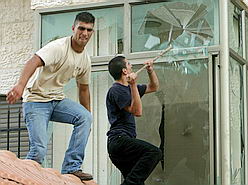
In response to the violence, Fatah protesters in the West Bank city of Ramallah arched to the Cabinet building - which had already shut down for the day - pelted it with stones, broke in and lit the second floor on fire. The militants threw files out the windows and witnesses could see pieces of furniture being thrown about.
Fatah loyalists also kidnapped a top official in the Palestinian Finance Ministry in the West Bank city of Ramallah, a Hamas official said.
Earlier, Hamas security men in the Gaza Strip seized five members of a force loyal to Abbas.
The conditions of the kidnapped men were unknown.
A second building in the compound was also set ablaze. Forced out by the flames and smoke, the militants moved to the nearby Education Ministry and torched the minister's car on the way. They then trashed the offices of a Hamas newspaper.
In the northern West Bank city of Nablus, dozens of Fatah-allied gunmen fired in the air, closed a major road with burning tires and threatened to retaliate for any Hamas violence in Gaza with attacks in the West Bank, a Fatah stronghold.
"This is forbidden in Islam, we are in the holy month of Ramadan," said Majed Badawi, 33, who managed to escape uninjured after his car was caught in the crossfire. "It's a shame on Hamas, who call themselves real Muslims, and a shame of Fatah as well. Why are they fighting and over what? We are victims because of both of them."
"Nothing can justify this violence," said Tawfik Abu Khoussa, a Fatah spokesman.
Ghazi Hamad, a spokesman for the Hamas government, said the violence was "regrettable," but the Hamas force was acting with restraint when it was attacked.
"The protest today was beyond acceptable legal norms and turned truly into lawlessness," he said.
In the West Bank city of Hebron, Fatah-allied militants blocked roads with burning tires and ransacked the offices of local Hamas lawmakers and set the furniture on fire in the street. In Nablus, Fatah gunmen attacked a Hamas women's center and traded fire with Hamas gunmen.
http://www.haaretz.com/hasen/spages/769437.html
*****
PS:
Actually it seems that the Palestinians are not really able to learn from their "mistakes". Since long time - especially after the founding of Hamas in the middle of the 1980's - they just try to fullfil the wishes of the Israeli government/occupation forces: to create a situation of civil war in the Palestinian/PA territories. A reader of the Israeli daily Yedioth Ahronoth wrote yesterday evening: "At least there keep'n busy with shot at there own wonderful selves and not at us!!"
*****
* Ramadan is the ninth month of the Muslim year, when Muslims do not eat between the rising and setting of the sun. During Ramadan, Muslims celebrate the fact that it was in this month that God first revealed the words of the Quran to Mohammed.
** (^^)
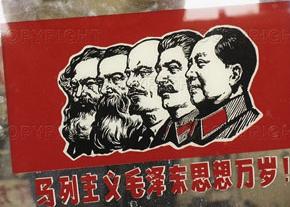
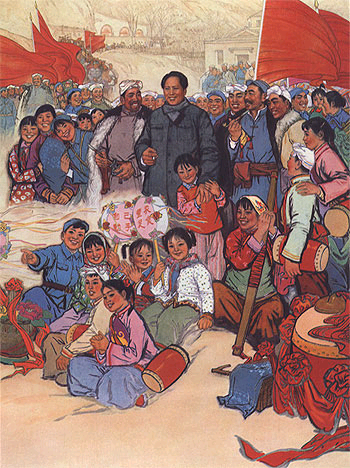
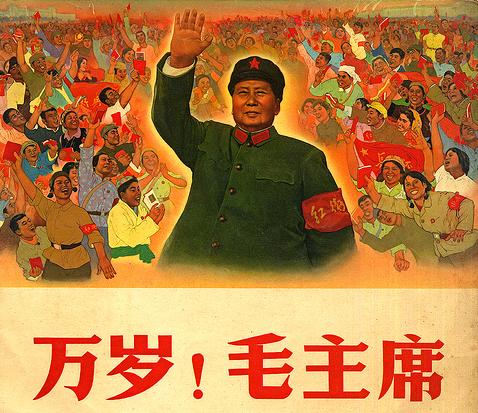
And please, my dear dongji, don't forget(^^):

*****
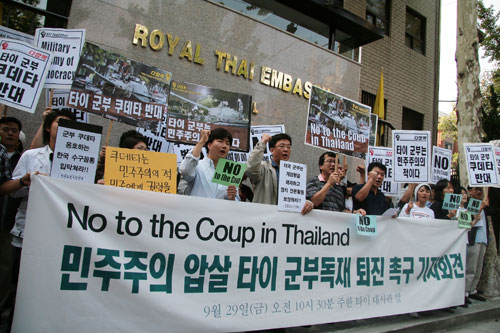
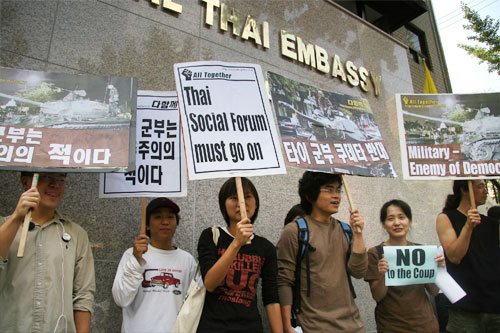
For more - pictures and a protest declaration(in Korean and English) - please check out this: [9.29] 민주주의 압살 타이 군부독재 퇴진 촉구 기자회견

덧글 목록
관리 메뉴
본문
Koreans aren't scared of Germany. Quite the opposite: http://www.koreaherald.co.kr/SITE/data/html_dir/2006/10/03/200610030028.asp부가 정보