사이드바 영역으로 건너뛰기

게시물에서 찾기분류 전체보기

“Occupy the World” – Fertile Soil for Revolutionary Intervention, but No Solution to the Capitalist Crisis

“Occupy the World” – Fertile Soil for Revolutionary Intervention, but No Solution to the Capitalist Crisis


First of all, let us not be naïve. Let us not think that this movement, nor the Spanish 15M movement, nor the “Arab revolts” which could be said to be the precursor for all these movements which are seeing mass assemblies in high profile locations to protest against the increasingly intolerable conditions which we face as a class the world over represent the long awaited turning of the tables and the end of capitalism with its wars, unemployment, poverty and exploitation. However, equally, let us not sneer at these significant stirrings, let us not conclude that the cacophony of slogans and stunts, the heady brew of activists and State repression, tambourines and meditation, fantastical interclass demands for reform and calls for revolution seemingly entwined in a contradictory mass do not crystallise the first steps in a process which leads to the revolutionary demise of capitalism whose crisis is now open and mainstream news.


Revolutionaries have long considered the whole process. The details may yet surprise us but underpinning it must be a rising tide of class struggle, presumably unleashed by an ever intensifying spiral of capitalist attacks in an attempt to shore up profitability, as is the actual case. This struggle will be the fertile soil for the formation of class wide bodies, workplace organisations, territorial organisations which will allow the mass of the class to participate in a process of delegation and creation of committees of struggle. These essential ingredients in themselves are no guarantee of success. Revolutionary form requires a revolutionary consciousness: i.e. a general recognition of the goal (communism) and the steps needed to overthrow capitalism. The active ingredient must be the widening of the revolutionary organisation inside the wider movement. Unless the politically advanced elements of the class, i.e. revolutionary organisations such as our own which exist in embryo today and those who will emerge to form the Proletarian International—gain a hearing and succeed in winning over the core of the working class to the communist programme, including the need for the workers’ mass organs to assume state power and get rid of all aspects of the capitalist state—the movement will be defeated. It will be up to the revolutionary minority to push for the proletarian power to expropriate the capitalist class and embark upon the transformation of society into one which serves the producers rather than oppresses and exploits them, where the product and raison d’etre of activity is the development of humanity, not the autonomous economy whose growth is satisfied by our stagnation and penury.


Obviously the “Occupy” movement is not this. It is not the product of a working class in struggle but it is the product of many activists with varying political lines whose ranks are being swelled by workers, particularly the youth who have been so hard hit by the current twists of the long running capitalist crisis.


Despite the realistic assessment that the movement will exhaust itself, will not break through the limits of capitalism if only because it is aimed primarily at reforming one aspect of capitalism, the positive aspects are not insignificant.


The fact that the “Occupy” movement kicked off in the USA, supposedly the impregnable fortress of world capitalism, the example for all others to follow for progress and social peace, the material proof of capitalism’s superiority, the victor of the cold war, the world’s greatest power and advocate of the capitalist path, is a significant blow to the reigning ideology that “it might not be perfect but it’s the best there is”. In this sense October 15 was the first global response to the capitalist crisis with hundreds of thousands involved in some 90 countries.


Massive and disproportionate police aggression has not succeeded in intimidating the movement.


Already the most radical revolutionary slogans are appearing; such as “Workers of the World Unite” placards in Chicago. Our Italian comrades intervened in the Rome event of October 15, a massive protest of 100 000 plus with the banner;


AGAINST THE BOSSES


WITHOUT THE UNION


POWER TO THE PROLETARIAT!*


Despite the haze, the lack of precise class vocabulary, the lack of a central message, the lack of political cohesion, the movement has successfully articulated a message against social inequality and the conditions which the working class are expected to endure as being inevitable. Its impact on wider society is hard to assess but this could be its real triumph. The working class in general is considering the movement and its (mixed) messages and under the weight of the facts on the ground, the unavoidable reality of a crisis which has massively hiked up unemployment and poverty, where wages have been at best stagnant or receded for years, where services are cut, in short, where everything is getting worse for the working class, it is hardly surprising that the impact on mass consciousness is not what the ruling class would want.


According to one poll carried out by academics at Quinnipac University 67 percent of those polled said they supported the views expressed by the protesters, while only 23 percent said they opposed them. Meanwhile, New Yorkers by an overwhelming margin of 87 percent to 10 percent support the right of the demonstrators to remain in Liberty Plaza.


Like the smashing of windows and spray painting and destruction of police cars etc which seem to accompany any major concentration of protestors these days, the “spectacular” aspects of single day events, crowds in plazas, are not going to stop our rulers from pursuing the economics of austerity, the constant attacks and cuts, the layoffs and insecurity, the condemnation of a generation to rot. The ruling class has no option. It has to pursue an anti-working class line, no matter what its details may be. The Occupy movement will neither bring the crisis to an end nor does it represent the way for doing so. But if it serves to put the issues of capitalist economic reality firmly on the agenda, if it serves to allow masses of workers to consider that there might be an alternative to their own sacrifice on the altar of saving capitalism, then it will not have been in vain. But all of that will only have meaning if it results in the strengthening and advancing of the revolutionary cause which at the moment is stuck at a very low ebb at a time when the material reality of capitalist crisis demands a class response on the industrial terrain, the terrain of production where the working class can really maintain an effective veto on the politics of inequality and start to build another society.


Ant*

진보블로그 공감 버튼트위터로 리트윗하기페이스북에 공유하기딜리셔스에 북마크

THREE CITIES, THREE OCCUPATIONS, ALL IN LESS THAN ONE WEEK

THREE CITIES, THREE OCCUPATIONS, ALL IN LESS THAN ONE WEEK


An account by a member of IP who visited Occupations in New York, Seattle and Vancouver. This account is a slightly modified version of a piece posted here on November 7, 2011.


Before I went to New York, I had only had a few hours’ experience at Occupy Vancouver. Some of it had been less than inspiring, including, on my last time there, having one person standing next to me (who I had never seen before) in a highly emotional state turn to me and very intensely tell me how there had just been a split amongst the core group of people involved in the organizing of the occupation, with the “liberals” (alternatively, the “hippie liberals”) having taken over, that it was a bunch of b.s. and that this was a terrible development. That was a little unsettling. I was, however, impressed with how the General Assemblies I attended were ‘facilitated’ so as to permit everyone present to participate, if they accepted and followed the agreed upon procedure, and to try to achieve maximum unity (the 90% consensus model). I was also impressed by the level of passion and openness expressed by the person who vented themselves to me. This thing was obviously very important to a number of these people.


Zuccotti Park in NYC was a different story. Even though the content of the first GA there I attended was uninteresting and not at all political, the ‘process’ was very impressive. The participants seemed more comfortable with and more proficient at the process. (Of course, they had been at it for almost a month longer than the ones in Vancouver.) And then their collective self-confidence – New Yorkers, you know – that was truly inspiring to experience. It seemed clear that this process was working well for them and they were proud of it. It really is something new, a new way of working together, in the most horizontal, the most “directly democratic” (beyond that, even, I would say) way yet realized by human beings. And the Occupy Wall Street encampment at Zuccotti Park is where it began. A sense that history was in the making here was felt but not easy to articulate at the time.


That sense became much clearer the next day. With the weather significantly warmer, there was a more relaxed, comfortable vibe to the place. (it was also afternoon, rather than evening.) This was several hours before the day’s GA. The person I was there with, a comrade, had been there a few times previously, and clearly felt very comfortable and confident about getting involved in any open discussion of interest to him. Various different conversations/discussions were going on in different parts of the park. In each case, we could listen in, ask what it was about, be informed about who it concerned/who was involved, and follow along if we wanted. It wasn’t long before we came across what I later learned is called the “Think Tank”. It is a place in the park, close to the middle, where open discussions on any topics can occur. One announces one’s topic, then sees who else wants to participate. It seems that the topics usually arise out of spontaneous discussions involving, initially, two or three people, which others then want to join into. My comrade and I participated in two of these discussions, one, which we stumbled upon, on capitalism vs. socialism, and another on how to find new ways to try to open people’s imaginations in a way that allows them to think outside of the restricted sphere of existence that the existing mass media, governments, educational systems, etc. enforce/impose on us. Each discussion involved about 8-10 people, with about 10-15 others just listening in. It was very informal – with just a “stacker” taking a list of people wanting to speak – but it seemed to work so well because people really wanted to make it work, rather than just get into another shouting match.


Here was real, serious discussion and debate, back and forth, with people really concerned to sharpen their views, to learn from each, in the most respectful way, among the widest variety of people (age, dress, style, race, sexual orientation, etc.) I think I had ever experienced. And although I was, unlike my comrade, slow to get involved, I did become actively involved and felt none of the unease and anxiety I would normally expect to feel in such a situation. Clearly, there was something big happening here, something that I had dreamt about being a part of for decades, something that has probably not existed in America since the late 1960s (when I was a child, but able to vaguely sense a feeling of ‘change in the air’). It was, and still is, exhilarating, to be sure.


My comrade suggested that I attend at least one session of one Working Group, since that was where a lot of good discussions occurred, and also where proposals put forward in the GA’s were initially worked out. I did attend one working group, on “visions and goals”, but only briefly, since the content at that time was not of interest, but again, the process used and its facilitation were impressive to witness. It was Halloween that day, and when I returned to Zuccotti Park from where the working group was meeting, it seemed that there was not an ‘official’ GA that evening; but there was a group of about 50-60 people near where the GA’s were being held holding an impromptu assembly, complete with various people dressed in very impressive Halloween costumes, including an impeccably dressed Emma Goldman. It was as much fun and convivial as it was serious and militant, but when we decided to hold a half hour break and then resume again, a few people announced different proposals for what to do during the half hour, including one to do a chain dance around the Merrill Lynch bull near the Bowling Green, another to go to the graveyard at nearby Trinity Church, across Broadway from Wall Street, to ask the spirits of the dead buried there for advice on what to do, to one to “go over there and discuss revolutionary politics.” Needless to say, I opted for the latter. It turned out this guy was still in high school and identified as an anarchist, and judged council communism to be a political tendency proximate to his. Another person self-identified as an anarcho-syndicalist. I didn’t label myself, but I did argue for the necessity of a Marxist critique and analysis of the economy and its crisis, after another person said it was essential for us to follow what’s happening in the economy, and to see how things are going to get a lot worse pretty soon – to which I wholeheartedly agreed. The discussion, involving at various times between six and twelve highly varied people, focused mostly on strategy towards the occupation movement from a revolutionary perspective. There seemed to be agreement reached that it was still too early to be focusing on ‘direct actions’ and trying to achieve any specific ‘gains’ or ‘victories’; that the principle aim should be, currently, to try grow the movement to involve as many people as possible from the ‘99%’, and to focus on discussion and mutual ‘education’, to get as many people as possible to recognize that our big goal should be the abolition of capitalism, and that we need to better understand how it dominates all our lives. It was one very satisfying discussion, one I won’t soon forget. That was pretty much it for that day at Occupy Wall Street, as it seemed all but a small number had left for Halloween events, including a massive Halloween march up Sixth Avenue.


The next day was a flight back to Seattle. The day after that I went to check out the Occupy Seattle encampment, which had recently been moved from Westlake Park, adjacent to the financial district in downtown Seattle, to Seattle Central Community College, in the Capitol Hill neighborhood, actually not very far away. It was about 1:30 p.m. when I got there, and it turned out that the little under a hundred people assembled there were holding a sort of rally to pep themselves up for what was coming. I had met one of the people who spoke at the rally, actually the best one in my estimation, at a recent public meeting. He’s a member of Seattle’s Black Orchid Collective and a very good public speaker. In fact, he was able to not only link the coming event to global capitalism, he also invoked the ever-increasing numbers of permanently unemployed that capitalism produces and contains in its various slums around the planet.


It turned out the coming event was a march up Seattle’s Broadway to a local branch of Chase Bank, owned by JP Morgan/Chase Bank, apparently one of the largest financial corporation in the world. I happily went along, up the street, with police escort. We chanted various slogans and chants along the way. Some were quite fun, including “Hey, hey, ho, ho, capitalism’s got to go!” and “Workers of the world unite, come and join the general strike!” (which was a reference specifically to the Occupy Oakland called strike, occurring that day). When we got to the bank branch we heard a few facts about JP Morgan/Chase Bank and its CEO, who was apparently in Seattle for a conference. It further turned out that about a half dozen people were already in the bank branch, ‘occupying’ it. We marched around the building a couple of times, chanting some more, and with a few people saying ‘their piece’ about banks. Several police with bicycles guarded the entrances to the building. It seemed that nothing much more was going to happen, for a while at least, but people remained, following what was going on inside. (1) At that point I had to leave, to catch a bus to Vancouver. I will say, though, that I was impressed by the militancy and the generally anti-capitalist tenor of the activity I saw and participated in that day in Seattle. The racial mix of the participants was also greater than what I saw in New York (even though it was impressive there too), and definitely more so than what I’ve seen in Vancouver.


I came back to Vancouver highly inspired by what I had experienced in New York and Seattle. I was convinced that there was ‘something in the air’ in America, that now is a time of soon-coming social change, and that many people’s consciousness was already changing, changing rapidly and massively, in the context of this very concentrated #OWS movement, and that we were likely still in the very early stages of it. Having had those American experiences, I was more comfortable and confident in participating in the occupation in my Canadian city, even if I find it difficult to shake my cynicism about the political attitudes and activities of my fellow citizens, especially those on the ‘left’. It could well be that the “liberals” have “taken over” control of Occupy Van., but it is still Occupy Van., part of the global #OWS (or “occupy together”) movement, and it is still open to everyone. I have participated, and tried to defend an anti-capitalist perspective, both in the GA’s and in informal discussions, and I have found other participants to be open to what I say and very respectful. I plan to stay involved and engaged, to defend and discuss an anti-capitalist perspective, specifically, an internationalist communist one, and to learn what I can from the others I engage with. I am also trying to get Occupy Van. to set up a ‘think tank’ like the one in Zuccotti Park.


E.


1. The Occupy Seattle action of Nov. 2 is described in this mainstream media article: http://blog.seattlepi.com/seattle911/2011/11/02/occupy-seattle-demonstrators-rally-at-chase-bank/

진보블로그 공감 버튼트위터로 리트윗하기페이스북에 공유하기딜리셔스에 북마크

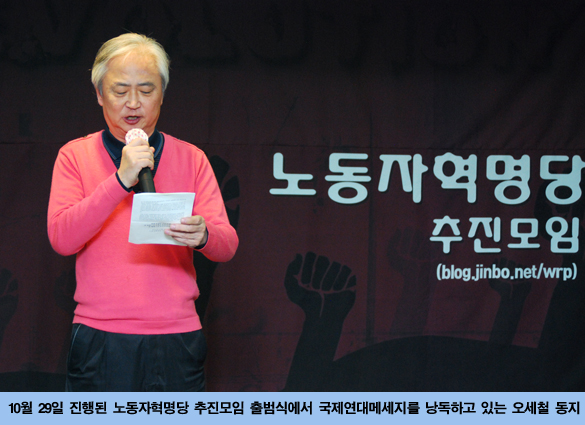
전 세계 노동자계급과 혁명적 공산주의자들에게 보내는 국제연대 메시지

전 세계 노동자계급과 혁명적 공산주의자들에게 보내는 국제연대 메시지 


사용자 삽입 이미지

우리는 지금 쇠퇴기 자본주의의 막다른 길목에서 수백년 유지해 온 체제가 단말마적 고통속에 마직막 숨을 거두려는 역사적 전환점에 서 있다.


  세계 대공황을 넘어 노동자를 포함한 인류를 야만의 삶으로 몰아 넣고 전쟁과 파시즘, 그리고 기아와 생태계의 파괴를 통하지 않고서는 더 이상 버틸 수 없는 지경으로 나아가고 있다.


  생명을 조금 더 연장하려는 자본주의 체제의 단기적 처방이 국가부채와 긴축, 실업과 정리해고, 복지의 파괴 등으로 이어지지만 그것은 더 큰 파국으로 가는 수순일 뿐이다.


  이와 같이 노동자 계급에 대한 자본의 전면적 공격은 필연적으로 인간답게 살려는 노동자들의 분노와 저항을 불러 일으켜 곳곳에서 계급투쟁이 격화되고 있다.


  이천년대 초반부터 고양되고 있는 노동자계급의 투쟁은 전 세계로 확산되어 68혁명과 같은 반격투쟁으로 나아가 혁명전야를 방불케 하고 있다. 그리스, 스페인, 아일랜드, 이탈리아 등의 긴축반대 투쟁, 북아프리카 중동의 민주화 투쟁, 칠레의 공공교육 투쟁, 미국의 월가점령 투쟁, 중국, 인도, 방글라데시의 노동자 투쟁, 그리고 한국의 비정규직 노동자 투쟁 등이 이를 증명하고 있다.


  이제 공산주의라는 대안사회가 인류의 단순한 희망과 꿈이 아니라 역사발전의 물질적 필요성이며, 우리가 실현해야 할 역사적 과제임을 일깨워 주고 있다.


  여기서 우리는 세계혁명을 향한 물질적이고 객관적인 조건이 주어지고 있음에도 불구하고, 또한 세계적인 노동자계급의 투쟁이 벌어지고 있음에도 불구하고, 맑스주의의 올바른 원칙과 전망을 세우면서 노동자계급과 함께 하려는 공산주의자의 조직인 당을 건설할 주체적 조건이 마련되지 않고 있다는 한계를 뼈져리게 느끼고 있다.


  오늘 우리는 세계혁명당이라는 새로운 인터내셔널의 건설을 향한 역사적 과제를 움켜 쥐고, 한국에서 공산주의자의 조직인 당을 만들려고 모였다. 이러한 움직임은 전 세계 노동자계급과 공산주의자들의 공통적 흐름이기 때문에 세계적 연대를 통해 토론하고 소통하며 공통강령을 마련하고 세계혁명으로 나아갈 것을 적극 제안한다.


세계 혁명당 건설 만세!
전 세계 노동자계급 혁명적 투쟁 만세!
전 세계 노동자여 단결하라!


2011년 10월 29일
노동자혁명당 추진모임

진보블로그 공감 버튼트위터로 리트윗하기페이스북에 공유하기딜리셔스에 북마크

What is a General Assembly?

대중총회란 무엇인가?


Introduction (ICC)

General Assemblies (GA) are the lifeblood of the struggle. This is where workers (from the private and public sectors, the unemployed, pensioners, students, children of working families etc.) can really take ownership of their struggles, decide collectively. This is the true place of workers' democracy. By being open to all, not limited by corporatism, the GA unites the various sectors of our class. It’s the place where the life of the struggle can be built and the struggles extended.

This is why unions concentrate all their efforts to sabotage them! The text below, produced by the CNT-AIT Gers ( http://sia32.lautre.net ) explains succinctly what a truly autonomous GA in the hands of strikers must be, and details the various pitfalls to guard against.


What is a general assembly? (Text of the CNT AIT, Gers)

Definition

We call a general assembly the regular meeting, democratic and sovereign, of workers, regrouped as and when, without criteria, which can be varied (those belonging to a union, a confederation of unions, a social movement). At no point should these workers be prevented from being delegates: the principle of the GA is the vote by head count.

Typology

There are several types of GA:

  • The GA of a single union
  • The combined GA of several unions
  • The GA of workers on strike

Moreover, it can be limited to a single profession or be ‘inter-professional’. [Regrouping those from many professions – trans.]

Functioning of the GA

  • The GA is democratic, and therefore guarantees each a turn to speak, shared equally in terms of duration and discussion topics. This is guaranteed by a mandate given to the moderator.
  • Speeches must also be consistent with an agenda, agreed at the beginning of the meeting, which does not include various decision points.
  • The GA is sovereign, and decisions are made by a show of hands, without any overturning of decisions, according to the agenda.
  • The GA meets regularly and keeps a record of its debates and decisions. The record is kept by a secretary appointed early in the meeting, who ensures the debates and decisions of the GA are made public. The GA gives the date and place of the next GA.

Threats to the GA

  • Monopolisation of debate: The GA becomes un-democratic. The classic case is the shop-steward who takes the role of moderator, participates in discussions or responds systematically giving their opinions. A variation on this is a participant in the room who monopolises the floor or speaks too often.
  • The handling of the debate: The agenda is not respected. When the debate is moving precisely towards direct action, or a motion to renew the strike, the agenda is changed in order to blur the clarity of discussion, and to confuse the whole point of a GA, which is to answer the question "What and how?"
  • Lack of democracy within the GA: the vote is not respected. Violating the agenda, votes are taken several times on decisions already made. Often, manipulation occurs at the end of the meeting, to destroy its coherence and audacity.
  • Neutralisation of the GA: there is no alternative to a GA, however rich. Often, a GA of striking workers is treated as a safety-valve for their anger, neutralising their revolt, transforming their militancy into a sterile talking-shop. Be on guard! In a GA, we have all the tools at hand to see if they are being monopolised, manipulated, and neutralised. In all cases, failure to denounce the above threats will undermine our activity, our words, and our decisions: in short, our very reason to go on strike!

"The emancipation of the workers will be the task of the workers themselves"

SIA 32 (Member of the CNT-AIT).

진보블로그 공감 버튼트위터로 리트윗하기페이스북에 공유하기딜리셔스에 북마크

They Don’t Get It

They Don’t Get It (Revised)

The following is a revised version of our leaflet posted on October 6, 2011. In addition to US events, it will be distributed in Canada and Belgium this weekend.


THEY DON’T GET IT….


When the media talk about Occupy Wall Street, they often do so with disdain: a movement that has no leaders, no set of demands, can’t be taken seriously. In a typical article, the New York Times quoted an ‘expert’ saying, “if the movement is to have lasting impact, it will have to develop leaders and clear demands”, and another one which stated that the passions have to be “channeled into institutions”. (NYT, 10/4) Their message to you is clear: ‘Go back to ‘politics as usual’, follow leaders, work within institutions, become foot-soldiers for the Democratic party and the unions in elections and other campaigns that change nothing at all, that don’t question the power structures that prop up this insane money-system.


They don’t get it that the absence of leaders in this movement is not a weakness but a strength, testifying to our collective determination, to our refusal to remain followers. They don’t get it that the absence of a narrow set of demands that can be recuperated by this or that institution, results from our understanding that the problem lies much deeper. That there are no quick fixes for a system that produces growing inequality, mass unemployment and misery, wars and ecological disasters.


If these problems could be solved by electing wiser politicians, adopting better laws etc, ‘politics as usual’ might be the way to go. But they can’t be solved that way. Politicians everywhere are bound by higher laws, the laws of capital. That’s why governments everywhere, regardless of their political color, are imposing austerity, forcing the working population to sacrifice so that more can be paid to the owners of capital. In fact the harshest cuts in wages, pensions and jobs are implemented by a ‘socialist’ government (in Greece). Politicians on the left may clamor for massive public spending , but that would only mean that we would be made poorer in a different way, through inflation.


There are no quick fixes because the system itself is obsolete. Pain and suffering are sometimes unavoidable but capitalism creates ever more pain that is easily avoidable, that only exists because in this society, profit trumps human needs. Almost two billion people on this planet are unemployed because capitalism has no need for them. Hundreds of millions live in slums, because building decent houses for them is not profitable. Many die of hunger each day because it’s not profitable to feed them. Everyone knows our planet is in danger and yet capitalism is continuing to destroy it in its desperate hunt for profit. Productivity never was higher, yet poverty increases. The know-how and resources are there for every inhabitant of this planet to live a decent life but that would not be profitable. Abundance has become possible but capitalism can’t handle abundance. It needs scarcity. Abundance in capitalism means overproduction, crisis, misery. This is insane. It must stop.


WE HAVE TO THINK OUTSIDE THE BOX


Capitalism is not “the end of history” but just a transient phase. It has changed the world but now no longer fits into it. We have to accept the fact that capitalism offers no perspective, no future. We have to prepare for a post-capitalist world, in which human relations are no longer commercial transactions, in which goods no longer represent a quantity of money but a concrete means to satisfy real human needs. A world in which competing corporations and warring nations are replaced by a human community that uses the resources of all for the benefit of all. We call that communism but it has nothing in common with the state-capitalist regimes that exist or existed in Russia, China and Cuba. Nothing is changed fundamentally if capitalists are replaced with bureaucrats with supposedly better intentions. Those regimes were not only thoroughly undemocratic, they also perpetuate wage-labor, exploitation and oppression of the vast majority of the population. The change must go deeper and must emancipate the oppressed, make them part of a real democracy instead of the sham that exists today.


In 2011, ten years after the attacks on New York that launched a decade of fear and demoralization, a breach has been opened. From Tunis to Cairo to Athens to Madrid to Santiago to New York, a fever is spreading. After taking it on the chin for so long, the working class, employed or unemployed, is beginning to rise up. We’re not gonna take it anymore! Something has changed. True, the Occupy Wall Street movement will not last forever. At some point, it will end, without any clear victory. But it’s just the beginning. This dynamic will continue and will gather strength. Be a part of it!


THERE’S MORE…


It’s clear that the”Occupy Wall Street”-movement has touched a nerve. Its message resonates throughout the country, even throughout the world. Everywhere people are raising their voice in protest against a system that produces increasing misery for the many and absurd wealth for the few. No wonder that the unions, progressive Democrats, even the President, and governors like Cuomo who is imposing draconian austerity on workers in NY, are attaching their wagons to this train, in order to get control over the locomotive. Don’t be fooled: These political tendencies are themselves the representatives of the 1%, of the banks and the capitalist system, not of the 99%. Let’s not allow our movement to be co-opted by the very powers in opposition to which it has arisen. The left of capital cynically claims that they want ‘economic justice’, too; that they seek a more just distribution of the wealth, through taxation of the rich, etc. (that’s their rhetoric, their practice is something else, see Cuomo’s recent move to kill the ‘billionnaires tax’ because it would chase the rich away).


The truth is that the unfairness, the unjust distribution of wealth, is built into the system and can’t be taken out of it. It will only increase more as capitalism sinks deeper into its crisis, for which it knows no way out (to throw more money in the economy or to save: they’re damned if they do and damned if they don’t). ‘Redistribution of wealth’ is an incomplete demand that can get nowhere if it’s not pushed further. As a slogan of May ’68 claimed: ‘Be realistic, demand the impossible”. The impossible within capitalism, that is. Although there are quite a few capitalists who profit from the crisis, overall, capitalism suffers from it too, so that there is less wealth to redistribute (and the competition between nations for capital assures that the 1% suffers least and the 99% most). No utopian plan for redistribution can address this shrinkage of wealth.


But what is wealth? In this society, goods and services equal money, abstract value that can be endlessly amassed, possessed ad infinitum, or, when no buyer is found, they equal pure waste. So money, abstract value, decides what is produced and what not. That is the box we’ve got to get out of. We have to abandon the idea that wealth is money, that work is wage-labor and start to see production of goods and services as things we can create for each other. We must realize that when we come together we can use the creative powers that humankind has to make technology, housing, food, transportation, art and so much more for everybody because the need is there, instead of for profit. Let’s get rid not just of Wall Street, but the whole exploitation-for-money-system. This perspective may seem utopian to many today, but it will become increasingly realistic as the crisis of capitalism deepens.


INTERNATIONALIST PERSPECTIVE


They Don’t Get It

The following leaflet was handed out at the Occupy Wall Street demo today in Manhattan:


THEY DON’T GET IT….


When the media talk about Occupy Wall Street, they often do so with disdain: a movement that has no leaders, no set of demands, can’t be taken seriously. In a typical article, the New York Times quoted an ‘expert’ saying, “if the movement is to have lasting impact, it will have to develop leaders and clear demands”, and another one which stated that the passions have to be “channeled into institutions”. (NYT, 10/4) Their message to you is clear: ‘Go back to ‘politics as usual’, follow leaders, work within institutions, become foot-soldiers for the Democratic party and the unions in elections and other campaigns that change nothing at all, that don’t question the power structures that prop up this insane money-system.


They don’t get it that the absence of leaders in this movement is not a weakness but a strength, testifying to our collective determination, to our refusal to remain followers. They don’t get it that the absence of a narrow set of demands that can be recuperated by this or that institution, results from our understanding that the problem lies much deeper. That there are no quick fixes for a system that produces growing inequality, mass unemployment and misery, wars and ecological disasters.


If these problems could be solved by electing wiser politicians, adopting better laws etc, ‘politics as usual’ might be the way to go. But they can’t be solved that way. Politicians everywhere are bound by higher laws, the laws of capital. That’s why governments everywhere, regardless of their political color, are imposing austerity, forcing the working population to sacrifice so that more can be paid to the owners of capital. In fact the harshest cuts in wages, pensions and jobs are implemented by a ‘socialist’ government (in Greece). Politicians on the left may clamor for massive public spending , but that would only mean that we would be made poorer in a different way, through inflation.


There are no quick fixes because the system itself is obsolete. Pain and suffering are sometimes unavoidable but capitalism creates ever more pain that is easily avoidable, that only exists because in this society, profit trumps human needs. Almost two billion people on this planet are unemployed because capitalism has no need for them. Hundreds of millions live in slums, because building decent houses for them is not profitable. Many die of hunger each day because it’s not profitable to feed them. Everyone knows our planet is in danger and yet capitalism is continuing to destroy it in its desperate hunt for profit. Productivity never was higher, yet poverty increases. The know-how and resources are there for every inhabitant of this planet to live a decent life but that would not be profitable. Abundance has become possible but capitalism can’t handle abundance. It needs scarcity. Abundance in capitalism means overproduction, crisis, misery. This is insane. It must stop.


WE HAVE TO THINK OUTSIDE THE BOX


Capitalism is not “the end of history” but just a transient phase. It has changed the world but now no longer fits into it. We have to accept the fact that capitalism offers no perspective, no future. We have to prepare for a post-capitalist world, in which human relations are no longer commercial transactions, in which goods no longer represent a quantity of money but a concrete means to satisfy real human needs. A world in which competing corporations and warring nations are replaced by a human community that uses the resources of all for the benefit of all. We call that communism but it has nothing in common with the state-capitalist regimes that exist or existed in Russia, China and Cuba. Nothing is changed fundamentally if capitalists are replaced with bureaucrats with supposedly better intentions. Those regimes were not only thoroughly undemocratic, they also perpetuate wage-labor, exploitation and oppression of the vast majority of the population. The change must go deeper and must emancipate the oppressed, make them part of a real democracy instead of the sham that exists today.


In 2011, ten years after the attacks on New York that launched a decade of fear and demoralization, a breach has been opened. From Tunis to Cairo to Athens to Madrid to Santiago to New York, a fever is spreading. After taking it on the chin for so long, the working class, employed or unemployed, is beginning to rise up. We’re not gonna take it anymore! Something has changed. True, the Occupy Wall Street movement will not last forever. At some point, it will end, without any clear victory. But it’s just the beginning. This dynamic will continue and will gather strength. Be a part of it!


INTERNATIONALIST PERSPECTIVE

진보블로그 공감 버튼트위터로 리트윗하기페이스북에 공유하기딜리셔스에 북마크

<세계혁명> 경제불황, 전쟁, 사회해체- 계급투쟁만이 해결책이다

경제불황, 전쟁, 사회해체- 계급투쟁만이 해결책이다


 Not dead yet

올 여름 경제위기의 극적인 첨예화는 자본주의 체제가 그 한계에 다달았음을 분명하게 보여준다. '부채위기'는 문자그대로 은행의 파산일뿐만 아니라 전체 국가들의 파산을 백일하에 드러냈고, 게다가 그리스나 포르투갈과 같이 경제가 허약한 나라들 뿐만 아니라 유로지역의 주요국가들, 특히 세계경제최강대국 미국도 포함된다.


그리고 이 위기는 전세계적일 뿐만 아니라 역사적이기도 하다. 지난 몇년간 뚜렷하게 모습을 드러낸 빚더미는 1960년대말 1970년대초에 이미 나타난 경제위기를 자본주의가 늦추거나 은폐하려한 시도들의 결과일 뿐이다. 또한 오늘의 '침체'가 진정한 불황으로서의 본 모습을 드러내면서, 우리는 이것이 실상, 1930년대에 생산을 마비시켰고 그당시 세계를 제국주의전쟁으로, 즉 제 2차세계대전으로 몰아갔던 위기과 같은 심각한 위기임을 인식해야 한다. 이 위기는 자본주의 체제가 역사적으로 쇠퇴했음을 보여준다.


오늘의 불황과 1930년대의 불황사이의 차이는 오늘의 자본주의는 어떤 수단도 갖고 있지 않다는데 있다. 1930년대에 지배계급은 그 위기에 대항한 그들 자체의 야만적인 해법, 즉 제국주의 전쟁에 전 사회를 동원하고 세계를 새롭게 분활하는 것을 관철시킬 수 있었다. 재조직화는 2차 세계대전 후, 1950년대와 1960년대에 있었던 재건의 기적의 토대를 만들어냈다. 그 당시 이러한 가능성이 존재했던 것은 부분적으로, 세계대전이 자동적으로 자본주의의 자기파괴를 의미하지 않았기 때문이며, 또 전후에 새로운 제국주의 종주국의 출현 여지가 여전히 존재했기 때문이다. 그러나 그것은 또한 그리고 무엇보다도 하나의 옵션이었는데, 이는 그 이전에 노동자계급이 1차 세계대전에 뒤이어 혁명을 시도했었고 그러면서 스탈린주의, 파시즘 그리고 민주주의로 인해 그 역사상 가장 심각한 배패를 경험했었기 때문이다.


오늘날 세계대전은 추상적이고 이론적인 의미에서만 하나의 옵션이다. 사실상 전세계적인 제국주의전쟁으로의 길은 자본주의가 옛 양대 블록 구도의 붕괴 후 그 어떤 안정적인 제국주의적 연합도 이뤄낼 수 없다는 점 때문에 막혀있다. 그 길은 또한 자본주의 주요국가들에서 착취당하는 사람들 대다수를 이 체제는 그 수호를 위해 투쟁하고 죽을 만한 가치가 있는 것이라고 설득하고 단합시킬 수 있는 이데올로기가 존재하기 않는다는 점에 의해서도 마찬가지로 가로막혀 있다. 이 두가지 요소들은 더 심층적인 어떤 것과 연결되어있는데, 노동자계급은 오늘날 패배당하지 않았고 여전히 자본주의에 대항해 그들 자신의 이해를 위해 투쟁에 나설 수 있다는 사실이 바로 그것이다.


노동자계급이 직면한 위험


이는 혁명으로의 그 어떤 자동적 현상이 존재함을 의미하는가? 아니다, 전혀 그렇지 않다. 노동자계급의 혁명은 도대체가 결코 '자동적 현상'이 될 수 없는데, 이 혁명은 과거의 그어떤 혁명보다도 더 높은 의식수준을 요구하기 때문이다. 그것은, 인간이 처음으로 연대원칙이 중심에 서 있는 그러한 한 사회에서 그들 자신의 생산과 분배에 대한 통제를 넘겨받는 바로 그 순간에 다름 아니다. 그래서 이 혁명은 점점 더 대대적으로 되어가는 일련의 투쟁들에 의해서만 준비될 수 있고, 그러한 투쟁은 다시 더 깊고 더 넓은 계급의식을 불러일으키게 된다.


1960년대 말 위기의 최근 시기가 시작된 이래, 노동자계급의 많은 주요한 투쟁들이 있었다. 68년 5월 프랑스에서의 사건들이 유발했던 국제적인 투쟁물결에서부터 1980년 폴란드에서의 대중파업들과 1980년대 영국 광산노동자파업에 이르기까지. 비록1990년대에 계급투쟁의 오랜 역류가 있었지만, 지난 몇년동안에, 그들에게 그 어떤 미래도 제공할 능력이 없는 현 사회질서에 대해 적극적으로 '분노하는' (스페인어 개념대로 말하자면) 새로운 세대가 등장했다. 튀니지, 이집트, 그리스, 스페인, 이스라엘 등등에서의 투쟁들에서 '혁명' 의 생각은 진지한 토론주제가 되었다. 1968년 파리, 1969년 밀라노의 거리들에서 그당시 그랬던 것처럼.


그러나 당장 이 생각은 아직 매우 혼란스럽고 막연하다. '혁명'은, 가장 분명하게는 튀니지와 이집트의 경우에서, 또 지금 리비아가 그런 것처럼 지배계급의 일부분으로부터 그 다른 한 부분으로의 권력의 단순한 이동정도로 이해되기 쉽다. 그리고 최근의 운동들에서, 지배체제에 대항한 투쟁은 계급투쟁임을, 즉 지배계급 전체에 대항한 노동자계급의 투쟁임을 분명히 해야 함을 파악한 것은 소수에 불과했다. 40여년간의 위기 이후 특히 자본주의의 주요국가 노동자계급은 1960년대말과 같은 모습을 더이상 띠지 않는다. 거대한 산업기지들과 강력한 계급투쟁의 집중지들은 사방으로 분산되었다. 전 세대가 지속적인 불안정과 실업의 원자화의 영향을 받았다. 노동자계급의 가장 절망적인 층들은 범죄와 허무주의 또는 종교적 근본주의에 빠져들 위험에 처해있다.


요컨대, 자본주의 사회의 길고 점점 더 첨예해지는 쇠퇴과정으로 인해, 노동자계급은 계급정체성을 재획득하고 사회의 지도력을 넘겨받아 그 사회를 새로운 방향으로 이끌 수 있다는 자신감을 형성하는 능력에 있어서 가장 심각하고 부정적인 영향을 받을 수 있다. 그리고 자본주의 착취에 대항해 투쟁하는 노동자계급의 모범이 없이는, 체제의 불평등하고 억압적이며 부패한 본질에 대항한 무수한 분노의 반응들이 있을 지언정, 그 자체만으로는 그 어떤 출구도 만들어낼 수 없다. 몇몇 반응들은 올여름 영국의 예에서처럼, 폭동, 봉기 및 수많은 약탈의 형태를 띨 지도 모른다... 세계의 다른 지역에서는 정당한 분노의 분출들이 지배계급에 의해 인도되어, 리비아에서 보여지듯이 제국주의의 한 진영에 대항해 다른 한 진영을 지지하는 용도로 투입될 수도 있다.


가장 비관적인 시나리오는, 피착취자들의 투쟁이 무의미하고 자기파괴적인 행동들로 분산되어버리고, 이때 노동자계급 전체가 너무 원자화되고 너무나 분열되어버려서 하나의 진정한 사회적 힘으로 출현할 수 없게되어 버리는 것이다. 이 시나리오가 실현된다면, 아무것도 자본주의가 우리 모두를 심연에 빠뜨리는 것을 막을 수 없을 것이다. 자본주의는 세계전쟁의 전개가 없이도 충분히 그렇게 할 수 있을 것이다. 그러나 우리는 아직 그 지점에 도달하지 않았다. 그와는 반대로, 새세대 노동자들은 경제적 붕괴, 제국주의적 충돌, 환경파괴라는 자본주의의 미래에 수동적으로 그리고 아무 저항없이 이용당할 용의가 전혀 없다는 많은 암시들이 존재하고, 이 새세대가 노동자계급의 더 나이든 세대들과, 자본주의로부터 생존의 위협을 받는 모든 이들을 자신들 주변으로 끌어모을 수 있다는 증후들이 존재한다.


<세계혁명>, 2011년 9월 1일


Economic depression, war, social decay: Only the class struggle offers a way out


The dramatic worsening of the world economic crisis over the summer gives us a clear indication that the capitalist system really is on its last legs. The ‘debt crisis’ has demonstrated the literal bankruptcy not only of the banks, but of entire states; and not only the states of weak economies like Greece or Portugal but key countries of the Eurozone and on top of it all, the most powerful economy in the world: the USA.


And if the crisis is global, it is also historic. The mountain of debt that has become so visible over the last few years is only the consequence of capitalism trying to postpone or hide the economic crisis which surfaced as far back as the late 1960s and early 70s. And as today’s ‘recession’ reveals its real face as a genuine depression, we should recognise that this is really the same underlying crisis as the one which paralysed production in the 1930s and tipped the world towards imperialist war. A crisis expressing the historical obsolescence of the capitalist system.


The difference between today’s depression and that of the 1930s is that capitalism today has run out of choices. In the 1930s, the ruling class was able to offer its own barbaric solution to the crisis: mobilising society for imperialist war and re-dividing the world market. This re-organisation created the conditions for launching the ‘boom’ of the 50s and 60s. This was an option at that time, partly because world war did not yet automatically imply the destruction of capitalism itself, and there was still room for new imperialist masters to emerge in the aftermath of the war. But it was an option above all because the working class in those days had tried and failed to make its revolution (after the First World War) and had been plunged into the worst defeat in its history, at the hands of Stalinism, fascism, and democracy.


Today world war is only an option in the most abstract theoretical sense. In reality, the road to a global imperialist war is obstructed by the fact that, in the wake of the collapse of the old two-bloc arrangement, capitalism today is unable to forge any stable imperialist alliances. It’s also obstructed by the absence of any unifying ideology capable of persuading the majority of the exploited in the central capitalist countries that this system is worth fighting and dying for. Both these elements are linked to something deeper: the fact that the working class today has not been defeated and is still capable of fighting for its own interests against the interests of capital.


Dangers facing the working class

Does this mean that we heading by some automatic process towards revolution? Not at all. The revolution of the working class can never be ‘automatic’ because it requires a higher level of consciousness than any past revolution in history. It is nothing less than the moment where human beings first assume control of their own production and distribution, in a society with relations of solidarity at its heart. It can therefore only be prepared by increasingly massive struggles which generate a wider and deeper class consciousness.


Since the latest phase of the crisis first raised its head in the late 60s, there have been many important struggles of the working class, from the international wave sparked off by the events of May 1968 in France to the mass strikes in Poland in 1980 and the miners’ strike in Britain in the mid-80s. And even though there was a long retreat in the class struggle during the 1990s, the last few years have shown that there is now a new generation which is becoming actively ‘indignant’ (to use the Spanish term) about the failure of the present social order to offer it any future. In the struggles in Tunisia, Egypt, Greece, Spain, Israel and elsewhere, the idea of ‘revolution’ has become a serious topic for discussion, just as it did in the streets of Paris in 1968 or Milan in 1969.


But for the moment this idea remains very confused: ‘revolution’ can easily be mistaken for the mere transfer of power from one part of the ruling class to another, as we saw most clearly in Tunisia and Egypt, and as we are now seeing in Libya. And within the recent movements, it is only a minority which sees that the struggle against the current system has to declare itself openly as a class struggle, a struggle of the proletariat against the entire ruling class.


After four decades of crisis, the working class, especially in the central countries of capitalism, no longer even has the same shape that it had in the late 60s. Many of the most important concentrations of industry and of class militancy have been dispersed to the four winds. Whole generations have been affected by permanent insecurity and the atomisation of unemployment. The most desperate layers of the working class are in danger of falling into criminality, nihilism, or religious fundamentalism.


In short, the long, cumulative decay of capitalist society can have the most profoundly negative effects on the ability of the proletariat to regain its class identity and to develop the confidence that it is capable of taking society in a new direction. And without the example of a working class struggle against capitalist exploitation, there can be many angry reactions against the unjust, oppressive, corrupt nature of the system, but they will not be able to offer a way forward. Some may take the form of rioting and looting with no direction, as we have seen in Britain over the summer. In some parts of the world legitimate rage against the rulers can even be dragged into serving the needs of one bourgeois faction or one imperialist power against another, as we are seeing in Libya.


In the most pessimistic scenario, the struggle of the exploited will be dissipated in futile and self-defeating actions and the working class as a whole will be too atomised, too divided to constitute itself into a real social force. If this happens, there will be nothing to stop capitalism from dragging us all towards the abyss, which it is perfectly capable of doing without organising a world war. But we have not yet reached that point. On the contrary, there is plenty of evidence that a new generation of proletarians is not going to let itself be pulled passively into a capitalist future of economic collapse, imperialist conflict and ecological breakdown, and that it is capable of rallying to its banners the previous generations of the working class and all those whose lives are being blighted by capital.  


WR 1/9/11

진보블로그 공감 버튼트위터로 리트윗하기페이스북에 공유하기딜리셔스에 북마크

영국 폭동에 대한 올바른 인식을 위하여 2 (ICT그룹)

Riots in Britain - The Fruit of Forty Years of Capitalist Crisis


http://www.leftcom.org/files/images/2011-08-08-london-riots.preview.jpg

As world stock markets tumbled and financial panic threatened the eurozone the British ruling class were congratulating themselves that London is well prepared for next year’s Olympics. Then, with all the unpredictability of a natural disaster Tottenham, Enfield, Brixton, Walthamstow, Croydon, Clapham burned. Since then riots have spread to other cities including Bristol and Birmingham. Now Prime Minister Cameron has been obliged to foresake his Italian villa and return to a city pitted by burnt-out and looted areas with all the visitor attraction of a war zone.


The immediate spark for the riot was the shooting by the Metropolitan police of 29 year old Mark Duggan who was dragged from a minicab and during the struggle with the police was killed, apparently by two shots fired at close range to his head. The police in a statement said that their officers were defending themselves from being shot at by Mark Duggan. This doesn’t tally with reports that the bullet which Duggan was supposed to have fired was a standard police issue. In other words, the usual long, drawn-out obfuscations to protect the police are already under way.


Following Mark Duggan’s death his family organised a protest outside the local police station where they asked to speak to a senior officer regarding the investigation into the shooting. It is reported that their intention was to hold an hour’s silent vigil after which they would then disperse. Far from explaining what had happened, senior officers refused to see them and instead chose to ‘disperse the crowd’, including truncheoning a 16 year old young woman. Protest turned to anger and when two empty police cars were stoned the police launched an outright attack on the gathering.


For now the details of what triggered the riots are not the main issue. The truth is they are an indication of the incipient social collapse that typifies capitalism in its supposedly advanced democratic metropoles today.


Big Society or Little Chance of a Civilised Life?

While it is easy for Labour politicians and their left-wing hangers-on to blame the current round of austerity cuts for the situation everyone (apart from maybe millionaires like Cameron and his crew) knows that anger and frustration have been running high for years as more and more youngsters are excluded from the world of wages and work. Undoubtedly the Con-Dem austerity cuts have only served to intensify and deepen the social chasm which divides the ‘haves’ and ‘have nots’. But that chasm cannot be bridged by a few new pool tables in government funded youth clubs. Nor would Labour offer any more serious solution. Labour’s role in propagating the low-pay, flexible economy which has no place for traditional skill training shouldn’t be forgotten, much less the cuts to services which were also carried out under the 1997-2010 Labour government and accepted by the trade unions. Even so, the situation goes back much further than the last Labour government.


Inevitably the present upheaval is being seen as a re-run of the riots of the 1980’s which focused around issues of race discrimination and associated unemployment, social deprivation and police harassment. All these factors remain (e.g. the metropolitan police, under the cover of tackling gun crime, still systematically harass black youths) but the present turmoil is happening after a period of forty years of capitalist crisis in a social environment which is crumbling. Whole generations of the working class have known nothing outside of low wage and precarious employment. A growing part of the permanently unemployed (the so-called under class) are surviving in an increasingly harsh and violent world however they can. Gun crime and knife crime are only one part of this. Life at the bottom of capitalist society is a mirror image of life at the top: everyone out for himself in a ruthless competition to survive and get their hands on money and material wealth, the only symbols of success in this capitalist world.


After the upheavals on the streets in the 1980s the state promoted ‘multi-culturalism’. State money was diverted to Black and Asian areas to finance sticking plaster solutions such as youth centres, language classes and even (in the case of muslim areas) waving visa restrictions for religious teachers to come from the home country to ‘educate’ young people in mosques here. The idea was to keep the ghettoes separate but quiet. Iraq, Afghanistan and the deepening crisis have put paid to all that. As the capitalist crisis deepens the only response it has left to the growing level of social exclusion is to increase the level of repression by the capitalist state.


Meanwhile anyone who protests — be it against a wrongful arrest, against increases in university fees, against austerity measures and pension cuts or simply against the existence of a parasitic monarchy — are liable to be arrested, beaten up or find themselves the subject of a police raid in the small hours. (Recently the Metropolitan police announced that anyone suspected of being an anarchist should be reported to the police, while on the run up to the royal wedding anti-royals were hunted out and arrested.) Increasingly this is the only response that the bourgeoisie can make, even within their nominal form of democracy.


A Communist Perspective

While the right wing press have been busy condemning the riots as simply ‘yobbery’ Labour and the left of capital are more careful about pinning the blame on the youth. Labour MP David Lammy was one of the first to comment. He condemned the violence as being an act that only targeted their own community, followed with the usual appeal for calm. The response of the British SWP has as usual revealed its role on the coat tails of Labour. For instance, while recognising the social and economic causes of the riots their solution is to call for some form of police accountability. As if reforming the police was a matter for a revolutionary organisation supposedly working for the overthrow of capitalism. The police are an integral part of the capitalist state machine whose core purpose is to defend capitalist legality, which in turn exists to defend the right of capitalists to make profits by extorting surplus value from workers.


It is not for communists to condemn the riots. They are a sign of capitalism’s crisis and decay. Neither do we romanticise the riotous act as an effective form of struggle against capitalist exploitation. In the present case the target of the crowd’s anger often appears to be in the main branches of national chain stores where the participants simply break into the stores and take what they can carry. Far from being a liberating form of activity this sort of ‘expropriation’ is simply a reflection of capitalist ideology which sees the strongest taking and keeping whatever possession it has acquired. So long as capitalism continues on its downward spiral of crisis with the rich getting richer and the poorest more and more excluded there will be more and more explosions like these. The race is on for the revival of a really liberating movement of the working class to present an alternative to capitalist barbarism. That movement will be a collective one where workers understand why they are battling against the forces of repression: for no less than the overthrow of the old world order and a completely new world where distribution is based, not on profits for the few, but on direct production to fulfil the needs of everyone. Instead of capitalist parliaments acting as a smokescreen for the real power of money and profit a revolutionary workers’ movement will form councils of recallable delegates who are accountable to those who elect them and whose sole purpose is to introduce a communist mode of production to ensure that all workers’ interests are addressed. In short, unless and until the working class begins to see there is an alternative to capitalism and begins to struggle politically there will be more outbursts from those who have no stake in this society, who have no serious job prospects, who are not enthralled by East Enders and who have no religion to chain them to this world.

진보블로그 공감 버튼트위터로 리트윗하기페이스북에 공유하기딜리셔스에 북마크

영국 폭동에 대한 올바른 인식을 위하여 1 (영국 꼬뮨그룹)

잃을 것도, 얻을 것도 없다. (초벌번역)


데이비드 브로더는 좌파는 영국 폭동의 비생산적인 본질에 대해 정직해야만 한다고 주장한다.

“폭동은 이 나라 뿐만 아니라 모든 곳에 있다. 그것은 바로 전 세계이다. 모든 사람은 신물이 나 있다, 아무도 아무것도 없다“  - 해크니의 고령자가  2011년 8월9일 사회주주의 노동자(social worker)에서 인용


 BBC의 작은 타블로이드판 보도를 보면 현재의 폭동에 대해서  단순히 범죄의 물결이라 생각 하고 있다. 마치 어디선가 온 것 처럼, 젊은이들은 갑자기 권위에 대해 존경하지 않는다;  그들은 국가 공권력을 과감하게 사용해야만  제압할 수 있을 것이다. 경찰의 행동이 증가되어야 할 필요성이 있는 것으로 그들 자신의 보도자료를 발표하였다.; BBC 함축은 폭도들을 진정시키는 유일한 방법은 당근이 아니라 몽둥이 이고 입마개 라는 것을 인정한다.


이에 대한 주요한 좌파의 반응은 소란 배후의 전후사정을 강조하고 있다.


사회전체에서 폭력과 억압과 비교할 때에 폭도들의 행동의 심각성을 경시하고 있다는 생각이다.; 그러나 단지 이것은 사진의 절반만을 볼뿐이다.: 만일 이러한 전후사정이 젊은 사람들이 분노와 소외감을 느끼는 이유라면, 그들은 왜 이러한 특별한 반응의 방법을 선택하지 않는 것일까?

우리는 이 아이들이 잃을 것이 아무것도 없다는 것에 대한 이야기를 많이 듣는다.;백주 대낮에 창문을 깨뜨리거나 차를 불태우 던지 하면서 법에 대한 공개적인 반항을 기꺼이 할 의지가 있는 이유중의 하나이다.


방해의 가파른 확장은 의심 할 바 없이 무모한 정신을 대담하게 만들고, 약탈하여 도망치게 하는 것을 가능하게 하고 있다.; 그러나 역시 이것들은 사회에서 지분 없는 사람들의 행동이다., 그러나 만일 그들이 잃을 것이 없다면, 폭도들은 잃을 것 또한 없다. 그들은 어느 대안에 대해서 고통을 가지고 있어서 개인적인 약탈이 다른 노동계급과 함께 공동의 대의를 만들어 가는 것 보다 더 앞서 나가는 길처럼 보인다.


폭력사태의 날들(days of rage)

런던에서 현재 일어나고 있는 폭동에 대한 좌파의 반응은 차라리 혼란스럽다. 확실히 많은 사람들은 반란의 기초는 거품이 일고 있는 사회적인 불만이라고 빠르게 짚어내었다. 그러나 폭도의 행동에 대해서 공개적으로 가까이에서 지지하는 이들은 거의 없다. 아마도 벽장은 이제 오늘의 사회주의 노동자(socialist worker)였다. 그리고 앞페이지 해드라인엔 폭력사태가 불공정에 대항하여 분출하였다.라고 다루었다. 이러한 세월이 흘러도 변하지 않는 얼빠진 문구는 단순히 그들의 입장의 불명확성을 반영하는 것에 지나지 않는다.; 만일 정말로 이것이 빼앗긴 자들의 어떤 위대한 반란이라면, 왜 합류하지 않는 것인가?


보통 사람들의 집과 차를 공격하는 것을 용납할수 없기 때문에 폭도들은 좌파 견해의 의표를 찔렀다. 지배층의 위선에 대해서 많은 이들이 불평한다.


만일 진정한 폭력이 전쟁이거나 진정한 약탈이 런던의 도시라면, 이러한 폭력이 영국이라는 어느 지역에서 가지고 있는 손상된 영향을 무시하는 것은 역시 위선적이다.


나는 이웃의 차가 불태워지고 누군가의 사유지가 기물 파손자에 의하여 파손되는 , 폭동을 미화하는 페이지를 앞면에 실은 신문을 당신이 팔수 있다고 생각하는 것에 정말로 반대한다.


한마디로, 좌파에게는 이러한 혼란은 새로울 것도 없다. 긍정적인 대안을 게시하려는 자신의 무능력을 반영하는 것은, 지난 10년 동안 사회주의자 그룹은 점차적으로 당시의 권력자에 대한 저항의 어느 형식에서 방금 꼬리가 잘렸다.


예를 들면 제국주의에 대항하여 싸우는 이슬람주의 그룹을 지지하는 것은 목적의 파산과 우리 자신의 약함을 인식해야 함을 보여준다, 우리는 전적으로 다른 목표에 물리적으로 저항하는 것에 참가하지 않기로 동의 할수 있다.
따라서 주장은 이렇다; 그들이 성취하려는 것, 그들이 짓밟히고, 그들이 실제적인 억압으로 고통받고, 그리고 그들이 우리의 적과 싸우고 있는 것에 신경을 쓰지 말라..


정치가의 느낌으로 단지 신경을 쓰는 좌파는 이러한 반란의 희생자들의 고통을 무시하는 동안에 그들의 곤경을 즐길 수 있다.


그들의 좌우명: 저항은 모든 것이다., 최종적인 목표는 아무것도 아니다.


좌익은 비록 그들이 노동계급 인민들의 집을 공격하고 있을 지라도, 심지어 그들이 원하는-같은 현상의 본질적으로 다른 버전 -긍정적인 생각을 가지고 있지 않을 지라도 폭도들을 지지한다. 마찬가지로, 폭동의 그 사실 자체는 급진적이거나 대안적인 생각의 약함을 표현한다;30년 전의 브릭스톤 이나 톡스 폭동과는 다르게, 투쟁과 적이 없다, 신물나고 짓밟히는 것에 대한 분노가 일렁이는 단순한 폭발적인 반응이다.


국가를 규탄하다.

그러나 핵심은 폭도들을 규탄하거나 용납하는 것이 아니다. 용납하거나 지지할 것이 없다;‘그들을 ’규탄‘ 그들과 교전 한다는 것은 아니다. 지배적인 매체와 정치적 담화에 대한 굴복의 표현일 뿐이다.


오히려 그 반대이다; 우리는 체포에 반대한다. 우리는 보다 더 많은 경찰력에 반대한다. 그리고 우리는 사람들을 감옥에 집어 넣는 것에 반대한다.


우리는 추방시키는 벌에 반대하고 법과 질서라는 이름하에 국가력이 점점 더 강해지는 반대한다.


그렇다. 우리는 그들을 짓밟히도록 한 자본주의 시스템에 대한 긍정적인 대안으로 찾으려고 노력하고 또한 폭도들과 그런 면에서 관계를 맺을 것이다.


그렇다, 그들은 더럽게 하는 것에 대하여 투쟁해야 한다.


그러나 그들의 현재 행동이 응답의 일부라는 것을 의미하지는 않는다.


그것은 개방적으로 그리고 정직하게 토론해야만 한다.


도덕적 반감에 우리의 손가락을 흔들어서 이러한 젊은 사람들을 부끄럽게 할 요량이 아니라면 이것과 다름 없는 할수 없는 것에 대해서 보호자처럼 상상 하는 것이나 다름 없다.


급진적으로 다르게 반영하는 투쟁의 방법을 우리가 믿는 공산주의자로서 사회적 관계에 놓여있다. 정부에 대항하여 싸우는 우리의 투쟁의 끝은 가능한 한 많은 사람들과 민주적인 방식에 있는 조직을 포함한다. 그리고 여기서 그리고 지금 대안사회를 증진시키기 위하여 찾는다. 이것은 당시의 권력자에 대항하여 하는 어떤 저항이라도 맹목적으로 응원하는 것과는 꽤 다른 태도이다; 그 것은 우리의 상호관계를 집단적으로 변화 시키기 위한 계획이며, 서로 다른 사람들이 평등주의자 안에서 비계급적인 방식으로 교전할 수 있는 많은 대중을 위한 계획이다. 바로 우리는 알고 있는 바와 같이 진저리 나는 사회를 원하지 않는다. 우리는 혁명적인 사회를 원한다.


불행하게도 좌파의 태도, 그리고 최근의 10년 동안 패배에서 그러한 생각은 전 세계 현재 투쟁의 물결에서 너무 적은 무게로 느껴진다; 그리스의 대중시위 로부터 스페인의 광장캠프에 이르기 까지 심지어 아랍반란은, 그들이 대신에 원하는 것을 표현할 수 없어서 대중 분노를 표현한다.


관련된 의지와 영웅주의에도 불구하고, 그러한 전망의 부족은 궁극적으로 그들이 운동을 요구를 들어 줄 수 있는 어떠한 방법을 찾을 수 있을 때까지 지배계급을 에워 쌓는 것을 의미한다.


이것은 궁극적으로 결정이 다른 사람들에 의하여 우리를 위해 만들어진 질서를 재생산 한다. 그리고 많은 사람들은 사회에서 전혀 지분을 갖고 있지 않다.


폭동은 빈곤과 분노의 반영이다. 그리고 폭동은 현재 사회의 대안에 관해서 어느 정도 넓게 퍼져 있는 긍정적인 비젼의 부족에 관한 극단적인 표현이다.


그러나 TUC 시위나 토리 회의에 반대한 집회처럼 그들을 기존의 좌파활동에 참가하라고 초대함으로써 그들을 훈련시키고 정치화 시키기 에는 충분하지 않다. 곧 바로 전망이 바로 전망이 있을 것 같아 보이지는 않으며 그리고 역시 무슨일이 일어나고 있는지 로부터 교훈을 끌어낼 필요성에 대해서는 대충 훓어본다. 현재의 폭동이 심지어 우리가 원하는 종류의 운동의 초기단계가 아니라는 사실에 관해서 역시 정직해야만 한다.


이것은 단지 결과가 노동계급 지역사회 사이에서 분리시킬 비생산적인 행동이고 폭력의 사용을 강화시키는 국가에게 변명을 줄 뿐이다.

-by 동백


nothing to lose, nothing to win


David Broder argues that the left has to be honest about the counter-productive nature of Britain’s riots


“It’s not just this country, there’s uprisings everywhere. It’s the whole world. Everyone’s fed up, no one has anything” – Hackney pensioners quoted in Socialist Worker, 9th August 2011

Watching the BBC’s rather tabloid coverage of the current riots, one would imagine it was simply a wave of criminality. As if coming from nowhere, young people suddenly have no respect for authority: they can only be kept down by bolder use of state force. Reporting their own coverage as ‘mounting calls for police action’, the BBC implicitly admit that the only way to appease the rioters is the muzzle, that there is no carrot but only stick.


The main leftist response to this has been to stress the context behind the disturbances: poverty, racism, police brutality. The idea is to downplay the significance of the rioters’ actions as compared to violence and oppression in society as a whole. But this is only half the picture: if this ‘context’ explains reasons why young people feel angry and alienated, why should they choose this particular means of response?


We hear a lot about how these kids have ‘nothing to lose’: one of the reasons they are so willing to resort to open defiance of the law, whether smashing windows in broad daylight or torching cars. The sheer extent of the disturbances has doubtless emboldened a spirit of recklessness, giving the impression it is possible to get away with looting: but these are also the actions of people without a stake in society. However, if they have ‘nothing to lose’, the rioters also have ‘nothing to win’: they have such little hope of any alternative that individual looting seems like a better way of getting ahead than does making common cause with other working-class people.


Days of rage


The left response to the current rioting in London has been rather confused. For sure, many have been quick to point to the bubbling social malaise underpinning the rebellion, but few have come close to open support for the rioters’ actions. Perhaps the closest yet was today’s Socialist Worker, and its  front page headline ‘Rage erupts against injustice’. This timeless, vacuous wording of the headline of course merely reflects the uncertainty of their position: if this were really some great rebellion of the dispossessed, why not join in?

The riots have wrong-footed left opinion because it is untenable to condone attacks on ordinary people’s homes and cars. Many complain about establishment hypocrisy: but if the ‘real’ violence is war or the ‘real’ looting is the City of London, it is also hypocritical to ignore the damaging effects that these riots also have on Britain’s communities. I really struggle to imagine how you would sell a paper with a front page glorifying the riots, to anyone whose neighbour had their car torched or whose estate was beset by vandalism.


In a sense, this confusion on the left is nothing new. Reflecting its own inability to pose a positive alternative, for decades socialist groups have increasingly tailed just any form of resistance to the powers-that-be. For instance, supporting Islamist groups fighting against imperialism shows a bankruptcy of purpose where, recognising our own weakness, we can contract out our ‘resistance’ to forces with totally different objectives. So the argument goes: never mind what they intend to achieve: they are downtrodden, they suffer real oppression, and they are fighting our enemies. Leftists concerned only with the feelings of politicians can enjoy their predicament whilst ignoring the suffering of these rebels’ victims. Their motto: the resistance is everything, the end goal is nothing.


Left-wing support for rioters – even if they are attacking working-class people’s homes, even if they have no positive idea what they want – is essentially another version of the same phenomenon. Equally, the very fact of the riot is an expression of the weakness of radical or alternative ideas: unlike the Brixton or Toxteth riots of thirty years ago, there is no struggle and no enemy, simply an explosive reaction to being angry, fed-up and downtrodden.


Con-Dem nation


The point, however, is not to ‘condemn’ or ‘condone’ the rioters. There is nothing to ‘condone’ or support; ‘condemning’ them is not a means of engaging with them, only an expression of submission to the dominant media and political discourse. Far from it: we are against arrests, we are against more police powers, and we are against the imprisonment of the people involved. We are opposed to the punishment of the dispossessed and opposed to more state power in the name of law-and-order.


And yes, we should try and engage the rioters in a positive alternative to a capitalist system which keeps them downtrodden. Yes, they should struggle against being shat upon. But that does not mean their current actions are part of the answer. That is a discussion to be had openly and honestly: if there is no point shaming these young people by wagging our fingers in moral disapproval, it is no better to patronisingly imagine they are not capable of better than this.


As communists we believe in a means of struggle which reflects a radically different set of social relations. To that end our fight against the government includes as many people as possible, organises in a democratic way, and seeks to promote an alternative social order in the here and now. This is a quite different attitude from blindly cheerleading any ‘resistance’ against the powers-that-be: it is a programme for collectively changing our mutual relations, a mass of people able to engage with each other in an egalitarian, non-hierarchical way.  We don’t just want to make it known that we’re fed up, we want to revolutionise society.


Unfortunately the attitudes of the left, and its defeats in recent decades, mean that such ideas have had far too little weight in the current wave of struggles around the world: from the mass protests in Greece to the square camps in Spain, or even the Arab uprisings, they express mass anger without being able to articulate what they want instead. Despite the intentions and heroism of those involved, a lack of such perspective ultimately means besieging the ruling class with pressure until they come up with some means of appeasing the movement. This ultimately reproduces an order where decisions are made for us by others and large numbers of people have no stake in society at all.


The riots are a reflection of poverty and anger, and an extreme expression of the lack of any widespread positive vision for an alternative to the current society. But it is not enough just to try and politicise them a bit more by inviting the participants to existing left activity like TUC demos or the rally against the Tory conference. In the immediate that seems a very unlikely prospect, and it also skims over the need to draw lessons from what is happening. We must also be honest that the current riots are not even the embryo of the kind of movement we want. This is counter-productive behaviour whose only results will be division amongst working-class communities and an excuse for the state to step up its use of force.

진보블로그 공감 버튼트위터로 리트윗하기페이스북에 공유하기딜리셔스에 북마크

카이로에서 매디슨까지 : 늙은 두더지가 초봄에 고개를 내밀다

카이로에서 매디슨까지:  늙은 두더지가 초봄에 고개를 내밀다

로렌 골드너


『반란자 노트』(Insurgent Notes)는 첫 호가 나온 지 아홉 달이 지난 지금 두나라(튀니지, 이집트)에서 정권이 무너지고 세 번째 나라(리비아)가 위험 지경에 빠져 있고, 알제리와 예멘, 바레인에서 대중들이 거리로 쏟아져 나온 사실에서 용기를 얻는다.


볼리비아에서는 추가 내핍 조치에 대한 반응으로2월 총파업이 일어나 에보 모랄레스의‘21세기 사회주의’ 신화를 끝장내버렸다. 프랑스에서는 작년 가을 노조 외부의 직종 간 위원회들이 사르코지의 공공부문 연금 “개혁”에 반대하는 대중 운동에 참여하는 모습을 드러냈고 영국에서는12월에 노동계급 청년들이 데이비드 캐머런의 대규모 예산 삭감에 저항하는 폭동을 이끌었다. 우리가 『반란자 노트』1호에 실린 「우리를 만들어낸 역사적 순간」이라는 글에 ‘1789-1848-1870-1905-1917-1968-20??’이라는 부제를 달았을 때, 우리의 조심스런 역사적 낙관주의조차도 그 순서에서2011년이 다음 해일지도 모른다는 것을 예언하게 해주진 않았다. 우리는 이런 사태 전개에 대해 영향력을 주장할 정도로 경솔하지는 않다. 우리는 그저 일어나는 폭풍의 바람을 일찍 느꼈을 뿐이고 그 일부가 될 것을 염원했고 또 염원하고 있을 뿐이다.


우리가 『반란자 노트』3호의 발간을 준비하고 있는 지금 세계적인 것으로 보이는 이 전염병이 자본주의 미국의 심장부 위스콘신 매디슨에서40년 만에 미국 노동계급의 최대 결집을 통해 확장되고 있다.


중단기 미래에 무슨 다른 일이 일어나든지 간에 최근의 사태는 한 쪽 즉 자본가 계급만 투쟁해온 지난40년간의 계급전쟁(무엇보다 미국에서의)은 끝이 났음을 보여준다.


그렇다고 해서 체제를 보호하고 재생산하는 제도들이 타도되었다는 말은 아니다. 매일 펼쳐지는 현실에 뒤떨어지지 않으려 그런 제도들이 이제는 애를 많이 써야만 하게 되었다고는 해도 말이다. 튀니지와 이집트에서는 지금 “관리 정부들”, 정치인들, 정당들, 노조들이 대중운동을, 그리고 무엇보다도 노동계급을 좀 더 온건한 물길로 이끌고 가려는 사회협약 개혁을 분장하느라 초과 근무 중이다.


그렇다면 위스콘신에서 모습을 드러내고 있는 세력들의 균형을 살펴보자. 1945년 이후 미국에 도입된 케인스주의적 시혜를 갉아먹어온40년 동안의 무지막지한 선전전이 현재의 순간을 준비해왔다. 이 순간 자본은 자신이 오래 진행해온 소모전을 한 판 승부로 전환시키려고 하고 있다.


지배 세력들이2011년을 미국의 주 단위 및 지방 단위 공공부문 노조를 상대로 결판의 해로 지정했다는 데에는 의심의 여지가 별로 없다. 이들 세력은 분명 위스콘신을 전국적 시험케이스로 만들어 이를 다른 곳에서도 최대한 빨리 반복하려고 한다. 이들 세력은 악명 높은 코치 형제 따위의 부추김과 재정 지원을 받아 자신들이 추구하는 거리낌 없는 “자유시장식”먹이 경쟁에 대한 마지막 장애물에 케이오 펀치를 날리기 위해 오바마의 “사회주의” 정책들(특히 보험회사들이 써준 보건의료 “개혁”)에 맞서 작년에 강경우파(티파티 등)가 거둔 성공의 여세를 활용하고 있다. 그들은 반대편의 지명 대변인들(민주당 의원, 노조간부)이 이미 다양한 예산 삭감을 통한 “고통 분담’에 동의하겠다고 꼬리를 내린 후에도 공공부문의 집단교섭을 철폐하려는 계획을 세워 이것을 주정부로부터는 공공서비스 일체를 마음대로 없애버리도록 하게 해주고 민주당으로부터는 공공부문 노조라는 그들의 주요 재정 원천을 없애버리게 해줄 원투 펀치로 여기는 것이다.


미국의 소득 불평등이1929년 이전의 수준에 이른 것은 물론이고 그 수준을 넘어선 지난40년 동안(공공의 구유 안에 주둥이를 더 깊숙이 집어넣으려고 당연히 나름의 국가권력 사용을 위해 자신들의 의제를 판촉하고 있는) “자유시장” 신봉자들은 모든 차원의 시스템을 통제하는 미국의 가장 부유한 자들로서 “엘리트” “특수 이익집단들”을 상대로 이들이 공공의 재산을 탈취한다며 악마로 만드는 데 꽤 큰 성공을 거두었다. “특수 이익집단들”은 때에 따라 흑인, 라틴계, 여성, 게이를 포함하곤 했지만 어떤 “특수 이익집단”도 조직 노동운동의 잔여세력만큼 우익의 앙심을 불러일으키지는 못했다(한 예로 약간의 성공을 거둔1996년UPS 파업을 놓고 보여준 월스트리트지의 발작적 반응을 상기해 보라). 그 사이에 노동운동은1955년 정점에 달했을 때 보유한 노동인구35%에서 오늘날의12%로 하락했고 사적 부문에서는 겨우8%뿐인 상태다. 이런 하락은 아웃소싱, 임시고용, 자본집약적 발전의 결합으로 인해 무엇보다도 월급이 좋고 안정적이며 노조가 결성된 일자리가 줄어들고 있음을 보여주는 현상으로서, 공공부문과 사적 부문 간의 노동 조건에서 격차를 만들어내는 중요한 한 요인이다. 우익의 포퓰리즘적 분노에 대한 지지를 끌어 모으려는 오늘날의 선전은 수백만의 다른 노동자들이 너무 오랫동안 열악한 상태에 있다는 것만 이유로 들이대면서 반면에 오늘 공공부문 종사자들 전체는 “특권층”으로 보인다는 말은 절대 하지 않는다. (사적 공적 부문 가릴 것 없이 노조들이 지독한 편협성에 사로잡힌 지난40년 동안 이런 현실을 다루려고 손가락 하나 까딱하지 않았으며 지금도 그렇게 하지 않는 문제에 대해서는 다시 언급할 것이다.)


“특수 이익들”에 대한 이 끝나지 않는 노랫가락과 연계되어 있는 것이 침체되고 나태한 국가 및 “큰 정부”를 놓고 부르는 비슷한 조의 노래다. 마치 이들 특수 이익의 미개한 영혼들이1930년대 불황기에 자본주의를 절벽에서 구한 것이 “큰 정부”였다는 사실을 모르는 것처럼 말이다. 『반란자 노트』에 있는 우리는 전적으로 다른 시각에서 자본주의 국가란 쓸모가 없다고 보지만, 똑 같은 현실 왜곡을 우익의 선전에서도 본다.


그들은1960년대 이래 아시아(일본, 남한, 대만, 그리고 오늘날의 중국)의 경제 성장에서 행한 국가의 역할이나 미국 자본주의 자체의(해밀턴 식) 국가-보호주의적 기원들(독일을 경유했지만 아시아인들은 이로부터 경제성장의 아이디어를 얻었다)은 말할 것도 없고, 맨해튼 프로젝트나 테네시 강 유역 개발과 같은 국가주의적인 프로젝트를 무시해버린다.


그러나 그런 식으로 물을 흐리게 만들려는 실제 목표는 물론 광범위한 지지를 받고 있는 사회보장제도와 노인의료보험과 같은 “수혜들”이다. “자유시장” 신봉자들은 기생충 같은HMO(건강유지기구, Health Maintenance Organization)가 건강 비용을 증가시켜 더 많은 재정 적자를 일으키는 주된 원인이라는 사실은 절대 언급하지 않는다. 또한 그들은2008년 이후 은행에 퍼부은 수조 달러 금융구제와 그로 인해 헤지 펀드 및 증권 패거리에게 계속 주고 있는 보너스는 말할 것도 없고 그런 부채 때문에 발생하는(완벽하게 보호를 받는 투자자들에게 돌아가는) 원리금 상환이나(더 최근에) 이라크 및 아프가니스탄의 전쟁에 퍼부은 수조 달러에 대해서도 언급하지 않는다. 그런 엄청난 부조의 수혜자들은 물론 “지대 추구자”가 아니다. 하지만 우익이 보면 연1만9천 달러를 받고 은퇴하는 주정부 공무원, 탈-산업화로 슬럼에 버려져 장애수당이나 사회보장제도, 노인의료보험으로 생존하고 있는 궁핍한 사람들이 바로 그런 사람들이다. 회색 양복을 입은 수백의 머저리 박사들이 미국기업연구소, 카토연구소, 혹은 피터피터슨연구소에서 나날을 보내며 이런 현실왜곡을 영구화하기  위해 통계와 선전을 가동시킨다. 게다가 이 모든 것은 괴롭힘을 당하는 “납세자”를 위함이라고 논변되(고 이 모든 것은 자신의 소득에서 누구보다도 더 낮은 퍼센티지의 세금을 내는 계급에 의해 재정 지원을 받)고 있다. 마치 “납세자” 대부분이(통상) 공적 교육, 교통, 보건의료, 주택과 그 외의 다양한 서비스로부터 도움을 받는 보통의 일하는 사람들이 아니라는 듯이 말이다.


끝으로 주류의 “자유시장” 선전은1970년 경 이후로 “큰 정부”와 그런 정부의 대규모 적자(대부분 재무성 채권의 외국보유자들에 의해 재정이 조달된)가 없었으면 오래 전에 자신들의 체제가 붕괴했을 것이라는 사실에 대해서도 침묵한다. “작은 정부” 프로그램과 밀턴 프리드먼 및 그의 동류가 주창한 균형예산 프로그램(예컨대110개국에 있는 미국의 군사 및 첩보 작전 비용을 누가 지불할 것인가?)을 실제로 시행할 경우1970-2008년의 “은폐된 불황”은 즉각 양과 범위 면에서1929년 이후의 침체를 질적으로 능가하는 것으로 변할 것이다.


미국 사회의 주요 부문에서 이데올로기적인 우위를 차지하고 또 많은 사람들에게 결과적으로 거의 아무런 의심도 불러일으키지 않는 자명한 진리로 통하게 된 유행어들(큰 정부, 고통 받는 납세자, “엘리트” 특수 이익집단들, 수혜들, 지대 추구자, 급증하는 의료비용 등)을 사용하며 우파가 위스콘신의 계급전쟁을 확대시키는 무대를 마련하는 수단으로 작용한 지난40년간의 선전전에 대해서는 충분하게 말한 셈이다. 『반란자 노트』를 읽을 가능성이 높은 사람들은 대부분 지금까지 말한 내용을 알 것이다. 우파의 선전전은 실제 전쟁의 일부로서 대부분 케인스주의적/사민주의적 전제들에 최면이 걸린 바람에 오래 전에 시작된 생산과 재생산 부문의 실질적 위기를 보지 못하고 따라서 우파의 이데올로기적 융단 폭격이 깔아 놓은 거짓말 안개에 효과적으로 대응할 수 없었던 “좌파”의 이데올로기적 무장해제에 의해 부추겨진 측면이 매우 크다.


우리의 관심사는 물론 우파 및 강경 우파에 대한 다들 잘 아는 비판을 통해 손쉽게 나아가는 것이 아니다. 그보다는 매디슨에서 일어나는 대치 국면에서 모습을 드러내고 있는 좌파의 강점과 약점을 평가하는 데 더 관심이 있다. 그것은 무엇보다도 좌파의 몇몇 약점들이 우파가 펼쳐놓은 이데올로기적인 안개를 반영하고 있다고 보기 때문이다.


물론 우리는1970년대 초 이후로 보지 못했던 규모로, 그리고 같은 지역(미네소타의 오스틴)의1985-1986년 호멜푸즈사의 파업, 1993-1996년에 일리노이 데카투어에서 일어난 더 오래 간 “세 파업”처럼 주목할 만하지만 고립되어 실패한 투쟁들을 훨씬 능가하는 대중 동원력을 지닌 계급투쟁이 미국 중심부에 귀환한 사실에 대해 기쁨을 표시하며 이야기를 시작한다1). 2월 중순 이후 위스콘신에서 일어나고 있는 사태의 규모는1970년대나1990년대보다 훨씬 더 심각한 오늘 미국 및 세계 자본주의가 직면한 위기를 반영하고 있다. (이번 사태는 동일한 위기의 확장이자 심화이지만 여기서는 상론할 수 없다.)


“사실들”―물론 널리 알려진 바이지만―에 대한 간단한 요약이 역시 필요할 것이다. 2010년11월 선거에서 말도 되지 않는 우익의 포퓰리즘적 반동 물결(특히 크게 울렸던 구호 하나가“큰 정부는 내 의료보장에서 손을 떼라!”였다)을 타고 스코트 워커와 공화당은 “일자리 창출”을 중심으로 한 프로그램으로 위스콘신 입법부의 양원을 장악했다. 그들은 권력의 품에 안기자마자 나오미 클라인의 『쇼크 독트린』 한 페이지를 빌려 말하면, 부자들과 기업에게는 대규모 감세를 해준 다음 바로 그런 감세로 인해 악화된 주정부 적자를 들먹이며 온갖 유형의 사회서비스에 삭감을 시도한 것은 물론이고 최소한의 공공감시도 없이 주정부가 멋대로 민영화할 수 있도록 하고, 게다가 덧난 데 긁는 식으로 공공부문 종사자의 집단교섭권을 박탈하는 법안을 밀어붙이려고 했다. (이 법안은 위스콘신 상원 민주당 의원14명이 공화당 다수파에 의한 법안 통과에 필요한 정족수 충족을 막으려고 주를 벗어나버려 바로 통과되지는 못했다. 문제의 법안은 추가적인 사법적 책략에 의해 민주당 의원들이 부재한 가운데 결국3월10일에 통과되었다. 워커와 그의 앞잡이들은 비밀과 충격의 방법으로 전리품을 챙기려고 했으나(우리가 이 글을 쓰고 있는 현재) 계속되는 주 의사당 점거, 혹한의 날씨 속에7만에서10만 명 사이의 규모로 반복되는 대중 집회(지금까지로 보면3월12일에 절정에 달한), 그리고50개 주에서의 지지 집회로 이어진, 주 전체는 물론이고 인근 지역, 그리고 결국에는 전국적으로 전개된 대중 동원이 이루어지는 것을 보고 놀라지 않을 수 없었다.


(법안 추진에 대한 반응으로 위스콘신 전역의 학교들이 휴교하도록 만든 파상 파업의 형태로 운동이 거의 즉각 전개되었다.) 이런 규모의 시위는40년 전 월남전 이후로는 매디슨에서 목격된 적이 없었다. 그리고 우리는1960년대 말, 1970년대 초의 운동에 대해서는 냉담하지 않으면 노골적으로 적대적이었던 조직 노동운동이 지금의 대중 결집에서는 훨씬 더 광범위하게 참여하고 있다는 사실을 확인함으로써 당시와의 거리를 가늠할 수 있다. 이번에는 진짜 게임인 것이다.


양측의 모두가 이번에는 진짜라는 것을 알고 있다. 우리는 코치 형제들과(같은 전술을 다른 곳에서, 지금 당장은 오하이오와 인디애나에서 시도할 목적으로) 어떤 사태든 면밀하게 모니터하는 공화당 중앙 지휘부가 위스콘신을 특별히 선호하는 시운전 지역으로 선택한 것인지는 알 수 없다. 우리 측에는, 즉 워커와 그의 무리보다 더 오래 버티려는 생각으로 매일 매일 시위를 하고 점거를 하는 대중들의 끈질김 속에는 “타흐리르 광장”의 분위기가 역력하다. 물론 위스콘신과 미국은 튀니지도 이집트도 아니다. 결정적 순간이 왔을 때 아무런 대중적인 기반이 없기 때문에 바로 비틀거리는 저 노인정치의 독재와는 달리 이곳 미국은 아직도 워커가 하려는 짓을 긍정적으로 받아들이고 처음 기회가 오면 그것을 흉내 내고 싶어 하는 우익 포퓰리즘이 상승 국면에 있기 때문이다.


이런 점은 우파로 하여금 과거 자신이 강압적으로 밀어붙인 똑 같은 사적 부문 노동자들에게 선동을 통해 다가갈 수 있게 해준다. 다른 모든 사람들을 감축한 것으로 말미암아, 그리고 “선진적인”(주로 노화에서만 선진적이지만) 자본주의 국가에서 가장 퇴행적인 세금구조로 인해(무엇보다도) 조세기반의 침식이 일어남으로써 “지속 불가능”하게 된 다양한 혜택, 건강보험, 그리고 이른바 롤스로이스식 연금을 가지고 있고, “경쟁”과 “시장의 힘”에 무풍지대인 공공부문 노동자들의 소위 특권적 종신 직장을 거론하면서 말이다. 다른 주에서는 이와 똑 같은 공격들이 자신들의2010년 선거에 돈을 대 준 바로 그 노조들의 지원을 받고 있는 제리 브라운(캘리포니아)이나 앤드류 쿠오모(뉴욕)와 같은 민주당원들에 의해 이루어지고 있다. (주류 언론은 주와 지역의 연금 펀드가2008년 주가폭락에서AAA 등급 정크본드에서 일어난 대규모 손실로 인해 곤란에 처했다는 점은 거의 언급하지 않는다. 월스트리트 발 “독성 자산”은 미국정부의 긴급 융자를 통해100% 상환이 이루어졌고, 그 독성은 각 주와 지자체에 전가되어 그 유명한 “납세자”―평범한 일하는 사람들―는 이제 세금은 더 많이 내면서 연금은 더 적게 받지 않으면 심지어 아예 받을 수도 없는 처지가 되었다.)


위스콘신의 결집에 절대적 지지를 표하면서 우리는 이번 운동이 다가올 몇 달 동안 분명 전국적 사안으로 떠오를 국면에서 첫 번째 대결이며 매우 초기적인 단계에 있다는 느낌을 받는다. 운동의 초점이 된 수도 매디슨은 캠브리지(매사추세츠), 앤아버(미시건), 버클리(캘리포니아)처럼60년대의 잔광(비록 축소는 되었지만) 일부가 아직도 어른거리는 자유주의 대학 도시다. (60년대에 거기서 살았던 꽤 많은 사람들이 아직도 거기에 있고 이번에도 거리에 나왔다.) 그 곳은 미네소타, 노스다코타에서처럼, 북유럽(스칸디나비아와 독일)의 사민주의와 미국 본토박이 초원 포퓰리즘이 오늘날은 그 전통이 희석되기는 했지만 주로 로버트 라 폴레트의 이름을 연상시키는 정치문화를 깊숙이 물들이고 있는 북부 중서부 주의 수도다. 주말의 대규모 시위에 모인 군중들 가운데 일부는 미국국기를 흔들었고 심지어는 국가가 아니면<신이여 아메리카를 축복하소서>를 부르기도 했다.


이것은 우리 스타일이 아니다. 그러나 우리는(1912년 위대한 매사추세츠 로웰 파업에서처럼) IWW(세계산업노동자동맹)도 때로는 자본가들과 그들의 국가로부터 그와 같은 상징성을 빼앗아 오려고 같은 행동을 한 것을 잘 알고 있다. 우리는 시위자 가운 많은 사람들 아니 아마도 대부분이 지금은 환멸을 느끼는 오바마 지지자들이고 그중 일부는 오바마가 자신들의 운동을 분명하게 지지하러 나오길 여전히 바라고 있을 것(신이 그들을 돕기를)이라고 추측한다. (회원1만1천 명의) 위스콘신 경찰협회도(미국 지방정부공무원노조의 조합원들인) 간수들과 마찬가지로 이번 운동을 지지했으며, 시위대와 경찰의 느긋하고 심지어는 명랑한 관계는 초기 단계에 있는 이 운동의 또 다른 표현으로 우리에게 다가온다. 우리는 뉴욕경찰과 엘에이경찰이 비슷한 여건의 흑인 및 라틴계 젊은이들에 의한 공공건물 점유를 다루며, 앞으로 그렇게 되겠지만 비슷한 예산 삭감이 일어날 때 그렇게 느긋한 모습을 보일지 상상할 수가 없다. “중산층” 삶의 방식 옹호에 대한 널리 유포된 이야기 역시 극복되어야 할 미국의 이데올로기적 혼란으로 우리에게 다가온다.


(경찰들과 간수들 다수는 이전의 블루컬러 노동자가 아니면 한 번도 노동계급이 되어본 적이 없는 잠재적 노동자들이다. 제이 굴드는 오래 전에 자신이 노동계급의 절반을 다른 절반을 죽이기 위해 고용할 수 있다는 유명한 말을 했는데, 최근 몇 십 년 간 미국 자본주의는 이 전술을 노동계급의 일부를 또 다른 일부의 투옥을 위해 고용하는 것으로 바꿨다.)


우리는 또한 적어도 매디슨 자체에서는(온라인의 사진과 비디오로 판단컨대) 일견 압도적으로 백인 중심으로 운동이 구성되어 있는 것을 보게 된다. 우리로서는 근처 시카고는 말할 것도 없고 근처 밀워키의 상당한 흑인들이 자신들이 결합하기로 한 모든 운동에 경찰과 간수들이 있는 사실을 좋게 받아들일지도 의문이다. (위스콘신은 백인에 비해 흑인을 감옥에 보내는 비율로 치자면 전체 주들 가운데 최고이거나 그에 가까운 것으로 나타나 있다. 매디슨이 소재하는 데인 카운티의 경우25세에서29세 사이의 흑인 중 거의 절반이 투옥되어 있거나 법원 명령에 따른 감시를 받고 있다. 그 곳의 흑인 남성은 백인 남성보다 투옥될 확률이21배나 더 높다.) 위스콘신 운동은 지금까지 합법과 비합법을 가르는 선을 아슬아슬하게 걸어왔다. (이번 운동은 의사당 건물을 점거하다가 결국은 경찰 요구에 의해 그곳에서 철수했으며, 교사 농성의 경우 학생들의 수업거부라는 강력한 지지를 받으며 와일드캣 파업[노조 일부가 불법으로 벌이는―역자]에 이르기도 했다.) 그러나 이번 운동이나 다른 곳의 유사한 운동들이 비합법의 선을 넘어 모든 것을 폐쇄해야 할 때 법 집행 요원들은 경찰이나 간수로서의 역할을 그만 두어야 하거나 아니면 명령에 따라 운동에 등을 돌려야 할 것이다.


글 초두에서 우리는 현상을 유지하고 쇄신해야 하는 제도들의 핵심 역할을 언급한 바 있다. 여기서 말하는 제도란 물론 노조와 민주당으로서 이들은 워커가 집단교섭권 철폐까지 가지만 않는다면 그가 추진하는 예산 삭감안에 자포자기식으로 서명하고 싶어 한다. 제시 잭슨과 리치 트럼카―지난 수십 년간 이들은 얼마나 많은 지는 운동에 죽음의 키스를 했던가―가 군중을 선동코자 날아 들어왔다. 마이클 무어도 자본주의는 한 번도 언급하지 않고 미국 헌법만 환기시킨 터무니없는 포퓰리즘적 연설을 하기 위해3월5일에 날아 들어왔다. 일리노이 주에 가서 숨어있던 민주당 정치인들은 워커가 자신들로 하여금 위스콘신으로 돌아가서 승리를 선언할 수 있도록 해줄 선물을 던져줄 것을 기대하며 주 상원의 “합리적” 공화당 의원들과 매일 접촉했던 것이 분명하다. 랜디 웨인가르텐 미국교원노조 의장도 하루 날아 들어와서 운동세력은 제안된 모든 삭감 안에 양보할 것을 충고하고는 다시 날아 나갔다.


정식 임명을 받은 현 체제 좌익 후견인들이 보여 준 이와 같은 쇼와는 달리 법안 내용이 알려지자 거의 바로(고등학교 학생들이 주도한) 수업 거부를 기폭제로 이번 운동을 시작한 결집된 일반 대중은 비겁하고 닳아빠진 환상을 공유하지 않았다. 임금과 수혜 부분에서는 다수가 양보하려는 것 같았지만 직장에서 못살게 구는 감독관들로부터의 최소한의 보호를 의미하는 필요불가결한 집단 교섭권을 놓고서는, 그리고 아무런 절차 없이 즉석에서 해고당하지 않고서도 그런 감독관들에게 엿 먹어라 하고 말할 수 있는 권리를 놓고서는 그런 것 같지 않았다. 처음부터 그렇게 많이 양보하는 것은 우리가 보기엔 최선의 전략이 아니지만 우리는 직장에서 하루하루 노조원 자격이 제공하는 보호막은 아무리 작은 것이라 하더라도 분명히 지지한다.


우리는 위스콘신의 운동이 워커의 법안을 저지할 수 있기를 진정 바란다. 그러나 이기든 지든 그것이 출범시킨 전국적 운동은 이번 운동이 규모가 더 커지긴 했어도 여전히 미국 노동자계급이1970년대 초 이후 싸우다 대부분 패배한 것과 같은 종류의 방어투쟁임을 알 필요가 있다. 어떤 지점에서건 이들 방어투쟁은 공세로 나가야만 한다.


이들 투쟁에 참여하는 사람들, 앞으로 결합하게 될 사람들은 우리가 처한 상황이 미봉책을 쓸 여지는 전혀 주지 않는다는 것을 깨달아야 한다. 자본주의의 세계적 위기는 탐욕스럽고 무자비한 월스트리트 은행가들이나 코치 형제의 음모, 부자를 위한 감세, 또는 예산 균형에 급급한 별 볼 일 없는 지역 정치인들의 문제가 아니다. 이런 것들은40년 전에 시작한 자본축적의 위기가 여러 방식으로 깊어지고 있다는 징후들이다. 이제 앞으로(그리고 이미 오랫동안) 자본가들로부터 경제적이고 정치적인 권력을 빼앗아오는 길목에서 다시 말해 사회적 혁명 과정에서 임시적 승리만 가능할 수도 있다. 위스콘신의 운동은 스코트 워커를 소환하고, 이전의 현상을 회복시킬 수도 있다. 그러나 이미 그 이전 현상이라는 것은(어느 정도) 보호막이 있던 과거의 공공부문에서 결국 가혹한 희생만 요구하는, 노동하는 사람들을 대상으로 한 장기 착취체제였다. 이젠 돌아갈 길이 없다.


미국의 공공부문 고용인들만큼이나 규모가 큰 개인 부문들은 지난40년에 걸쳐 착취당해 온 모든 사람들을 찾아가야 한다. 이름값을 하는 노동계급운동이라면 모두가 가장 억압받는 사람들의 이해관계를 대변한다. 오늘 이들은 현재 실업상태로 점점 무주택 상태로 내몰리고 있는 미국 인구의15-20%, 임시직 노동자들, 합법 및 비합법으로 시달림 받는 이주 노동자들, 수백만의 주변부 백인 흑인 라틴계 젊은이들, 그리고 투옥중인3백만의 사람들을 포함한다. 우리는 터져 나오는 모든 투쟁이 그런 사람들을 모두 즉각 끌어들일 수 없다는 것을 잘 알고 있다. 하지만 그런 보편적 손 내밀기―우리가 “대자적 계급” 방향 설정이라 부를 수 있는 것―가 필요조건이라고 이해되는 “분위기”가 좀 덜 극단적인 상황에서1960년대 몇 년 동안 존재했던 것과 같은 분위기처럼 조성되어야 한다.


개량주의는 오늘 가능하지 않으며, 모든 것을 바꾸지 않고서는―즉 사회적 혁명 없이는―어떤 것도 더 나아질 수 없다는 것을 아직도 인식하지 못하는 사람들도 결국 그런 인식을 해야 할 것이다. 그것은 우선 민주당과 노조 관료들, 그리고 “부자들”에 대한 공허한 포퓰리즘적 수사학의 쇄신을 일로 삼고 있는 제시 잭슨 따위, 리치 트럼카 따위, 마이클 무어 따위로부터 벗어나는 것을 의미한다. 이는 그런 인물들이 상황이 요구하는 만큼만 좌파에게 더 다가가서 말할 것임을 이해하는 것이기도 하다. 왜냐하면 위스콘신 운동의 대부분은 이해하지 못하더라도 그런 인물들은 급속하게 양분되는 상황에서 궁극의 문제는 권력과 통제임을 알고 있기 때문이다. (우리는1934년 미네아폴리스 총파업 와중에 그곳 민주당 의원이 스스로 혁명적 사회주의자임을 천명했다는 것을 기억할 필요가 있다.)


중동에서 위스콘신, 오하이오, 인디애나에 이르기까지 다가올 몇 달이 결정적일 것임은 틀림이 없다.2)


 1) 역자주: “세 파업”이란1990년대 초중반 일리노이 데카투어 소재 거대기업들인 캐터필러사(Caterpillar), 스태일리사(Staley), 브릿지스톤/파이어스톤사(Bridgestone/Firestone)에서 각각 일어난 파업을 가리킨다.


 2) 편집자 주: 필자인 로렌 골드너에게 위스콘신 사태에 대한 미국 노동자계급과 주류 언론의 반응에 대해 조금더 알려줄 것을 요청하자 다음의 내용을 이메일로 보내왔다.


솔직히 미국 노동자계급 전체가 이번 집회를 어떻게 보고 있는지는 알지 못합니다. 그리고 어떻게 알 수 있을지도 모르겠군요. 지난40년에 걸쳐 위축되어온 노동자들 다수는 이번 운동에 대해 그다지 호의적이진 않은 것 같습니다(적어도 위스콘신에서는요). 자신들과 비교하면 공공부문 노동자들은 “특권적”이라는 선전에 넘어간 때문이지요. 그들의 태도는 “왜 그들도 당해선 안 돼?”였습니다. 그러나 이것은 늘 문제가 많은 매체 보도에 바탕을 두고 멀리서 내리는 판단이기도 합니다.


주류 언론의 보도 자체를 보면 “보수적” 매체들(예: 폭스 뉴스 등)은 물론(늘 그렇듯) 연10만 달러 연금을 갖고 은퇴하는 일부 주 관료나 다른 비슷한 “스캔들”에 관한 선정적인 이야기로 “특권적” 공공부문 노동자에 대한 보도를 하면서, 자신의 의제를 관철시키려는 스코트 워커 지사의 시도를 지지했습니다. 미국 공공부문 종사자의 평균 연금액수는 실제로는 연1만9천 달러에 가까운 것 같습니다. 내 글이 지적하고 있듯이 보수 매체가 호소하는 대상은 “납세자” 즉 노동계급과는 뭔가 다르다고 하는 익명의 집단입니다(미국에서는 부자들이 누구보다도 세금을 적게 냅니다).


“자유주의” 매체―미국에 자유주의 주류 매체(뉴욕타임스, 워싱턴포스트)가 얼마라도 남아 있다면―는“우파”처럼 그렇게 악랄한 보도를 하지는 않았지만 대부분의 주와 시가 직면한 예산 위기에 초점을 맞추었고 공공부문 노동자들의 불어나는 연금이 문제의 주요 원인이라는 막연한 견해를 따르는 편이었습니다. 늘 그렇듯이 주와 시의 채권을 구매한 공채보유자들의 전액 보상 요구와 다른 자본가들의 이해관계가 문제의 한 근원이라는 점은 대체로 언급되지 않았습니다. 주나 시의 파산이 일어나면 이들이 가장 소리 높여100% 보상을 부르짖을 텐데, 법적으로도 이들이 상환을 받는 “첫 번째 대상”입니다.


진보블로그 공감 버튼트위터로 리트윗하기페이스북에 공유하기딜리셔스에 북마크

[IP 55호] North Africa, the Middle East, China… Which Movements for Which Perspective?

North Africa, the Middle East, China…
Which Movements for Which Perspective?


Since the beginning of the confrontations that are agitating the countries of North Africa, the Middle East and even China, the ruling class has conducted a frantic ideological campaign to reduce these protests to movements directed against their corrupt and tyrannical leaders. This ideological smokescreen, thrown up by the media, is an occasion, of course, for the international ruling class, to speak in praise of the political system in force in the European countries and America, a discourse draped in the defense of “human rights”. An analysis of the events, their context and their stakes shows that reality is much more complex and especially much more threatening for the world ruling class. Lately, the planes and ships sent by the United States and several European countries have benefited from these movements to try to get rid of the very uncontrollable Gaddafi, under the cover of the defense of oppressed populations.


The context….


This ground swell of confrontation started in January 2011 in Tunisia following the immolation of a young student selling fruit. But, if this very specific tragic event could serve to unleash such social upheavals, it is that it constituted the spark to set off the powder keg constituted by the misery, oppression and total absence of any perspective for the mass of the population. Indeed, the deepening of the world economic crisis, since 2008, has provoked a major degradation of living and working conditions in poor countries and frontal attacks through austerity plans, increases in unemployment, and the suppression of certain “social gains,” in the countries seen as “rich”. It is absolutely not about a localized crisis of certain fragile economies or resulting from management errors or the corruption of certain bankers as has been claimed, but is indeed a deep crisis testifying to more and more fundamental contradictions of the functioning of the capitalist mode of production.


It is the production of value that is the fundamental engine of this world economic system. The whole of the social, economic and political functioning of the system is thus subjected to the necessity of producing value and of making possible the accumulation and circulation of value.


In capitalist logic, the production of abstract wealth is the goal, and real, concrete wealth, the commodities placed at the disposal of society, are only the means. But the growth of the former depends on the growth of the latter. They must develop in tandem because commodities are composed of both: exchange value and use value. And it is the uneven development of capitalism, the generalization of its real domination on society, which separates them. The reduction in living labor in the process of production where increasingly more sophisticated technologies intervene, entails, on the one hand, a fall in the creation of exchange value and, on the other hand, an overproduction of use values which cannot be consumed in a productive way.


Today, this contradiction has become insurmountable. In the past, such crises of accumulation led to massive devalorizations in which superfluous capital and superfluous workers were destroyed on a grand scale. All the means used by capital in the past decades to try to contain the problem have only constituted one more serious threat for the survival of humanity, because of the necessary destruction, increasingly more fierce, to restore a stable basis for the accumulation of abstract value. The vertiginous growth of debt, the growth of the ideologies (religious, nationalist) against “the other,” the use by capital of social convulsions, provoked by its own crisis, to make war, the growth of environmental destruction, are all signs indicating that capitalism is going in a deadly direction.


But the capitalist class does not seek devalorization for its own sake. On the contrary, it tries to protect itself. For example, by reducing its costs, by laying off millions of workers, by reducing the wages of those who remain, by making them work harder, by reducing the state expenditure for the maintenance of the life of the increasing masses of those whose labor has become superfluous, all to create more room for the growth of profits. That results in the impoverishment of masses of proletarians. The prices of housing, energy and the products of necessities become out of reach.


We are thus facing a worldwide economy undermined by the dangers inherent in its very functioning. The consequences are marked both by the increasing level of bankruptcies of companies, and of the banks that hold unprecedented amounts of state debt, but also by the reduction in the volume of employment, wage levels, and everything designated as prior “social gains”. The current mode of economic functioning has no other perspective to offer to the world than that of the massive destruction of value, expulsion from the labor process and growing impoverishment. The current protest movements took off from that absence of perspective and reaction to economic and social pressures. The question for the ruling class is that of its capacity to maintain social control and to channel the social movements, which we will take up below.


The movements which are currently unfolding in the Maghreb, in the Middle East, in China… must thus be placed in this context of a major aggravation of the world economic crisis and its repercussions on the proletariat, working or unemployed. They express a revolt against price increases but also, and this is fundamental, against the complete absence of any perspective provided by the capitalist system. This absence of perspective appears more and more strongly and affects the whole planet.


Analysis of the movements….


Before speaking of the strengths or weaknesses of these movements, it is important to place them in the general dynamic of the reaction of the global proletariat against the exploitation and incessant degradation of its living and working conditions. In these movements, the international proletariat reaffirms its existence and its power of resistance and is a fundamental element when it raises questions about the future of humanity.


To return more specifically to the movements that began in January one can underline two characteristics in the current movements of revolt: their inter-class character and their form.


It is clear that the waves of fundamental opposition that are now shaking whole countries affect at the same time several layers of the population and a diverse series of demands. We are not here in the presence of a reaction against a specific austerity plan, or against the closings of companies, but rather the explosion against oppression, in all its forms. It is thus normal that mixed in these movements are the entire segments of the proletariat with their economic demands and segments of the middle-class with their democratic aspirations and their political illusions. Such a mixture should thus not make us forget the presence of the proletariat in this dynamic, or minimize the significance of the movements. This inter-class character is also colored by the composition of the proletariat in the various countries affected. For example, if Egypt has industrial zones and a proletariat that manifested itself recently during violent strikes, the Tunisian economy is based more on service firms.


Thus, the movements of revolt which are now agitating North Africa, the Middle East and China express at the same time the refusal of the misery generated by the capitalist mode of production, the search for new perspectives, but also the illusion of political hopes in a change of political leaders. They therefore reflect the difficulty for the world proletariat to emerge as a class with distinct interests from those of the ruling class and to envision a new society that breaks with the economic, social and political mode of functioning of capitalism.


The whole issue of “democratic transformations,” while they reflect the attempts of the exploited class to free itself from police terror and brutal repression, also raises the question of the most adequate forms of social control for the ruling class. Indeed, as we emphasized above, what constitutes the heart of the functioning of capitalism is the accumulation and circulation of value. Everything that can block this process is thus a threat to the very existence of the capitalist mode of production, such as the strikes and all the actions that block this production and this circulation of value. The strategy of the ruling class thus consists at the same time in finding the best forms of social control to avoid any obstacle to the process of valorization, but in the event of social “fires,” to identify the kinds of demands that can be conceded without calling into question the sacrosanct law of value.


The belief in a “democratic solution” is not generalized and the masses of emigrants trying to reach the coasts of the Italian island of Lampedusa from Tunisia shows that the prospect of political change does not constitute a perspective for survival for a large number of proletarians.


In connection with “democracy” the attitude of the international bourgeoisies was exemplary vis-à-vis the social events now occurring. The American and European leaders for decades supported the tyrants now banished because they constituted a tool for effective social control for the safeguarding of American and European economic interests. Once these tyrants started to become too fragile pawns, even, too cumbersome, the American and European leaders played another card: that of the “circuit breaker” in the person of new leaders set up as a lightening rod to protect against social dissatisfaction. In addition, as we already observed in other countries where authoritarian regimes predominated, the forms of “democratic” organization of the state appear more adapted, because more flexible, to the requirements of the production and circulation of value. Where the weight of a bureaucracy, of a rigid state control, came to burden commercial exchanges, the structures of neo-liberalism had shown themselves to be much more efficient. In addition, on the level of social control, the diffuse and more discrete control of the democratic regimes is shown, there too, to be much more effective than that of a political system which has only brute force to ensure its domination. The “democratic” bourgeois system produces more adherence than authoritarian systems.


The aspirations present in the protest movements for more freedom and more “democratic” modes are thus to be seen in this context. Democracy, like all the institutions composing the capitalist system, transforms itself, thus following the transformations of the mode of production itself. The democracy of 2011 is no longer the democracy of the 19th century.


We witnessed rather caricatural reversals in the attitude of some European bourgeoisies and the example of French diplomacy and its sweeping declarations revealed a 360 ° turn in the adaptation of the ruling class.


In the same way, as we already mentioned, NATO and the Atlantic Alliance, after a late but heroic turnaround, decided to intervene militarily in Libya. Whereas recently, Gaddafi was pandered to due to his oil wealth and juicy commercial contracts, this same Gaddafi is now denounced as the insane bloodthirsty person who murders his own population. What a discovery! When we see the late character of this intervention as well as the confusion, even contradictions, in the statement of the mission of this intervention and its limits, one can easily see that it is indeed the protection of its strategic interests, political and economic, which underlies this “humane” awakening.


The situation is indeed very delicate: a major oil production zone, all the Near and Middle-East is prey to popular movements which threaten an already fragile equilibrium in this significant area. It is a question, for the ruling classes of the “democratic” countries to protect their economic interests, to undertake an ideological discourse for the promotion of democracy, to support the modernization of obsolete political regimes, while not provoking a situation of generalized chaos that would go against American and European economic and strategic interests. That’s what explains this mixture of intervention and wait-and-see policy in the current policy of the “democratic” countries. To that, must be added the typical situation of the United States already tied down in Iraq and by the war in Afghanistan and which thus chose to thrust the European countries into the forefront in Libya -- countries already enmeshed in rivalries and strategic divergences.


A second element should be highlighted related to these movements and their particular form. On several occasions, IP had pointed to the “new forms of struggles”. The characteristics that we had focused on at the time are again to be found in the current movements, and for example, in the whole series of movements which mobilized the young Greeks, French or Londoners a few months ago. Thus, we no longer await movements organized around political parties, with long term perspectives, but rather more transitory regroupings made possible by communication technologies (cell phones and Internet networks), conceived as diffuse protests and without a particular political coloration. The young people, arranged a long time in the category of the “whatever generation”, tinted by nihilism and individualism, are often now at the cutting edge of the confrontations.


But the current movements are important on another level: they constitute an experience of collective struggle, the capacity to oppose, the capacity to say “no”, to reject the established order. For many of the protesters, these actions constitute the first expression of their opposition to that order, and their comprehension of the power of mass action. These experiences, combined with the questioning of perspectives, will not fail to leave important traces for the future development of the political consciousness of the proletariat.


Lastly, we cannot finish without saying a word about the situation in China. We pointed out that the protest movement started in Tunisia and extended like a Tsunami to the Maghreb countries, to Yemen, to the Middle East. But the winds of anger blew as far as China where they met a social situation that had been agitated for many years. IP showed in the last issue of its review, how the social movements which have unfolded in China clearly affect the proletariat which opposes the appalling conditions of exploitation to which it is subjected and which constitutes the basis of the economic development of the country. And the fact that China has now been contaminated by the North African movements is significant in more than one way. On the one hand, it shows -- if it were still necessary for some to be convinced -- the reactivity of the world proletariat which can thus be set ablaze by the least spark. In addition, and this relates to the longer-term perspectives, the capacity of opposition of the proletariat to its living and working conditions constitutes the real and single threat to the continuation of the functioning of the capitalist mode of production. It is in that respect that the proletariat represents the fundamental contradiction within the system: a class at the same time necessary to it, but with completely opposed interests, it has the capacity to call into question the very process of production and circulation of value, to threaten the profits which the capitalist leaders garner by means of the pressure on wages.


To conclude…


It is clear that the preservation of this system, whatever its specific political and economic forms, can only generate increased misery, wars, destruction of the environment and, at the end of the day, a profound degradation of the conditions of existence of humankind.


The ground swell which started in Tunisia and has now spread to so many countries shows that the proletariat, even if it is mingled with other social classes, does not remain passive when faced by the degradation of its living and working conditions. But what continues to be posed, through these movements, is the question of the historical perspective. Basically, fierce exploitation, the destruction of the planet, wars, the massive expulsion of workers from the production process, increasing impoverishment, etc., remain the only and necessary perspective for the continued functioning of capitalism. No temporary improvement, whether it is economic or political, will slacken this increased pressure and that degradation. Only the putting into question of the actual bases of this society, namely, an economy based on the production of value, will be able to constitute a real questioning of the capitalist mode of production, and lead to a radically different perspective for humanity.


Rose


March 2011


진보블로그 공감 버튼트위터로 리트윗하기페이스북에 공유하기딜리셔스에 북마크