본문
Inside Gaza: An Eyewitness Report
January, 08 2009
By Ewa Jasiewicz
WHEN I got there, the gates of Beit Hanoun hospital were shut, with teenage men hanging off them. The mass of people striving to get inside was a sign that there had been an attack. Inside the gates, the hospital was full. Parents, wives, cousins, emotionally frayed and overwhelmed, were leaning over injured loved ones.
The Israeli Apache helicopter had attacked at 3.15pm. Witnesses said that two missiles had been fired into the street in Hay al Amel, east Beit Hanoun, close to the border with Israel. With rumours of an imminent invasion this empty scrubland is rapidly becoming a no-man's land which people cross quickly, fearing attack by Israeli jets.
But the narrow, busy streets of the Boura area rarely escape the intensifying airstrikes.
Eyewitnesses said children had been playing and waiting in the streets there for their parents to finish praying at the nearby mosque. "We could see it so clearly, it was so close, we looked up and everyone ran. Those that couldn't were soon flat on the ground," said Khalil Abu Naseer, who was lucky to have escaped the incoming missile.
"Look at this, take it," insisted men in the street, handing me pieces of the missile the size of a fist, all with jagged edges.
"All the windows were blown out, our doors were blown in, there was glass everywhere," explained a neighbour. It was these lumps of missile, rock and flying glass that smashed into the legs, arms, stomachs, heads and backs of 16 people, two of them children, who had been brought to Beit Hanoun Hospital on Thursday afternoon.
Fadi Chabat, 24, was working in his shop, a small tin shack that was a community hub selling sweets, cigarettes and chewing gum. When the missile exploded, he suffered multiple injuries. He died on Friday morning in Kamal Adwahn Hospital in Jabaliya. As women attended the grieving room at Fadi Chabat's home yesterday to pay their respects, Israeli F16 fighter jets tore through the skies overhead and blasted four more bombs into the empty areas on the border. Two elderly women in traditional embroidered red and black dresses carrying small black plastic shopping bags moved as quickly as they could; others disappeared behind the walls of their homes, into courtyards and off the streets.
At Fadi's house the grief was still fresh. Nearly all the women were crying, a collective outpouring of grief and raw pain with free-flowing tears.
"He prayed five times a day, he was a good Muslim, he wasn't part of any group, not Fatah, not Hamas, not one, none of them, he was a good student, and he was different," said one of his sisters. She took me to see Fadi's younger brother, who had been wounded in the same airstrike. Omar, eight, was sitting on his own in a darkened bedroom on a foam mattress with gauze on his back covering his wounds.
"He witnessed everything, he saw it all," the sisters explained. "He kept saying, I saw the missile, I saw it, Fadi's been hit by a missile'."
The memory sets Omar off into more tears, his sisters, mother and aunts breaking down along with him.
Nine-year-old Ismaeel, who had been on the street with his sisters Leema, four, and Haya, 12, had been taking out rubbish when they were struck by the missiles.
Ismaeel had been brought into the hospital still breathing and doctors at first though he would pull through, but in the end he died of internal injuries.
Within the past six days in Beit Hanoun alone, according to hospital records seven people have been killed, among them three children and a mother of ten other youngsters. Another 75 people have been injured, including 29 children and 17 women.
As well as the fatalities and wounded, hundreds of homes have had their windows blown out and been damaged by flying debris and shrapnel. Two homes have been totally destroyed. Nearby the premises of two organisations have been reduced to rubble. One of them, the Sons of the City Charity, associated with Hamas, was blasted with two Apache-fired missiles, gutting a neighbouring apartment in the process and breaking windows at Beit Hanoun Hospital. The Cultural Development Association and the offices of the Popular Front for the Liberation of Palestine, were levelled by bombs dropped from F16 jets.
It is hard to imagine what the Israeli pilots of these aircraft see from so far up in the sky. Do they see people walking; standing around and talking in the street; kids with sticks chasing each other in play? Or are the figures digitised, micro-people, perhaps just blips on a screen?
Whatever is seen from the air, the victims are often ordinary people. Last Thursday night saw volunteers from the Palestinian Red Crescent Society in Beit Hanoun take to the streets in an effort to save lives. Like all emergency medical staff in Gaza, they risk death working in the maelstrom of every Israeli invasion, during curfews and night fighting.
In one of the ambulances during an evening of total darkness caused by nightly power cuts, I meet Yusri, a veteran of more than 14 years of Israeli incursions into the Beit Hanoun district of Gaza. Moustachioed, energetic, and gregarious, Yusri is in his 40s and a local hero. Seen by people within the community as a man who rarely sleeps, he is a front-line paramedic who zooms through Gaza's streets to reach casualties, ambulance horn blaring as he shouts through a loudhailer for onlookers and the dazed to get out of the way.
"Where's the strike?" Yusri asks locals, as we pick our way through a gutted charred charity office and the house of the Tarahan family. Their home, on the buffer zone, has been reduced to a concrete sandwich. There are six casualties, but miraculously none of them are serious.
Beit Hanoun Hospital is a simple, 48-bed local facility with no intensive care unit, decrepit metal stretchers and rickety beds. I drink tea in a simple office with a garrulous crowd of ear, nose and throat specialists, surgeons and paediatricians. The talk is all about politics: how the plan for Gaza is to merge it with Egypt; how Israel doesn't want to liquidate Hamas as it serves their goal of a divided Palestine to have a weak Hamas alienated from the West Bank.
The chat is interrupted by lulls of intent listening as news crackles through on Sawt Al Shab ("The Voice Of The People"), Gaza's grassroots news station. Almost everyone here is tuned in. It is listened to by taxi drivers, families in their homes huddled around wood stoves or under blankets and groups of men on street corners crouched beside transistor radio sets.
It feeds live news on the latest resistance attacks, interspersed with political speeches from various leaders, and fighter music - thoaty, deep male voices united in buoyant battle songs about standing up, reclaiming al-Quds (Jerusalem) avenging fresh martyrs, and staying steadfast.
News is fed through on operations by armed wings of every political group active in Gaza; the Qasam (Hamas), the Abu Ali Mustapha Martyrs Brigade (PFLP), the Al Aqsa Martyrs Brigade (which is affiliated with Fatah) and Saraya al-Quds (Islamic Jihad). One thing is widely recognised - the attack on Gaza has brought all armed resistance groups together. However, everybody adds wryly that "once this is all over, they'll all break apart again".
One of the surgeons asks me about whether I'm scared, and whether I really think I have protection as a foreigner here. I talk in detail about Israel's responsibility to protect emergency services; to cease fire; to facilitate movement;, to respect the Geneva Conventions, including protection of civilians and injured combatants. The surgeon talking to me is an intelligent man, highly respected in the community, in his late 40s. He takes his time, explaining to me in detail that all the evidence from everything Gazans have experienced points to Israel operating above the law - that there is no protection, that these laws, these conventions, do not seem to apply to Israel, nor does it abide by them, and that I should be afraid, very afraid, because Gazans are afraid.
He recounts a story from the November 2006 invasion which saw more than 60 people killed, one entire family in one day alone. About 100 tanks invaded Beit Hanoun, with one blocking each entrance for six days. He remembers how the Red Cross brought water and food and took away the refuse. All co-ordination was cut off with the Palestinian Authority. The same will happen this time, he insists. He remembers too how one ambulance driver, Yusri, a maverick, a hero, loved by all the staff and community, faced down the tanks to evacuate the injured. Yusri, the surgeon says, just drove up to the tank and started shouting through his loudhailer, telling them to move for the love of God because we had a casualty, then just swerved round them and made off.
Yusri has carried the injured and dead in every invasion in the past 14 years. He shows me a leg injury sustained when a tank rammed into his ambulance. The event was caught on camera by journalists, and a case brought against the Israel Occupation Forces, but they ruled the army had acted appropriately in self defence.
"Look in the back of the ambulance here, how many people do you think can fit in here? I was carrying 10 corpses at a time after the invasion, there was a man cut in two here in the back, it was horrific. But you carry on. I want to serve my country," he says.
During a prolonged power cut in that six-day invasion there was no electricity to power a ventilator, and doctors took turns hand pumping oxygen to keep one casualty alive for four hours before they could be transferred. Roads were bulldozed, ambulances were banned from moving, dead people lay in their homes for days, and when permission was finally given for the corpses' collection, medics had to carry them on stretchers along the main street.
Today in Gaza everyone is terrified that such events are now repeating themselves, only worse. Gazans now feel collectively abandoned. The past week's massacres, indiscriminate attacks and overflowing hospitals, and the fact that anyone can be hit at any time in any place, has left people utterly terrorised. No-one dares think of what might become of them in these difficult and unpredictable days. As they say in Gaza, "Bein Allah" - "It's up to God".
Ewa Jasiewicz is a journalist and activist. She is currently the co-ordinator for the Free Gaza movement and one of the only international journalists on the ground in Gaza
계속 보기...
Gaza Catastrophe
January, 08 2009
By Nafeez Mosaddeq Ahmed
Israel claims it is fighting in Gaza to stop Hamas rocket-fire against Israel, the continuation of which constituted a flagrant breach of the six-months ceasefire. Hence, the objective of the military operation is limited by the aim of putting an end to the rocket-fire. In fact, the current outbreak of violence cannot be understood without analysing the asymmetries in military violence between the two parties; the dynamic structure of the conflict in the context of the character of the Israeli occupation; the central role of recent discoveries of substantial natural gas reserves in Gaza; and joint Anglo-American and Israeli attempts to monopolise the lucrative (and strategic) energy resources through a political process tied to a corrupt Palestinian Authority run by Mahmoud Abbas' Fatah Party. Hamas' unprecedented victory in democratic elections in 2006 fundamentally threatened these plans. Operation Cast Lead, the concurrent Israeli military venture, was operationalised as a war plan in early 2008, and already finalised in detail as far back as 2001 by Israeli military intelligence. Its execution in late December 2008 into January 2009 is designed to head-off not only domestic Israeli elections, but more significantly, the outcome of further incoming Palestinian democratic elections likely to consolidate Hamas' power, to permanently shift the balance of geopolitical and economic power in its favour. The long-term goal is the "cantonization" of the Occupied Territories making way for increased Israeli encroachment, and ultimately the escalation of Palestinian emigration.
Disproportionate Violence - 700: 4
Who bears primary responsibility for the violence? You decide:
Nearly 700 Palestinians are dead, and 3,00 Palestinians injured. At least 13,000 civilians - half of them children - have been forced to flee their homes, now turned to rubble. (Save the Children Alliance, 02.01.09) Israeli human rights groups, like B'Tselem (The Israeli Center for Human Rights in the Occupied Territories) based in Jerusalem, confirm that the Israeli military is committing war crimes by intentionally targeting the civilian population in Gaza.
As I write, here comes news of example: "Israeli shelling kills dozens at UN school in Gaza" reports the London Guardian. More than 40 Palestinians were killed "after missiles exploded outside a UN school" in Jabaliya refugee camp by two Israeli tank shells, "where hundreds of people were sheltering from the continuing Israeli offensive." Several dozen civilians were wounded. The school was clearly marked according to officials. And elsewhere, "at least 12 members of an extended family, including seven young children, were killed in an air strike on their house in Gaza City." Hours earlier, "three young men - all cousins - died when the Israelis bombed another UN school, the Asma primary school in Gaza City," where about 400 Palestinians had sought shelter "after fleeing their homes in Beit Lahiya in northern Gaza."
As foreign journalists remain banned from entry into Gaza for for no plausible reason, Israeli human rights groups like B'Tselem are reporting extensively on the deliberate mass destruction of civilian life and infrastructure by Israeli forces. B'Tselem points out that Israeli officials have described how the entirety of Palestinian society can be considered as providing a support network to Hamas, and is therefore a legitimate target. But worse, the stories that B'Tselem brings to light, ignored by mainstream media pundits, are deeply horrifying. Here are some examples:
On 1 Jan. 2009, the Israeli army killed four women and eleven children in the Jabalya refugee camp. B'Tselem comments: "Such extensive loss of civilian life constitutes a grave breach of international humanitarian law and cannot be justified on military grounds." (B'Tselem, 4.01.09) The Israeli human rights group documents dozens of eye-witness testimonies confirming. On 4th January, "soldiers opened fire from a tank toward a passenger taxi outside Gaza City. The four children in the taxi witnessed their mother and another woman killed." On 27th December, two Palestinian toddlers "aged three and six, stepped out of their home to feed chickens in the yard. Before they reached the coop, the house was hit by the bombing of a nearby building." The three year old was killed.
This barely scratches the surface of what has been done. Other Israeli human rights groups, UN agencies, Amnesty International and Human Rights Watch, Save the Children, along with dozens of other credible independent organizations confirm that Israeli forces are indiscriminately targeting the entire Palestinian civilian population, blowing up residential areas, destroying power plants, bombing sewage facilities, annihilating hospitals, pummelling roads, all into bloody rubble.
Compare the hundreds of Palestinians killed, thousands injured, and tens of thousands made homeless, to the fact that only 4 Israelis have been killed due to Hamas rocket-attacks since the outbreak of conflict in December. (Guardian, 03.01.09) Of course, these deaths are condemnable and outrageous. But they are not cases of massive, systematic massacres of civilians - which are precisely what Palestinians have been experiencing under Israeli politico-territorial domination for the last decade.
The Long-Term View - 5000: 14
Consider, for instance, that on 19th September 2007, Israel's security cabinet unanimously declared the entire Gaza Strip an "enemy entity" - solely due to ongoing Hamas rocket-fire. Yet that rocket-fire was and is a response to continued indiscriminate Israeli military bombardments. In January 2007, Israeli Defence Forces (IDF) staged three days of air strikes killing 30 Palestinians, and on the 17th, the Gaza strip was placed under total closure. In response, over 150 rockets and mortars were fired into Israel between the 15th and 18th of that month by Hamas. Yet while these caused no injuries or fatalities to any Israelis, in that same period, nearly 700 Palestinians (including 224 civilians of whom 78 were children) were killed by Israeli extra-judicial executions.
Indeed, over the last 7 years of conflict, a grand total of 14 Israelis were killed by Hamas' rocket-fire, compared to an estimated 5,000 Palestinians killed by Israeli forces with advanced American and British-supplied military equipment (Guardian, 30.12.08) "Among those killed in the first wave of strikes", reports the Guardian, "were eight teenage students waiting for a bus and four girls from the same family in Jabaliya, aged one to 12 years old."
Who Broke the Ceasefire?
It is a matter of historical record that the tentative six-month ceasefire was broken by Israel. On 4th November 2008, Israeli forces raided Gaza late at night killing 6 Palestinians, eliciting Hamas rocket-fire. (Guardian, 05.11.08) By late December, Israel called for a 48-hour truce in retaliatory attacks. An official from the UN Relief and Works Agency reported that Israel flagrantly violated the lull, exploiting the opportunity to drop 100 tonnes of bombs on Hamas government installations. (Ha'aretz, 30.12.08)
Root Cause of Palestinian Resistance: Structural Genocide in the Occupied Territories
After Hamas came to power in democratic elections, Israel imposed a brutal siege on Gaza in 2005, denying 1.5 million Palestinians electricity, fuel, food imports, medical supplies, and vital maintenance goods and spare parts. As water and sanitation services deteriorated, hunger and ill-health intensified, and mortality rates increased. International aid agencies like Oxfam warned of a major public health crisis.
The UN Special Rapporteur for Human Rights in the Palestinian Territories, Richard Falk, said that the siege of Gaza warned that the Israeli siege of Gaza, threatening the lives of an entire civilian population, expressed genocidal intent:
"Is it an irresponsible overstatement to associate the treatment of Palestinians with this criminalized Nazi record of collective atrocity? I think not. The recent developments in Gaza are especially disturbing because they express so vividly a deliberate intention on the part of Israel and its allies to subject an entire human community to life-endangering conditions of utmost cruelty. The suggestion that this pattern of conduct is a holocaust-in-the-making represents a rather desperate appeal to the governments of the world and to international public opinion to act urgently to prevent these current genocidal tendencies from culminating in a collective tragedy... But it would be unrealistic to expect the UN to do anything in the face of this crisis, given the pattern of US support for Israel and taking into account the extent to which European governments have lent their weight to recent illicit efforts to crush Hamas as a Palestinian political force."
"Here's One I Prepared Earlier..."
The siege was a strategy to prepare the ground for a protracted military operation, known as "Cast Lead". Although justified on the grounds of stopping Hamas rocket-fire, the operation was planned over six months before the launch of the operation at the end of 2008.
Canadian analyst Professor Michel Chossudovsky from the University of Ottawa has revealed that Operation Cast Lead is in fact the legacy of "a broader military-intelligence agenda first formulated by the government of Prime Minister Ariel Sharon in 2001", aiming to produce a "planned humanitarian disaster," designed to inflict mass civilian casualties and terror - that is, to weaken resistance, increase Israeli control, and encourage Palestinian emigration. Contrary to Israeli official rhetoric, military targets are secondary to this principal objective.
In this respect, operation beginning in December 08 actually implements what was known as the "Dagan Plan" in 2001 - Operation Justified Vengeance, named after known its founder, retired general and current Mossad commander, Meir Dagan. The operation planned to destroy "the infrastructure of the Palestinian leadership" and collect the arms of "various Palestinian forces and expelling or killing its military leadership." The cumulative impact of this strategy would be to eliminate the viability of Gazan political and military resistance to Israeli penetration, permitting the forcible "cantonization" of the Occupied Territories under the nominal rule of the politically-coopted Fatah faction.
Hints that the scope of the operation, already killing and injuring thousands of Palestinian civilians, would be far broader than hitherto admitted, came when Deputy Defence Minister Matan Vilnai told Israeli Army Radio that the Palestinians would "bring upon themselves a bigger Holocaust because we will use all our might to defend ourselves."
Post-1999: Gaza as Locus of Resource Conflict
The question, of course, is why now? Pundits have pointed at the telling coincidence of imminent Israeli elections, requiring the Olmert cabinet to find new ways to regain some semblance of credibility after the disastrous Hizbullah defeat in southern Lebanon, not to mention the impact of domestic scandals. Yet even more significant is the role of imminent Palestinian elections. As of September 2008, Israeli political observes noted an erupting "constitutional crisis" in the Occupied Territories due to disagreement "between Hamas and Fatah over when the next Palestinian elections will be held." Hamas officials stated that they would "not acknowledge Abu Mazen's legitimacy as President of the Palestinian Authority (PA) after January 2009, when it believes his term in office is due to finish." According to Hamas, "new elections should be held in January 09′ since according to the PA's Basic Law (which also serves as its temporary constitution) Abu Mazen finishes his Presidential term after 4 years." In the event of failure to do so, the Presidency "temporarily passes to the Speaker of the Parliament, Abd al-‘Aziz Dweik." As he is currently imprisoned by Israeli authorities, Hamas would resort to appointing Dweik's deputy "who is also a Hamas member."
Given the growing weakness of Abbas and the increasing popularity of Hamas, it was far from likely that the PA would be able to forestall elections until January 2010, as it had wanted to, without severe recriminations and domestic opposition. Both presidential and parliamentary elections were therefore likely in 2009, and would have allowed Hamas to consolidate its power in the Occupied Territories.
Israeli military and policy planners clearly recognized that this would create significant difficulties for Israel's own plans for the Occupied Territories. A decade back, the British the oil firm BG International discovered a huge deposit of natural gas just off the Gaza coast, containing 1.2 trillion cubic feet of gas valued at over $4 billion. Controlling security over air and water around Gaza, Israel quickly moved to negotiate a deal with BG to access Gaza's natural gas at cheap rates.
The incentives for Israel are obvious - as the Telegraph reports: "Israel's indigenous gas fields - north of the Gaza Marine field - could run out within a few years and the only other long-term source will be a pipeline from neighbouring Egypt."
The British Foreign Office, described the reserves as "by far the most valuable Palestinian natural resource." Tel Aviv journalist Arthur Neslen cites an informed British source saying, "The UK and US, who are the major players in this deal, see it as a possible tool to improve relations between the PA and Israel. It is part of the bargaining baggage." The project could provide up to 10 per cent of the Israel's energy needs, at around half the price the same gas would cost from Egypt. The Gaza Strip would be effectively circumvented, as the gas would be piped directly onshore to Ashkelon in Israel. Neslen reports another informed source noting "an obvious linkage" between the BG-Israel deal and "attempts to bolster the Olmert-Abbas political process." Yet this process is designed precisely to marginalise the Palestinian people, as Neslen reports that "up to three-quarters of the $4bn of revenue raised might not even end up in Palestinian hands at all. While the PIF officially disputes the percentages, it will provide no others for fear of a public backlash." The "preferred option" of the US an UK is that the gas revenues would be held in "an international bank account over which Abbas would hold sway." No wonder then, that Ziad Thatha, the Hamas economic minister, had denounced the deal as "an act of theft" that "sells Palestinian gas to the Zionist occupation."
Things didn't go quite according to plan. In fact, before any deal could be finalised, Hamas won the 2006 elections to the Palestinian Legislative Council, provoking a bitter power struggle between Hamas and the pro-west Fatah, fuelled by the input of US and Israeli arms to the latter. Ultimately, the Palestinian Authority split in 2007, with Hamas taking control of Gaza and Fatah taking control of West Bank. Having been excluded from the US-UK brokered gas deal between Israel and the PA, one of the first things that Hamas did after getting elected was to declare that the natural gas deal was void, and would have to be renegotiated.
With Hamas declaring the constitutional imperative to hold elections in 2009, as early as January if possible, Israeli military and policy planners recognized the probability of a Hamas win - with all its political implications. At one time even stating its willingness to recognise Israel's right to exist within its 1967 borders, a consolidated Hamas government in control of Gaza's natural resources would fundamentally alter the balance of power in the region, granting Palestinians the prospects of sustained economic growth, foreign investment, unprecedented infrastructure development, and thereby the prospect of a far more equal relationship with Israel, who in coming years needs to increasingly diversify energy supplies. Meanwhile Israel's original Anglo-America sponsored plans for the Occupied Territories - a docile Fatah-controlled patchwork of underdeveloped cantonized Bantustans whose natural resources are controlled by Israel and profited by Anglo-American companies - would be thrown into the sea.
Israeli Military Objectives
Pundits, slavishly quoting Israeli defence sources, claim that Israel is trying to stop the Hamas rocket-fire, and will keep the operation rolling until they believe that they have degraded Hamas military capabilities sufficiently so as to forever prevent Hamas from firing rockets at Israel again. Ever. Failing this, pundits tend to be confused about the scope of Israel's objectives, noting that the state aim is rather vague and intrinsically impossible to measure.
Given the preceding analysis, Israel's official war aim is difficult to take seriously. On the contrary, there is thus little doubt that Operation Cast Lead is aimed at obliterating Hamas as a viable source of politico-military resistance in the Palestinian Territories, paving the way for the "cantonization" of the latter under the erection of the corrupt Abbas-led PA, before imminent 2009 Palestinian elections could consolidate Hamas' socio-political entrenchment. The operation thus has two major objectives:
1) The short-term objective is to allow Israeli and Anglo-American unchallenged monopolisation of the Gaza gas reserves, and continued apartheid-style domination of the Territories.
2) The long-term objective is to create permanent conditions facilitating Israel's re-encroachment on the Territories, encouraging Palestinian emigration and expulsion from their homes, and absorbing their remaining lands under renewed Israeli settler-colonisation programmes.
The war on Gaza is, therefore, a war on democracy; a war on the right of peoples to self-determination; a war on the right of peoples' to utilise their own resources for their own benefit. It continues and extends the policies of repression and discrimination perpetrated by Israel in the Occupied Territories since 1948, when three quarters of a million Palestinians were forced from their homes, and hundreds massacred, by Israeli forces in the Nakba (Catastrophe). Since then, Israel has continued to violate UN resolutions, attempted to grab as much territory as possible from the Palestinians, denied them the right to statehood and self-determination, and instituted racist laws to deprive them of civil liberties and human rights. Even Israeli officials like Ami Ayalon, the retired head of Shin Bet, Israel's domestic security service, have condemned these policies as a form of "apartheid": "The things a Palestinian has to endure, simply coming to work in the morning, is a long and continuous nightmare that includes humiliation bordering on despair... We have to decide soon what kind of democracy we want here. The present model integrates apartheid and is not commensurate with Judaism." (Ma'ariv, 05.12.00)
Israel's illegal occupation of Palestine is supported by the US, Britain, and Western Europe, through financial aid, extensive supplies of arms and military equipment, diplomatic support. The global social justice movement needs to extend its support for Gaza far beyond marching and demonstrations, by pressuring media, government and civil society institutions to recognize that the Gaza crisis is an outcome of long-term policies that can only be understood in the context of recognizing the reality of Israel as a Setter-Colonial Apartheid regime sponsored by Anglo-American power.
Thus, the global social justice movement should look to widening and deepening public understanding of the origins of the current crisis in the contemporary conjuncture of the global imperial system. Yet just as South African apartheid required a massive international campaign of diplomatic and economic boycotting to bring it down, so too will the Israeli Settler-Colonial Apartheid regime require a comprehensive campaign of diplomatic and economic boycotts to weaken the nexus that ties Anglo-American power to Israel, and move toward a meaningful resolution of the conflict based on democracy and equality for Jews and non-Jews, together.
Where can we start, practically? An outstanding example is to call for the establishment of an International Criminal Tribunal for Israel (ICTI) under UN Charter Article 22, as has been advocated by the Islamic Human Rights Commission (IHRC), a London-based NGO with Special Consultative Status with the United Nations Economic and Social Council. As IHRC Chairman Massoud Shadjareh observed, "The setting up of such a tribunal is long-overdue, and is desperately needed to address the war crimes perpetrated not only in the current attacks on Gaza but in previous campaigns against the Lebanese and Palestinians. The relevant procedures and precedents are in place. It is time for the UN to act if it hopes to regain a shred of credibility amongst the outraged peoples of the world." The IHRC's call for a tribunal resonates with numerous comments from independent experts on Israeli war crimes, such as Francis Boyle, Professor of International Law at the University of Illinois:
"The establishment of ICTI would provide some small degree of justice to the victims of Israeli war crimes, crimes against humanity and genocide against the Peoples of Lebanon and Palestine--just as the ICTY has done in the Balkans. Furthermore, the establishment of ICTI by the U.N. General Assembly would serve as a deterrent effect upon Israeli leaders such as Prime Minister Olmert, Foreign Minister Livni, Defense Minister Barak , Chief of Staff Ashkenazi and Israel's other top generals that they will be prosecuted for their further infliction of international crimes upon the Lebanese and the Palestinians."
So here's something you can do to make the establishment of an ICTI a real possibility - write to the UN General Assembly President, demanding the creation of an Israeli war crimes tribunal under UN Charter Article 22.






 아래의 김광석 앨범은 노신에게 선물주려고 사놓은거다. 승용차에 CD 플레이어가 없다고 테이프를 구해오라 해서 망연자실했으나, mp3에 담아 카팩과 전달하면 될 것 같다. 심지어 우편으로 부쳐야해...번거롭다 번거로워...
술 마시면 어찌나 인심이 후해지는지, 평소같으면 절대 안 할 약속을 이렇게 하고 다닌다니까....
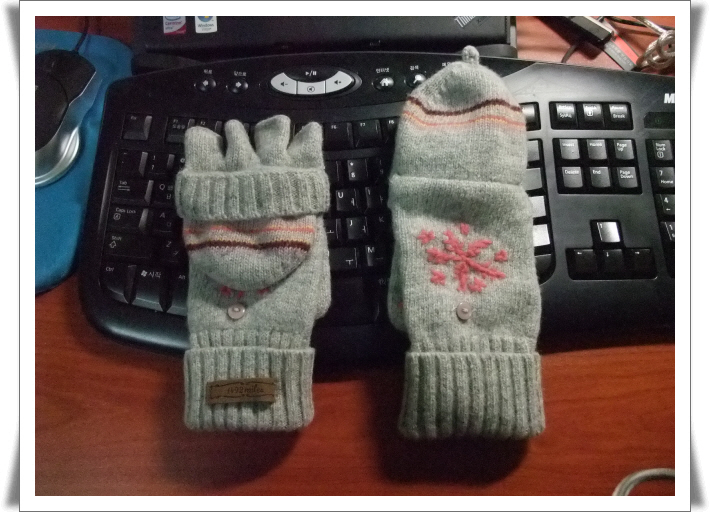
사진기를 들고 보니 후배 K가 사준 장갑도 눈에 띈다.
생각해보니, 후배들 등쳐먹은 일이 드물지는 않았구나. 미국에 있을 때 인편으로 보내온 장갑/목도리 셋트 중 일부다. 본인이 절대로 직접 골랐을 것 같지는 않고 아마도 지금의 부인인 Y씨에게 부탁하지 않았었을까 싶네... 모양도 예쁘고, 편리함도 뛰어난 장갑이다. 조카 우재가 부러워하는...
잠깐, 그러고보니 바탕에 깔린 키보드도 직장 이웃한테 얻어온 구호품 ㅎㅎㅎ
아래의 김광석 앨범은 노신에게 선물주려고 사놓은거다. 승용차에 CD 플레이어가 없다고 테이프를 구해오라 해서 망연자실했으나, mp3에 담아 카팩과 전달하면 될 것 같다. 심지어 우편으로 부쳐야해...번거롭다 번거로워...
술 마시면 어찌나 인심이 후해지는지, 평소같으면 절대 안 할 약속을 이렇게 하고 다닌다니까....
사진기를 들고 보니 후배 K가 사준 장갑도 눈에 띈다.
생각해보니, 후배들 등쳐먹은 일이 드물지는 않았구나. 미국에 있을 때 인편으로 보내온 장갑/목도리 셋트 중 일부다. 본인이 절대로 직접 골랐을 것 같지는 않고 아마도 지금의 부인인 Y씨에게 부탁하지 않았었을까 싶네... 모양도 예쁘고, 편리함도 뛰어난 장갑이다. 조카 우재가 부러워하는...
잠깐, 그러고보니 바탕에 깔린 키보드도 직장 이웃한테 얻어온 구호품 ㅎㅎㅎ
 그리고 며칠 전에 친구 M 에게서 받은 핸드폰 장식줄...
고른 사람의 따뜻한 마음이 느껴지는 따뜻한 문양이다. 요즘 날씨에 딱 어울림.
그리고 며칠 전에 친구 M 에게서 받은 핸드폰 장식줄...
고른 사람의 따뜻한 마음이 느껴지는 따뜻한 문양이다. 요즘 날씨에 딱 어울림.

 사실, 공연에 가서 열렬히 호응하는 스타일은 아니다. 사람들 열광해서 일어나도 마지막에 죽지못해 겨우 일어나는 수준 ....
근데, 오늘 두 시간 거의 내내 서 있지 않을 수 없었더랬다.
심장의 리듬이 리셋되는 기분이랄까?
아우.. 정말 그 대단한 포스!!!
(근데 두 시간 지나고 나니까 노친네들이 왜 디너쇼 가는지 알겠더라... 발바닥도 아프고 어깨도 아프고 목도 아프고 ㅎㅎㅎㅎㅎㅎ)
사실, 공연에 가서 열렬히 호응하는 스타일은 아니다. 사람들 열광해서 일어나도 마지막에 죽지못해 겨우 일어나는 수준 ....
근데, 오늘 두 시간 거의 내내 서 있지 않을 수 없었더랬다.
심장의 리듬이 리셋되는 기분이랄까?
아우.. 정말 그 대단한 포스!!!
(근데 두 시간 지나고 나니까 노친네들이 왜 디너쇼 가는지 알겠더라... 발바닥도 아프고 어깨도 아프고 목도 아프고 ㅎㅎㅎㅎㅎㅎ)

 김윤아의 카리스마야 진즉 간파하고 있었지만,
막상 가까이서 대면하고 보니 정말 그 포스가...
자신을 폭발시키는 에너지와 주변 사람들을 감염시키는 그 내공이 감히 범접할 수가 없더라. 주변에서 기 세다는 사람을 수 없이 보았지만 (심지어 나보고 기가 세다는 사람도 있는데 이건 쫌...), 이렇게 압도당하는 느낌은 처음인 듯...
내 옆에 있던 범생이 스타일 두 남학생은 김윤아가 이쪽으로 고개를 돌릴 때마다 완전 자지러지더라... 윤아 누나 눈에서 나온 레이저 맞고 감전된 귀여운 강아지들 같았음 ㅎㅎ 완전 귀엽더라니!!!
김윤아의 카리스마야 진즉 간파하고 있었지만,
막상 가까이서 대면하고 보니 정말 그 포스가...
자신을 폭발시키는 에너지와 주변 사람들을 감염시키는 그 내공이 감히 범접할 수가 없더라. 주변에서 기 세다는 사람을 수 없이 보았지만 (심지어 나보고 기가 세다는 사람도 있는데 이건 쫌...), 이렇게 압도당하는 느낌은 처음인 듯...
내 옆에 있던 범생이 스타일 두 남학생은 김윤아가 이쪽으로 고개를 돌릴 때마다 완전 자지러지더라... 윤아 누나 눈에서 나온 레이저 맞고 감전된 귀여운 강아지들 같았음 ㅎㅎ 완전 귀엽더라니!!!



 저렇게 다른 이들을 행복하고 즐겁게 만들어줄 수 있다니...
본인들도 행복할거야...
(타인들에게 고통과 절망을 안겨주는 이들이 꼭 스스로 불행한 건 아니겠지만서도 ㅎㅎㅎ 심지어 거기에 보람을 느끼는 것처럼 보이는 분들도 있는데 뭐 ㅎㅎ)
나도 2008년 얼마 남지 않은 기간 동안, 주변 사람에게 즐거움과 행복을 듬뿍 나눠주리다. 그러려면 내일 보고서 원고 마무리부터 깔끔하게 하여 공동연구자 샘들에게 즐거움과 행복을 ㅎㅎㅎ
저렇게 다른 이들을 행복하고 즐겁게 만들어줄 수 있다니...
본인들도 행복할거야...
(타인들에게 고통과 절망을 안겨주는 이들이 꼭 스스로 불행한 건 아니겠지만서도 ㅎㅎㅎ 심지어 거기에 보람을 느끼는 것처럼 보이는 분들도 있는데 뭐 ㅎㅎ)
나도 2008년 얼마 남지 않은 기간 동안, 주변 사람에게 즐거움과 행복을 듬뿍 나눠주리다. 그러려면 내일 보고서 원고 마무리부터 깔끔하게 하여 공동연구자 샘들에게 즐거움과 행복을 ㅎㅎㅎ

댓글 목록
관리 메뉴
본문
저는 올해 계획은 음력으로 세울 생각입니다. -_-;;; 이번 주 미국 출장다녀오면서 저도 해외에서 열심히 계획을? ㅋㅋ 그나저나 자살 관련 논문을 정리하신다니, 자료는 사망자료를 쓰신건가요? 요새 응급의학과랑 작업하는게 있는데, 응급실자료를 보니 '자살시도'가 외상의 세부 코드로 분류가 가능하더라구요. ^^;;;부가 정보
관리 메뉴
본문
나도 칭찬좀!!부가 정보
관리 메뉴
본문
에셔/ 저도 실천은 음력 설부터 시작임다 ㅎㅎ 자살은 사망자료하고 국건영 데이터 썼죠. 응급실 자료라... 생각은 있는디, 일단 하던 것 마저하고 조금씩 넓혀가야 할듯... 나중에 도와줘요azrael/ 아니, 뭐 나름 근거가 있어야 칭찬을 하지, 다짜고짜 뭘 칭찬하라는겨???
부가 정보
관리 메뉴
본문
태클은 아니지만..당신의 2007년 부족하나마 그 칭찬들은 누가 다 받은거야...난 그냥 배불리 먹여주면 그걸로 만족^^부가 정보
관리 메뉴
본문
장양/ 당신 운전 잘한다고 내가 얼마나 많은 칭찬을 했어? 벌써 잊은거야?부가 정보